


 |
市場調查報告書
商品編碼
2119699
新加坡最後一公里配送:市佔率分析、產業趨勢與統計及成長預測(2026-2031)Singapore Last-Mile Delivery - Market Share Analysis, Industry Trends & Statistics, Growth Forecasts (2026 - 2031) |
||||||

※ 本網頁內容可能與最新版本有所差異。詳細情況請與我們聯繫。
根據 Mordor Intelligence 預測,新加坡最後一公里配送市場規模將從 2025 年的 129.8 億美元成長到 2026 年的 145.3 億美元,然後在 2031 年達到 255.7 億美元,2026 年至 2031 年的複合年成長率為 11.97%。
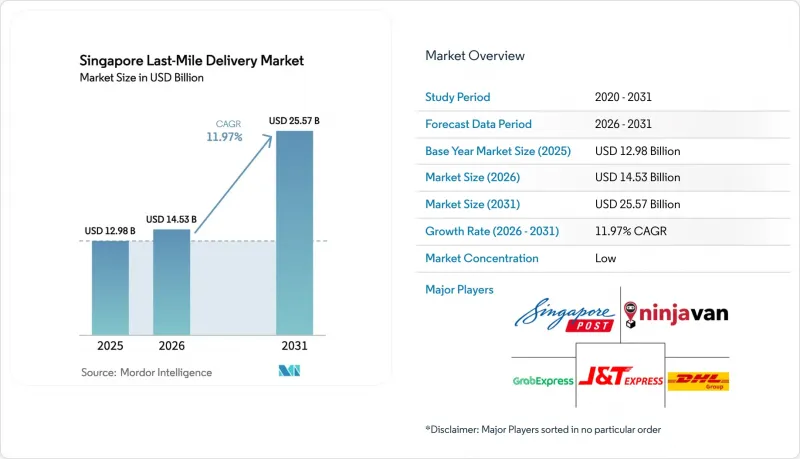
本報告按服務類型(標準配送、當日達、快捷郵件專遞)、經營模式(企業對企業 (B2B)、企業對消費者 (B2C)、消費者對消費者 (C2C))和終端用戶行業(電子商務零售、時尚生活、美容、健康與個人護理、消費電子產品及其他)進行分類。市場預測以美元計價。
新加坡最後一公里外送市場趨勢與洞察
電子商務的快速普及正在推動市場的結構性擴張。
新加坡近55%的網購訂單來自海外經銷商,這給購物節期間的最後一公里配送能力帶來了巨大壓力。 TikTok、Instagram和Facebook等社群電商平台如今貢獻了59%的跨國購物,讓小包裹配送成為「新常態」。 Shopee國際平台在試點階段賣家訂單量增加了八倍,顯示免運費獎勵能夠持續提升小包裹量。包裹量的持續成長迫使承運商投資建造多式聯運海關樞紐和先進的小包裹分揀系統,以涵蓋城邦邊界以外的全部區域。
當日達和特快專遞需求的不斷成長,正在重新定義人們對服務的期望。
目前,52%的消費者期望在24小時內收到各種品類的商品,當日送達已成為標配。受高階電子產品、B2B庫存補貨和溫控藥品訂單的推動,快遞服務正以7.4%的複合年成長率成長。人口老化和遠端醫療的進步正推動醫療保健和醫療用品配送業務以9.6%的複合年成長率擴張。能夠處理-35 度C至室溫溫度的自動化倉庫系統確保了冷鏈完整性並降低了工人風險。因此,整合冷鍊和快遞服務在新加坡的最後一公里配送市場創造了高利潤。
勞動市場趨緊和人事費用上升正在加速自動化技術的應用。
由於產業收入成長速度超過勞動力成長速度,89%的物流公司表示面臨人才短缺的困境。自主機器人、人工智慧路線最佳化工具以及諸如新加坡科技研究局(A*STAR)SIMTech的「最後一公里物流管理」等數位化調度引擎,使得承運商能夠在不相應增加員工的情況下擴大小包裹處理量。然而,隨著薪資物流不斷上升,勞動供應年增率僅1.2%,而營收成長率卻高達8.7%,自動化帶來的投資報酬率(ROI)正在進一步縮短。
細分市場分析
2025年,標準配送在新加坡最後一公里配送市場仍將佔52.34%的佔有率。這反映出消費者日益成長的成本意識以及1-3天配送網路的最佳化。同時,由於營運商將速度作為差異化優勢,預計2026年至2031年間,快遞服務的複合年成長率將達到7.1%。當日達應用程式可在45分鐘內送達全島,而GrabExpress則利用其超級應用程式司機池進行雜貨和小包裹的混合配送。附加服務服務正在擴大快遞服務的潛在收入,同時緩解因標準價格日益同質化而導致的利潤率下降。
位於零售設施內的輕資產微型倉配中心進一步縮短了前置作業時間。然而,隨著路邊空間日益緊張,儲物櫃、自動機器人或預約取貨等替代方案正在出現。藥品產業的GDP標準和HACCP法規的合規性構成了營運障礙,這使得擁有認證品管系統的現有業者更具優勢。因此,新加坡快遞服務的最後一公里配送市場成長超過了整體業務量成長速度,顯示優質化趨勢日益明顯。
其他好處:
- Excel格式的市場預測(ME)表
- 3個月的分析師支持
目錄
第1章:引言
- 研究假設和市場定義
- 調查範圍
第2章:調查方法
第3章執行摘要
第4章 市場狀況
- 市場概覽
- 市場促進因素
- 電子商務普及率的快速成長
- 當日送達和快捷郵件的需求增加。
- 政府支持的全國儲物櫃網路
- 透過社群電商平台進行跨境小包裹運輸
- 冷鏈產業的B2B庫存補貨機會
- 甲級城市物流地產的供應狀況
- 市場限制因素
- 都市區的道路沿線空間和交通堵塞
- 勞動市場緊張與人事費用上升
- 電子商務平台分階段取消運費補貼
- 車隊電氣化中高額的COE和電動車充電成本
- 價值供應鏈分析
- 監理情勢
- 技術展望
- 波特五力模型
- 逆向/退貨物流洞察
- 地緣政治事件對供應鏈變化的影響
第5章 市場規模與成長預測
- 按服務
- 標準配送
- 當日送達
- 快遞
- 按經營模式
- 企業對企業 (B2B) 交易
- Business-to-Consumer(B2C)
- C2C(消費者對消費者交易)
- 按最終用戶行業分類
- 電子商務零售
- 時尚與生活風格
- 美容、健康和個人護理
- 家居和家具
- 家用電子電器/家用電器
- 醫療保健和醫療用品
- 其他
第6章 競爭情勢
- 市場集中度
- 策略趨勢
- 市佔率分析
- 公司簡介
- Ninja Van
- Singapore Post
- J&T Express
- GrabExpress
- DHL Express
- Lalamove
- Pickupp
- Roadbull
- uParcel
- GoGoX
- DSV
- FedEx
- UPS
- Aramex
- YCH Group
- EVFY
- Locad
- BEST Inc
- Citywide Express Logistics Pte. Ltd.
- Fastbee Logistics
第7章 市場機會與未來展望
According to Mordor Intelligence, the Singapore last-Mile delivery market size is expected to grow from USD 12.98 billion in 2025 to USD 14.53 billion in 2026 and is forecast to reach USD 25.57 billion by 2031 at 11.97% CAGR over 2026-2031.
This report is Segmented by Service (Standard Delivery, Same-Day, and Express Delivery), Business Model (Business-To-Business (B2B), Business-To-Consumer (B2C), and Customer-To-Consumer (C2C)), End-User Industry (E-Commerce Retail, Fashion & Lifestyle, Beauty, Wellness & Personal Care, Consumer Electronics & Appliances, and More). The Market Forecasts are Provided in Terms of Value (USD).
Singapore Last-Mile Delivery Market Trends and Insights
E-commerce Penetration Surge Drives Structural Market Expansion
Close to 55% of online purchases in Singapore arrive from overseas merchants, straining last-mile capacity during shopping festivals. Social-commerce discovery channels-TikTok, Instagram, Facebook-now funnel 59% of all cross-border purchases, making micro-shipments the new normal. Shopee's International Platform multiplied seller orders eightfold during pilots, proving that free cross-border shipping incentives permanently elevate parcel flows. Sustained volume growth pushes carriers to invest in multi-modal customs clearance nodes and advanced small-parcel sortation capable of regional reach beyond the city-state.
Rising Same-Day and Express Demand Reshapes Service Expectations
Same-day options have become baseline as 52% of shoppers now expect sub-24-hour fulfillment across more categories. Express services grow at 7.4% CAGR, fueled by premium electronics, B2B restocking, and temperature-sensitive pharma orders. Aging demographics and telemedicine lift healthcare & medical supplies deliveries by 9.6% CAGR. Automated storage and retrieval systems capable of -35 °C to ambient handling protect cold-chain integrity and cut labor exposure. Integrated cold-chain plus express capacity therefore commands premium yields within the Singapore last-mile delivery market.
Tight Labour Market and Rising Manpower Costs Accelerate Automation Adoption
Eighty-nine percent of logistics employers report recruitment difficulties as sector revenue outpaces workforce growth. Autonomous mobile robots, AI route optimizers, and digital dispatch engines such as A*STAR SIMTech's Last-Mile Logistics Management allow carriers to scale parcel volumes without proportional headcount. Automation ROI shortens further when paired with mounting wage pressure and a 1.2% annual labor-supply increase against an 8.7% revenue rise.
Other drivers and restraints analyzed in the detailed report include:
- Government-Backed Nationwide Locker Network Creates Infrastructure Foundation
- Cross-Border Micro-Shipments Via Social Commerce Accelerate Regional Integration
- Urban Curb-Space and Traffic Congestion Constrain Operational Efficiency
For complete list of drivers and restraints, kindly check the Table Of Contents.
Segment Analysis
Standard delivery retained 52.34% of the Singapore last-mile delivery market share in 2025, reflecting entrenched cost-sensitive habits and optimized 1-to-3-day networks. Express services, however, post a 7.1% CAGR (2026-2031) as merchants weaponize speed for differentiation. Same-day courier apps deliver island-wide in 45 minutes, and GrabExpress leverages super-app driver pools for blended food-and-parcel dispatch. Cold-chain add-ons, secure handling, and white-glove furniture installation broaden express addressable revenue while cushioning margins against commoditized standard rates.
Asset-light micro-fulfilment nodes sited within retail estates compress lead times further. Yet escalating curb-space constraints trigger alternate modes: locker drop-offs, autonomous robots, or scheduled pick-ups. Compliance with GDP pharma standards and HACCP rules raises operational barriers, favoring incumbents with certified quality systems. The Singapore last-mile delivery market size for express services, therefore, rises faster than overall volume growth, signaling ongoing premiumization.
Complete Report Scope:
- By Service
- Standard Delivery
- Same-day
- Express Delivery
- By Business Model
- Business-to-Business (B2B)
- Business-to-Consumer (B2C)
- Customer-to-Consumer (C2C)
- By End-user Industry
- E-commerce Retail
- Fashion & Lifestyle
- Beauty, Wellness & Personal Care
- Home & Furniture
- Consumer Electronics & Appliances
- Healthcare & Medical Supplies
- Others
List of Companies Covered in this Report:
- Ninja Van
- Singapore Post
- J&T Express
- GrabExpress
- DHL Express
- Lalamove
- Pickupp
- Roadbull
- uParcel
- GoGoX
- DSV
- FedEx
- UPS
- Aramex
- YCH Group
- EVFY
- Locad
- BEST Inc
- Citywide Express Logistics Pte. Ltd.
- Fastbee Logistics
Additional Benefits:
- The market estimate (ME) sheet in Excel format
- 3 months of analyst support
TABLE OF CONTENTS
1 Introduction
- 1.1 Study Assumptions & Market Definition
- 1.2 Scope of the Study
2 Research Methodology
3 Executive Summary
4 Market Landscape
- 4.1 Market Overview
- 4.2 Market Drivers
- 4.2.1 E-commerce penetration surge
- 4.2.2 Rising same-day / express demand
- 4.2.3 Government-backed nationwide locker network
- 4.2.4 Cross-border micro-shipments via social-commerce platforms
- 4.2.5 Cold-chain B2B restocking opportunities
- 4.2.6 Availability of Grade-A urban logistics real estate
- 4.3 Market Restraints
- 4.3.1 Urban curb-space & traffic congestion
- 4.3.2 Tight labour market & rising manpower costs
- 4.3.3 Phasing-out of shipping subsidies by e-commerce platforms
- 4.3.4 High COE & EV-charging costs for fleet electrification
- 4.4 Value / Supply-Chain Analysis
- 4.5 Regulatory Landscape
- 4.6 Technological Outlook
- 4.7 Porter's Five Forces
- 4.7.1 Threat of New Entrants
- 4.7.2 Bargaining Power of Buyers
- 4.7.3 Bargaining Power of Suppliers
- 4.7.4 Threat of Substitutes
- 4.7.5 Competitive Rivalry
- 4.8 Reverse / Return Logistics Insights
- 4.9 Impact of Geo-Political Events on Supply Chain Shifts
5 Market Size & Growth Forecasts
- 5.1 By Service
- 5.1.1 Standard Delivery
- 5.1.2 Same-day
- 5.1.3 Express Delivery
- 5.2 By Business Model
- 5.2.1 Business-to-Business (B2B)
- 5.2.2 Business-to-Consumer (B2C)
- 5.2.3 Customer-to-Consumer (C2C)
- 5.3 By End-user Industry
- 5.3.1 E-commerce Retail
- 5.3.2 Fashion & Lifestyle
- 5.3.3 Beauty, Wellness & Personal Care
- 5.3.4 Home & Furniture
- 5.3.5 Consumer Electronics & Appliances
- 5.3.6 Healthcare & Medical Supplies
- 5.3.7 Others
6 Competitive Landscape
- 6.1 Market Concentration
- 6.2 Strategic Moves
- 6.3 Market Share Analysis
- 6.4 Company Profiles (includes Global level Overview, Market level overview, Core Segments, Financials as available, Strategic Information, Market Rank/Share, Products & Services, Recent Developments)
- 6.4.1 Ninja Van
- 6.4.2 Singapore Post
- 6.4.3 J&T Express
- 6.4.4 GrabExpress
- 6.4.5 DHL Express
- 6.4.6 Lalamove
- 6.4.7 Pickupp
- 6.4.8 Roadbull
- 6.4.9 uParcel
- 6.4.10 GoGoX
- 6.4.11 DSV
- 6.4.12 FedEx
- 6.4.13 UPS
- 6.4.14 Aramex
- 6.4.15 YCH Group
- 6.4.16 EVFY
- 6.4.17 Locad
- 6.4.18 BEST Inc
- 6.4.19 Citywide Express Logistics Pte. Ltd.
- 6.4.20 Fastbee Logistics
7 Market Opportunities & Future Outlook
- 7.1 White-Space & Unmet-Need Assessment

 印度D2C(直接面對消費者)物流:市場佔有率分析、行業趨勢和統計數據以及成長預測(2026-2031年)德國最後一公里配送:市場佔有率分析、產業趨勢與統計及成長預測(2026-2031 年)歐洲電子商務最後一公里配送:市場佔有率分析、產業趨勢與統計及成長預測(2026-2031 年)印度電子商務最後一公里配送:市場佔有率分析、產業趨勢與統計及成長預測(2026-2031)
 全球末端配送車輛市場預測(至2034年)-按車輛類型、動力系統、有效載荷能力、自動化程度、所有權、應用、最終用戶、銷售管道、分銷管道和地區分類的分析美國電子商務最後一公里配送:市場佔有率分析、產業趨勢與統計、成長預測(2026-2031)美國醫療小包裹最後一公里配送:市場佔有率分析、產業趨勢與統計及成長預測(2026-2031 年)英國醫療小包裹最後一公里配送:市場佔有率分析、產業趨勢與統計及成長預測(2026-2031 年)
 自主最後一公里配送市場-2026-2032年全球市場預測食品低溫運輸最後一公里配送市場:全球市場預測(2026-2032 年)