


 |
市場調查報告書
商品編碼
2125492
德國最後一公里配送:市場佔有率分析、產業趨勢與統計及成長預測(2026-2031 年)Germany Last Mile Delivery - Market Share Analysis, Industry Trends & Statistics, Growth Forecasts (2026 - 2031) |
||||||

※ 本網頁內容可能與最新版本有所差異。詳細情況請與我們聯繫。
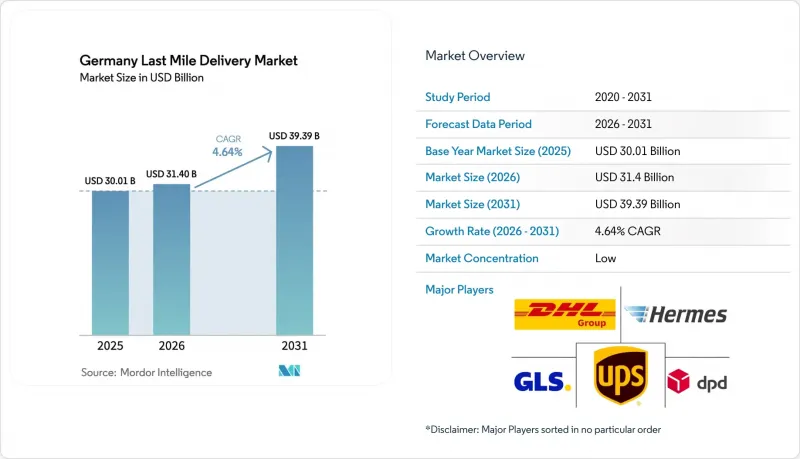
據 Mordor Intelligence 稱,2025 年德國最後一公里配送市場價值為 300.1 億美元,預計到 2031 年將達到 393.9 億美元,而 2026 年為 314 億美元,預測期(2026-2031 年)的複合年成長率為 4.64%。
本報告按服務類型(標準配送、當日達、快捷郵件專遞)、經營模式(企業對企業 (B2B)、企業對消費者 (B2C)、消費者對消費者 (C2C))、終端用戶行業(電子商務零售、時尚生活、美容等)以及聯邦州(巴登-符騰堡州、柏林、巴伐利亞州等)進行細分。市場預測以美元計價。
德國最後一公里配送市場的趨勢與洞察
國內電子商務小包裹量激增
隨著網路購物在德國消費者中日益普及,德國境內的B2C小包裹流通量持續成長,年出貨量屢創新高。跨境電商平台如Temu和Shein大量進口小包裹,導致進口量激增,對都市區分揀中心帶來巨大壓力。消費者調查顯示,消費者對可預測的配送時間期望不斷提高,對擁有高密度收出貨中心和自動化分類系統的物流公司需求日益成長。 Zalando與About You於2025年簽署的由時尚產業主導的合作協議,將透過整合統一物流系統,進一步提升了小包裹密度。大型業者可以透過規模經濟維持履約,而新參與企業則需要在服務覆蓋不足的地區承擔更高的單次配送成本。
擴大自宅配櫃和PUDO網路
2024年10月,DPD與GLS的合作打造了德國最大的開放式儲物櫃系統,實現了數千個自動化儲物櫃之間的小包裹遞送互通性。德國郵政敦豪集團預計,到2030年,大多數居住者的步行範圍內都將設有Packstation自助取件點。 2025年,myflexbox與DPD合作推出的建築整合式儲物櫃提高了首次投遞成功率,並縮短了包裹停留時間。零售支付API現在可以即時顯示儲物櫃位置,促進「點擊取貨」服務,並降低因投遞失敗造成的成本。對於能夠承擔多年租賃協議的大型企業而言,儲物櫃的初始投資雖然數額巨大,但卻具有優勢。
人事費用和燃料成本上漲
2024年的集體談判導致郵政和小包裹遞送工人的薪資大幅上漲,進一步推高了運輸公司的成本基礎,而這些公司營運成本中超過一半都用於人事費用。司機短缺問題依然嚴峻,迫使公司提高起薪和簽約獎金。 2024年,由於能源價格波動和高速公路通行費上漲,燃油成本也隨之上升,如果合約中的價格調整條款未能跟上通貨膨脹的投入成本,利潤率將面臨壓力。分類中心的自動化和車輛的部分電氣化在一定程度上緩解了這些壓力,但這需要持續數年的資本投資。
細分市場分析
到2025年,標準配送服務將佔據德國最後一公里配送市場的62.45%。這主要得益於消費者對配送費用的高度敏感,以及該服務所涵蓋的廣泛農村地區。當日達服務目前仍屬於小眾市場,但預計將以3.62%的複合年成長率(2026-2031年)實現最強勁的成長,因為都市區消費者在時間緊迫的購物環境中越來越重視即時。
在德國的最後一公里配送市場,當日達服務的市場規模預計將穩定成長,這得益於與零售商的合作,旨在規範訂單截止時間,以及利用微型樞紐作為中轉站。配送公司正利用人工智慧分類系統,將包裹分配到夜間路線,確保在午夜前完成配送,從而在不影響單位利潤率的情況下保持服務差異化。儘管標準配送的盈利仍依賴高密度的配送中心和一體化的幹線運輸,但在B2B領域,對需要保證送達時間的快遞服務的需求仍然穩定。
其他好處:
- Excel格式的市場預測(ME)表
- 3個月的分析師支持
目錄
第1章:引言
- 研究假設和市場定義
- 調查範圍
第2章:調查方法
第3章執行摘要
第4章 市場狀況
- 市場概覽
- 市場促進因素
- 國內電子商務小包裹量激增
- 擴大自宅配櫃和PUDO網路
- 永續發展法規支持電動車隊的擴張
- 將閒置的店面和停車場改造成微型中心
- 基於人工智慧的區域物流和路線最佳化
- 2024 年德國郵政法案將擴大基礎設施投資。
- 市場限制因素
- 人事費用和燃料成本上漲
- 包裹被竊/損壞和首次投遞失敗
- 透過集體談判提高薪資
- 城市地區物流地產短缺
- 價值供應鏈分析
- 監理情勢
- 技術展望
- 波特五力模型
- 新冠疫情與地緣政治事件的影響
第5章 市場規模與成長預測
- 按服務
- 標準配送
- 當日送達
- 快遞
- 按經營模式
- 企業對企業 (B2B) 交易
- Business-to-Consumer(B2C)
- C2C(消費者對消費者交易)
- 按最終用戶行業分類
- 電子商務零售
- 時尚與生活風格
- 美容、健康和個人護理
- 家居和家具
- 家用電子電器/家用電器
- 醫療保健和醫療用品
- 其他
- 德國各聯邦州
- 巴登-符騰堡州
- 柏林
- 巴伐利亞
- 北萊茵-威斯特法倫州
- 其他德國聯邦州
第6章 競爭情勢
- 市場集中度
- 策略趨勢
- 市佔率分析
- 公司簡介
- Deutsche Post DHL Group
- Hermes
- UPS
- DPD
- GLS
- FedEx Express
- DSV
- Rhenus Logistics
- CEVA Logistics
- Speedlink Transport
- Delivery Hero
- GO Express & Logistics
- Berlin Last Mile
- Courier Service Germany
- Cencora
- PTV Logistics GmbH
- Redwood Fulfillment
- Landmark Global
- Yusen Logistics
- AIT Worldwide Logistics, Inc.
第7章 市場機會與未來展望
According to Mordor Intelligence, the Germany last mile delivery market size was valued at USD 30.01 billion in 2025 and estimated to grow from USD 31.4 billion in 2026 to reach USD 39.39 billion by 2031, at a CAGR of 4.64% during the forecast period (2026-2031).
This report is Segmented by Service (Standard Delivery, Same-Day, and Express Delivery), Business Model (Business-To-Business (B2B), Business-To-Consumer (B2C), and Customer-To-Consumer (C2C)), End-User Industry (E-Commerce Retail, Fashion & Lifestyle, Beauty, and More), Federal State (Baden-Wurttemberg, Berlin, Bavaria, and More). The Market Forecasts are Provided in Terms of Value (USD).
Germany Last Mile Delivery Market Trends and Insights
Surge in Domestic E-commerce Parcel Volumes
Domestic B2C parcel flows continue to rise as German consumers deepen online shopping penetration, sending annual shipment counts to record highs Cross-border platforms such as Temu and Shein import sizeable parcel quantities, amplifying inbound volumes and stretching urban sorting hubs. Consumer surveys reveal higher expectations for predictable delivery windows, consolidating demand around carriers with dense stop coverage and automated sortation. The fashion-led Zalando-About You tie-up, signed in 2025, further amplifies parcel density by pooling fulfillment under unified logistics leadership. Larger operators gain scale economies that shield margins, whereas newcomers shoulder a higher cost-per-stop in sparsely served corridors.
Expansion of Parcel-Locker & PUDO Networks
The October 2024 DPD-GLS alliance created Germany's largest open locker system, enabling parcel hand-off interoperability across thousands of automated boxes. Deutsche Post DHL is on track to install a Packstation within walking distance for most urban residents by 2030. Building-integrated lockers launched through the 2025 myflexbox-DPD cooperation improve first-attempt success and shrink delivery dwell time. Retail checkout APIs now surface locker locations in real time, encouraging click-and-collect and cutting failed delivery costs. High up-front locker investment favors scale players able to underwrite multi-year site leases.
Rising Labor & Fuel Costs
Collective bargaining rounds in 2024 granted postal and parcel employees meaningful wage increases, lifting the cost base for carriers that already spend more than half of their operating expenses on personnel. Driver shortages remain chronic, forcing firms to raise entry pay and sign-on bonuses. Fuel outlays also climbed during 2024 amid energy-price volatility and higher highway tolls, compressing margins where contractual rate-adjustment clauses lag input inflation. Automation in sort centers and partial fleet electrification offset some pressure but require multiyear capital commitments.
Other drivers and restraints analyzed in the detailed report include:
- Sustainability Regulations Driving EV Fleets
- AI-Enabled Zonal Logistics & Route Optimization
- Scarce Inner-city Logistics Real Estate
For complete list of drivers and restraints, kindly check the Table Of Contents.
Segment Analysis
Standard delivery services captured 62.45% of the Germany last mile delivery market share in 2025, sustained by consumer sensitivity to shipping fees and the breadth of rural destinations served. Same-day options, though niche, is expected to log the strongest forward pace at a 3.62% CAGR (2026-2031) as urban shoppers increasingly value immediacy for time-critical purchases.
The Germany last mile delivery market size for same-day services is expected to rise steadily, helped by retailer partnerships that pool order cut-off times and micro-hub staging. Carriers employ AI sorting to feed evening rounds that deliver before midnight, maintaining service differentiation without eroding unit margins. Standard delivery profitability remains tied to high stop density and consolidated line-haul, while express-service demand stabilizes in B2B verticals needing guaranteed transit.
Complete Report Scope:
- By Service
- Standard Delivery
- Same-day
- Express Delivery
- By Business Model
- Business-to-Business (B2B)
- Business-to-Consumer (B2C)
- Customer-to-Consumer (C2C)
- By End-user Industry
- E-commerce Retail
- Fashion & Lifestyle
- Beauty, Wellness & Personal Care
- Home & Furniture
- Consumer Electronics & Appliances
- Healthcare & Medical Supplies
- Others
- By German Federal State
- Baden-Wurttemberg
- Berlin
- Bavaria
- North Rhine-Westphalia
- Rest of German Federal State
List of Companies Covered in this Report:
- Deutsche Post DHL Group
- Hermes
- UPS
- DPD
- GLS
- FedEx Express
- DSV
- Rhenus Logistics
- CEVA Logistics
- Speedlink Transport
- Delivery Hero
- GO Express & Logistics
- Berlin Last Mile
- Courier Service Germany
- Cencora
- PTV Logistics GmbH
- Redwood Fulfillment
- Landmark Global
- Yusen Logistics
- AIT Worldwide Logistics, Inc.
Additional Benefits:
- The market estimate (ME) sheet in Excel format
- 3 months of analyst support
TABLE OF CONTENTS
1 Introduction
- 1.1 Study Assumptions & Market Definition
- 1.2 Scope of the Study
2 Research Methodology
3 Executive Summary
4 Market Landscape
- 4.1 Market Overview
- 4.2 Market Drivers
- 4.2.1 Surge in domestic e-commerce parcel volumes
- 4.2.2 Expansion of parcel-locker & PUDO networks
- 4.2.3 Sustainability regulations driving EV fleets
- 4.2.4 Micro-hub reuse of vacant retail & parking assets
- 4.2.5 AI-enabled zonal logistics & route optimisation
- 4.2.6 German Postal Law 2024 boosting infrastructure spend
- 4.3 Market Restraints
- 4.3.1 Rising labour & fuel costs
- 4.3.2 Package theft/damage & failed first-attempts
- 4.3.3 Wage-inflation from collective bargaining rounds
- 4.3.4 Scarce inner-city logistics real-estate
- 4.4 Value / Supply-Chain Analysis
- 4.5 Regulatory Landscape
- 4.6 Technological Outlook
- 4.7 Porter's Five Forces
- 4.7.1 Bargaining Power of Buyers
- 4.7.2 Bargaining Power of Suppliers
- 4.7.3 Threat of New Entrants
- 4.7.4 Threat of Substitutes
- 4.7.5 Intensity of Competitive Rivalry
- 4.8 Impact of COVID-19 and Geo-Political Events
5 Market Size & Growth Forecasts
- 5.1 By Service
- 5.1.1 Standard Delivery
- 5.1.2 Same-day
- 5.1.3 Express Delivery
- 5.2 By Business Model
- 5.2.1 Business-to-Business (B2B)
- 5.2.2 Business-to-Consumer (B2C)
- 5.2.3 Customer-to-Consumer (C2C)
- 5.3 By End-user Industry
- 5.3.1 E-commerce Retail
- 5.3.2 Fashion & Lifestyle
- 5.3.3 Beauty, Wellness & Personal Care
- 5.3.4 Home & Furniture
- 5.3.5 Consumer Electronics & Appliances
- 5.3.6 Healthcare & Medical Supplies
- 5.3.7 Others
- 5.4 By German Federal State
- 5.4.1 Baden-Wurttemberg
- 5.4.2 Berlin
- 5.4.3 Bavaria
- 5.4.4 North Rhine-Westphalia
- 5.4.5 Rest of German Federal State
6 Competitive Landscape
- 6.1 Market Concentration
- 6.2 Strategic Moves
- 6.3 Market Share Analysis
- 6.4 Company Profiles (includes Global level Overview, Market level overview, Core Segments, Financials as available, Strategic Information, Market Rank/Share for key companies, Products & Services, and Recent Developments)
- 6.4.1 Deutsche Post DHL Group
- 6.4.2 Hermes
- 6.4.3 UPS
- 6.4.4 DPD
- 6.4.5 GLS
- 6.4.6 FedEx Express
- 6.4.7 DSV
- 6.4.8 Rhenus Logistics
- 6.4.9 CEVA Logistics
- 6.4.10 Speedlink Transport
- 6.4.11 Delivery Hero
- 6.4.12 GO Express & Logistics
- 6.4.13 Berlin Last Mile
- 6.4.14 Courier Service Germany
- 6.4.15 Cencora
- 6.4.16 PTV Logistics GmbH
- 6.4.17 Redwood Fulfillment
- 6.4.18 Landmark Global
- 6.4.19 Yusen Logistics
- 6.4.20 AIT Worldwide Logistics, Inc.
7 Market Opportunities & Future Outlook
- 7.1 White-space & Unmet-need Assessment

 新加坡最後一公里配送:市佔率分析、產業趨勢與統計及成長預測(2026-2031)印度D2C(直接面對消費者)物流:市場佔有率分析、行業趨勢和統計數據以及成長預測(2026-2031年)歐洲電子商務最後一公里配送:市場佔有率分析、產業趨勢與統計及成長預測(2026-2031 年)印度電子商務最後一公里配送:市場佔有率分析、產業趨勢與統計及成長預測(2026-2031)
 全球末端配送車輛市場預測(至2034年)-按車輛類型、動力系統、有效載荷能力、自動化程度、所有權、應用、最終用戶、銷售管道、分銷管道和地區分類的分析美國電子商務最後一公里配送:市場佔有率分析、產業趨勢與統計、成長預測(2026-2031)美國醫療小包裹最後一公里配送:市場佔有率分析、產業趨勢與統計及成長預測(2026-2031 年)英國醫療小包裹最後一公里配送:市場佔有率分析、產業趨勢與統計及成長預測(2026-2031 年)
 自主最後一公里配送市場-2026-2032年全球市場預測食品低溫運輸最後一公里配送市場:全球市場預測(2026-2032 年)