


 |
市場調查報告書
商品編碼
2125683
馬來西亞資料中心建置:市場佔有率分析、產業趨勢與統計及成長預測(2026-2031 年)Malaysia Data Center Construction - Market Share Analysis, Industry Trends & Statistics, Growth Forecasts (2026 - 2031) |
||||||

※ 本網頁內容可能與最新版本有所差異。詳細情況請與我們聯繫。
根據 Mordor Intelligence 預測,馬來西亞資料中心建設市場規模預計將在 2026 年達到 37.1 億美元,到 2031 年達到 77.4 億美元,在整個預測期內保持強勁成長,複合年成長率達 15.88%。
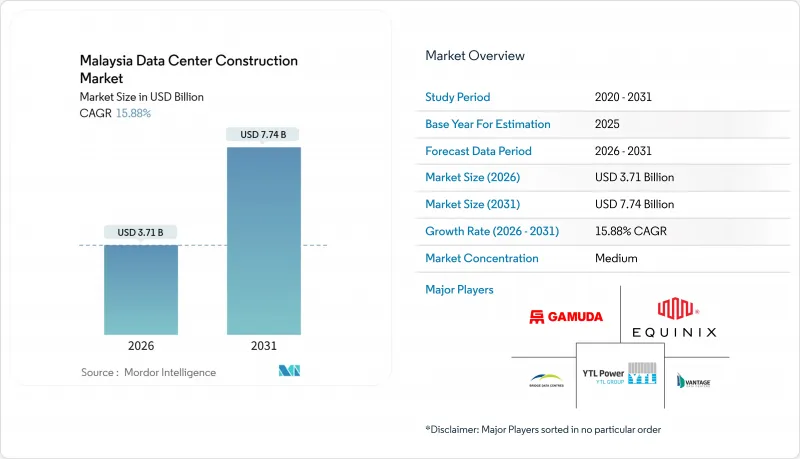
本報告按資料中心層級(一級、二級、三級、四級)、資料中心規模(小規模、中型、大型、超大規模)、資料中心類型(託管資料中心、超大規模資料中心業者/雲端服務供應商、企業級和邊緣資料中心)以及基礎設施(電力基礎設施、機械基礎設施等)進行細分。市場預測以美元計價。
馬來西亞資料中心建設市場趨勢與洞察
新加坡凍結新許可證的連鎖反應
新加坡在2019年凍結新許可證的發放,使得200-300兆瓦的超大規模資料中心未滿足的需求得以跨越海峽流動,使柔佛州的營運商能夠以比新加坡低40-60%的地價,實現亞毫秒級的延遲。 Vantage Data Centers於2025年11月以16億美元收購了一個300兆瓦的資料中心園區,而Bridge Data Centres在前一年簽署了一份400兆瓦的電網契約,這些都表明了為應對持續的需求外流所做的準備。根據馬來西亞投資發展局(MIDA)的記錄,2024年資料中心產業的外國直接投資(FDI)將達到200億馬幣,比2022年成長五倍,這將支持該地區內部容量的結構性重新配置。
超大規模雲端和人工智慧擴展
2024年5月,微軟宣布將投資22億美元用於多站點園區和人才發展計畫;同月,Google也為其在馬來西亞的首個雲端區域撥款20億美元。隨後,位元組跳動宣布計畫投資100億馬幣(約21億美元)在其Bridge Data Centers MY06資料中心打造人工智慧中心,標誌著馬來西亞已躋身主要可用區之列。楊忠禮電力(YTL Power)的500兆瓦「綠色資料中心園區」將NVIDIA GB200 NVL72機架與現場太陽能發電相結合,實現了1.3的PUE值,為人工智慧最佳化的永續性樹立了區域標竿。
提高輸電網容量和尖峰時段費率
為彌補變電站升級改造的成本,西班牙國家能源公司(Tenaga Nacional Belhad)於2025年7月將商業電費上調了14%。這將使一座10兆瓦的發電設施每年的電費增加約20萬美元。業者正透過以C-RESS協議為基礎的20年期太陽能購電協議(PPA)來規避風險,Vantage與ib vogt簽訂的30兆瓦虛擬購電協議便是這項轉變的例證。
細分市場分析
儘管2025年三級資料中心佔總營收的56.04%,但四級資料中心的容量預計將超越其他所有級別,實現16.87%的複合年成長率。因此,隨著超大規模資料中心業者資料中心營運商部署可並行維護的電力和冷卻鏈,馬來西亞四級資料中心專案的市場規模預計將迅速擴大。 Equinix計畫於2027年在其JH2園區新增2225個配備2N電源的機櫃。
儘管一級和二級資料中心在邊緣運算和災害復原工作負載中仍然發揮著至關重要的作用,但預計在2023年至2025年間,人工智慧訓練和推理在新訂單中的佔比將從不足10%上升至近25%。 NTT位於柔佛州的園區正在規劃雙電源線路和72小時的自主燃料供應,以滿足業務永續營運要求。這種轉變反映出終端用戶不願容忍即使是輕微的溫度或電力波動,從而推動馬來西亞資料中心建設市場朝向更高規格的設施發展。
儘管預計到2025年大型資料中心將佔55.46%的市場佔有率,但「超大規模園區」(指單體裝置容量超過100兆瓦的資料中心)仍有望以16.34%的複合年成長率成長。隨著Vantage公司256兆瓦的KUL2資料中心和Bridge Data Centres公司400兆瓦的供電合約投入運作,馬來西亞資料中心建設市場中超大規模資料中心的佔有率預計將會成長。
園區模式簡化了土地購置、電力供應合約談判和分階段移交流程。 Vantage 的 300 兆瓦「JHB1」專案讓租戶在多年內逐步擴展運作,而 Bridge 的「MY07」專案已獲得額外 200 兆瓦的土地。中小型資料中心繼續為託管服務供應商和邊緣快取提供支持,但它們在馬來西亞資料中心建設市場中的佔有率正在萎縮。
其他好處:
- Excel格式的市場預測(ME)表
- 3個月的分析師支持
目錄
第1章:引言
- 研究假設和市場定義
- 調查範圍
第2章:調查方法
第3章執行摘要
第4章 市場狀況
- 市場概覽
- 市場促進因素
- 新加坡暫停令帶來的溢出需求
- 馬來西亞數位稅收和獎勵計劃(MyDIGITAL,DTax)
- 超大規模雲端和人工智慧基礎設施擴展(微軟、Google、AWS)
- 柔佛和賽城的土地和電力價格實惠
- 企業可再生能源供應計畫 (C-RESS) 可簽訂 20 年的綠色電力購買協議 (PPA)。
- 透過海底電纜登陸(MIST、Apricot、Bifrost)改善連接性。
- 市場限制因素
- 增加電網容量和尖峰時段電價
- 資料中心認證技術人員短缺
- 土地用途核准流程分散且涉及多個階段,導致核准延誤。
- 柔佛降溫走廊面臨水資源短缺風險增加
- 產業供應鏈分析
- 監理情勢
- 技術展望
- 波特五力分析
- 資料中心關鍵統計數據
- 馬來西亞資料中心營運商列表(按兆瓦計)
- 馬來西亞主要資料中心項目清單(2025-2030 年)
- 馬來西亞資料中心建設中的資本支出和營運支出
- 馬來西亞資料中心2023年及2024年電力消耗量(單位:兆瓦)
- 將人工智慧(AI)引入馬來西亞資料中心建設
- 監理與合規框架
- 宏觀經濟因素對市場的影響
第5章 市場規模與成長預測
- 層級特定
- 一級和二級
- 三級
- 第四級
- 按資料中心規模
- 小規模
- 中等的
- 大規模
- 超大規模
- 依資料中心類型
- 託管資料中心
- 超大規模資料中心業者雲端服務供應商/雲端服務供應商(CSP)
- 企業和邊緣資料中心
- 透過基礎設施
- 電力基礎設施
- 配電解決方案
- 備用電源解決方案
- 機械基礎設施
- 冷卻系統
- 機架和機櫃
- 伺服器和儲存
- 其他機械基礎設施
- 一般建築
- 服務 - 設計與諮詢、整合、支援與維護
- 電力基礎設施
第6章 競爭情勢
- 市場集中度
- 策略趨勢
- 市佔率分析
- Data Center Infrastructure Investment Based on Megawatt(MW)Capacity, 2024 vs 2030
- Data Center Construction Landscape(Key Vendors Listings)
- 公司簡介
- Aurecon Group Pty Ltd
- AECOM
- DSCO Group Pte Ltd
- Turner and Townsend Holdings Ltd
- Jacobs Engineering Group Inc.
- Gaw Capital Partners
- JLand Group Bhd
- Cyclect Group Pte Ltd
- Basis Bay Sdn Bhd
- Mah Sing Group Bhd
- Equinix Inc.
- Vantage Data Centers LLC
- Bridge Data Centres Malaysia Sdn Bhd
- YTL Power International Bhd(Green DC Park)
- Gamuda Bhd
- Telekom Malaysia Berhad
- Exabytes Capital Group Sdn Bhd
- GDS Holdings Ltd
- AIMS Data Centre(Time dotCom Bhd)
- Gamuda Engineering Sdn Bhd
- List of Data Center Construction Companies
第7章 市場機會與未來展望
According to Mordor Intelligence, the Malaysia data center construction market size reached USD 3.71 billion in 2026 and is projected to reach USD 7.74 billion by 2031, reflecting a robust 15.88% CAGR across the forecast horizon.
This report is Segmented by Tier Type (Tier 1 and 2, Tier 3, and Tier 4), Data Center Size (Small, Medium, Large, and Hyperscale), Data Center Type (Colocation Data Center, Hyperscalers/Cloud Service Provider, and Enterprise and Edge Data Center), and Infrastructure (Electrical Infrastructure, Mechanical Infrastructure, and More). The Market Forecasts are Provided in Terms of Value (USD).
Malaysia Data Center Construction Market Trends and Insights
Spill-Over Demand From Singapore Moratorium
Singapore's 2019 freeze on new permits pushed 200-300 megawatts of unmet hyperscale demand across the causeway, enabling operators in Johor to deliver sub-2-millisecond latency to Singapore at land prices 40-60% lower than across the Strait. Vantage Data Centers' USD 1.6 billion acquisition of a 300-megawatt campus in November 2025 and Bridge Data Centres' 400-megawatt grid agreement the previous year illustrate pre-positioning for continued overflow. Malaysia's Investment Development Authority recorded RM 20 billion in data-center FDI during 2024, a five-fold jump from 2022, confirming the structural re-allocation of regional capacity.
Hyperscale Cloud and AI Build-Outs
Microsoft committed USD 2.2 billion in May 2024 for multi-site campuses and workforce programs, while Google earmarked USD 2 billion for its first Malaysian cloud region in the same month. ByteDance followed with a RM 10 billion (USD 2.1 billion) AI hub anchored by Bridge Data Centres' MY06 site, signifying Malaysia's elevation to a primary availability zone. YTL Power's 500-megawatt Green DC Park integrates Nvidia GB200 NVL72 racks and on-site solar to achieve a 1.3 PUE, setting a regional benchmark for AI-optimized sustainability.
Grid Capacity and Peak Tariff Escalation
Tenaga Nasional Berhad lifted commercial tariffs 14% in July 2025 to finance substation upgrades, raising a 10-megawatt facility's annual electricity bill by roughly USD 200,000. Operators hedge exposure through 20-year solar PPAs under C-RESS; Vantage's 30-megawatt virtual PPA with ib vogt exemplifies this shift.
Other drivers and restraints analyzed in the detailed report include:
- Malaysia Digital Tax and Incentive Schemes
- Sub-Sea Cable Landings Elevating Connectivity
- Shortage of Certified Data-Center Technicians
For complete list of drivers and restraints, kindly check the Table Of Contents.
Segment Analysis
Tier 3 installations controlled 56.04% of 2025 revenue, yet Tier 4 capacity is forecast to post a 16.87% CAGR, outpacing all other classes. The Malaysia data center construction market size for Tier 4 projects is therefore projected to rise sharply as hyperscalers deploy concurrent-maintainable power and cooling chains. Equinix will add 2,225 cabinets with 2N electrical feeds at its JH2 campus in 2027.
Tier 1 and Tier 2 sites remain relevant for edge and disaster-recovery workloads, but the share of AI training and inference rose from under 10% to nearly 25% of new bookings between 2023 and 2025. NTT's Johor campus plans dual utility feeds and 72-hour fuel autonomy to meet business-continuity mandates. The pivot reflects end-user intolerance for even brief thermal or power excursions, pushing the Malaysia data center construction market toward higher-spec builds.
Large facilities held 55.46% share in 2025; nevertheless, hyperscale campuses, defined as single-site builds exceeding 100 megawatts, are poised to expand at a 16.34% CAGR. The Malaysia data center construction market share for hyperscale sites is thus set to grow as Vantage's 256-megawatt KUL2 and Bridge Data Centres' 400-megawatt electricity deal come online.
Campus models improve land acquisition, utility negotiation, and phased delivery. Vantage's 300-megawatt JHB1 enables multi-year tenant ramp-ups, while Bridge's MY07 reserves acreage for 200 additional megawatts. Medium and small facilities continue to support managed service providers and edge caching, but they capture a shrinking slice of the Malaysia data center construction market.
Complete Report Scope:
- By Tier Type
- Tier 1 and 2
- Tier 3
- Tier 4
- By Data Center Size
- Small
- Medium
- Large
- Hyperscale
- By Data Center Type
- Colocation Data Center
- Hyperscalers/Cloud Service Provider (CSPs)
- Enterprise and Edge Data Center
- By Infrastructure
- Electrical Infrastructure
- Power Distribution Solution
- Power Backup Solutions
- Mechanical Infrastructure
- Cooling Systems
- Racks and Cabinets
- Servers and Storage
- Other Mechanical Infrastructure
- General Construction
- Services - Design and Consulting, Integration, Support and Maintenance
- Electrical Infrastructure
List of Companies Covered in this Report:
- Aurecon Group Pty Ltd
- AECOM
- DSCO Group Pte Ltd
- Turner and Townsend Holdings Ltd
- Jacobs Engineering Group Inc.
- Gaw Capital Partners
- JLand Group Bhd
- Cyclect Group Pte Ltd
- Basis Bay Sdn Bhd
- Mah Sing Group Bhd
- Equinix Inc.
- Vantage Data Centers LLC
- Bridge Data Centres Malaysia Sdn Bhd
- YTL Power International Bhd (Green DC Park)
- Gamuda Bhd
- Telekom Malaysia Berhad
- Exabytes Capital Group Sdn Bhd
- GDS Holdings Ltd
- AIMS Data Centre (Time dotCom Bhd)
- Gamuda Engineering Sdn Bhd
Additional Benefits:
- The market estimate (ME) sheet in Excel format
- 3 months of analyst support
TABLE OF CONTENTS
1 INTRODUCTION
- 1.1 Study Assumptions and Market Definition
- 1.2 Scope of the Study
2 RESEARCH METHODOLOGY
3 EXECUTIVE SUMMARY
4 MARKET LANDSCAPE
- 4.1 Market Overview
- 4.2 Market Drivers
- 4.2.1 Spill-Over Demand From Singapore Moratorium
- 4.2.2 Malaysia Digital Tax and Incentive Schemes (MyDIGITAL, DTax)
- 4.2.3 Hyperscale Cloud and AI Build-Outs (Microsoft, Google, AWS)
- 4.2.4 Affordable Land and Power in Johor and Cyberjaya
- 4.2.5 Corporate Renewable Energy Supply Scheme (C-RESS) Enabling 20-Yr Green PPAs
- 4.2.6 Sub-Sea Cable Landings (MIST, Apricot, Bifrost) Elevating Connectivity
- 4.3 Market Restraints
- 4.3.1 Grid Capacity and Peak Tariff Escalation
- 4.3.2 Shortage of Certified Data-Center Technicians
- 4.3.3 Fragmented Multi-Tier Land-Use Approvals Causing Delays
- 4.3.4 Rising Water-Stress Risk in Johor Cooling Corridor
- 4.4 Industry Supply-Chain Analysis
- 4.5 Regulatory Landscape
- 4.6 Technological Outlook
- 4.7 Porter's Five Forces Analysis
- 4.7.1 Bargaining Power of Suppliers
- 4.7.2 Bargaining Power of Consumers
- 4.7.3 Threat of New Entrants
- 4.7.4 Threat of Substitutes
- 4.7.5 Intensity of Competitive Rivalry
- 4.8 Key Data Center Statistics
- 4.8.1 Exhaustive Data Center Operators in Malaysia (in MW)
- 4.8.2 List of Major Upcoming Data Center Projects in Malaysia (2025-2030)
- 4.8.3 CAPEX and OPEX For Malaysia Data Center Construction
- 4.8.4 Data Center Power Capacity Absorption In MW, Malaysia, 2023 and 2024
- 4.9 Artificial Intelligence (AI) Inclusion in Data Center Construction in Malaysia
- 4.10 Regulatory and Compliance Framework
- 4.11 Impact of Macroeconomic Factors on the Market
5 MARKET SIZE AND GROWTH FORECASTS (VALUE)
- 5.1 By Tier Type
- 5.1.1 Tier 1 and 2
- 5.1.2 Tier 3
- 5.1.3 Tier 4
- 5.2 By Data Center Size
- 5.2.1 Small
- 5.2.2 Medium
- 5.2.3 Large
- 5.2.4 Hyperscale
- 5.3 By Data Center Type
- 5.3.1 Colocation Data Center
- 5.3.2 Hyperscalers/Cloud Service Provider (CSPs)
- 5.3.3 Enterprise and Edge Data Center
- 5.4 By Infrastructure
- 5.4.1 Electrical Infrastructure
- 5.4.1.1 Power Distribution Solution
- 5.4.1.2 Power Backup Solutions
- 5.4.2 Mechanical Infrastructure
- 5.4.2.1 Cooling Systems
- 5.4.2.2 Racks and Cabinets
- 5.4.2.3 Servers and Storage
- 5.4.2.4 Other Mechanical Infrastructure
- 5.4.3 General Construction
- 5.4.4 Services - Design and Consulting, Integration, Support and Maintenance
- 5.4.1 Electrical Infrastructure
6 COMPETITIVE LANDSCAPE
- 6.1 Market Concentration
- 6.2 Strategic Moves
- 6.3 Market Share Analysis
- 6.4 Data Center Infrastructure Investment Based on Megawatt (MW) Capacity, 2024 vs 2030
- 6.5 Data Center Construction Landscape (Key Vendors Listings)
- 6.6 Company Profiles (includes Global Level Overview, Market Level Overview, Core Segments, Financials as Available, Strategic Information, Market Rank/Share for Key Companies, Products and Services, Recent Developments)
- 6.6.1 Aurecon Group Pty Ltd
- 6.6.2 AECOM
- 6.6.3 DSCO Group Pte Ltd
- 6.6.4 Turner and Townsend Holdings Ltd
- 6.6.5 Jacobs Engineering Group Inc.
- 6.6.6 Gaw Capital Partners
- 6.6.7 JLand Group Bhd
- 6.6.8 Cyclect Group Pte Ltd
- 6.6.9 Basis Bay Sdn Bhd
- 6.6.10 Mah Sing Group Bhd
- 6.6.11 Equinix Inc.
- 6.6.12 Vantage Data Centers LLC
- 6.6.13 Bridge Data Centres Malaysia Sdn Bhd
- 6.6.14 YTL Power International Bhd (Green DC Park)
- 6.6.15 Gamuda Bhd
- 6.6.16 Telekom Malaysia Berhad
- 6.6.17 Exabytes Capital Group Sdn Bhd
- 6.6.18 GDS Holdings Ltd
- 6.6.19 AIMS Data Centre (Time dotCom Bhd)
- 6.6.20 Gamuda Engineering Sdn Bhd
- 6.7 List of Data Center Construction Companies
7 MARKET OPPORTUNITIES AND FUTURE OUTLOOK
- 7.1 White-Space and Unmet-Need Assessment

 中東資料中心建置:市場佔有率分析、產業趨勢與統計及成長預測(2026-2032 年)亞太地區資料中心建置:市場佔有率分析、產業趨勢與統計及成長預測(2026-2031年)南美洲資料中心建置:市場佔有率分析、產業趨勢與統計及成長預測(2026-2031 年)德國資料中心建置:市場佔有率分析、產業趨勢與統計及成長預測(2026-2031 年)日本資料中心建置:市場佔有率分析、產業趨勢與統計及成長預測(2026-2032)歐洲資料中心建置:市場佔有率分析、產業趨勢與統計及成長預測(2026-2031 年)法國資料中心建置:市場佔有率分析、產業趨勢與統計及成長預測(2026-2031 年)泰國資料中心建置:市場佔有率分析、產業趨勢與統計及成長預測(2026-2031)義大利資料中心建置:市場佔有率分析、產業趨勢與統計及成長預測(2026-2031 年)英國資料中心建置:市場佔有率分析、產業趨勢與統計及成長預測(2026-2031 年)