


 |
市場調查報告書
商品編碼
2119792
泰國資料中心建置:市場佔有率分析、產業趨勢與統計及成長預測(2026-2031)Thailand Data Center Construction - Market Share Analysis, Industry Trends & Statistics, Growth Forecasts (2026 - 2031) |
||||||

※ 本網頁內容可能與最新版本有所差異。詳細情況請與我們聯繫。
根據 Mordor Intelligence 預測,泰國資料中心建設市場規模將從 2025 年的 8.7 億美元成長到 2026 年的 9.4 億美元,到 2031 年達到 14.9 億美元,2026 年至 2031 年的複合年成長率為 9.49%。
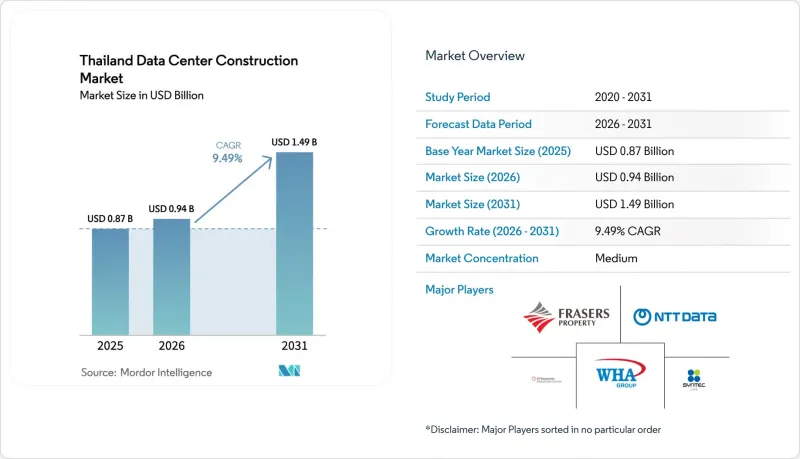
本報告按資料中心層級(一級和二級、三級、四級)、資料中心規模(小規模、中型、大型、超大規模)、資料中心類型(託管資料中心、超大規模資料中心業者雲端服務供應商、企業邊緣資料中心)以及基礎設施(電力基礎設施、機械基礎設施及其他)進行分類。市場預測以美元計價。
泰國資料中心建置市場趨勢及洞察。
利用超大規模資料中心業者雲端服務商擴展雲端服務建設
隨著亞馬遜雲端服務(AWS)、Google雲端和微軟Azure等雲端服務商進軍需要滿足本地雲端和可再生能源需求的地區,數十億美元的基礎設施建設浪潮正在重塑泰國的資料中心建設市場。 2025年3月,泰國投資委員會批准了總額達27億美元的新資料中心項目,其中包括北京昊陽在羅勇府建設的300兆瓦資料中心園區,這印證了以超大規模資料中心業者資料中心營運商為主要租戶的項目所帶來的連鎖效應。春武里府和羅勇府憑藉豐富的可用土地、接近性海底電纜登陸點以及可降低電網電價10-15%的直接購電試點項目,已成為核心樞紐。由於超大規模資料中心業者地段的售罄,兆瓦級資料中心用地的競爭正蔓延至東部經濟走廊(EEC)的次要地段。
政府對東部經濟走廊(EEC)數位走廊的激勵措施
長達15年的免稅期、IT設備免稅進口以及簡化的土地所有權制度構成了東部經濟走廊(EEC)政策組合的基礎,大大減輕了開發商此前因資金壓力而被迫遷往鄰國馬來西亞和越南的局面。 「泰國數位園區」將為海底光纜系統提供暗纖,並使符合資格的資料中心能夠以低於商業價格的價格採購高達50兆瓦的可再生能源和發電資源。 「快速通道」框架將授權時間從18個月縮短至6個月,這對於土木工程、電氣和機械工程同步進行的超大規模建設而言至關重要。 WHA公司透露,在2025年第一季向一家資料中心客戶出售了180英畝土地,證實了市場對EEC地塊的需求依然強勁。綜合來看,這些激勵措施將使預期的複合年成長率(CAGR)提高2個百分點以上。
與該地區其他國家相比,電價較高
2025年商業電費平均為每千瓦時4.20泰銖,比馬來西亞和越南高出約15-20%,這將推高持續高負載運行的GPU叢集的總擁有成本(TCO)。儘管泰國國家電力局(EGAT)的直接購電試驗計畫允許符合條件的設施以折扣價獲得可再生能源,但這項2吉瓦的計劃僅限於不到40個大型場所,這有利於超大規模資料中心業者,而中型託管公司則需支付標準電價。開發商目前正在考慮實施結合現場太陽能發電和電池儲能的系統以降低尖峰需求,但資本支出(CAPEX)增加了失敗的風險。除非2024年電力發展規劃中設定的10吉瓦可再生能源擴建目標能夠加速推進,否則高昂的電價可能會阻礙小規模的建設。
細分市場分析
到2025年,三級資料中心將佔泰國資料中心建置市場的56.43%,為企業提供99.982%的服務等級協定(SLA),而無需四級資料中心高成本的容錯能力。然而,超大規模資料中心業者需要N+N級電力和冷卻系統來託管密度超過每機架30kW的AI訓練模型,這推動了四級資料中心建設以10.32%的複合年成長率成長。 SUPERNAP泰國春武里四級資料中心於2024年成為東南亞少數具備容錯能力的資料中心之一,為營運商提供了GPU賦能設計的藍圖。液冷維修,例如STT GDC於2025年4月實施的每機架100kW系統,透過將電源使用效率(PUE)從1.6提高到1.2,進一步提升了四級資料中心的經濟性。
曾經深受中小企業青睞的Tier 1和Tier 2資料中心,隨著工作負載向更高層級的託管機房集中,其市場佔有率正在下降。無法獲得升級至Tier 3級資金的營運商,要麼被迫被收購,要麼退出市場。投資轉向Tier 4級別,由於其機械複雜性更高,將促使企業與能夠根據執行時間 Institute協議進行容錯認證的專業工程公司建立合作關係。雖然在預測期內,Tier 3仍將構成泰國資料中心建設市場規模的基礎,但隨著人工智慧應用的加速,Tier 4預計將超越其他所有層級。
至2025年,大型資料中心(10-50兆瓦)將佔投資總額的54.54%,但超大規模資料中心(定義為超過50兆瓦的園區)的複合年成長率(CAGR)高達10.64%。亞馬遜網路服務(AWS)和Google雲端(Google Cloud)都計劃在未來幾年內投資超過10億美元用於建造超大規模資料中心區域,而北京昊陽的300兆瓦羅勇計畫建成後,其規模將遠遠超過泰國現有的資料中心。如果所有已公佈的容量都能實現,預計到2029年,泰國資料中心建置市場的超大規模專案規模將超過大型託管資料中心。施耐德電機的模組化建築和預製機房使開發商能夠將引進週期縮短六個月,從而在主要租戶要求24個月內「快速交付機架」時,為其提供競爭優勢。
中型(5-10MW)資料中心的發展相對滯後,因為企業傾向於直接遷移到公共雲端或將工作負載整合到共用的20MW託管機房。小規模(5MW以下)資料中心目前專注於邊緣運算和災害復原,由於其區域基本客群(尤其是在清邁和普吉島),本地投資是合理的。儘管如此,泰國資料中心建設市場仍然對與5G基地台和零售場所相連的微型資料中心有需求,從而保持了供應鏈的多樣性。
其他好處
- Excel格式的市場預測(ME)表
- 3個月的分析師支持
目錄
第1章:引言
- 研究假設和市場定義
- 調查範圍
第2章:調查方法
第3章執行摘要
第4章 市場狀況
- 市場概覽
- 市場促進因素
- 透過超大規模資料中心業者雲端服務商加速雲端服務的擴展
- 政府對東部經濟走廊數位走廊的支持措施
- OTT影片流量和邊緣節點需求的擴張
- 由房地產投資信託基金支持的資料中心房地產市場流動性加速成長
- 資料主權強制合規(PDPA)
- 量子技術的新電源和冷卻標準正在湧現。
- 市場限制因素
- 將優質電力價格與該地區其他公司進行比較
- 接入115千伏特電網的審核流程耗時很長。
- 曼谷大都會區地價上漲
- Uptime Tier認證工程師短缺
- 工業供應鏈分析
- 監理情勢
- 技術展望
- 波特五力分析
- 資料中心的關鍵統計數據
- 泰國資料中心營運商列表(每兆瓦)
- 泰國即將建造的主要資料中心項目清單(2025-2030 年)
- 泰國資料中心建設中的資本支出和營運支出
- 2023年及2024年泰國資料中心電力消耗量(兆瓦)
- 將人工智慧(AI)引入泰國資料中心建設
- 監理與合規框架
- 宏觀經濟因素對市場的影響
第5章 市場規模與成長預測
- 層級類型
- 一級和二級
- 三級
- 第四級
- 按資料中心規模
- 小規模
- 中號
- 大規模
- 超大規模
- 依資料中心類型
- 託管資料中心
- 超大規模資料中心業者雲端服務供應商(CSP)
- 企業邊緣資料中心
- 透過基礎設施
- 電力基礎設施
- 配電解決方案
- 備用電源解決方案
- 機械基礎設施
- 冷卻系統
- 機架和機櫃
- 伺服器和儲存
- 其他機械基礎設施
- 一般建築
- 服務 – 設計與諮詢、整合、支援與維護
- 電力基礎設施
第6章 競爭情勢
- 市場集中度
- 策略趨勢
- 市佔率分析
- 2024 年與 2030 年資料中心基礎設施投資(以兆瓦 (MW) 容量計)對比
- Data Center Construction Landscape(Key Vendors Listings)
- 公司簡介
- Aurecon Group Pty Ltd
- AECOM(泰國)有限公司
- Princeton Digital Group
- Syntec Construction PCL
- Central Pattana PCL
- Thai Kajima Co., Ltd
- Thai Obayashi Corp. Ltd
- PPS Group PCL
- 弗雷澤斯地產(泰國)有限公司
- WHA Corporation PCL
- STT GDC Thailand Co., Ltd
- NTT全球資料中心(泰國)有限公司
- True Internet Data Center Co., Ltd
- SUPERNAP(泰國)有限公司
- CAT Telecom PLC(National Telecom)
- GULF INNO Infrastructure Co., Ltd
- 華為技術(泰國)有限公司
- 施耐德電機(泰國)有限公司
- 台達電子(泰國)有限公司
- List of Data Center Construction Companies
第7章 市場機會與未來展望
According to Mordor Intelligence, the Thailand data center construction market size is expected to increase from USD 0.87 billion in 2025 to USD 0.94 billion in 2026 and reach USD 1.49 billion by 2031, growing at a CAGR of 9.49% over 2026-2031.
This report is Segmented by Tier Type (Tier 1 and 2, Tier 3, and Tier 4), Data Center Size (Small, Medium, Large, and Hyperscale), Data Center Type (Colocation Data Center, Hyperscalers/Cloud Service Provider, and Enterprise and Edge Data Center), and Infrastructure (Electrical Infrastructure, Mechanical Infrastructure, and More). The Market Forecasts are Provided in Terms of Value (USD).
Thailand Data Center Construction Market Trends and Insights
Intensified Cloud-Service Build-Outs by Hyperscalers
A multibillion-dollar wave of captive infrastructure is reshaping the Thailand data center construction market as Amazon Web Services, Google Cloud, and Microsoft Azure commit to local regions that must meet sovereign-cloud and renewable-energy mandates. The Board of Investment approved USD 2.7 billion in new data center projects in March 2025, including a 300 MW campus in Rayong by Beijing Haoyang, confirming the pull-through effect of hyperscaler anchor tenants. Chonburi and Rayong have emerged as core nodes thanks to land availability, proximity to submarine-cable landing sites, and direct power-purchase pilots that shave 10-15% off grid tariffs. Liquid-cooling adoption is quickening in tandem because hyperscalers favor 100 kW-per-rack densities for AI training. Competition for megawatt-scale sites is now spilling into secondary EEC plots as prime parcels sell out.
Government Incentives for Eastern Economic Corridor Digital Corridors
Fifteen-year tax holidays, duty-free imports of IT equipment, and streamlined land-ownership rights underpin the EEC policy package, removing much of the fiscal drag that historically pushed developers into neighboring Malaysia or Vietnam. Digital Park Thailand supplies dark fiber to submarine cable systems and enables qualifying data centers to procure up to 50 MW of renewable power at rates below commercial tariffs. The FastPass framework compresses permitting from eighteen to six months, a critical advantage for hyperscale builds that stage civil, electrical, and mechanical work concurrently. WHA Corporation disclosed land sales of 180 acres to a single data-center customer in 1Q 2025, underscoring sustained appetite for EEC plots. Collectively, these incentives add more than two percentage points to forecast CAGR.
Premium Electricity Tariffs versus Regional Peers
Commercial tariffs averaged THB 4.20 per kWh in 2025, roughly 15-20% higher than Malaysia or Vietnam, driving up total cost of ownership for GPU clusters that draw continuous high loads. EGAT's direct power-purchase pilot lets qualifying facilities lock in renewable energy at discounts, but the 2 GW program supports fewer than forty large sites, advantaging hyperscalers and leaving mid-tier colocation firms on standard rates. Developers are now exploring on-site solar-plus-battery systems to shave peak demand, though capex adds payback risk. Unless the 2024 Power Development Plan's 10 GW renewable expansion is accelerated, high tariffs may curb small-format builds.
Other drivers and restraints analyzed in the detailed report include:
- Growth in OTT Video Traffic and Edge-Node Demand
- Mandatory Data-Sovereignty Compliance (PDPA)
- Lengthy 115 kV Grid-Connection Approval Cycles
For complete list of drivers and restraints, kindly check the Table Of Contents.
Segment Analysis
Tier 3 installations controlled 56.43% of Thailand data center construction market in 2025, offering enterprises 99.982% service-level agreements without Tier 4's costlier fault tolerance. Hyperscalers, however, are driving a 10.32% CAGR in Tier 4 builds by insisting on N + N power and cooling to host AI training models at densities that breach 30 kW per rack. SUPERNAP Thailand's Tier IV Chonburi campus became one of Southeast Asia's only fault-tolerant sites in 2024, giving operators a blueprint for GPU-ready design. Liquid-cooling retrofits such as the 100 kW-per-rack system deployed by STT GDC in April 2025 further bolster Tier 4 economics by boosting power-usage effectiveness from 1.6 to 1.2.
Tier 1 and Tier 2 footprints, once popular with small enterprises, are declining as workloads consolidate into higher-tier colocation suites. Operators that cannot finance Tier 3 upgrades face acquisition or exit. The investment tilt toward Tier 4 elevates mechanical complexity, encouraging partnership with specialist engineering firms that can certify fault tolerance under Uptime Institute protocols. Over the forecast window, Tier 3 will still anchor the Thailand data center construction market size, but Tier 4 is set to outgrow every other tier as AI adoption accelerates.
Large-format facilities (10-50 MW) represented 54.54% of 2025 spending, yet the hyperscale segment, defined as campuses topping 50 MW, is moving at a 10.64% CAGR. Amazon Web Services and Google Cloud have each earmarked multiyear investments exceeding USD 1 billion for hyperscale regions, while Beijing Haoyang's 300 MW Rayong plan will dwarf existing Thai footprints once completed. The Thailand data center construction market size for hyperscale projects is set to overtake large-format colocation by 2029 if all announced capacity materializes. Modular construction and prefabricated power rooms from Schneider Electric let developers shave deployment cycles by 6 months, a competitive edge when anchor tenants require first-rack delivery within 24 months.
Medium-format (5-10 MW) facilities lag because enterprises either leapfrog directly into public cloud or consolidate workloads into shared 20 MW colocation halls. Small (sub-5 MW) sites now skew toward edge computing and disaster recovery, particularly in Chiang Mai and Phuket, where regional consumer bases justify local caching. Nonetheless, the Thailand data center construction market retains a place for micro-facilities tied to 5G towers and retail hubs, keeping supply chains diverse.
Complete Report Scope:
- By Tier Type
- Tier 1 and 2
- Tier 3
- Tier 4
- By Data Center Size
- Small
- Medium
- Large
- Hyperscale
- By Data Center Type
- Colocation Data Center
- Hyperscalers/Cloud Service Provider (CSPs)
- Enterprise and Edge Data Center
- By Infrastructure
- Electrical Infrastructure
- Power Distribution Solution
- Power Backup Solutions
- Mechanical Infrastructure
- Cooling Systems
- Racks and Cabinets
- Servers and Storage
- Other Mechanical Infrastructure
- General Construction
- Services - Design and Consulting, Integration, Support and Maintenance
- Electrical Infrastructure
List of Companies Covered in this Report:
- Aurecon Group Pty Ltd
- AECOM (Thailand) Ltd
- Princeton Digital Group
- Syntec Construction PCL
- Central Pattana PCL
- Thai Kajima Co., Ltd
- Thai Obayashi Corp. Ltd
- PPS Group PCL
- Frasers Property (Thailand) PCL
- WHA Corporation PCL
- STT GDC Thailand Co., Ltd
- NTT Global Data Centers (Thailand) Ltd
- True Internet Data Center Co., Ltd
- SUPERNAP (Thailand) Co., Ltd
- CAT Telecom PLC (National Telecom)
- GULF INNO Infrastructure Co., Ltd
- Huawei Technologies (Thailand) Co., Ltd
- Schneider Electric (Thailand) Ltd
- Delta Electronics (Thailand) PCL
Additional Benefits:
- The market estimate (ME) sheet in Excel format
- 3 months of analyst support
TABLE OF CONTENTS
1 INTRODUCTION
- 1.1 Study Assumptions and Market Definition
- 1.2 Scope of the Study
2 RESEARCH METHODOLOGY
3 EXECUTIVE SUMMARY
4 MARKET LANDSCAPE
- 4.1 Market Overview
- 4.2 Market Drivers
- 4.2.1 Intensified Cloud-Service Build-Outs by Hyperscalers
- 4.2.2 Government Incentives for Eastern Economic Corridor Digital Corridors
- 4.2.3 Growth in OTT Video Traffic and Edge-Node Demand
- 4.2.4 Accelerating Liquidity in REIT-Backed Data-Center Real-Estate
- 4.2.5 Mandatory Data-Sovereignty Compliance (PDPA)
- 4.2.6 Emerging Quantum-Ready Power and Cooling Standards
- 4.3 Market Restraints
- 4.3.1 Premium Electricity Tariffs versus Regional Peers
- 4.3.2 Lengthy 115 kV Grid-Connection Approval Cycles
- 4.3.3 Rising Land Prices in Metro Bangkok
- 4.3.4 Shortage of Uptime-Tier-Accredited Engineers
- 4.4 Industry Supply-Chain Analysis
- 4.5 Regulatory Landscape
- 4.6 Technological Outlook
- 4.7 Porter's Five Forces Analysis
- 4.7.1 Bargaining Power of Suppliers
- 4.7.2 Bargaining Power of Consumers
- 4.7.3 Threat of New Entrants
- 4.7.4 Threat of Substitutes
- 4.7.5 Intensity of Competitive Rivalry
- 4.8 Key Data Center Statistics
- 4.8.1 Exhaustive Data Center Operators in Thailand (in MW)
- 4.8.2 List of Major Upcoming Data Center Projects in Thailand (2025-2030)
- 4.8.3 CAPEX and OPEX For Thailand Data Center Construction
- 4.8.4 Data Center Power Capacity Absorption In MW, Thailand, 2023 and 2024
- 4.9 Artificial Intelligence (AI) Inclusion in Data Center Construction in Thailand
- 4.10 Regulatory and Compliance Framework
- 4.11 Impact of Macroeconomic Factors on the Market
5 MARKET SIZE AND GROWTH FORECASTS (VALUE)
- 5.1 By Tier Type
- 5.1.1 Tier 1 and 2
- 5.1.2 Tier 3
- 5.1.3 Tier 4
- 5.2 By Data Center Size
- 5.2.1 Small
- 5.2.2 Medium
- 5.2.3 Large
- 5.2.4 Hyperscale
- 5.3 By Data Center Type
- 5.3.1 Colocation Data Center
- 5.3.2 Hyperscalers/Cloud Service Provider (CSPs)
- 5.3.3 Enterprise and Edge Data Center
- 5.4 By Infrastructure
- 5.4.1 Electrical Infrastructure
- 5.4.1.1 Power Distribution Solution
- 5.4.1.2 Power Backup Solutions
- 5.4.2 Mechanical Infrastructure
- 5.4.2.1 Cooling Systems
- 5.4.2.2 Racks and Cabinets
- 5.4.2.3 Servers and Storage
- 5.4.2.4 Other Mechanical Infrastructure
- 5.4.3 General Construction
- 5.4.4 Services - Design and Consulting, Integration, Support and Maintenance
- 5.4.1 Electrical Infrastructure
6 COMPETITIVE LANDSCAPE
- 6.1 Market Concentration
- 6.2 Strategic Moves
- 6.3 Market Share Analysis
- 6.4 Data Center Infrastructure Investment Based on Megawatt (MW) Capacity, 2024 vs 2030
- 6.5 Data Center Construction Landscape (Key Vendors Listings)
- 6.6 Company Profiles (Includes Global Level Overview, Market Level Overview, Core Segments, Financials as Available, Strategic Information, Market Rank/Share, Products and Services, and Recent Developments)
- 6.6.1 Aurecon Group Pty Ltd
- 6.6.2 AECOM (Thailand) Ltd
- 6.6.3 Princeton Digital Group
- 6.6.4 Syntec Construction PCL
- 6.6.5 Central Pattana PCL
- 6.6.6 Thai Kajima Co., Ltd
- 6.6.7 Thai Obayashi Corp. Ltd
- 6.6.8 PPS Group PCL
- 6.6.9 Frasers Property (Thailand) PCL
- 6.6.10 WHA Corporation PCL
- 6.6.11 STT GDC Thailand Co., Ltd
- 6.6.12 NTT Global Data Centers (Thailand) Ltd
- 6.6.13 True Internet Data Center Co., Ltd
- 6.6.14 SUPERNAP (Thailand) Co., Ltd
- 6.6.15 CAT Telecom PLC (National Telecom)
- 6.6.16 GULF INNO Infrastructure Co., Ltd
- 6.6.17 Huawei Technologies (Thailand) Co., Ltd
- 6.6.18 Schneider Electric (Thailand) Ltd
- 6.6.19 Delta Electronics (Thailand) PCL
- 6.7 List of Data Center Construction Companies
7 MARKET OPPORTUNITIES AND FUTURE OUTLOOK
- 7.1 White-Space and Unmet-Need Assessment

 中東資料中心建置:市場佔有率分析、產業趨勢與統計及成長預測(2026-2032 年)亞太地區資料中心建置:市場佔有率分析、產業趨勢與統計及成長預測(2026-2031年)南美洲資料中心建置:市場佔有率分析、產業趨勢與統計及成長預測(2026-2031 年)德國資料中心建置:市場佔有率分析、產業趨勢與統計及成長預測(2026-2031 年)日本資料中心建置:市場佔有率分析、產業趨勢與統計及成長預測(2026-2032)歐洲資料中心建置:市場佔有率分析、產業趨勢與統計及成長預測(2026-2031 年)法國資料中心建置:市場佔有率分析、產業趨勢與統計及成長預測(2026-2031 年)義大利資料中心建置:市場佔有率分析、產業趨勢與統計及成長預測(2026-2031 年)英國資料中心建置:市場佔有率分析、產業趨勢與統計及成長預測(2026-2031 年)越南資料中心建設:市場佔有率分析、產業趨勢與統計及成長預測(2026-2031年)