


 |
市場調查報告書
商品編碼
2125684
南美洲資料中心建置:市場佔有率分析、產業趨勢與統計及成長預測(2026-2031 年)South America Data Center Construction - Market Share Analysis, Industry Trends & Statistics, Growth Forecasts (2026 - 2031) |
||||||

※ 本網頁內容可能與最新版本有所差異。詳細情況請與我們聯繫。
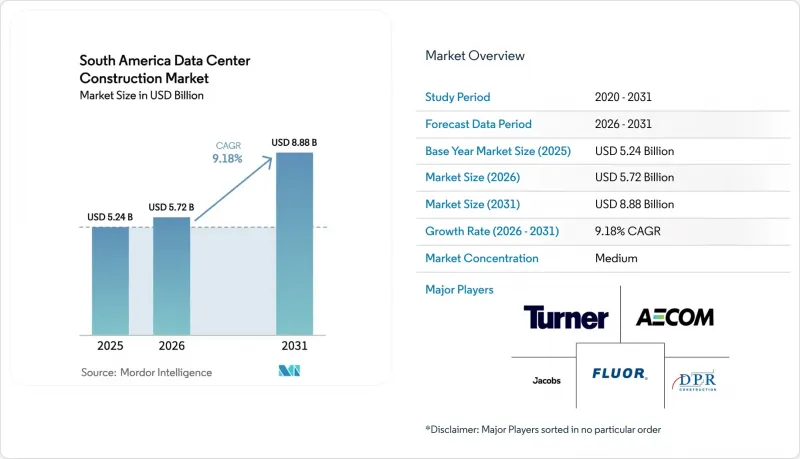
據 Mordor Intelligence 稱,南美資料中心建設市場預計到 2026 年價值 57.2 億美元,高於 2025 年的 52.4 億美元,預計到 2031 年將達到 88.8 億美元。
預計從 2026 年到 2031 年,其複合年成長率將達到 9.18%。
本報告按層級(一級和二級,三級和四級)、資料中心類型(託管、本地超大規模資料中心業者資料中心 (CSP)、企業級資料中心、邊緣資料中心)和基礎設施(電力基礎設施、機械基礎設施)進行細分。市場預測以美元計價。
南美洲資料中心建置市場趨勢與洞察
倡導「雲端優先」策略的公司正掀起數位化浪潮
隨著企業採用混合雲端,從傳統本地部署環境轉變為混合雲環境的轉變正在加速,並重新定義了資料中心建置的優先事項。像福塔萊薩這樣的區域性城市正在崛起為戰略樞紐,16 條海底光纜提供的全球連結能力堪比大都市。哥倫比亞正是這一趨勢的典型代表,其網際網路普及率超過三分之二,電子商務的蓬勃發展推動了對營運商中立設施的需求。總部位於巴西的 Patria 公司正透過投資 10 億美元開發一個面向企業工作負載的新平台,展現了這一市場機會的巨大規模。隨著資料主權法規在全部區域的推行,企業尋求合規環境,託管資料中心的採用率也進一步提高。提供混合雲端閘道和強大合規系統的供應商正在擴大其在南美洲資料中心建立市場的佔有率。
加快對超大規模和託管設施的資本投資。
雲端巨頭們宣布計畫在2030年新建價值超過80億美元的資料中心,將傳統的建設週期縮短至最短18個月。 AWS在智利投資40億美元、在巴西投資18億美元的擴建計劃,以及V.tal在福塔萊薩投資10億美元的園區,正在重振區域供應鏈。 Scala資料中心提案的500億美元「人工智慧之城」項目,目標裝置容量為4.7吉瓦,清楚展現了其超大規模資料中心的雄心壯志。模組化設計和預製機房如今已成為滿足超大規模資料中心建設工期的標準配備。規模小規模的營運商正在透過整合或與專業建築公司合作,以保持在南美洲資料中心建立市場的競爭力。
不斷上漲的電力和房地產成本
在聖保羅,適合建造超大規模資料中心園區的土地價格目前正飆升,促使開發商將目光轉向坎皮納斯等二線城市,這些城市擁有更大的地塊和充足的電力儲備。雖然巴西85%的電力來自可再生能源,但持續的乾旱導致水力發電量下降,推高了電價,並影響了資料中心的營運成本。民眾對電網壓力的擔憂日益加劇,因為民眾擔心資料中心可能會威脅到住宅的電力供應。為了應對這一問題,開發商正在利用現場太陽能發電、電池儲能和購電協議(PPA),這些舉措正在影響南美資料中心市場的建設計畫。
細分市場分析
到2025年,三級資料中心將佔總收入的54.12%。這反映出企業對高容錯性和成本效益設計的偏好。在這一類別中,銀行和數位化優先的零售商在冗餘電源系統和多路徑光纖方面的投資佔比最高。隨著雲端區域對鄰近互連空間的需求不斷成長,預計南美洲資料中心建置市場中三級資料中心的市場規模將穩定擴大。四級資料中心的容量目前小規模,但預計到2031年將以11.24%的複合年成長率成長,這主要得益於人工智慧模型訓練、政府對公共雲端採用的強制性要求以及金融科技平台對99.995%運轉率的要求。因此,南美資料中心建設市場中與四級資料中心建設相關的佔有率預計將會上升,這將導致能夠同時提供可維護性和容錯性的承包商之間的競爭加劇。
更高等級的認證需要雙電源供電、有功-有功功率架構以及嚴格的認證審核,這會延長試運行週期。因此,專門從事複雜機械、電氣和管道系統的承包商可以獲得更高的報酬。 HostDime 在巴西獲得的 ISO 27701 認證就反映了合規認證與等級評定之間的關聯。
隨著企業尋求可擴展的本地伺服器替代方案,同時保持網路多樣性和合規性,託管服務在2025年仍佔總收入的55.63%。主要大都會圈的營運商中立資料中心幾乎已滿,新建設正轉向郊區和區域中心城市。同時,預計到2031年,自建超大規模資料中心將以11.76%的複合年成長率成長,擴大其在南美資料中心建設市場的規模。 AWS、微軟和Google正在擴展其業務,以支援針對亞毫秒延遲最佳化的雲端區域和邊緣節點,這對於遊戲和金融科技交易至關重要。
超大規模資料中心業者正在採用可重複使用的設計模板,以降低進度風險並簡化供應商認證流程,從而實現開關設備、發電機和預製模組的大規模採購。這種標準化正在本地供應鏈中推廣,促使組件製造商遵守全球規範。託管服務供應商也積極回應,提供生態系統豐富的園區,這些園區提供交叉連接架構和雲端存取解決方案,從而在南美洲資料中心建設市場中脫穎而出。
其他好處:
- Excel格式的市場預測(ME)表
- 3個月的分析師支持
目錄
第1章:引言
- 研究假設和市場定義
- 調查範圍
第2章:調查方法
第3章執行摘要
第4章 市場狀況
- 市場概覽
- 市場促進因素
- 由「雲端優先」驅動的企業數位化浪潮
- 對超大規模資料中心和託管服務的資本投資正在加速成長。
- AI/GPU密集型工作負載正在推動高密度設計。
- 巴西和智利政府為中立東道主提供稅收優惠
- 取得綠色融資的途徑,適用於三級及以上節能建築
- 金融科技和遊戲產業中心對亞毫秒延遲的需求。
- 市場限制因素
- 不斷上漲的電力和房地產成本
- 接入電網的前置作業時間很長。
- 複雜機電設備安裝的技術純熟勞工短缺。
- 水資源緊張法規限制了蒸發冷卻技術的應用。
- 供應鏈分析
- 監理情勢
- 技術展望
- 波特五力分析
- 資料中心的關鍵統計數據
- 南美洲資料中心營運商列表(每兆瓦)
- 南美洲主要資料中心項目清單(2025-2030 年)
- 南美洲資料中心建置的資本支出(CAPEX)和營運費用(OPEX)
- 2023 年和 2024 年南美洲主要城市資料中心的電力吸收能力(單位:兆瓦)。
- 將人工智慧(AI)引入南美洲資料中心建設
- 監理與合規框架
第5章 市場規模與成長預測
- 層級特定
- 一級和二級
- 三級
- 第四級
- 依資料中心類型
- 搭配
- 自主研發的超大規模資料中心業者(CSP)
- 企業和邊緣運算
- 透過基礎設施
- 透過電力基礎設施
- 配電解決方案
- 備用電源解決方案
- 透過機械基礎設施
- 冷卻系統
- 機架和機櫃
- 伺服器和儲存
- 其他機械基礎設施
- 一般建築
- 服務 - 設計與諮詢、整合、支援與維護
- 透過電力基礎設施
- 一級和二級
第6章 競爭情勢
- 市場集中度
- 策略趨勢
- 市佔率分析
- Data Center Infrastructure Investment Based on Megawatt(MW)Capacity, 2024 vs 2030
- Data Center Construction Landscape(Key Vendors Listings)
- 公司簡介
- AECOM
- Turner Construction Company
- Jacobs Solutions Inc.
- DPR Construction
- Fluor Corporation
- Constructora Andrade Gutierrez
- Sonda Ingenieria e Implementacion
- Mercury Engineering
- Hensel Phelps
- Gilbane Building Company
- McCarthy Building Companies
- Balfour Beatty US
- Rider Levett Bucknall
- Fonseca Mercadante Constructor
- GSI Ingenieria & Construccion
- Quark Datacenter Solutions
- ACECO TI
- Whiting-Turner Contracting Company
- Synergy Engenharia
- Constructora Sudamericana
第7章 市場機會與未來展望
According to Mordor Intelligence, South America data center construction market size in 2026 is estimated at USD 5.72 billion, growing from 2025 value of USD 5.24 billion with 2031 projections showing USD 8.88 billion, growing at 9.18% CAGR over 2026-2031.
This report is Segmented by Tier Type (Tier 1 and 2, Tier 3 and Tier 4), Data Center Type(Colocation, Self-Built Hyperscalers (CSPs), Enterprise, and Edge), and Infrastructure (Electrical Infrastructure, Mechanical Infrastructure). The Market Forecasts are Provided in Terms of Value (USD).
South America Data Center Construction Market Trends and Insights
Cloud-first Enterprise Digitalization Wave
Enterprise adoption of hybrid cloud is reshaping construction priorities as organizations exit legacy on-premises environments. Secondary cities such as Fortaleza have emerged as strategic hubs because sixteen submarine cables deliver global connectivity that rivals major metros. Colombia illustrates the trend, with internet penetration surpassing two-thirds of the population and e-commerce surging, which increases demand for carrier-neutral facilities. Brazil-based Patria committed USD 1 billion to a new platform targeting these enterprise workloads, signalling the scale of opportunity. Data sovereignty rules across the region further accelerate colocation uptake as enterprises seek compliant environments. Providers able to deliver hybrid cloud gateways and robust compliance frameworks are gaining share in the South America data center construction market.
Hyperscale and Colocation Capex Build-out Acceleration
Cloud majors have announced more than USD 8 billion in new sites through 2030, compressing traditional build schedules to as little as 18 months. AWS's USD 4 billion Chile region and USD 1.8 billion Brazil expansion, along with V.tal's USD 1 billion Fortaleza campus, are catalyzing regional supply chains. Scala Data Centers' USD 50 billion AI City proposal targeting 4.7 GW exemplifies superscale ambition. Modular designs and prefabricated power rooms are now mainstream to meet hyperscale timelines. Smaller operators are consolidating or partnering with construction specialists to remain competitive in the South America data center construction market.
Escalating Power and Real-estate Costs
Land suitable for hyperscale campuses in Sao Paulo now commands premium valuations, pushing developers toward secondary zones such as Campinas that offer larger parcels and improved power headroom. Brazil sources 85% of its electricity from renewables, yet drought cycles reduce hydropower output and raise electricity prices, affecting facility operating costs. Public concern about grid stress has grown as citizens fear data centers may jeopardize the residential supply. Developers respond with on-site solar, battery storage, and power purchase agreements that shape construction blueprints in the South America data center construction market.
Other drivers and restraints analyzed in the detailed report include:
- AI / GPU-dense Workloads Driving High-density Designs
- Government "Neutral Host" Tax Incentives in Brazil and Chile
- Long Lead-time for Utility Grid Interconnects
For complete list of drivers and restraints, kindly check the Table Of Contents.
Segment Analysis
Tier 3 sites captured 54.12% of overall revenue in 2025, reflecting enterprise preference for resilient yet cost-balanced designs. Within this category, banks and digital-first retailers account for the majority of spend on redundant power trains and multi-path fibre. The South America data center construction market size for Tier 3 facilities is projected to expand steadily as cloud regions seek adjacent interconnection space. Tier 4 capacity, while smaller today, shows an 11.24% CAGR through 2031 as AI model training, government public-cloud mandates, and fintech platforms demand 99.995% uptime. The South America data center construction market share associated with Tier 4 builds is therefore positioned to rise, intensifying competition for contractors able to deliver concurrent maintainability and fault tolerance.
Higher tiers require dual utility feeds, active-active power architectures, and stringent certification audits that lengthen commissioning cycles. Contractors specialising in complex mechanical, electrical, and plumbing systems thus command price premiums. HostDime's ISO 27701 achievement in Brazil illustrates how compliance certifications intersect with tiering decisions
Colocation retained 55.63% of 2025 revenue as enterprises sought scalable alternatives to on-premises servers while maintaining network diversity and regulatory compliance. Carrier-neutral sites in major metros recorded near-full occupancy, pushing new builds toward suburbs and secondary cities. Simultaneously, self-built hyperscale sites register a 11.76% CAGR to 2031, elevating the South America data center construction market size for proprietary campuses. AWS, Microsoft, and Google expand footprints to support cloud regions and edge nodes tuned for sub-1 ms latency critical to gaming and fintech transactions.
Hyperscalers deploy repeatable design templates that compress schedule risk and simplify vendor qualification, leading to bulk procurement of switchgear, generators, and prefabricated modules. This standardisation cascades through local supply chains, incentivising parts manufacturers to align with global specifications. Colocation operators respond with ecosystem-rich campuses offering cross-connect fabrics and cloud on-ramps to differentiate in the South America data center construction market.
Complete Report Scope:
- By Tier Type
- Tier 1 and 2
- Tier 3
- Tier 4
- By Data Center Type
- Colocation
- Self-build Hyperscalers (CSPs)
- Enterprise and Edge
- By Infrastructure
- By Electrical Infrastructure
- Power Distribution Solution
- Power Backup Solutions
- By Mechanical Infrastructure
- Cooling Systems
- Racks and Cabinets
- Servers and Storage
- Other Mechanical Infrastructure
- General Construction
- Service - Design and Consulting, Integration, Support and Maintenance
- By Electrical Infrastructure
- Tier 1 and 2
List of Companies Covered in this Report:
- AECOM
- Turner Construction Company
- Jacobs Solutions Inc.
- DPR Construction
- Fluor Corporation
- Constructora Andrade Gutierrez
- Sonda Ingenieria e Implementacion
- Mercury Engineering
- Hensel Phelps
- Gilbane Building Company
- McCarthy Building Companies
- Balfour Beatty US
- Rider Levett Bucknall
- Fonseca Mercadante Constructor
- GSI Ingenieria & Construccion
- Quark Datacenter Solutions
- ACECO TI
- Whiting-Turner Contracting Company
- Synergy Engenharia
- Constructora Sudamericana
Additional Benefits:
- The market estimate (ME) sheet in Excel format
- 3 months of analyst support
TABLE OF CONTENTS
1 INTRODUCTION
- 1.1 Study Assumptions and Market Definition
- 1.2 Scope of the Study
2 RESEARCH METHODOLOGY
3 EXECUTIVE SUMMARY
4 MARKET LANDSCAPE
- 4.1 Market Overview
- 4.2 Market Drivers
- 4.2.1 Cloud-first enterprise digitalization wave
- 4.2.2 Hyperscale and colocation capex build-out acceleration
- 4.2.3 AI / GPU-dense workloads driving high-density designs
- 4.2.4 Government neutral host tax incentives in Brazil and Chile
- 4.2.5 Green financing access for Tier III+ energy-efficient builds
- 4.2.6 Sub-1 ms latency demand from fintech and gaming hubs
- 4.3 Market Restraints
- 4.3.1 Escalating power and real-estate costs
- 4.3.2 Long lead-time for utility grid interconnects
- 4.3.3 Skilled labor shortages for complex MEP installations
- 4.3.4 Water-stress regulations limiting evaporative cooling adoption
- 4.4 Supply-Chain Analysis
- 4.5 Regulatory Landscape
- 4.6 Technological Outlook
- 4.7 Porter's Five Forces Analysis
- 4.7.1 Bargaining Power of Suppliers
- 4.7.2 Bargaining Power of Consumers
- 4.7.3 Threat of New Entrants
- 4.7.4 Threat of Substitutes
- 4.7.5 Intensity of Competitive Rivalry
- 4.8 Key Data Center Statistics
- 4.8.1 Exhaustive Data Center Operators in South America(in MW)
- 4.8.2 List of Major Upcoming Data Center Projects in South America (2025-2030)
- 4.8.3 CAPEX and OPEX For South AmericaData Center Construction
- 4.8.4 Data Center Power Capacity Absorption In MW, Selected Cities, South America, 2023 and 2024
- 4.9 Artificial Intelligence (AI) Inclusion in Data Center Construction in South America
- 4.10 Regulatory and Compliance Framework
5 MARKET SIZE AND GROWTH FORECASTS (VALUE)
- 5.1 By Tier Type
- 5.1.1 Tier 1 and 2
- 5.1.1.1 Tier 3
- 5.1.1.2 Tier 4
- 5.1.2 By Data Center Type
- 5.1.2.1 Colocation
- 5.1.2.2 Self-build Hyperscalers (CSPs)
- 5.1.2.3 Enterprise and Edge
- 5.1.3 By Infrastructure
- 5.1.3.1 By Electrical Infrastructure
- 5.1.3.1.1 Power Distribution Solution
- 5.1.3.1.2 Power Backup Solutions
- 5.1.3.2 By Mechanical Infrastructure
- 5.1.3.2.1 Cooling Systems
- 5.1.3.2.2 Racks and Cabinets
- 5.1.3.2.3 Servers and Storage
- 5.1.3.2.4 Other Mechanical Infrastructure
- 5.1.3.3 General Construction
- 5.1.3.4 Service - Design and Consulting, Integration, Support and Maintenance
- 5.1.3.1 By Electrical Infrastructure
- 5.1.1 Tier 1 and 2
6 COMPETITIVE LANDSCAPE
- 6.1 Market Concentration
- 6.2 Strategic Moves
- 6.3 Market Share Analysis
- 6.4 Data Center Infrastructure Investment Based on Megawatt (MW) Capacity, 2024 vs 2030
- 6.5 Data Center Construction Landscape (Key Vendors Listings)
- 6.6 Company Profiles (includes Global level Overview, Market level overview, Core Segments, Financials as available, Strategic Information, Market Rank/Share for key companies, Products and Services, Recent Developments)
- 6.6.1 AECOM
- 6.6.2 Turner Construction Company
- 6.6.3 Jacobs Solutions Inc.
- 6.6.4 DPR Construction
- 6.6.5 Fluor Corporation
- 6.6.6 Constructora Andrade Gutierrez
- 6.6.7 Sonda Ingenieria e Implementacion
- 6.6.8 Mercury Engineering
- 6.6.9 Hensel Phelps
- 6.6.10 Gilbane Building Company
- 6.6.11 McCarthy Building Companies
- 6.6.12 Balfour Beatty US
- 6.6.13 Rider Levett Bucknall
- 6.6.14 Fonseca Mercadante Constructor
- 6.6.15 GSI Ingenieria & Construccion
- 6.6.16 Quark Datacenter Solutions
- 6.6.17 ACECO TI
- 6.6.18 Whiting-Turner Contracting Company
- 6.6.19 Synergy Engenharia
- 6.6.20 Constructora Sudamericana
7 MARKET OPPORTUNITIES AND FUTURE OUTLOOK
- 7.1 White-space and Unmet-need Assessment

 中東資料中心建置:市場佔有率分析、產業趨勢與統計及成長預測(2026-2032 年)亞太地區資料中心建置:市場佔有率分析、產業趨勢與統計及成長預測(2026-2031年)德國資料中心建置:市場佔有率分析、產業趨勢與統計及成長預測(2026-2031 年)日本資料中心建置:市場佔有率分析、產業趨勢與統計及成長預測(2026-2032)歐洲資料中心建置:市場佔有率分析、產業趨勢與統計及成長預測(2026-2031 年)法國資料中心建置:市場佔有率分析、產業趨勢與統計及成長預測(2026-2031 年)泰國資料中心建置:市場佔有率分析、產業趨勢與統計及成長預測(2026-2031)義大利資料中心建置:市場佔有率分析、產業趨勢與統計及成長預測(2026-2031 年)英國資料中心建置:市場佔有率分析、產業趨勢與統計及成長預測(2026-2031 年)越南資料中心建設:市場佔有率分析、產業趨勢與統計及成長預測(2026-2031年)