


 |
市場調查報告書
商品編碼
2119657
法國資料中心建置:市場佔有率分析、產業趨勢與統計及成長預測(2026-2031 年)France Data Center Construction - Market Share Analysis, Industry Trends & Statistics, Growth Forecasts (2026 - 2031) |
||||||

※ 本網頁內容可能與最新版本有所差異。詳細情況請與我們聯繫。
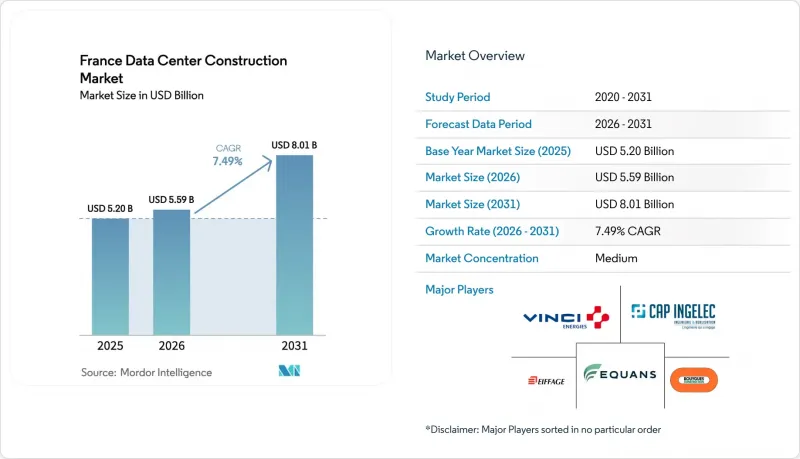
根據 Mordor Intelligence 預測,法國資料中心建設市場規模將從 2025 年的 52 億美元成長到 2026 年的 55.9 億美元,然後在 2031 年達到 80.1 億美元,2026 年至 2031 年的複合年成長率為 7.49%。
本報告按資料中心層級(一級和二級、三級和四級)、資料中心類型(託管、超大規模雲端超大規模資料中心業者(CSP) 自建、企業級、邊緣運算)和基礎設施(電力基礎設施、機械基礎設施)進行分類。市場預測以美元計價。
法國資料中心建置市場趨勢與洞察
數位轉型及對託管雲端的需求
企業正在用混合雲端架構取代本地硬體,這需要與公共雲端區域或專用託管機房建立低延遲連接。特定產業的合規性要求正在重新定義規範;醫療保健提供者要求機房符合 ISO 13485 標準,而遊戲和彩票運營商在遷移工作負載之前會進行多站點審計。託管服務層級的需求促使建構商整合邊緣設備和 AI 推理叢集的暫存空間。為滿足歐洲資料保護法規,對本地託管環境的需求日益成長,這進一步鞏固了對本地容量的需求。
5G部署和邊緣運算密度增加
隨著5G的廣泛部署,計算叢集正被放置在更靠近街道和工廠車間的地方。在伊斯特爾市的私有5G部署等市政項目中,微型資料中心正被整合到市政基礎設施中,以支援即時影像分析,這為擅長在整修的設備間內進行高密度電氣佈線的承包商創造了商機。在其生產線上部署5G的製造商需要堅固耐用、具備液冷功能的機殼,以承受工業環境的高溫和振動。
巴黎地區土地和建築成本上漲
由於A86環城公路沿線工業用地供應有限,地價已超過每平方公尺300歐元(345.51美元)。同時,鋼材和開關設備的成本持續以每年5%至7%的速度上漲。預計到2025年,人事費用將從每平方公尺112.80歐元(129.88美元)上漲至121.02歐元(139.34美元),這將對承包商的利潤率造成壓力。開發商正將業務轉移到里昂、波爾多和馬賽等地,這些地方的地價較低,且有市政優惠政策。為了應對成本上漲的壓力,建商正在採用工廠預製模組,這不僅減少了現場施工,也降低了對價格波動較大的原料的依賴。
細分市場分析
2025年,Tier 3級資料中心繼續佔據法國資料中心建設市場佔有率的52.15%。這是因為大多數企業應用需要高運轉率,但容錯能力要求較低。在法國資料中心建設市場中,Tier 3級設施的市場規模預計將繼續穩定成長,儘管其複合年成長率低於整個產業。相較之下,Tier 4級資料中心預計將以7.87%的年均成長率成長至2031年,這主要得益於人工智慧模型訓練、金融科技支付處理以及國家關鍵基礎設施工作負載對99.995%可用性的需求。
第四級專案需要大規模的配電室和更先進的建築管理軟體,因為它們需要2N電源系統、雙光纖路徑以及整個機械子系統的並行維護能力。 Thesee資料中心園區是全國首個獲得「Uptime Tier IV」認證的託管設施,它整合了基於人工智慧的冷卻最佳化技術,在不影響冗餘性的前提下降低了能耗。因此,供應商對人工智慧驅動的環境控制系統、防電弧閃光開關設備以及可將資料傳輸到可靠性儀表板的預測性維護感測器的需求日益成長。
預計到2025年,託管服務供應商將佔據法國資料中心建設市場56.60%的佔有率。這主要是由於企業傾向於靈活的、基於營運成本(OPEX)的容量合約。同時,由於公共雲端供應商要求控制成本並保證機架可用性,預計到2031年,自建超大規模資料中心業者企業將維持9.65%的複合年成長率。
超大規模資料中心業者中心園區採用模板化設計,由54-60兆瓦的模組組成,這些模組在不同區域重複部署,使建造者能夠在材料和工期方面受益於可重複性。微軟承諾的40億歐元(46.1億美元)投資正用於這些統一的殼體結構,加速運作。隨著資料主權法規和毫秒延遲目標的日益重要,企業和邊緣運算專案仍然至關重要,規模經濟效益不再是首要考慮因素,這促使工廠、醫院和智慧城區等場所加速建設微型設施。
其他好處:
- Excel格式的市場預測(ME)表
- 3個月的分析師支持
目錄
第1章:引言
- 研究假設和市場定義
- 調查範圍
第2章:調查方法
- 研究框架
- 第二次調查
- 初步調查
- 數據三角測量與洞察生成
第3章執行摘要
第4章 市場狀況
- 市場概覽
- 市場促進因素
- 數位轉型及對託管雲端的需求
- 5G部署和邊緣運算整合
- 政府對人工智慧和數位主權領域的投資正在激增。
- 低碳、核能電力供應情勢
- 基於國家利益的快速許可製度(2025 年)
- 針對低延遲人工智慧/物聯網工作負載的邊緣資料中心的發展
- 市場限制因素
- 巴黎大都會區的土地價格和建築成本正以越來越快的速度上漲。
- 2025年嚴格能源效率揭露法案(ICPE)
- FLAP子市場局部電網容量瓶頸
- 加強冷卻系統用水法規
- 供應鏈分析
- 監理情勢
- 技術趨勢:液冷和浸沒式冷卻、AI運維
- 波特五力分析
- 資料中心的關鍵統計數據
- 法國資料中心營運商列表(每兆瓦)
- 法國主要資料中心項目清單(2025-2030 年)
- 法國資料中心建設中的資本支出與營運支出
- 法國主要城市資料中心電力消耗量(兆瓦),2023 年和 2024 年
- 法國將人工智慧(AI)引入資料中心建設
- 監理與合規框架
第5章 市場規模與成長預測
- 層級特定
- 一級和二級
- 三級
- 第四級
- 依資料中心類型
- 搭配
- 內部建置的超大規模資料中心業者(CSP)
- 企業和邊緣運算
- 透過基礎設施
- 按類型分類的電氣基礎設施
- 配電解決方案
- 備用電源解決方案
- 透過機械基礎設施
- 冷卻系統
- 機架和機櫃
- 伺服器和儲存
- 其他機械基礎設施
- 一般建築
- 服務(設計和諮詢、整合、支援和維護)
- 按類型分類的電氣基礎設施
第6章 競爭情勢
- 市場集中度
- 策略趨勢
- 市佔率分析
- Data Center Infrastructure Investment Based on Megawatt(MW)Capacity, 2024 vs 2030
- Data Center Construction Landscape(Key Vendors Listings)
- 公司簡介
- Bouygues Construction
- Eiffage
- Vinci Energies
- Equans(formerly Engie Solutions)
- CAP INGELEC
- Artelia Group
- APL Data Center
- LPI Group
- Mercury Engineering
- TPF Ingenierie
- M+W Group(Exyte)
- JERLAURE
- Data4 Group
- Interxion(Digital Realty)
- Telehouse France
- OVHcloud
- Etix Everywhere
- Colt Data Centre Services
- Thesee DataCenter
- Euclyde Data Centers
- List of Data Center Construction Companies
第7章 市場機會與未來展望
According to Mordor Intelligence, the France data center construction market size is expected to grow from USD 5.20 billion in 2025 to USD 5.59 billion in 2026 and is forecast to reach USD 8.01 billion by 2031 at 7.49% CAGR over 2026-2031.
This report is Segmented by Tier Type (Tier 1 and 2, Tier 3 and Tier 4), Data Center Type(Colocation, Self-Built Hyperscalers (CSPs), Enterprise, and Edge), Infrastructure (Electrical Infrastructure, Mechanical Infrastructure). The Market Forecasts are Provided in Terms of Value (USD).
France Data Center Construction Market Trends and Insights
Digital Transformation and Managed-Cloud Demand
Enterprises are replacing on-premises hardware with hybrid-cloud architectures that need low-latency links to public-cloud regions and specialised colocation halls. Sector-specific compliance is reshaping specifications; healthcare operators seek ISO 13485 halls, while gaming and lottery operators commission multi-site audits before moving workloads. The managed-services layer compels builders to integrate staging space for edge appliances and AI inference clusters. Demand for sovereign-hosted environments is anchoring capacity inside national borders to meet European data-protection rules.
5G Roll-Out and Edge-Computing Densification
Widespread 5G coverage is pushing computing clusters closer to streets and factory floors. Municipal projects, such as the Istres private 5G rollout, embed micro-data centers into civic infrastructure to support real-time video analytics, creating opportunities for contractors versed in high-density electrical layouts that fit inside refurbished utility rooms. Manufacturers deploying 5G on production lines are requesting ruggedised edge enclosures paired with liquid cooling that withstand industrial heat and vibration.
Escalating Paris-Region Land and Build-Cost Inflation
Limited industrial plots inside the A86 ring road have pushed average site prices beyond EUR 300(USD 345.51) per square meter, while steel and switchgear costs continue to rise at 5-7% annually. Hourly labour rates advanced from EUR 112.80 (USD 129.88) to EUR 121.02 (USD 139.34) during 2025, squeezing contractor margins. Developers are diverting pipelines to Lyon, Bordeaux and Marseille, where land is cheaper and municipal incentives are available. To offset cost pressures, builders are adopting factory-prefabricated modules that cut on-site labour hours and reduce exposure to price-volatile commodities.
Other drivers and restraints analyzed in the detailed report include:
- Government AI and Digital-Sovereignty Investment Surge
- Availability of Low-Carbon Nuclear-Backed Electricity
- Stringent 2025 Energy-Efficiency Disclosure Law (ICPE)
For complete list of drivers and restraints, kindly check the Table Of Contents.
Segment Analysis
Tier 3 halls retained 52.15% of France data center construction market share in 2025 because most enterprise applications require high but not fault-tolerant uptime. The France data center construction market size for Tier 3 builds is forecast to continue expanding steadily yet below the overall industry CAGR. Tier 4, by contrast, is projected to grow 7.87% annually through 2031 as AI model training, fintech clearing and critical national infrastructure workloads need 99.995% availability.
Tier 4 projects entail 2N power trains, dual fibre paths and concurrent maintainability across mechanical subsystems, prompting larger electrical rooms and more sophisticated building-management software. The Thesee DataCenter campus, recognised as the nation's first Uptime Tier IV colocation site, integrates AI-based cooling optimisation that trims energy consumption without compromising redundancy. Suppliers are therefore seeing heightened demand for AI-driven environmental controls, arc-flash-resistant switchgear and predictive-maintenance sensors that feed reliability dashboards.
Colocation operators commanded 56.60% of France data center construction market share in 2025, since enterprises prefer an opex-based capacity that can be contracted flexibly. Self-built hyperscaler halls, however, will record a 9.65% CAGR to 2031 as public-cloud providers seek cost control and guaranteed rack availability.
Hyperscaler campuses employ template-based designs with 54-60 MW blocks that replicate across regions, letting constructors gain repeatability benefits on materials and timelines. Microsoft's EUR 4 billion (USD 4.61 billion) pledge is channelled into such cookie-cutter shells that accelerate commissioning. Enterprise and edge projects remain relevant where data-sovereignty rules or millisecond latency targets override economies of scale, prompting construction of micro-facilities inside factories, hospitals, and smart-city districts.
Complete Report Scope:
- By Tier Type
- Tier 1 and 2
- Tier 3
- Tier 4
- By Data Center Type
- Colocation
- Self-build Hyperscalers (CSPs)
- Enterprise and Edge
- By Infrastructure
- By Electrical Infrastructure
- Power Distribution Solution
- Power Backup Solutions
- By Mechanical Infrastructure
- Cooling Systems
- Racks and Cabinets
- Servers and Storage
- Other Mechanical Infrastructure
- General Construction
- Service (Design and Consulting, Integration, Support and Maintenance)
- By Electrical Infrastructure
List of Companies Covered in this Report:
- Bouygues Construction
- Eiffage
- Vinci Energies
- Equans (formerly Engie Solutions)
- CAP INGELEC
- Artelia Group
- APL Data Center
- LPI Group
- Mercury Engineering
- TPF Ingenierie
- M+W Group (Exyte)
- JERLAURE
- Data4 Group
- Interxion (Digital Realty)
- Telehouse France
- OVHcloud
- Etix Everywhere
- Colt Data Centre Services
- Thesee DataCenter
- Euclyde Data Centers
Additional Benefits:
- The market estimate (ME) sheet in Excel format
- 3 months of analyst support
TABLE OF CONTENTS
1 INTRODUCTION
- 1.1 Study Assumptions and Market Definition
- 1.2 Scope of the Study
2 RESEARCH METHODOLOGY
- 2.1 Research Framework
- 2.2 Secondary Research
- 2.3 Primary Research
- 2.4 Data Triangulation and Insight Generation
3 EXECUTIVE SUMMARY
4 MARKET LANDSCAPE
- 4.1 Market Overview
- 4.2 Market Drivers
- 4.2.1 Digital transformation and managed-cloud demand
- 4.2.2 5G roll-out and edge-computing densification
- 4.2.3 Government AI and digital-sovereignty investment surge
- 4.2.4 Availability of low-carbon nuclear-backed electricity
- 4.2.5 Fast-track national-interest permit regime (2025)
- 4.2.6 Edge data-center growth for AI/IoT low-latency workloads
- 4.3 Market Restraints
- 4.3.1 Escalating Paris-region land and build-cost inflation
- 4.3.2 Stringent 2025 energy-efficiency disclosure law (ICPE)
- 4.3.3 Localised grid-capacity bottlenecks in FLAP sub-markets
- 4.3.4 Tightening water-usage regulations for cooling systems
- 4.4 Supply-Chain Analysis
- 4.5 Regulatory Landscape
- 4.6 Technological Outlook Liquid and immersion cooling, AI-ops
- 4.7 Porters Five Forces Analysis
- 4.7.1 Bargaining Power of Suppliers
- 4.7.2 Bargaining Power of Buyers
- 4.7.3 Threat of New Entrants
- 4.7.4 Threat of Substitutes
- 4.7.5 Intensity of Competitive Rivalry
- 4.8 Key Data Center Statistics
- 4.8.1 Exhaustive Data Center Operators in France(in MW)
- 4.8.2 List of Major Upcoming Data Center Projects in France (2025-2030)
- 4.8.3 CAPEX and OPEX For France Data Center Construction
- 4.8.4 Data Center Power Capacity Absorption In MW, Selected Cities, France, 2023 and 2024
- 4.9 Artificial Intelligence (AI) Inclusion in Data Center Construction in France
- 4.10 Regulatory and Compliance Framework
5 MARKET SIZE and GROWTH FORECASTS (VALUE)
- 5.1 By Tier Type
- 5.1.1 Tier 1 and 2
- 5.1.2 Tier 3
- 5.1.3 Tier 4
- 5.2 By Data Center Type
- 5.2.1 Colocation
- 5.2.2 Self-build Hyperscalers (CSPs)
- 5.2.3 Enterprise and Edge
- 5.3 By Infrastructure
- 5.3.1 By Electrical Infrastructure
- 5.3.1.1 Power Distribution Solution
- 5.3.1.2 Power Backup Solutions
- 5.3.2 By Mechanical Infrastructure
- 5.3.2.1 Cooling Systems
- 5.3.2.2 Racks and Cabinets
- 5.3.2.3 Servers and Storage
- 5.3.2.4 Other Mechanical Infrastructure
- 5.3.3 General Construction
- 5.3.4 Service (Design and Consulting, Integration, Support and Maintenance)
- 5.3.1 By Electrical Infrastructure
6 COMPETITIVE LANDSCAPE
- 6.1 Market Concentration
- 6.2 Strategic Moves
- 6.3 Market Share Analysis
- 6.4 Data Center Infrastructure Investment Based on Megawatt (MW) Capacity, 2024 vs 2030
- 6.5 Data Center Construction Landscape (Key Vendors Listings)
- 6.6 Company Profiles (includes Global level Overview, Market level overview, Core Segments, Financials as available, Strategic Information, Market Rank/Share for key companies, Products and Services, Recent Developments)
- 6.6.1 Bouygues Construction
- 6.6.2 Eiffage
- 6.6.3 Vinci Energies
- 6.6.4 Equans (formerly Engie Solutions)
- 6.6.5 CAP INGELEC
- 6.6.6 Artelia Group
- 6.6.7 APL Data Center
- 6.6.8 LPI Group
- 6.6.9 Mercury Engineering
- 6.6.10 TPF Ingenierie
- 6.6.11 M+W Group (Exyte)
- 6.6.12 JERLAURE
- 6.6.13 Data4 Group
- 6.6.14 Interxion (Digital Realty)
- 6.6.15 Telehouse France
- 6.6.16 OVHcloud
- 6.6.17 Etix Everywhere
- 6.6.18 Colt Data Centre Services
- 6.6.19 Thesee DataCenter
- 6.6.20 Euclyde Data Centers
- 6.7 List of Data Center Construction Companies
7 MARKET OPPORTUNITIES and FUTURE OUTLOOK
- 7.1 White-space and Unmet-need Assessment

 中東資料中心建置:市場佔有率分析、產業趨勢與統計及成長預測(2026-2032 年)亞太地區資料中心建置:市場佔有率分析、產業趨勢與統計及成長預測(2026-2031年)南美洲資料中心建置:市場佔有率分析、產業趨勢與統計及成長預測(2026-2031 年)德國資料中心建置:市場佔有率分析、產業趨勢與統計及成長預測(2026-2031 年)日本資料中心建置:市場佔有率分析、產業趨勢與統計及成長預測(2026-2032)歐洲資料中心建置:市場佔有率分析、產業趨勢與統計及成長預測(2026-2031 年)泰國資料中心建置:市場佔有率分析、產業趨勢與統計及成長預測(2026-2031)義大利資料中心建置:市場佔有率分析、產業趨勢與統計及成長預測(2026-2031 年)英國資料中心建置:市場佔有率分析、產業趨勢與統計及成長預測(2026-2031 年)越南資料中心建設:市場佔有率分析、產業趨勢與統計及成長預測(2026-2031年)