


 |
市場調查報告書
商品編碼
2119656
德國資料中心建置:市場佔有率分析、產業趨勢與統計及成長預測(2026-2031 年)Germany Data Center Construction - Market Share Analysis, Industry Trends & Statistics, Growth Forecasts (2026 - 2031) |
||||||

※ 本網頁內容可能與最新版本有所差異。詳細情況請與我們聯繫。
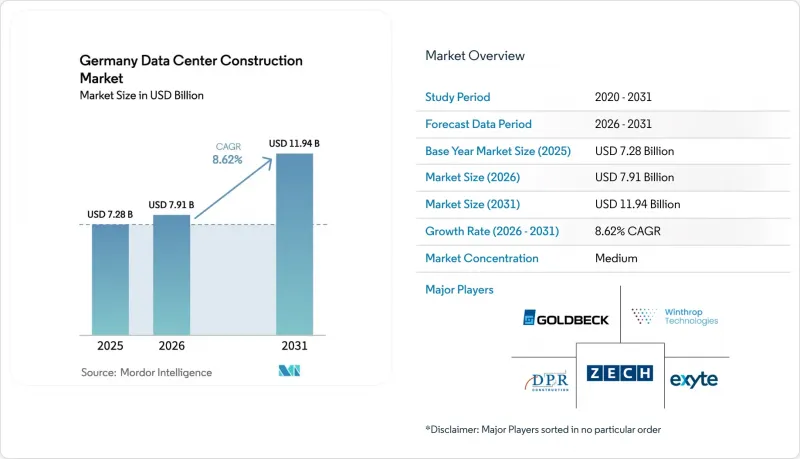
據 Mordor Intelligence 稱,2025 年德國資料中心建設市場價值為 72.8 億美元,預計到 2031 年將從 2026 年的 79.1 億美元成長至 119.4 億美元,預測期(2026-2031 年)的複合年成長率為 8.62%。
本報告按基礎設施(電力基礎設施、機械基礎設施、一般建築)、等級(一級和二級、三級、四級)以及資料中心類型(託管、超大規模資料中心業者(CSP) 的現場建設等)對產業進行細分。所有上述細分市場的規模和預測均以價值(百萬美元)表示。
德國資料中心建置市場趨勢與洞察
超大規模雲端運算領域的資本投資激增,正在推動千兆瓦規模的擴張。
超大規模業者正透過破紀錄的資本投資重塑德國資料中心建設市場。 AWS 正在法蘭克福附近投資 94.4 億美元建造多個園區,這些園區旨在處理千兆瓦級負載,預計交付週期為 18-24 個月,這將推動對預製模組和同步授權的需求。隨後,微軟宣布了一項 32 億歐元(36 億美元)的擴建計劃,該計劃將使德國的 AI 處理能力加倍,並新增功率超過 40kW 的機架。同時建造多個建築的模式有利於那些能夠協調跨分散式站點的工作團隊和物流的公司,而小規模的本地承包商則面臨被市場淘汰的風險。更短的工期加劇了對技術純熟勞工和專用開關設備的競爭,並增加了對全球供應鏈的依賴。因此,德國資料中心建設市場更青睞那些能夠在不影響 PUE 效能的前提下快速擴展的建築商。
AI/ML機架密度的變化正在加速液冷工程的推進。
如今,人工智慧推理和訓練叢集的單機架功耗已超過 80kW,使得風冷不再實用,並導致液冷維修和待開發區部署的需求激增。谷歌發布的 1MW CDU 設計藍圖展示了超大規模資料中心業者正在採用的標準化高壓液冷架構。 GlobalConnect 等先驅企業報告稱,在實施液冷工程後,冷卻能耗降低了 90%,樹立了新的能源效率標準。 Supermicro 在 2024 年至 2025 年間交付了超過 2000 個液冷機架,證實了該硬體的快速普及,並鞏固了新的建築標準。建設公司現在在樓板施工階段就整合冷卻劑分配單元和熱回收迴路,從而縮短了後期施工階段,並改變了德國資料中心建設市場的合約範圍。
法蘭克福周邊地區缺乏 110 千伏電網連接,導致管線計畫延長。
法蘭克福110千伏主幹電網已接近滿載運作,新建併網專案的前置作業時間長達八年,遠遠超過典型的超大規模資料中心規劃週期。 Digital Realty在當地擁有的20多個資料中心清晰地展現了高需求和由此導致的電網飽和。為了應對這一問題,開發商要么將項目拆分為100兆瓦以下的小型項目,要么將重心轉移到勃蘭登堡州、柏林和北萊茵-威斯特法倫州。如今,施工進度取決於電力公司對基礎設施升級的核准,這使得EPC合約的簽訂變得更加複雜。因此,電網接取不足的問題反映在德國資料中心建設市場的土地估值和購電協議(PPA)溢價。
細分市場分析
預計到2025年,Tier 3級資料中心將佔據德國資料中心建設市場56.68%的佔有率,展現出卓越的可靠性和成本效益平衡。同時,Tier 4級資料中心正以10.74%的複合年成長率成長,成為2026年至2031年間德國資料中心建設市場成長最快的領域。超大規模資料中心和金融服務業的買家認為,高冗餘度對於實現99.995%的運轉率至關重要。建造需求包括雙路主動電源路徑、可並行維護的冷卻系統以及容錯光纖佈線。雖然專注於Tier 4級設計的建造者可以獲得更高的利潤率,但他們需要更長的測試週期並遵守監管審計要求。
隨著企業遷移到雲端並追求更高的可用性,目前對一級和二級資料中心建置的需求有限。以三級和四級資料中心為中心的整合正在加速企業從傳統託管模式向人工智慧賦能的超大規模資料中心的轉型。微軟斥資32億歐元的擴建計畫將四級資料中心用於滿足持續的機器學習工作負載需求。在並行維護架構方面擁有豐富經驗的公司能夠保持穩定的訂單來源,而專注於低階資料中心的承包商可能需要重新學習相關技能。因此,隨著最低可靠性要求的提高,德國資料中心建設產業正在向高階資料中心轉型。
儘管託管服務在2025年佔總營收的48.65%,但自建超大規模專案預計將以每年11.87%的速度成長,進一步加速德國資料中心建設市場的擴張。自主雲端策略使超大規模資料中心業者能夠繞過中立的託管商,完全擁有自己的設施。這種所有權模式需要擴大數吉瓦級的園區,這就要求快速的授權流程、高壓變電站以及覆蓋整個園區的液冷系統。
邊緣運算和企業級資料中心建置雖然規模較小,但具有重要的策略意義,能夠滿足對延遲敏感的工作負載和監管資料居住要求。亞馬遜在勃蘭登堡投資78億歐元的自主雲端計畫清楚地展示了超大規模資料中心超大規模資料中心業者如何將國家合規要求與自管基礎設施結合。對承包商而言,超大規模資料中心業者中心營運商的內部建設專案意味著工作集中在少數大規模客戶身上,並需接受嚴格的供應商審計。為了在德國資料中心建立市場保持競爭力,託管服務供應商正在大力推廣區域供熱再利用和「能源即服務 (EaaS)」模式。
其他好處:
- Excel格式的市場預測(ME)表
- 3個月的分析師支持
目錄
第1章:引言
- 研究假設和市場定義
- 調查範圍
第2章:調查方法
第3章執行摘要
第4章 市場狀況
- 市場概覽
- 市場促進因素
- 超大規模雲端運算領域的資本投資激增,推動了數吉瓦規模的擴張。
- AI/ML 機架密度(>80 kW/機架)的轉變正在加速液冷工程的推進。
- EnEfG(2024)規定的50%可再生能源需求正在刺激維修投資。
- 輸電能力重新分配方案(Repartition-verfahren)將開放二線都會大都會圈。
- 廢熱購買獎勵(最高可達 180 歐元/兆瓦時)正在促進熱能再利用基礎設施的發展。
- 在 Tier 3/4 建築專案中試行部署現場氫燃料電池,降低了柴油備用電源的運作成本。
- 市場限制因素
- 法蘭克福周邊 110 千伏輸電網的連接能力不足,導致超過 200 兆瓦的新發電工程延長。
- 開關設備和發電機的資本投資成本不斷上漲(自 2022 年起成長 32%)
- 根據 EnEfG 將 PUE 限制在 1.2(針對新建資料中心)將增加設計成本。
- 柏林TXL機場周邊土地使用禁令限制了可用於超大規模開發的土地供應。
- 價值供應鏈分析
- 監理情勢
- 技術展望
- 波特五力模型
第5章 資料中心關鍵統計數據
- 德國資料中心營運商列表(每兆瓦)
- 德國即將建造的主要資料中心項目清單(2025-2030 年)
- 德國資料中心建設中的資本支出和營運支出
- 2023 年和 2024 年德國主要城市的資料中心電力消耗量(單位:兆瓦)。
第6章:人工智慧(AI)在德國資料中心建置的應用
第7章 監理與合規框架
第8章 市場規模與成長預測
- 層級特定
- 一級和二級
- 三級
- 第四級
- 依資料中心類型
- 搭配
- 內部建置的超大規模資料中心業者(CSP)
- 企業和邊緣運算
- 透過基礎設施
- 透過電力基礎設施
- 配電解決方案
- 備用電源解決方案
- 透過機械基礎設施
- 冷卻系統
- 機架和機櫃
- 伺服器和儲存
- 其他機械基礎設施
- 一般建築
- 服務 - 設計與諮詢、整合、支援與維護
- 透過電力基礎設施
第9章 競爭情勢
- 市場集中度
- 策略趨勢
- 市佔率分析
- Data Center Infrastructure Investment Based on Megawatt(MW)Capacity, 2024 vs 2030
- Data Center Construction Landscape(Key Vendors Listings)
- 公司簡介
- Michel Bau GmbH and Co KG
- Mercury Engineering
- Collen Construction Ltd
- DPR Construction
- Royal HaskoningDHV
- Soben
- Winthrop Technologies Ltd
- Zech Group SE
- Exyte GmbH
- Noris Network AG
- CBRE Group Inc.
- STRABAG SE
- NTT Global Data Centers EMEA GmbH
- GOLDBECK GmbH
- Arup Group Ltd
- Turner and Townsend Ltd
- Munters AB
- Siemens AG(Infrastructure)
- Schneider Electric SE
- Vertiv Holdings Co
第10章 市場機會與未來展望
- 評估閒置頻段和未滿足的需求
According to Mordor Intelligence, the Germany data center construction market size was valued at USD 7.28 billion in 2025 and estimated to grow from USD 7.91 billion in 2026 to reach USD 11.94 billion by 2031, at a CAGR of 8.62% during the forecast period (2026-2031).
This report Segments the Industry Into Infrastructure (By Electrical Infrastructure, by Mechanical Infrastructure, General Construction), by Tier Type (Tier 1 and 2, Tier 3, Tier 4), by Data Center Type (Colocation, Self-Built Hyperscalers (CSPs) and More). The Market Sizes and Forecasts are Provided in Terms of Value (USD Million) for all the Above Segments.
Germany Data Center Construction Market Trends and Insights
Hyperscale Cloud Capex Boom Fuels Multi-GW Build-outs
Hyperscale operators are redefining the Germany data center construction market through record capital deployment. AWS committed USD 9.44 billion to multiple Frankfurt-area campuses designed for gigawatt-scale loads and 18-24 month delivery timetables,catalyzing demand for prefabricated modules and concurrent permitting. Microsoft followed with a EUR 3.2 billion (USD 3.6 billion) expansion that doubles national AI capacity and specifies racks above 40 kW. Multi-building scheduling favors firms that can coordinate parallel crews and logistics across dispersed plots, while smaller regional contractors risk displacement. Accelerated timelines intensify competition for skilled labor and specialized switchgear, deepening reliance on global supply chains. The Germany data center construction market therefore rewards builders that scale quickly without compromising PUE performance.
AI/ML Rack-Density Shift Accelerates Liquid-Cooling Projects
AI inference and training clusters now exceed 80 kW per rack, making air cooling impractical and triggering a wave of liquid-cooling retrofits and green-field deployments. Google's open 1 MW CDU blueprint illustrates a standardized high-voltage, liquid-ready architecture adopted by hyperscalers. Early movers such as GlobalConnect report 90% cuts in cooling energy after submersion projects, setting new efficiency baselines. Supermicro shipped more than 2,000 liquid-cooled racks between 2024 and 2025, proving fast hardware uptake and locking in new construction norms. Construction firms now integrate coolant distribution units and heat-recovery loops at slab stage, compressing later trades and altering contractual scopes within the Germany data center construction market.
Scarce 110 kV Grid Connections Around Frankfurt Delay Pipeline Projects
Frankfurt's 110 kV backbone operates near maximum load, extending new interconnection lead times to as long as eight years, well beyond typical hyperscale planning cycles. Digital Realty's cluster of more than 20 local facilities underlines the demand legacy and the resulting saturation. In response, developers fragment projects below 100 MW or pivot to Brandenburg, Berlin, and North Rhine-Westphalia. Construction scheduling becomes contingent on utility-approved reinforcement works, complicating EPC contracts. The Germany data center construction market therefore prices grid-access scarcity into land valuations and PPA premiums.
Other drivers and restraints analyzed in the detailed report include:
- Mandatory 50% Renewable-Power Requirement Under EnEfG Drives Retrofit Spending
- Grid-Capacity Re-allocation Scheme Opens Secondary Metros
- Cap-ex Inflation on Switchgear and Generators Raises Construction Costs
For complete list of drivers and restraints, kindly check the Table Of Contents.
Segment Analysis
Tier 3 captured 56.68% of the Germany data center construction market share in 2025, confirming its balance of reliability and cost efficiency. Tier 4, however, is expanding at 10.74% CAGR, the swiftest pace within the Germany data center construction market size during 2026-2031. Hyperscale and financial-services buyers justify premium redundancy to achieve 99.995% uptime. Construction mandates include dual active power paths, concurrently maintainable cooling, and fault-tolerant fiber routes. Builders specializing in Tier 4 designs can command higher margins but must manage longer testing cycles and regulatory audits.
Tier 1 and Tier 2 builds now attract limited demand as enterprises shift to cloud and require higher availability. Consolidation around Tier 3 and Tier 4 accelerates a move from enterprise hosting to AI-ready hyperscale estates. Microsoft's EUR 3.2 billion expansion specifies Tier 4 halls designed for continuous machine-learning workloads. Firms with deep experience in concurrent-maintenance architectures will see sustained pipelines, while contractors focused on lower tiers may need to reskill. The Germany data center construction industry therefore rotates toward premium tiers as table-stake reliability rises.
Colocation accounted for 48.65% of 2025 revenue, yet self-build hyperscale projects are forecast to rise 11.87% annually, adding momentum to the Germany data center construction market size trajectory. Sovereign-cloud strategies drive hyperscalers to own facilities outright, bypassing neutral hosts. This ownership model scales multi-gigawatt campuses and demands fast-track permitting, high-voltage substations, and campus-wide liquid cooling.
Edge and enterprise builds remain smaller but strategic, supporting latency-sensitive workloads and regulatory data residency. Amazon's EUR 7.8 billion Brandenburg sovereign-cloud program underscores how hyperscalers combine national compliance with self-managed infrastructure. For contractors, hyperscale self-builds concentrate scope into fewer, larger clients with stringent vendor audits. Colocation providers counter with district-heat reuse and energy-as-a-service models to stay competitive inside the Germany data center construction market.
Complete Report Scope:
- By Tier Type
- Tier 1 and 2
- Tier 3
- Tier 4
- By Data Center Type
- Colocation
- Self-build Hyperscalers (CSPs)
- Enterprise and Edge
- By Infrastructure
- By Electrical Infrastructure
- Power Distribution Solution
- Power Backup Solutions
- By Mechanical Infrastructure
- Cooling Systems
- Racks and Cabinets
- Servers and Storage
- Other Mechanical Infrastructure
- General Construction
- Service - Design and Consulting, Integration, Support and Maintenance
- By Electrical Infrastructure
List of Companies Covered in this Report:
- Michel Bau GmbH and Co KG
- Mercury Engineering
- Collen Construction Ltd
- DPR Construction
- Royal HaskoningDHV
- Soben
- Winthrop Technologies Ltd
- Zech Group SE
- Exyte GmbH
- Noris Network AG
- CBRE Group Inc.
- STRABAG SE
- NTT Global Data Centers EMEA GmbH
- GOLDBECK GmbH
- Arup Group Ltd
- Turner and Townsend Ltd
- Munters AB
- Siemens AG (Infrastructure)
- Schneider Electric SE
- Vertiv Holdings Co
Additional Benefits:
- The market estimate (ME) sheet in Excel format
- 3 months of analyst support
TABLE OF CONTENTS
1 INTRODUCTION
- 1.1 Study Assumptions and Market Definition
- 1.2 Scope of the Study
2 RESEARCH METHODOLOGY
3 EXECUTIVE SUMMARY
4 MARKET LANDSCAPE
- 4.1 Market Overview
- 4.2 Market Drivers
- 4.2.1 Hyperscale cloud capex boom fuels multi-GW build-outs
- 4.2.2 AI/ML rack-density shift (>80 kW/rack) accelerates liquid-cooling projects
- 4.2.3 Mandatory 50 % renewable-power requirement under EnEfG (2024) drives retrofit spending
- 4.2.4 Grid-capacity re-allocation scheme (Repartition-verfahren) opens secondary metros
- 4.2.5 Waste-heat purchase incentives (up to EUR 180/MWh) spur heat-re-use infrastructure
- 4.2.6 On-site H? fuel-cell pilots cut diesel-backup OPEX in Tier 3/4 builds
- 4.3 Market Restraints
- 4.3.1 Scarce 110 kV grid connections around Frankfurt delays >200 MW pipeline
- 4.3.2 Cap-ex inflation on switchgear and generators (+32 % since 2022)
- 4.3.3 Tightened PUE ?1.2 (new DCs) under EnEfG raises design costs
- 4.3.4 Berlin land-use moratorium near TXL airport restricts hyperscale plots
- 4.4 Value / Supply-Chain Analysis
- 4.5 Regulatory Landscape
- 4.6 Technological Outlook
- 4.7 Porter's Five Forces
- 4.7.1 Bargaining Power of Suppliers
- 4.7.2 Bargaining Power of Consumers
- 4.7.3 Threat of New Entrants
- 4.7.4 Threat of Substitutes
- 4.7.5 Intensity of Competitive Rivalry
5 KEY DATA CENTER STATISTICS
- 5.1 Exhaustive Data Center Operators in Germany (in MW)
- 5.2 List of Major Upcoming Data Center Projects in Germany (2025-2030)
- 5.3 CAPEX and OPEX For Germany Data Center Construction
- 5.4 Data Center Power Capacity Absorption In MW, Selected Cities, Germany, 2023 and 2024
6 ARTIFICIAL INTELLIGENCE (AI) INCLUSION IN DATA CENTER CONSTRUCTION IN Germany
7 REGULATORY and COMPLIANCE FRAMEWORK
8 MARKET SIZE and GROWTH FORECASTS (VALUE)
- 8.1 By Tier Type
- 8.1.1 Tier 1 and 2
- 8.1.2 Tier 3
- 8.1.3 Tier 4
- 8.2 By Data Center Type
- 8.2.1 Colocation
- 8.2.2 Self-build Hyperscalers (CSPs)
- 8.2.3 Enterprise and Edge
- 8.3 By Infrastructure
- 8.3.1 By Electrical Infrastructure
- 8.3.1.1 Power Distribution Solution
- 8.3.1.2 Power Backup Solutions
- 8.3.2 By Mechanical Infrastructure
- 8.3.2.1 Cooling Systems
- 8.3.2.2 Racks and Cabinets
- 8.3.2.3 Servers and Storage
- 8.3.2.4 Other Mechanical Infrastructure
- 8.3.3 General Construction
- 8.3.4 Service - Design and Consulting, Integration, Support and Maintenance
- 8.3.1 By Electrical Infrastructure
9 COMPETITIVE LANDSCAPE
- 9.1 Market Concentration
- 9.2 Strategic Moves
- 9.3 Market Share Analysis
- 9.4 Data Center Infrastructure Investment Based on Megawatt (MW) Capacity, 2024 vs 2030
- 9.5 Data Center Construction Landscape (Key Vendors Listings)
- 9.6 Company Profiles (includes Global level Overview, Market level overview, Core Segments, Financials as available, Strategic Information, Market Rank/Share for key companies, Products and Services, Recent Developments)
- 9.6.1 Michel Bau GmbH and Co KG
- 9.6.2 Mercury Engineering
- 9.6.3 Collen Construction Ltd
- 9.6.4 DPR Construction
- 9.6.5 Royal HaskoningDHV
- 9.6.6 Soben
- 9.6.7 Winthrop Technologies Ltd
- 9.6.8 Zech Group SE
- 9.6.9 Exyte GmbH
- 9.6.10 Noris Network AG
- 9.6.11 CBRE Group Inc.
- 9.6.12 STRABAG SE
- 9.6.13 NTT Global Data Centers EMEA GmbH
- 9.6.14 GOLDBECK GmbH
- 9.6.15 Arup Group Ltd
- 9.6.16 Turner and Townsend Ltd
- 9.6.17 Munters AB
- 9.6.18 Siemens AG (Infrastructure)
- 9.6.19 Schneider Electric SE
- 9.6.20 Vertiv Holdings Co
10 MARKET OPPORTUNITIES and FUTURE OUTLOOK
- 10.1 White-Space and Unmet-Need Assessment

 中東資料中心建置:市場佔有率分析、產業趨勢與統計及成長預測(2026-2032 年)亞太地區資料中心建置:市場佔有率分析、產業趨勢與統計及成長預測(2026-2031年)南美洲資料中心建置:市場佔有率分析、產業趨勢與統計及成長預測(2026-2031 年)日本資料中心建置:市場佔有率分析、產業趨勢與統計及成長預測(2026-2032)歐洲資料中心建置:市場佔有率分析、產業趨勢與統計及成長預測(2026-2031 年)法國資料中心建置:市場佔有率分析、產業趨勢與統計及成長預測(2026-2031 年)泰國資料中心建置:市場佔有率分析、產業趨勢與統計及成長預測(2026-2031)義大利資料中心建置:市場佔有率分析、產業趨勢與統計及成長預測(2026-2031 年)英國資料中心建置:市場佔有率分析、產業趨勢與統計及成長預測(2026-2031 年)越南資料中心建設:市場佔有率分析、產業趨勢與統計及成長預測(2026-2031年)