


 |
市場調查報告書
商品編碼
2119658
英國資料中心建置:市場佔有率分析、產業趨勢與統計及成長預測(2026-2031 年)United Kingdom Data Center Construction - Market Share Analysis, Industry Trends & Statistics, Growth Forecasts (2026 - 2031) |
||||||

※ 本網頁內容可能與最新版本有所差異。詳細情況請與我們聯繫。
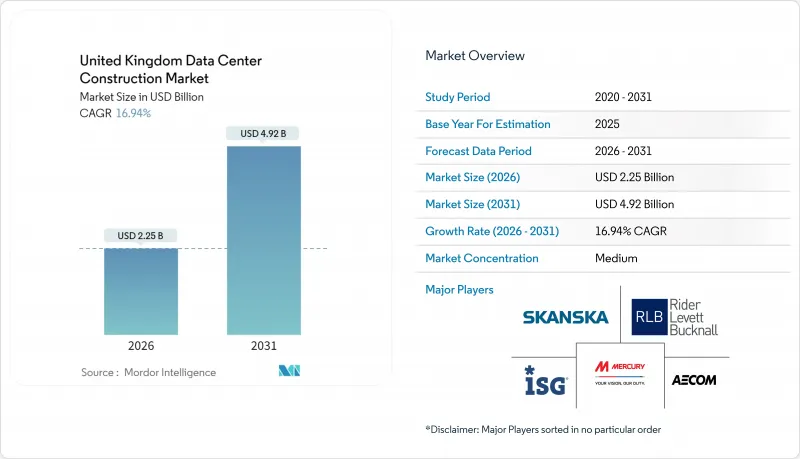
根據 Mordor Intelligence 預測,英國資料中心建設市場規模預計將在 2026 年達到 22.5 億美元,並在 2031 年擴大到 49.2 億美元,在此期間的複合年成長率將達到 16.94%。
本報告按層級(一級、二級、其他)、資料中心規模(小規模、中型、大型、超大規模)、資料中心類型(託管資料中心、超大規模資料中心業者雲端服務供應商(CSP)、企業級和邊緣資料中心)以及基礎設施(電力基礎設施、機械基礎設施、其他)進行分類。市場預測以美元計價。
英國資料中心建置市場趨勢與洞察
超大規模資料中心業者營運商的預租賃以及AI-GPU需求的激增
微軟宣布投資300億英鎊,將自有機房與長期預租協議結合,確保計畫從啟動之日起即可運作。隨後,Google宣布了一項50億英鎊(約61.2億美元)的計劃,確保其在多個園區擁有GPU密集型空間。英偉達隨後投資110億英鎊(約136億美元)用於最佳化推理處理的容量,進一步驗證了核心租戶模式的有效性。像CyrusOne這樣的開發商在恩菲爾德的建設開始前就獲得了90兆瓦的容量,從而將資金籌措成本降低了150-200個基點。政府對關鍵基礎設施的認定,透過展現監管的穩定性,鞏固了投資者的信心。
5G/6G部署將加速邊緣網路和核心網路的建置。
英國電信 (BT) 和亞馬遜雲端服務 (AWS)運作“波長區域”,將雲端運算能力整合到營運商網路中,以實現擴增實境(AR) 和自動駕駛汽車工作負載低於 10 毫秒的延遲。沃達豐與Google雲端合作,計劃到 2026 年在 15 個城市部署邊緣節點,旨在將需求擴展到傳統樞紐城市之外。泰晤士自由港的私人 5G 網路就是一個例證,它展示了產業叢集如何繞過公共營運商,建立專用邊緣基礎設施。一項 10 億英鎊的多元化基金正在津貼國內設備供應,並加快新建微型資料中心的採購週期。這些舉措正在將容量成長分散到數十個 1 至 5 兆瓦的站點,從而在全國範圍內擴大建設機會。
東南電網堵塞,132千伏線路暫時中斷。
英國國家電網系統營運商(ESO)已暫停在大倫敦地區及周邊部分郡縣接受新的132千伏輸電線路接入申請。除非開發商自行承擔昂貴的上游升級費用,否則這將導致該項目延期7至10年。此類自籌資金可能會使每個100兆瓦園區的項目預算增加1.5億英鎊(1.86億美元)。 Equinix公司為其位於赫特福德郡、耗資39億英鎊(48.4億美元)的園區選擇了一條客製化的400千伏饋線,但這一變通方案導致其原剪切機延誤了18個月。因此,開發商正將目光轉向曼徹斯特和蘇格蘭,SP Energy Networks和SSE Networks目前仍在提供三年後的輸電接取服務。
細分市場分析
預計到2025年,三級資料中心將佔總營收的57.84%,這凸顯了它們對能夠承受計畫內維護期的典型企業工作負載的適用性。英國金融行為監理局(FCA)將於2025年3月生效的營運彈性需求規定,銀行必須能夠承受基礎設施故障,這促使關鍵應用遷移到配備冗餘電源和冷卻路徑的四級資料中心。雖然四級資料中心的設計需要多投入30%至40%的資金,但由於消除了停機風險,它們對金融服務和醫療保健業者極具吸引力。預計從2026年到2031年,四級資料中心的複合年成長率將達到17.32%,超過英國整體資料中心建設市場的成長速度。
對價格敏感的託管客戶對三級資料中心的需求依然強勁。例如,Digital Realty等業者近期在其倫敦園區擴建了三級資料中心,採用N+1冗餘配置,以在保證運作和提供具有競爭力的租金之間取得平衡。隨著傳統企業資料中心逐步淘汰,一級和二級面積也持續縮小。因此,根據政府對關鍵基礎設施的政策指導方針,英國資料中心建設市場正逐步向更高冗餘度轉型,從而推動了以高階服務主導的成長趨勢。
超大規模資料中心園區裝置容量將超過 50 兆瓦,預計到 2025 年將佔總收入的 62.65%。電力利用率的提升、冷卻效率的提高以及人力資源的有效利用,將使超大規模資料中心的電力使用效率 (PUE) 低於 1.15,而小規模資料中心的 PUE 則為 1.4-1.6。 Equinix 在剪切機的擴建計劃以及 QTS 投資 100 億英鎊(124 億美元)的 Bryce 項目,都是模組化、分階段部署的典範,這種模式可以根據租戶成長的速度調整電力供應。預計超大規模資料中心市場在預測期內將以 17.43% 的複合年成長率成長,進一步鞏固其在英國資料中心建設市場的主導地位。
大型(10-50兆瓦)和中型(5-10兆瓦)資料中心既吸引了需要在附近進行運算的用戶,也吸引了預算不足以建造超大規模資料中心的本地企業。高寶資料位於曼徹斯特的30兆瓦園區就是這類資料中心的典型例子。隨著運算需求轉向通訊基礎設施,5兆瓦以下的小規模邊緣資料中心正在減少。總體而言,規模仍然是資本效率的主要預測因素,從而確保了超大規模資料中心持續的結構性優勢。
其他好處:
- Excel格式的市場預測(ME)表
- 3個月的分析師支持
目錄
第1章:引言
- 研究假設和市場定義
- 調查範圍
第2章:調查方法
第3章執行摘要
第4章 市場狀況
- 市場概覽
- 市場促進因素
- 5G/6G 的部署正在加速邊緣網路和核心網路的建置。
- 超大規模資料中心業者營運商的領先租賃以及AI-GPU需求的激增
- 政府人工智慧成長區和140億英鎊的CNI計劃
- 為資料中心提供關鍵基礎設施稅優惠
- 國家重要基礎設施快速審核系統
- 綠色能源現場小型模組化反應器試點項目
- 市場限制因素
- 東南電網堵塞,132千伏線路暫時中斷。
- 建築工地勞動力和機電成本不斷上漲
- 當地居民對水資源問題和對景觀的影響表示反對。
- 歐盟法規收緊/英國範圍3碳排放報告的合規成本
- 產業供應鏈分析
- 監理情勢
- 技術展望
- 波特五力分析
- 資料中心的關鍵統計數據
- 英國資料中心營運商列表(每兆瓦)
- 英國即將啟動的主要資料中心專案清單(2025-2030 年)
- 英國資料中心建置中的資本支出與營運支出
- 英國資料中心電力容量吸收量(兆瓦),2023 年和 2024 年
- 英國將人工智慧(AI)引入資料中心建設
- 監理與合規框架
- 宏觀經濟因素對市場的影響
第5章 市場規模與成長預測
- 層級特定
- 一級和二級
- 三級
- 第四級
- 按資料中心規模
- 小規模
- 中等的
- 大規模
- 超大規模
- 依資料中心類型
- 託管資料中心
- 超大規模資料中心業者雲端服務供應商/雲端服務供應商(CSP)
- 企業和邊緣資料中心
- 透過基礎設施
- 電力基礎設施
- 配電解決方案
- 備用電源解決方案
- 機械基礎設施
- 冷卻系統
- 機架和機櫃
- 伺服器和儲存
- 其他機械基礎設施
- 一般建築
- 服務 - 設計與諮詢、整合、支援與維護
- 電力基礎設施
第6章 競爭情勢
- 市場集中度
- 策略趨勢
- 市佔率分析
- Data Center Infrastructure Investment Based on Megawatt(MW)Capacity, 2024 vs 2030
- Data Center Construction Landscape(Key Vendors Listings)
- 公司簡介
- Skanska UK plc
- ISG Ltd
- AECOM
- Rider Levett Bucknall
- Mercury Engineering
- Mace Group
- Laing O'Rourke
- Goodman Group
- JCA Engineering
- Bouygues Energies and Services(Equans)
- 2bm Limited(Keysource Group)
- CBRE Data Centre Solutions
- Turner and Townsend plc
- Schneider Electric UK
- Kier Group
- Vinci Energies UK(Actemium)
- Fluor Ltd
- Balfour Beatty plc
- Equinix UK Services Ltd
- List of Data Center Construction Companies
第7章 市場機會與未來展望
According to Mordor Intelligence, the United Kingdom data center construction market size reached USD 2.25 billion in 2026 and is projected to climb to USD 4.92 billion by 2031, reflecting a 16.94% CAGR over the period.
This report is Segmented by Tier Type (Tier 1 and 2, and More), Data Center Size (Small, Medium, Large, and Hyperscale), Data Center Type (Colocation Data Center, Hyperscalers/Cloud Service Provider (CSPs), and Enterprise and Edge Data Center), and Infrastructure (Electrical Infrastructure, Mechanical Infrastructure, and More). The Market Forecasts are Provided in Terms of Value (USD).
United Kingdom Data Center Construction Market Trends and Insights
Hyperscaler Pre-Leasing and AI-GPU Demand Wave
Microsoft's GBP 30 billion pledge bundled owned halls with long-term pre-leases that guarantee occupancy as soon as power is switched on. Google followed with a GBP 5 billion (USD 6.12 billion) program that locks in tenant status for GPU-dense space across multiple campuses. Nvidia then committed GBP 11 billion (USD 13.6 Billion) to inference-optimized capacity, further validating the anchor-tenant model. Developers such as CyrusOne secured 90 MW in Enfield before breaking ground, compressing financing spreads by 150-200 basis points. The government's critical-infrastructure designation reinforced investor confidence by signaling regulatory stability.
5G / 6G Roll-Out Accelerates Edge and Core Build-Outs
BT and AWS activated Wavelength Zones in London and Manchester, embedding cloud compute inside carrier networks to hit sub-10 millisecond latency for augmented-reality and autonomous-vehicle workloads. Vodafone paired with Google Cloud to deploy edge nodes across 15 cities by 2026, spreading demand beyond traditional hubs. The private 5G grid at Thames Freeport shows industrial clusters bypassing public carriers for dedicated edge infrastructure. A GBP 1 billion diversification fund is subsidizing domestic equipment supply, shortening procurement cycles for new micro-data centers. These initiatives fragment capacity additions into dozens of 1-5 MW sites, extending the construction opportunity set nationwide.
Grid Congestion in South-East, 132 kV Connection Moratoriums
National Grid ESO paused new 132 kV offers in parts of Greater London and surrounding counties, creating seven-to-ten-year delays unless developers bankroll costly upstream upgrades. Project budgets can rise by GBP 150 million (USD 186 million) for a 100 MW campus under such self-funded reinforcement. Equinix chose a bespoke 400 kV feed for its GBP 3.9 billion (USD 4.84 billion) Hertfordshire campus, but the workaround added 18 months to the pre-construction timeline. Developers are therefore pivoting to Manchester and Scotland, where SP Energy Networks and SSE Networks still offer three-year energization slots.
Other drivers and restraints analyzed in the detailed report include:
- Government AI Growth Zones and £14 Billion CNI Program
- Nationally Significant Infrastructure Fast-Track Permits
- Construction-Grade Labor and MEP Cost Inflation
For complete list of drivers and restraints, kindly check the Table Of Contents.
Segment Analysis
Tier 3 sites captured 57.84% of revenue in 2025, underscoring their suitability for general enterprise workloads that tolerate planned maintenance windows. The Financial Conduct Authority's operational-resilience mandate, effective March 2025, requires banks to withstand infrastructure failures, nudging critical applications toward Tier 4 halls that duplicate every power and cooling path. Although Tier 4 designs demand 30-40% more capital, they remove downtime risk, appealing to financial services and healthcare operators. Over 2026-2031, Tier 4 is forecast to register a 17.32% CAGR, outpacing the broader United Kingdom data center construction market.
Demand for Tier 3 remains healthy among price-sensitive colocation customers. Operators such as Digital Realty recently expanded London campuses with Tier 3, N+1 redundancy to balance uptime guarantees against competitive rent. Tier 1 and Tier 2 footprints continue to shrink as legacy enterprise sites are decommissioned. The net effect is a gradual migration toward higher redundancy, aligning with government rhetoric on critical infrastructure and supporting the United Kingdom data center construction market's premium-driven growth profile.
Hyperscale campuses exceeded 50 MW and accounted for 62.65% of revenue in 2025. Power-purchase leverage, cooling economies, and labor utilization drive power usage effectiveness (PUE) below 1.15, compared with 1.4-1.6 for smaller builds. Equinix's Hertfordshire expansion and QTS's GBP 10 billion (USD 12.4 billion) Blyth plan exemplify modular phasing, allowing supply to track tenant ramps. Over the forecast period, hyperscale is expected to record a 17.43% CAGR, reinforcing its dominance in the United Kingdom data center construction market.
Large (10-50 MW) and medium (5-10 MW) facilities together attract regional enterprises that need proximate compute but lack hyperscale budgets. Kao Data's 30 MW Manchester campus typifies this cohort. Small edge sites under 5 MW are declining as compute shifts into telecom street furniture. Overall, scale remains the single-largest predictor of capital efficiency, ensuring hyperscale's structural advantage persists.
Complete Report Scope:
- By Tier Type
- Tier 1 and 2
- Tier 3
- Tier 4
- By Data Center Size
- Small
- Medium
- Large
- Hyperscale
- By Data Center Type
- Colocation Data Center
- Hyperscalers/Cloud Service Provider (CSPs)
- Enterprise and Edge Data Center
- By Infrastructure
- Electrical Infrastructure
- Power Distribution Solution
- Power Backup Solutions
- Mechanical Infrastructure
- Cooling Systems
- Racks and Cabinets
- Servers and Storage
- Other Mechanical Infrastructure
- General Construction
- Services - Design and Consulting, Integration, Support and Maintenance
- Electrical Infrastructure
List of Companies Covered in this Report:
- Skanska UK plc
- ISG Ltd
- AECOM
- Rider Levett Bucknall
- Mercury Engineering
- Mace Group
- Laing O'Rourke
- Goodman Group
- JCA Engineering
- Bouygues Energies and Services (Equans)
- 2bm Limited (Keysource Group)
- CBRE Data Centre Solutions
- Turner and Townsend plc
- Schneider Electric UK
- Kier Group
- Vinci Energies UK (Actemium)
- Fluor Ltd
- Balfour Beatty plc
- Equinix UK Services Ltd
Additional Benefits:
- The market estimate (ME) sheet in Excel format
- 3 months of analyst support
TABLE OF CONTENTS
1 INTRODUCTION
- 1.1 Study Assumptions and Market Definition
- 1.2 Scope of the Study
2 RESEARCH METHODOLOGY
3 EXECUTIVE SUMMARY
4 MARKET LANDSCAPE
- 4.1 Market Overview
- 4.2 Market Drivers
- 4.2.1 5G / 6G Roll-Out Accelerates Edge and Core Build-Outs
- 4.2.2 Hyperscaler Pre-Leasing and AI-GPU Demand Wave
- 4.2.3 Government AI Growth Zones and GBP 14 Billion CNI Programme
- 4.2.4 Data-Center-as-Critical-Infrastructure Tax Incentives
- 4.2.5 Nationally Significant Infrastructure Fast-Track Permits
- 4.2.6 On-Site Small-Modular-Reactor Pilots for Green Power
- 4.3 Market Restraints
- 4.3.1 Grid Congestion in South-East, 132 kV Connection Moratoriums
- 4.3.2 Construction-Grade Labour and MEP Cost Inflation
- 4.3.3 Local Opposition over Water and Visual Footprint
- 4.3.4 Tight EU / UK Scope-3 Carbon-Reporting Compliance Costs
- 4.4 Industry Supply-Chain Analysis
- 4.5 Regulatory Landscape
- 4.6 Technological Outlook
- 4.7 Porter's Five Forces Analysis
- 4.7.1 Bargaining Power of Suppliers
- 4.7.2 Bargaining Power of Consumers
- 4.7.3 Threat of New Entrants
- 4.7.4 Threat of Substitutes
- 4.7.5 Intensity of Competitive Rivalry
- 4.8 Key Data Center Statistics
- 4.8.1 Exhaustive Data Center Operators in United Kingdom (in MW)
- 4.8.2 List of Major Upcoming Data Center Projects in United Kingdom (2025-2030)
- 4.8.3 CAPEX and OPEX For United Kingdom Data Center Construction
- 4.8.4 Data Center Power Capacity Absorption In MW,United Kingdom, 2023 and 2024
- 4.9 Artificial Intelligence (AI) Inclusion in Data Center Construction in United Kingdom
- 4.10 Regulatory and Compliance Framework
- 4.11 Impact of Macroeconomic Factors on the Market
5 MARKET SIZE AND GROWTH FORECASTS (VALUE)
- 5.1 By Tier Type
- 5.1.1 Tier 1 and 2
- 5.1.2 Tier 3
- 5.1.3 Tier 4
- 5.2 By Data Center Size
- 5.2.1 Small
- 5.2.2 Medium
- 5.2.3 Large
- 5.2.4 Hyperscale
- 5.3 By Data Center Type
- 5.3.1 Colocation Data Center
- 5.3.2 Hyperscalers/Cloud Service Provider (CSPs)
- 5.3.3 Enterprise and Edge Data Center
- 5.4 By Infrastructure
- 5.4.1 Electrical Infrastructure
- 5.4.1.1 Power Distribution Solution
- 5.4.1.2 Power Backup Solutions
- 5.4.2 Mechanical Infrastructure
- 5.4.2.1 Cooling Systems
- 5.4.2.2 Racks and Cabinets
- 5.4.2.3 Servers and Storage
- 5.4.2.4 Other Mechanical Infrastructure
- 5.4.3 General Construction
- 5.4.4 Services - Design and Consulting, Integration, Support and Maintenance
- 5.4.1 Electrical Infrastructure
6 COMPETITIVE LANDSCAPE
- 6.1 Market Concentration
- 6.2 Strategic Moves
- 6.3 Market Share Analysis
- 6.4 Data Center Infrastructure Investment Based on Megawatt (MW) Capacity, 2024 vs 2030
- 6.5 Data Center Construction Landscape (Key Vendors Listings)
- 6.6 Company Profiles (includes Global Level Overview, Market Level Overview, Core Segments, Financials as Available, Strategic Information, Market Rank / Share for Key Companies, Products and Services, Recent Developments)
- 6.6.1 Skanska UK plc
- 6.6.2 ISG Ltd
- 6.6.3 AECOM
- 6.6.4 Rider Levett Bucknall
- 6.6.5 Mercury Engineering
- 6.6.6 Mace Group
- 6.6.7 Laing O'Rourke
- 6.6.8 Goodman Group
- 6.6.9 JCA Engineering
- 6.6.10 Bouygues Energies and Services (Equans)
- 6.6.11 2bm Limited (Keysource Group)
- 6.6.12 CBRE Data Centre Solutions
- 6.6.13 Turner and Townsend plc
- 6.6.14 Schneider Electric UK
- 6.6.15 Kier Group
- 6.6.16 Vinci Energies UK (Actemium)
- 6.6.17 Fluor Ltd
- 6.6.18 Balfour Beatty plc
- 6.6.19 Equinix UK Services Ltd
- 6.7 List of Data Center Construction Companies
7 MARKET OPPORTUNITIES AND FUTURE OUTLOOK
- 7.1 White-Space and Unmet-Need Assessment

 中東資料中心建置:市場佔有率分析、產業趨勢與統計及成長預測(2026-2032 年)亞太地區資料中心建置:市場佔有率分析、產業趨勢與統計及成長預測(2026-2031年)南美洲資料中心建置:市場佔有率分析、產業趨勢與統計及成長預測(2026-2031 年)德國資料中心建置:市場佔有率分析、產業趨勢與統計及成長預測(2026-2031 年)日本資料中心建置:市場佔有率分析、產業趨勢與統計及成長預測(2026-2032)歐洲資料中心建置:市場佔有率分析、產業趨勢與統計及成長預測(2026-2031 年)法國資料中心建置:市場佔有率分析、產業趨勢與統計及成長預測(2026-2031 年)泰國資料中心建置:市場佔有率分析、產業趨勢與統計及成長預測(2026-2031)義大利資料中心建置:市場佔有率分析、產業趨勢與統計及成長預測(2026-2031 年)越南資料中心建設:市場佔有率分析、產業趨勢與統計及成長預測(2026-2031年)