

 |
市場調查報告書
商品編碼
2125392
印尼汽車租賃市場:市場佔有率分析、產業趨勢與統計及成長預測(2026-2031)Indonesia Car Rental - Market Share Analysis, Industry Trends & Statistics, Growth Forecasts (2026 - 2031) |
||||||

※ 本網頁內容可能與最新版本有所差異。詳細情況請與我們聯繫。
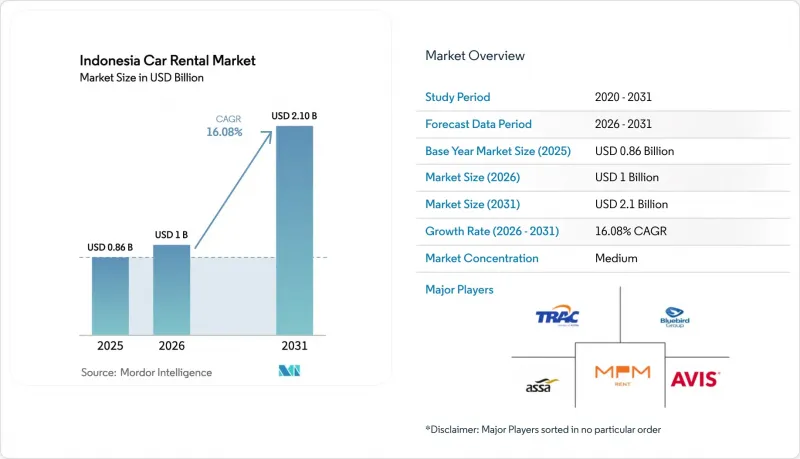
根據 Mordor Intelligence 估計,印尼汽車租賃市場到 2026 年的價值將達到 10 億美元,高於 2025 年的 8.6 億美元,預計到 2031 年將達到 21 億美元。
預計從 2026 年到 2031 年,其複合年成長率將達到 16.08%。
本報告按預訂類型(線上和線下)、租賃期限(短期、中期、長期)、用途(旅遊/休閒、日常通勤、其他)、車輛類型(經濟型/掀背車、其他)、燃料類型(內燃機-汽油、內燃機-柴油、其他)、最終用戶(企業和個人)、租賃管道和地區進行細分。市場預測以美元計價。
印尼汽車租賃市場趨勢與洞察
國際和國內遊客數量不斷增加
2024年,印尼接待了約1,390萬國際遊客,國內旅遊人數超過10億人次,旅遊業在邊境限制放寬後迅速復甦。旅遊部預測,在落地簽政策擴大和「十大新峇裡島」大規模資本投資增加了座位容量,並使客流來源不再局限於爪哇島。世界旅遊及旅行理事會(WTTC)預測,2025年旅遊業將佔印尼國內生產毛額(GDP)的4.6%。遊客群體的擴大直接推動了對租車和包車旅遊的需求,尤其是在公共交通不便的島嶼上。
數位優先預訂平台的激增
預計到2024年,印尼數位經濟規模將達到900億美元,這主要得益於電子商務交易的激增,並且預計這一成長勢頭還將持續。線上租車預訂將在2024年佔據所有交易的很大一部分,並隨著消費者轉向提供即時價格比較、無現金支付和會員獎勵等功能的超級應用程式而實現顯著成長。像Blue Bird Taxi和Gojek這樣的合作模式,能夠協助現有車輛業者拓展全國基本客群,同時降低獲客成本。聚合平台正在利用豐富的數據來最佳化動態定價、提高車輛運轉率,並即時提升銷售保險和輔助服務。
共享旅遊超級應用程式正在蠶食短租市場。
2024年,Grab和Gojek在印尼提供了大量的隨選旅遊服務。如果Grab與GoTo的合作提案得以實現,將配送、支付和共乘整合到統一的錢包中,則有望進一步增強網路效應。都市區消費者更傾向於選擇上門共乘服務,而非自駕租車,以避免堵塞費和停車位短缺的問題。商務旅客也透過費用管理平台預訂共乘服務,繞過傳統的機場接送櫃檯。為了保持競爭力,租車公司正在探索按小時計費的方案、與航空公司合作推出常旅客計劃,並推出高階SUV車型,以滿足那些不易被應用程式同質化的小眾市場需求。
細分市場分析
預計到2025年,線上通路將佔印尼租車市場收入的68.84%,年複合成長率達16.85%。這一主導地位反映了智慧型手機的高普及率、無現金支付的蓬勃發展以及消費者對整合旅行規劃、地圖和電子錢包等功能的超級應用程式的親和性。儘管到2025年,印尼線下旅行社櫃檯的租車市場規模仍將保持可觀的收入,但隨著小規模業者開始在聚合平台上發布車輛資訊以吸引價格敏感型遊客,其市場佔有率正在下降。
超級應用生態系統整合了叫車、外送和數位銀行服務,促進了每日租車套餐的交叉銷售。現有品牌正在部署基於雲端的預訂引擎、推播通知折扣和人工智慧客服聊天機器人,以提供與技術平台相媲美的用戶體驗。線上資料收集能夠按國籍、旅行目的和消費水準進行用戶細分,使營運商能夠透過里程限制和Wi-Fi路由器捆綁銷售的A/B測試來創造額外收入。
受旅遊旺季需求的推動,短期租賃(指租期1至30天)預計在2025年將佔印尼汽車租賃市場57.88%的佔有率。長期租賃合約預計也將在2025年成為印尼汽車租賃市場的重要收入來源,年複合成長率將達到17.12%。各公司正採用經營性租賃的方式來節省資金並將維護責任轉移給服務供應商。
長期租賃方案通常包含駕駛人薪資、定期維護和全面保險,使客戶免受殘值波動的影響。車隊管理人員利用遠端資訊處理技術監控油耗和預防性維護,從而減少停機時間。這一趨勢也二手二手車處置方式,車齡3-5年的車輛會被競標或出售給叫車司機,比私人轉售更快收回資金。
預計到2025年,旅遊業將佔印尼總收入的63.74%,而商務出行預計將以17.62%的複合年成長率成長,成為下一個成長引擎。印尼的投資合格評級和快速的許可證核准流程正在促進跨國公司的遷址,從而增加了對高階主管用車、專案現場接送服務以及外籍員工家屬交通的需求。工廠工人的日常通勤套餐和業務流程外包(BPO)員工的共乘服務需求也不斷成長。
旅遊相關預訂主要集中在峇裡島、日惹和龍目島,這些地區提供包含行程規劃和多語言GPS導航的自駕遊套裝行程。租車公司正利用印尼群島的地理特徵和尚不發達的城際列車,提供機場接送、快速SIM卡辦理和24小時道路救援系統等客製化服務。同時,企業合約正在幫助租車公司實現收入來源多元化,緩解季節性波動,並實現可預測的車輛運轉率。
其他好處:
- Excel格式的市場預測(ME)表
- 3個月的分析師支持
目錄
第1章:引言
- 研究假設和市場定義
- 調查範圍
第2章:調查方法
第3章執行摘要
第4章 市場狀況
- 市場概覽
- 市場促進因素
- 來自日本國內外的遊客數量均增加。
- 「數位化優先」預訂平台的激增
- 企業對長期經營租賃的需求日益成長
- 政府的電動車發展藍圖正在加速車輛電氣化。
- 符合清真標準的旅遊套餐正在重振小眾租賃市場。
- 區域機場連通性的快速擴展
- 市場限制因素
- 叫車超級應用正在顛覆短期租賃市場。
- 現有企業間價格主導競爭加劇
- 都市區的交通堵塞和停車位不足阻礙了自動駕駛技術的廣泛應用。
- 區域許可製度的碎片化以及稅收合規負擔
- 價值供應鏈分析
- 監理情勢
- 技術展望
- 波特五力模型
第5章 市場規模與成長預測
- 按預訂類型
- 線上
- 離線
- 租賃期
- 短期(30天或更短)
- 中期(1-12個月)
- 長期(12個月或以上)
- 透過使用
- 旅遊休閒
- 日常通勤
- 企業用車/商務旅遊
- 機場接送
- 車輛類型
- 經濟型/掀背車
- 多用途汽車(MPV)
- 運動型多用途車(SUV)
- 豪華/行政
- 按燃料類型
- 內燃機(ICE)- 汽油
- 內燃機柴油
- 油電混合
- 電池式電動車(BEV)
- 最終用戶
- 公司
- 個人
- 租賃頻道
- 聚合平台
- 直接出租給消費者(租賃公司)
- 超應用程式捆綁包
- 按地區
- Java
- 雅加達大都會圈(Jabodetabek)
- 西爪哇(不包括雅加達)
- 中爪哇和東爪哇
- 峇裡島和努沙登加拉
- 蘇門答臘
- 加里曼丹
- 蘇拉威西
- 巴布亞和馬魯古群島
- Java
第6章 競爭情勢
- 市場集中度
- 策略趨勢
- 市佔率分析
- 公司簡介
- Blue Bird Group
- TRAC Astra Rent A Car
- Adi Sarana Armada(ASSA Rent)
- Mitra Pinasthika Mustika Rent
- The Hertz Corporation
- Avis Budget Group
- Europcar Indonesia
- Indorent(PT Indomobil Multi Jasa)
- Globe Rent a Car
- Otomo
- Grab Rentals
- GoCar Rental(Gojek)
- DOcar
- Movic
- Easyrent
- Tiket.com Car Rental
- Traveloka Car Rental
第7章 市場機會與未來展望
According to Mordor Intelligence, the indonesian car rental market size in 2026 is estimated at USD 1.0 billion, growing from 2025 value of USD 0.86 billion with 2031 projections showing USD 2.1 billion, growing at 16.08% CAGR over 2026-2031.
This report is Segmented by Booking Type (Online and Offline), Rental Duration (Short-Term, Medium-Term and Long-Term), Application (Tourism and Leisure, Daily Commuting, and More), Vehicle Type (Economy/Hatchback and More), Fuel Type (ICE-Petrol, ICE-Diesel, and More), End-User (Corporate and Individual), Rental Channel, and Region. The Market Forecasts are Provided in Terms of Value (USD).
Indonesia Car Rental Market Trends and Insights
Rising International and Domestic Tourist Arrivals
In 2024, Indonesia welcomed around 13.9 million international visitors and recorded over 1 billion domestic journeys, marking a swift rebound in its tourism sector following the easing of border restrictions. The Ministry of Tourism projects inbound visitors will rise to between 14.6 and 16 million in 2025, supported by visa-on-arrival expansion and marketing of the "10 New Balis" destinations. Significant capital investment in Komodo, Lombok, and other regional airports increases seat capacity and disperses travel flows beyond Java. The World Travel & Tourism Council projects the sector will contribute 4.6% to GDP in 2025. A larger tourist base directly lifts self-drive rentals and chauffeured packages, particularly in islands where public transport is limited.
Surge in Digital-First Booking Platforms
In 2024, Indonesia's digital economy hit the USD 90 billion mark, buoyed by a surge in e-commerce transactions, with projections indicating further growth. Online rental bookings accounted for a substantial share of the overall transactions in 2024 and are growing significantly annually as consumers gravitate to super-apps offering instant price comparison, cashless payments, and loyalty rewards. Partnerships like Blue Bird taxis integrating with Gojek allow legacy fleets to unlock a nationwide customer base while cutting acquisition costs. Aggregators use rich data to fine-tune dynamic pricing, optimize fleet utilization, and upsell insurance or ancillary services in real time.
Ride-Hailing Super-Apps Cannibalizing Short-Term Rentals
Grab and Gojek processed a significant number of on-demand rides in Indonesia during 2024. A proposed Grab-GoTo tie-up could deepen network effects, bundling deliveries, payments, and ride-sharing into a single wallet. Urban consumers prefer door-to-door rides over self-drive rentals to avoid congestion fees and parking scarcity. Corporate travelers also book ride-hailing through expense-management dashboards, bypassing traditional airport pickup counters. To stay relevant, rental firms are exploring hourly packages, loyalty linkage with airlines, and premium SUVs to serve niches less exposed to app-based commoditization.
Other drivers and restraints analyzed in the detailed report include:
- Growing Corporate Demand for Long-Term Operational Leasing
- Government EV Roadmap Accelerating Fleet Electrification
- Intensifying Price-Led Competition Among Incumbents
For complete list of drivers and restraints, kindly check the Table Of Contents.
Segment Analysis
Online channels generated 68.84% of the Indonesian car rental market revenue in 2025, climbing at a 16.85% CAGR. The dominance reflects deep smartphone penetration, a cashless payment boom, and consumer comfort with super-apps integrating trip planning, mapping, and digital wallets. Indonesia's car rental market size, attributed to offline travel-agency counters, remained at significant revenue in 2025 but is losing share as small operators list fleets on aggregator portals to reach price-sensitive tourists.
Super-app ecosystems combine ride-hailing, food delivery, and digital banking, encouraging cross-selling day-long rental packages. Legacy brands adopt cloud-based reservation engines, push-notification discounts, and AI-enabled customer-service chatbots to match the user experience of tech platforms. Data captured online allows segmentation by nationality, trip purpose, and spend, enabling operators to A/B test mileage caps or bundle Wi-Fi routers for incremental revenue.
Short-term bookings, defined as rentals lasting 1-30 days, held a 57.88% share in the Indonesian car rental market in 2025 due to seasonal tourism peaks. Long-term contracts surpassed the noteworthy revenue i the Indonesian car rental market in 2025 and are projected to expand at a 17.12% CAGR. Corporations adopt operating leases to preserve capital and shift maintenance responsibilities to service providers.
Long-term packages typically include driver salaries, periodic servicing, and full insurance, insulating clients from residual-value swings. Fleet managers deploy telematics to monitor fuel consumption and preventive maintenance, reducing downtime. The trend also anchors used-vehicle disposal channels, where cars aged three to five years are auctioned or sold to ride-hailing drivers, recouping capital faster than private resales.
Tourism accounted for 63.74% of revenue in 2025; however, business mobility is on course to become the next growth engine, expanding at an 17.62% CAGR. Indonesia's investment-grade rating and quick licensing approvals spur multinational relocations, raising demand for executive transfers, project-site shuttles, and expatriate family transport. Daily commuting packages for factory staff and shared vans for BPO workers also widen addressable volumes.
Tourism bookings concentrate in Bali, Yogyakarta, and Lombok, where self-drive packages include itinerary curation and GPS navigation in multiple languages. Car rental firms tailor airport meet-and-greet services, fast-track SIM card kits, and 24/7 roadside assistance, leveraging Indonesia's archipelagic geography and limited inter-city rail. In parallel, corporate contracts diversify income, cushioning seasonality and yielding predictable fleet-utilization ratios.
Complete Report Scope:
- By Booking Type
- Online
- Offline
- By Rental Duration
- Short-term (Less than/Equals 30 days)
- Medium-term (1 to 12 months)
- Long-term (Above 12 months)
- By Application
- Tourism and Leisure
- Daily Commuting
- Corporate Fleet / Business Mobility
- Airport Transfer
- By Vehicle Type
- Economy / Hatchback
- Multi-Purpose Vehicle (MPV)
- Sports Utility Vehicle (SUV)
- Luxury / Executive
- By Fuel Type
- ICE - Petrol
- ICE - Diesel
- Hybrid-Electric
- Battery-Electric (BEV)
- By End-user
- Corporate
- Individual
- By Rental Channel
- Aggregator Platforms
- Direct-to-Consumer (Rental Co.)
- Super-App-Based Bundles
- By Region
- Java
- Greater Jakarta (Jabodetabek)
- West Java (ex-Jakarta)
- Central and East Java
- Bali and Nusa Tenggara
- Sumatra
- Kalimantan
- Sulawesi
- Papua and Maluku
- Java
List of Companies Covered in this Report:
- Blue Bird Group
- TRAC Astra Rent A Car
- Adi Sarana Armada (ASSA Rent)
- Mitra Pinasthika Mustika Rent
- The Hertz Corporation
- Avis Budget Group
- Europcar Indonesia
- Indorent (PT Indomobil Multi Jasa)
- Globe Rent a Car
- Otomo
- Grab Rentals
- GoCar Rental (Gojek)
- DOcar
- Movic
- Easyrent
- Tiket.com Car Rental
- Traveloka Car Rental
Additional Benefits:
- The market estimate (ME) sheet in Excel format
- 3 months of analyst support
TABLE OF CONTENTS
1 Introduction
- 1.1 Study Assumptions & Market Definition
- 1.2 Scope of the Study
2 Research Methodology
3 Executive Summary
4 Market Landscape
- 4.1 Market Overview
- 4.2 Market Drivers
- 4.2.1 Rising International and Domestic Tourist Arrivals
- 4.2.2 Surge in Digital-First Booking Platforms
- 4.2.3 Growing Corporate Demand for Long-Term Operational Leasing
- 4.2.4 Government EV Roadmap Accelerating Fleet Electrification
- 4.2.5 Halal-Friendly Tourism Packages Boosting Niche Rentals
- 4.2.6 Rapid Expansion of Secondary-Airport Connectivity
- 4.3 Market Restraints
- 4.3.1 Ride-Hailing Super-Apps Cannibalizing Short-Term Rentals
- 4.3.2 Intensifying Price-Led Competition Among Incumbents
- 4.3.3 Urban Congestion and Parking Scarcity Deterring Self-Drive
- 4.3.4 Fragmented Regional Licensing and Tax Compliance Burden
- 4.4 Value / Supply-Chain Analysis
- 4.5 Regulatory Landscape
- 4.6 Technological Outlook
- 4.7 Porter's Five Forces
- 4.7.1 Bargaining Power of Suppliers
- 4.7.2 Bargaining Power of Buyers/Consumers
- 4.7.3 Threat of New Entrants
- 4.7.4 Threat of Substitute Products
- 4.7.5 Intensity of Competitive Rivalry
5 Market Size & Growth Forecasts (Value, USD)
- 5.1 By Booking Type
- 5.1.1 Online
- 5.1.2 Offline
- 5.2 By Rental Duration
- 5.2.1 Short-term (Less than/Equals 30 days)
- 5.2.2 Medium-term (1 to 12 months)
- 5.2.3 Long-term (Above 12 months)
- 5.3 By Application
- 5.3.1 Tourism and Leisure
- 5.3.2 Daily Commuting
- 5.3.3 Corporate Fleet / Business Mobility
- 5.3.4 Airport Transfer
- 5.4 By Vehicle Type
- 5.4.1 Economy / Hatchback
- 5.4.2 Multi-Purpose Vehicle (MPV)
- 5.4.3 Sports Utility Vehicle (SUV)
- 5.4.4 Luxury / Executive
- 5.5 By Fuel Type
- 5.5.1 ICE - Petrol
- 5.5.2 ICE - Diesel
- 5.5.3 Hybrid-Electric
- 5.5.4 Battery-Electric (BEV)
- 5.6 By End-user
- 5.6.1 Corporate
- 5.6.2 Individual
- 5.7 By Rental Channel
- 5.7.1 Aggregator Platforms
- 5.7.2 Direct-to-Consumer (Rental Co.)
- 5.7.3 Super-App-Based Bundles
- 5.8 By Region
- 5.8.1 Java
- 5.8.1.1 Greater Jakarta (Jabodetabek)
- 5.8.1.2 West Java (ex-Jakarta)
- 5.8.1.3 Central and East Java
- 5.8.2 Bali and Nusa Tenggara
- 5.8.3 Sumatra
- 5.8.4 Kalimantan
- 5.8.5 Sulawesi
- 5.8.6 Papua and Maluku
- 5.8.1 Java
6 Competitive Landscape
- 6.1 Market Concentration
- 6.2 Strategic Moves
- 6.3 Market Share Analysis
- 6.4 Company Profiles (includes Global Level Overview, Market Level Overview, Core Segments, Financials as Available, Strategic Information, Market Rank/Share for Key Companies, Products and Services, SWOT Analysis, and Recent Developments)
- 6.4.1 Blue Bird Group
- 6.4.2 TRAC Astra Rent A Car
- 6.4.3 Adi Sarana Armada (ASSA Rent)
- 6.4.4 Mitra Pinasthika Mustika Rent
- 6.4.5 The Hertz Corporation
- 6.4.6 Avis Budget Group
- 6.4.7 Europcar Indonesia
- 6.4.8 Indorent (PT Indomobil Multi Jasa)
- 6.4.9 Globe Rent a Car
- 6.4.10 Otomo
- 6.4.11 Grab Rentals
- 6.4.12 GoCar Rental (Gojek)
- 6.4.13 DOcar
- 6.4.14 Movic
- 6.4.15 Easyrent
- 6.4.16 Tiket.com Car Rental
- 6.4.17 Traveloka Car Rental
7 Market Opportunities & Future Outlook
- 7.1 White-space & Unmet-Need Assessment

 印度汽車租賃市場:市場佔有率分析、產業趨勢與統計及成長預測(2026-2031)汽車租賃:市場佔有率分析、產業趨勢與統計及成長預測(2026-2031)北美汽車租賃:市場佔有率分析、產業趨勢與統計及成長預測(2026-2031 年)新加坡汽車租賃:市場佔有率分析、產業趨勢與統計及成長預測(2026-2031)法國汽車租賃市場:市場佔有率分析、產業趨勢與統計及成長預測(2026-2031)泰國汽車租賃市場:市場佔有率分析、產業趨勢與統計及成長預測(2026-2031)英國汽車租賃:市場佔有率分析、產業趨勢與統計及成長預測(2026-2031)馬來西亞汽車租賃市場:市場佔有率分析、產業趨勢與統計及成長預測(2026-2031)印度電動自行車租賃:市場佔有率分析、產業趨勢與統計及成長預測(2026-2031)東協汽車租賃市場:市場佔有率分析、產業趨勢與統計及成長預測(2026-2031)