


 |
市場調查報告書
商品編碼
2116664
新加坡汽車租賃:市場佔有率分析、產業趨勢與統計及成長預測(2026-2031)Singapore Car Rental - Market Share Analysis, Industry Trends & Statistics, Growth Forecasts (2026 - 2031) |
||||||

※ 本網頁內容可能與最新版本有所差異。詳細情況請與我們聯繫。
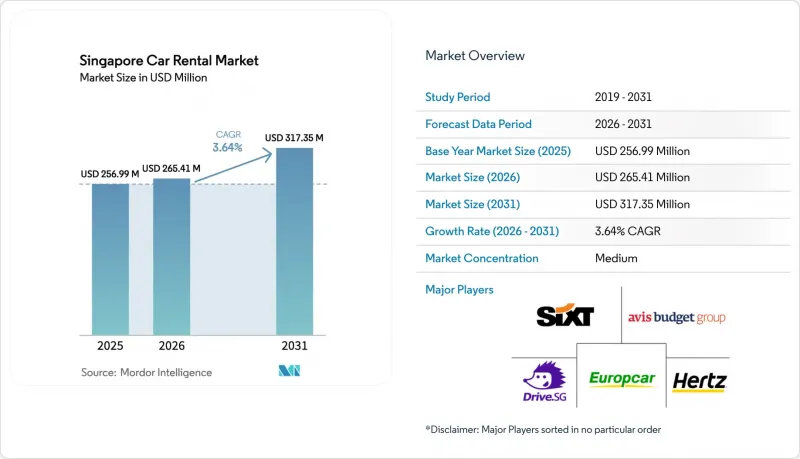
根據 Mordor Intelligence 的數據,新加坡汽車租賃市場在 2025 年的價值為 2.5699 億美元,預計到 2031 年將達到 3.1735 億美元,而 2026 年為 2.6541 億美元,預測期(2026-2031 年)的複合年成長率為 3.4%。
本報告按車輛類型(低成本、高成本、其他)、預訂管道(線上、線下)、租賃期限(短期、長期)、用途(旅遊、日常通勤)、動力傳動系統類型(內燃機、混合動力、電動車)和最終用戶(個人、企業)進行細分。市場預測以美元計價。
新加坡汽車租賃市場趨勢及洞察
擁車證溢價不斷上漲,使得擁有私家車變得更加困難。
A類擁車證(COE)溢價大幅上漲,導致小型轎車的總預融資成本居高不下。儘管陸路交通管理局(LTA)宣布增加配額,但價格仍遠高於疫情前水準。一些家庭因經濟原因難以負擔汽車,已連續數週預訂經濟型轎車用於週末出行,這表明人們的出行預算正在發生結構性調整。富裕買家轉向B類車輛進一步推高了入門級轎車的租賃需求,因為租賃公司正將目光投向潛在客戶群最廣泛的群體。鑑於人們的出行方式正持續向變動成本模式轉變,即使擁車證價格略有下降,也不太可能立即促使消費者重新選擇完全擁有車輛。
旅遊業復甦及入境遊客數量
2024年,入境旅客人數達到1,650萬人次,年增21.5%,旅遊收入總合298億新元(約221億美元)。在旅遊旺季,機場租車業者的車輛運轉率較淡季顯著提升。經濟型車輛的預訂主要來自印尼、馬來西亞和中國的遊客。然而,一個值得關注的趨勢正在顯現:來自印度和中東的租車用戶對高階SUV表現出越來越濃厚的興趣,甚至願意支付額外費用跨境駕駛至馬來西亞。同時,車主們透過點對點(P2P)平台出租他們在海外逗留期間閒置的私家車,在無需運營商投入任何資金的情況下增加了車輛供應。受休閒入境推動的週末和假日用車需求穩定成長的支撐,新加坡租車市場前景依然樂觀。
租車保險費飆升。
儘管汽車保險的淨保費收入不斷成長,但承保虧損也在顯著擴大。租車續保報價遠高於以往,標準保險的免賠額也有所提高。為了降低風險,Avis 對零免賠額和部分保險選項收取每日費用,這可能會大幅增加客戶的每週支出。負責處理與第三方汽車相關糾紛的 FIDReC 擴大了權限,這雖然減輕了部分營運商的負擔,但也延長了結算週期,並佔用了營運商的資金。議價能力有限的小規模租車業者正面臨利潤率下降的壓力,這阻礙了新進業者進入市場。
細分市場分析
預計到2025年,經濟型汽車將佔新加坡汽車租賃市場佔有率的40.21%,到2031年複合年成長率將達到6.27%,這表明成本績效的需求仍然是汽車使用的基礎。隨著營運商將電動車補貼優惠擴大到七人座車型,新加坡的SUV租賃市場也呈現成長跡象。 Eurocars Leasing公司對其數位平台進行了升級,允許客戶在預訂過程中根據車輛供應情況,將馬自達3更換為保時捷卡宴。 GetGo公司持續引進掀背車以最佳化各門市的停車位,同時透過引進特斯拉Model 3進行試駕,檢驗市場對高階電動車的需求。 Hertz公司與特斯拉達成的全球協議正在推動特斯拉汽車被納入本地車隊,而陸路交通管理局(LTA)的清潔能源政策預計將進一步改變車輛組成。
業者註意到,假日期間經濟艙到高級艙的交叉預訂量增加,顯示追加提升銷售有潛在收益。然而,隨著純電動車殘值趨於穩定,且維修成本較內燃機汽車下降,利潤率差距正在縮小。預計車隊管理人員將專注於符合監管、成本和客戶體驗標準的中價位電動轎車。
預計到2025年,線上通路的營收佔比將超過73.29%,到2031年將以8.24%的複合年成長率成長。這一轉變反映出消費者對基本契約、即時定價和無鑰匙進入服務的接受度不斷提高。 GetGo採用純行動端模式,取消了櫃檯人員和紙本文件,並已累積了龐大的用戶群。 Europcar利用高意圖流量,將租車服務整合到新加坡航空的KrisFlyer預訂流程中,讓顧客每次休閒消費都能賺取哩程。然而,對於尋求臨時預訂和個人化服務的客戶而言,線下管道仍然至關重要。 Sixt旗下的myDriver已與國泰航空合作,為該航空公司的高階客戶提供專車接送服務,並將高價值客戶直接引導至Sixt平台。
每個營運商都面臨著來自數位化搜尋工具日益成長的壓力,迫使他們在精簡成本結構和透過靈活的取車地點及配套服務實現差異化之間做出選擇。與 SAP Concur 和 Navan 的 API 整合使自動費用報告成為現實,並擴大了與企業客戶的互動。隨著基於距離的收費系統日益普及,將即時基於距離的定價整合到預訂應用程式中有望進一步提升數位化管道的吸引力。
其他好處
- Excel格式的市場預測(ME)表
- 3個月的分析師支持
目錄
第1章:引言
- 研究假設和市場定義
- 調查範圍
第2章:調查方法
第3章執行摘要
第4章 市場狀況
- 市場概覽
- 市場促進因素
- 擁車證溢價不斷上漲,使得擁有私家車變得更加困難。
- 旅遊業復甦及入境遊客數量
- 企業對靈活出行解決方案的需求
- 政府對電動車租賃的獎勵措施(車輛租賃補貼、稅收回饋)
- 訂閱式和P2P租賃平台的成長
- 透過人工智慧驅動的車輛營運最佳化降低營運成本。
- 市場限制因素
- 因保證金糾紛導致信任危機
- 高昂的ERP徵收堵塞費導致租賃利用率下降。
- 租車保險費飆升。
- 夜間公共電動車充電樁短缺
- 價值供應鏈分析
- 監理情勢
- 技術展望(與互聯駕駛和自動駕駛相關的其他功能)
- 波特五力模型
第5章 市場規模與成長預測
- 按車輛類型
- 低價
- 高價
- 價格極高
- 運動型多用途車(SUV)/多用途車(MPV)
- 透過預訂管道
- 線上
- 離線
- 租賃期
- 短期(30天或更短)
- 長期(超過30天)
- 透過使用
- 觀光
- 一般通勤
- 依動力傳動系統類型
- 內燃機(ICE)
- 混合
- 電動車(EV)
- 最終用戶
- 個人
- 公司
第6章 競爭情勢
- 市場集中度
- 策略趨勢(併購、汽車電氣化、技術合作)
- 市佔率分析
- 公司簡介
- Avis Budget Group
- Hertz Corporation
- Sixt SE
- Europcar Mobility Group
- GetGo Technologies Pte Ltd
- Car Club Pte Ltd(TribeCar)
- Drive.SG Pte Ltd
- AKA Car Rental
- Ride Now
- Motorist Pte Ltd
第7章 市場機會與未來展望
According to Mordor Intelligence, the Singapore car rental market size was valued at USD 256.99 million in 2025 and estimated to grow from USD 265.41 million in 2026 to reach USD 317.35 million by 2031, at a CAGR of 3.64% during the forecast period (2026-2031).
This report is Segmented by Vehicle Type (Economy, Premium, and More), Booking Channel (Online and Offline), Rental Duration (Short-Term and Long-Term), Application (Tourism and General Commuting), Powertrain Type (Internal Combustion Engine (ICE), Hybrid, and Electric Vehicle ), and End-User (Individual and Corporate). The Market Forecasts are Provided in Terms of Value (USD).
Singapore Car Rental Market Trends and Insights
Rising COE Premiums Pricing Out Ownership
Category A Certificate of Entitlement (COE) premiums have risen significantly, pushing the all-in cost of a compact sedan to a high level before financing. Despite the Land Transport Authority (LTA) releasing additional quotas, prices remain well above pre-pandemic levels . Households priced out of ownership are reserving economy cars for weekends several weeks in advance, indicating a structural reset in mobility budgeting. Affluent buyers migrating to Category B vehicles further amplify rental demand for entry-level sedans because fleet operators focus on segments with the widest addressable base. The shift toward variable-cost mobility suggests that a mild COE retreat will not immediately prompt consumers to revert to outright ownership.
Tourism Rebound and Inbound Arrivals
International arrivals reached 16.5 million in 2024, a 21.5% increase year-over-year, while tourism receipts totaled SGD 29.8 billion (USD 22.1 billion) . During holiday peaks, airport-based rental operators experienced a significant increase in utilization rates compared to off-peak months. Economy-class bookings are predominantly led by visitors hailing from Indonesia, Malaysia, and China. However, there is a noticeable trend: renters from India and the Middle East are increasingly gravitating toward premium sport-utility vehicles (SUVs), even willingly paying a cross-border surcharge for drives into Malaysia. Meanwhile, peer-to-peer hosts are capitalizing on their idle cars, listing them while abroad, which in turn amplifies fleet supply without any capital expenditure from operators. The outlook for the Singapore car rental market remains optimistic, buoyed by steady weekend and holiday utilization driven by inbound leisure travel.
Spiking Insurance Premiums for Rental Fleets
Motor gross written premiums have increased, while underwriting losses have significantly risen. Renewal quotes for rental fleets are notably higher than previous levels, and deductibles on standard policies have also increased . To mitigate exposure, Avis imposes daily charges for zero-deductible waivers and partial options, which can substantially raise weekly expenses for customers. FIDReC's expanded remit to handle third-party motor disputes offers a means of redress but also prolongs settlement timelines, tying up operators' cash. Small fleets, with limited bargaining power, are facing compressed margins, which is slowing the entry of new players into the market.
Other drivers and restraints analyzed in the detailed report include:
- Government EV-Rental Incentives Drive Electrification
- AI-Driven Fleet Optimization Lowering Operator Costs
- Scarcity of Overnight Public EV Chargers
For complete list of drivers and restraints, kindly check the Table Of Contents.
Segment Analysis
The economy category accounted for 40.21% of the Singapore car rental market share in 2025 and is on track to post a 6.27% CAGR through 2031, demonstrating that value-oriented demand remains the backbone of fleet utilization. As operators cascade EV rebates into seven-seater models, the Singapore car rental market for SUVs is poised for growth. Eurokars Leasing revamped its digital platform, allowing customers to switch from a Mazda 3 to a Porsche Cayenne mid-booking, contingent on availability. While GetGo continues to use hatchbacks to optimize parking across its sites, its pilot of Tesla Model 3 units tests the market's appetite for premium EVs. Hertz's global deal for Tesla vehicles is now seeding the local fleet, and the LTA's cleaner-energy mandate is poised to reshape the vehicle mix.
Operators note an uptick in cross-booking from economy to premium tiers during holidays, hinting at potential upsell revenue. However, as battery EV residuals stabilize and their servicing costs drop compared to combustion engines, the margin gap tightens. Fleet managers are expected to shift their focus towards mid-priced EV sedans that align with regulatory, cost, and consumer experience benchmarks.
Online channels captured more than 73.29% of 2025 revenue and are on track for an 8.24% CAGR to 2031. The shift reflects consumer comfort with app-based contracts, real-time pricing, and keyless entry. GetGo, which leverages a mobile-only approach that eliminates counter staff and paper forms, has amassed a significant subscriber base. Europcar, capitalizing on high-intent traffic, embedded rental offers into Singapore Airlines' KrisFlyer booking path, earning miles for each leisure transaction. However, offline channels remain vital for those seeking last-minute or personalized services. Sixt's myDriver, in collaboration with Cathay Pacific, offers chauffeur services to the airline's premium clientele, steering high-value clients straight to Sixt.
Operators face mounting pressure from digital price-discovery tools, prompting them to either tighten their cost structures or differentiate themselves with flexible pickup points and bundled services. With API integrations into SAP Concur and Navan, automatic expense reconciliation is now a reality, broadening corporate engagement. As the rollout of distance-based charging progresses, the integration of real-time trip pricing in booking apps is set to bolster the appeal of digital channels.
Complete Report Scope:
- By Vehicle Type
- Economy
- Premium
- Luxury
- Sport Utility Vehicle and Multi-Purpose Vehicle
- By Booking Channel
- Online
- Offline
- By Rental Duration
- Short-term (Less Than 30 days)
- Long-term (More Than 30 days)
- By Application
- Tourism
- General Commuting
- By Powertrain Type
- Internal Combustion Engine (ICE)
- Hybrid
- Electric Vehicle (EV)
- By End User
- Individual
- Corporate
List of Companies Covered in this Report:
- Avis Budget Group
- Hertz Corporation
- Sixt SE
- Europcar Mobility Group
- GetGo Technologies Pte Ltd
- Car Club Pte Ltd (TribeCar)
- Drive.SG Pte Ltd
- AKA Car Rental
- Ride Now
- Motorist Pte Ltd
Additional Benefits:
- The market estimate (ME) sheet in Excel format
- 3 months of analyst support
TABLE OF CONTENTS
1 Introduction
- 1.1 Study Assumptions and Market Definition
- 1.2 Scope of the Study
2 Research Methodology
3 Executive Summary
4 Market Landscape
- 4.1 Market Overview
- 4.2 Market Drivers
- 4.2.1 Rising COE Premiums Pricing Out Ownership
- 4.2.2 Tourism Rebound and Inbound Arrivals
- 4.2.3 Corporate Demand for Flexible Mobility Solutions
- 4.2.4 Government EV-Rental Incentives (CVES, Tax Rebates)
- 4.2.5 Growth of Subscription and Peer-To-Peer Rental Platforms
- 4.2.6 AI-Driven Fleet Optimization Lowering Operator Costs
- 4.3 Market Restraints
- 4.3.1 Security-Deposit Disputes Eroding Trust
- 4.3.2 High ERP Congestion Charges Dampen Rental Utilization
- 4.3.3 Spiking Insurance Premiums for Rental Fleets
- 4.3.4 Scarcity of Overnight Public EV Chargers
- 4.4 Value / Supply-Chain Analysis
- 4.5 Regulatory Landscape
- 4.6 Technological Outlook (connected and autonomous add-ons)
- 4.7 Porter's Five Forces
- 4.7.1 Threat of New Entrants
- 4.7.2 Bargaining Power of Buyers/Consumers
- 4.7.3 Bargaining Power of Suppliers
- 4.7.4 Threat of Substitute Products/Services
- 4.7.5 Intensity of Competitive Rivalry
5 Market Size and Growth Forecasts (Value, USD)
- 5.1 By Vehicle Type
- 5.1.1 Economy
- 5.1.2 Premium
- 5.1.3 Luxury
- 5.1.4 Sport Utility Vehicle and Multi-Purpose Vehicle
- 5.2 By Booking Channel
- 5.2.1 Online
- 5.2.2 Offline
- 5.3 By Rental Duration
- 5.3.1 Short-term (Less Than 30 days)
- 5.3.2 Long-term (More Than 30 days)
- 5.4 By Application
- 5.4.1 Tourism
- 5.4.2 General Commuting
- 5.5 By Powertrain Type
- 5.5.1 Internal Combustion Engine (ICE)
- 5.5.2 Hybrid
- 5.5.3 Electric Vehicle (EV)
- 5.6 By End User
- 5.6.1 Individual
- 5.6.2 Corporate
6 Competitive Landscape
- 6.1 Market Concentration
- 6.2 Strategic Moves (M&A, fleet electrification, tech tie-ups)
- 6.3 Market Share Analysis
- 6.4 Company Profiles {(Includes Global level Overview, Market level overview, Core Segments, Financials as available, Strategic Information, Market Rank/Share for key companies, Products and Services, and Recent Developments)}
- 6.4.1 Avis Budget Group
- 6.4.2 Hertz Corporation
- 6.4.3 Sixt SE
- 6.4.4 Europcar Mobility Group
- 6.4.5 GetGo Technologies Pte Ltd
- 6.4.6 Car Club Pte Ltd (TribeCar)
- 6.4.7 Drive.SG Pte Ltd
- 6.4.8 AKA Car Rental
- 6.4.9 Ride Now
- 6.4.10 Motorist Pte Ltd
7 Market Opportunities and Future Outlook

 印度汽車租賃市場:市場佔有率分析、產業趨勢與統計及成長預測(2026-2031)汽車租賃:市場佔有率分析、產業趨勢與統計及成長預測(2026-2031)北美汽車租賃:市場佔有率分析、產業趨勢與統計及成長預測(2026-2031 年)印尼汽車租賃市場:市場佔有率分析、產業趨勢與統計及成長預測(2026-2031)法國汽車租賃市場:市場佔有率分析、產業趨勢與統計及成長預測(2026-2031)泰國汽車租賃市場:市場佔有率分析、產業趨勢與統計及成長預測(2026-2031)英國汽車租賃:市場佔有率分析、產業趨勢與統計及成長預測(2026-2031)馬來西亞汽車租賃市場:市場佔有率分析、產業趨勢與統計及成長預測(2026-2031)印度電動自行車租賃:市場佔有率分析、產業趨勢與統計及成長預測(2026-2031)東協汽車租賃市場:市場佔有率分析、產業趨勢與統計及成長預測(2026-2031)