


 |
市場調查報告書
商品編碼
2117326
汽車租賃:市場佔有率分析、產業趨勢與統計及成長預測(2026-2031)Automobile Rental And Leasing - Market Share Analysis, Industry Trends & Statistics, Growth Forecasts (2026 - 2031) |
||||||

※ 本網頁內容可能與最新版本有所差異。詳細情況請與我們聯繫。
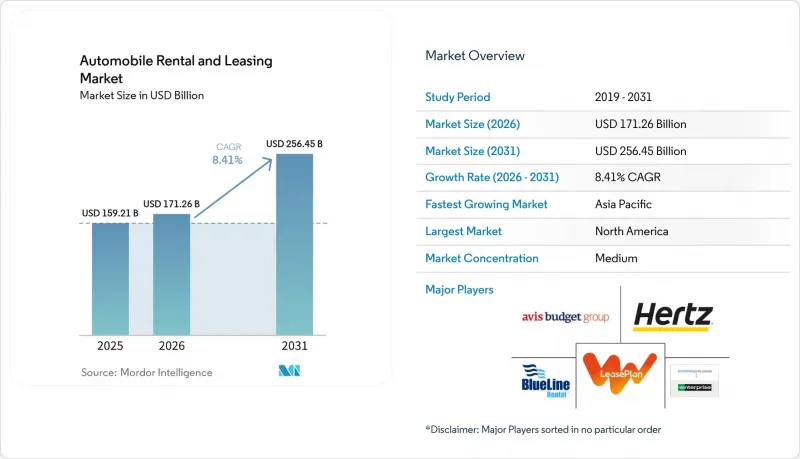
據 Mordor Intelligence 稱,2025 年汽車租賃市場價值 1592.1 億美元,預計到 2031 年將達到 2564.5 億美元,而 2026 年為 1712.6 億美元,預測期(2026-2031 年)複合年成長率為 8.41%。
本報告按車輛類型(乘用車和商用車)、服務類型(租賃)、預訂方式(線上和線下)、最終用戶(個人和企業)、動力系統(內燃機和電動車)以及地區進行細分。市場預測以美元計價。
全球汽車租賃市場的趨勢和洞察。
全球商務和休閒旅遊的復甦
到2025年中期,商務旅行將基本恢復到疫情前水準。相比之下,休閒旅行不僅已經復甦,而且超過了之前的水平。休閒旅遊的成長導致商務用車日租金顯著高於休閒日租金。車隊管理人員現在正利用人工智慧預測技術,提前為重大活動做好車輛部署。一家歐洲大型營運商報告稱,由於實施了基於預測的車輛重新分配策略,其資產利用率顯著提高。沙烏地阿拉伯在其「2030願景」舉措下,目標是在本十年末吸引大量遊客。這一雄心勃勃的目標,加上沙烏地阿拉伯的汽車租賃滲透率相對於更發達的市場較低,預計將在未來幾年推動強勁的需求。儘管復甦步伐不均衡,但中國的國內旅遊需求已全面恢復,而海外遊客數量仍遠低於疫情前水準。
政府獎勵正在加速汽車電氣化進程。
美國《通膨控制法案》為商用電動車提供大量補貼,顯著降低了五年內的總擁有成本。歐洲的《清潔車輛指令》規定,未來幾年內,公共採購中相當一部分必須是零排放車輛。這項要求迫使私人租賃公司對其車隊進行電氣化改造,以維持機場的營運權。在中國,雙軌制政策預計將在不久的將來有效地禁止在主要城市租賃新的內燃機汽車。同時,加州正在透過引入高峰時段車網互動(V2G)電力傳輸的競爭性收費系統來加速電氣化進程。因此,營運商正在策略性地選擇補貼最優惠的地區進行部署,加州的電動車與內燃機汽車的比例遠高於中西部農村地區。
車輛購置成本和資金籌措成本不斷上漲
在預測期內,受利率上升的推動,車隊價格大幅上漲,並在2024年中期達到高峰。每次利率大幅上漲都導致每輛車的年度利息負擔顯著增加,從而對息稅折舊攤銷前利潤率(EBITDA獲利率)構成壓力。由於電池材料成本上漲,汽車製造商提高了車隊的標價,但小規模的營運商無法享受大量採購的成本優勢,被迫支付全額。為了控制資本支出,車隊營運商正在延長平均持有期。然而,這種策略導致維護成本增加,並增加了殘值風險。
細分市場分析
預計到2025年,乘用車將佔總收入的75.16%,而商用車預計將以8.43%的複合年成長率成長,超過汽車租賃市場的整體成長率。這一快速成長主要由電商巨頭和區域配送公司推動,它們選擇靈活的租賃協議來應對季節性需求高峰。最近一項大規模合約將向北美各地的末端配送公司部署數千輛電動貨車,凸顯了該產業向電動車隊轉型的趨勢。在交通流量波動較大的三線城市,平均兩年多的短期租賃正成為常態。乘用車仍佔據較大的市場佔有率,但正面臨來自P2P(點對點)服務的壓力,這些服務提供的日租金要低得多,尤其是在停車費高昂、抑制私家車擁有量的密集都市區。
乘用車市場受益於出行需求的復甦,企業客戶對其租賃業務給予了很高的每日租金。然而,這種市場主導地位也伴隨著日益加劇的脆弱性。在曼哈頓和倫敦等都市區,短期租賃在過去兩三年顯著下降,郊區和休閒市場的成長部分抵消了這一降幅。在商業領域,客戶越來越傾向於選擇包含維護、遠端資訊處理和駕駛員培訓等配套服務套餐,這給P2P模式帶來了難以克服的轉換障礙。隨著日益嚴格的環境法規導致合規性變得更加複雜,許多公司正在轉向專業的租賃公司進行外包。
儘管2025年租賃支出佔比仍高達67.37%,但租賃業務的複合年成長率(CAGR)仍達到8.51%,超過了整體汽車租賃市場的成長速度。企業往往更傾向於選擇能夠將上行風險和殘值風險轉嫁給服務供應商的租賃協議。一家近期合併的歐洲租賃公司管理大規模的車隊,該公司透露,其合約中相當一部分包含提前終止柔軟性,與往年相比大幅成長。同時,在北美,受稅額扣抵的推動,電動車(EV)租賃諮詢量也顯著增加,這些政策大幅降低了購車成本。
租車不僅對休閒旅客,對短期商務旅客而言,仍扮演著至關重要的角色。這一趨勢主要得益於人工智慧驅動的定價策略,這些策略顯著提升了部分公司的單車收益。然而,由於電動車的折舊免稅額,租車的短期使用對其造成了顯著影響。例如,一家大型業者在出售一輛二手電動轎車時,就產生了巨額減損費用。同時,訂閱模式也正在蓬勃發展。德國正在實施的一項試驗計畫便是這一趨勢的典型例證,該計畫將租車的靈活性與租賃的可預測性相結合,讓客戶能夠以固定費率柔軟性每月多次更換車輛。
區域分析
到2025年,北美將佔全球銷售額的32.37%,但由於市場成熟,其成長潛力有限,複合年成長率將與整體市場相近。 《通貨膨脹控制法案》正在加速電動車的普及,而加州的V2G(車輛到電網)定價機制則鼓勵雙向充電。休閒預訂領域的P2P(點對點)服務滲透率已降至低點,促使現有業者推出替代平台。 2024年發生的一起勒索軟體攻擊導致15,000個網站癱瘓,此後企業客戶加強了網路安全要求,導致ISO 27001認證數量激增。
亞太地區是成長最快的地區,年複合成長率高達8.47%。儘管中國的「雙學分」政策將於2027年後禁止在主要城市租賃新的內燃機汽車,但印度的企業租賃業務在充電基礎設施不足的情況下依然蓬勃發展。 Grab和微信等超級應用程式使預訂轉換率提高了兩倍。然而,監管方面的不一致,例如印度歧視性的商品和服務稅(GST),使得跨境車輛分配變得複雜。在歐洲,強制性電氣化推動了穩定成長。在德國和英國,允許客戶每月最多更換三次車輛的訂閱模式正變得越來越受歡迎。在南歐,季節性需求波動意味著車輛閒置成本在淡季可能飆升至五分之二,因此當地開始採用與當地活動日曆掛鉤的動態定價。在西班牙巴利阿里群島實施的一項擁有200輛車的V2G項目,在遊客數量激增時幫助穩定了電網。
南美市場依然集中,巴西業者佔據了該地區市場的大部分佔有率。貨幣對沖租賃可以保護企業客戶免受雷亞爾和披索匯率波動的影響。高利率(預計到2025年中期,巴西SELIC利率仍將居高不下)抑制了車隊資金籌措,但電子商務的擴張正在推動貨車租賃業務的發展。沙烏地阿拉伯計畫在2030年吸引1億遊客,這為中東和非洲市場提供了結構性支撐。平均租賃期限為12天,是全球平均的三倍。阿拉伯聯合大公國正利用其富裕的旅遊業來擴大其豪華轎車和電動車的產品陣容,而南非則面臨與犯罪相關的保費問題。土耳其正透過將旅遊業與跨境租賃結合,崛起為區域中心。
其他好處
- Excel格式的市場預測(ME)表
- 3個月的分析師支持
目錄
第1章:引言
- 研究假設和市場定義
- 調查範圍
第2章:調查方法
第3章執行摘要
第4章 市場狀況
- 市場概覽
- 市場促進因素
- 全球商務和休閒旅遊的復甦
- 政府獎勵正在加速汽車電氣化進程。
- 電子商務推動了對卡車和貨車靈活租賃的需求。
- 行動/線上預訂的普及率正在迅速提高。
- 人工智慧驅動的動態定價和預測性維護
- 車網互動(V2G)的收入來源正在將租賃車隊轉變為分散式能源資產。
- 市場限制因素
- 汽車購買和資金籌措成本不斷上漲
- 共乘和P2P汽車共享加劇了競爭
- 電動車殘值波動與維修成本不確定性
- 配備先進連網/遠端資訊處理功能的車輛數量不斷增加,這意味著在網路安全和資料隱私方面肩負著更大的責任。
- 價值供應鏈分析
- 監理情勢
- 技術展望
- 波特五力模型
第5章 市場規模與成長預測
- 按車輛類型
- 搭乘用車
- 商用車輛
- 按服務類型
- 租賃
- 租
- 透過預訂方式
- 線上
- 離線
- 最終用戶
- 個人
- 公司
- 透過驅動系統
- 內燃機(ICE)
- 電動車(EV)
- 按地區
- 北美洲
- 美國
- 加拿大
- 其他北美國家
- 南美洲
- 巴西
- 阿根廷
- 其他南美國家
- 歐洲
- 德國
- 英國
- 法國
- 義大利
- 西班牙
- 其他歐洲國家
- 亞太地區
- 中國
- 印度
- 日本
- 韓國
- 其他亞太國家
- 中東和非洲
- 阿拉伯聯合大公國
- 沙烏地阿拉伯
- 南非
- 土耳其
- 其他中東和非洲國家
- 北美洲
第6章 競爭情勢
- 市場集中度
- 策略趨勢
- 市佔率分析
- 公司簡介
- Enterprise Holdings
- The Hertz Corporation
- Avis Budget Group
- Sixt SE
- Europcar Mobility Group
- Localiza
- LeasePlan
- Ryder System
- Penske Truck Leasing
- PACCAR Leasing
- United Rentals
- U-Haul Holding
- Turo
- Getaround
- BlueLine Rental
- Zoomcar
- eHi Car Service
- Grab Rentals
- Uber Technologies(Uber Rent/XL)
- Element Fleet Management
第7章 市場機會與未來展望
According to Mordor Intelligence, the automobile rental and leasing market size was valued at USD 159.21 billion in 2025 and estimated to grow from USD 171.26 billion in 2026 to reach USD 256.45 billion by 2031, at a CAGR of 8.41% during the forecast period (2026-2031).
This report is Segmented by Vehicle Type (Passenger Cars and Commercial Vehicles), Service Type (Rental and Leasing), Mode of Booking (Online and Offline), End User (Individual and Corporate), Propulsion Type (Internal Combustion Engine and Electric Vehicles), and Geography. The Market Forecasts are Provided in Terms of Value (USD).
Global Automobile Rental And Leasing Market Trends and Insights
Recovery in Global Business and Leisure Travel
By mid-2025, business trips nearly returned to pre-pandemic levels. In contrast, leisure journeys not only recovered but also exceeded previous benchmarks. This increase in leisure travel has driven corporate daily rates significantly higher than leisure rates . Fleet managers are now leveraging AI forecasting, repositioning vehicles well in advance of major events. A prominent European operator, after integrating predictive rebalancing, reported a notable improvement in asset utilization. Saudi Arabia, with its Vision 2030 initiative, aims to attract a substantial number of visitors by the end of the decade. This ambitious target, combined with relatively low rental penetration compared to more developed markets, indicates strong multi-year demand. While recovery is uneven, China's domestic traffic has fully rebounded, yet international arrivals remain significantly below pre-pandemic levels.
Government Incentives Accelerating Fleet Electrification
The U.S. Inflation Reduction Act provides commercial electric vehicles (EVs) with significant subsidies, leading to a notable reduction in their five-year total cost of ownership . Under Europe's Clean Vehicles Directive, a substantial portion of public procurements must be zero-emission within the next few years. This mandate is pushing private lessors to electrify their fleets to maintain airport concessions. In China, a dual-credit policy is set to effectively prohibit new internal combustion engine (ICE) rentals in major cities in the near future. Meanwhile, California is bolstering the case for electrification by offering competitive peak-hour vehicle-to-grid (V2G) tariffs . As a result, operators are strategically timing their deployments in areas with the most lucrative subsidies, leading to a significantly higher ratio of EVs to ICEs in California compared to rural Midwest regions.
Rising Vehicle Acquisition and Financing Costs
Over the forecast period, fleet prices experienced significant growth, driven by rising interest rates, which reached their peak in mid-2024. Each substantial increase in interest rates added notable annual interest costs per vehicle, exerting pressure on EBITDA margins. Original-equipment makers raised fleet list prices due to inflation in battery material costs, while smaller operators, lacking the advantage of volume leverage, were forced to pay full sticker prices. To manage capital expenditures, fleets have extended their average hold periods. However, this strategy has led to higher maintenance expenses and increased exposure to residual-value risks.
Other drivers and restraints analyzed in the detailed report include:
- E-Commerce-Led Demand for Flexible Truck and Van Leasing
- Mobile/Online Booking Penetration Surge
- EV Residual-Value Volatility and Repair-Cost Uncertainty
For complete list of drivers and restraints, kindly check the Table Of Contents.
Segment Analysis
Passenger cars captured 75.16% of 2025 revenue, whereas commercial vehicles are forecast to advance at an 8.43% CAGR, eclipsing overall automobile rental and leasing market growth. E-commerce giants and regional couriers are driving the surge, opting for flexible leases to navigate seasonal peaks. A significant contract, finalized recently, will deploy thousands of electric vans with last-mile carriers across North America, highlighting the industry's shift towards electrified fleets. In rural tier-3 cities, where volumes fluctuate, shorter leases-averaging a little over two years-are becoming the norm. While passenger cars maintain a dominant market share, they're feeling the pinch from peer-to-peer services that undercut daily rates, especially in dense urban areas where parking costs deter ownership.
Passenger vehicles are reaping the benefits of a travel resurgence, commanding premium daily rates from corporate clients. However, their market dominance belies a growing vulnerability: urban hubs like Manhattan and London have witnessed a noticeable dip in short-term rentals over the past couple of years, a decline somewhat balanced by growth in suburban and leisure markets. On the commercial front, clients are gravitating towards bundled services-maintenance, telematics, and driver training-creating switching barriers that peer-to-peer models struggle to overcome. With stricter environmental regulations complicating compliance, many are turning to specialist lessors for outsourcing.
Rental captured 67.37% of 2025 spend, but leasing expands at an 8.51% CAGR, outperforming the broader automobile rental and leasing market. Enterprises gravitate toward leases that shift rising interest-rate exposure and residual risk to service providers. In recent times, a newly merged European lessor, overseeing a large fleet of vehicles, revealed that a significant portion of its contracts featured early-termination flexibility, marking a notable increase compared to previous years. Meanwhile, in North America, inquiries for electric vehicle (EV) leases experienced substantial growth, driven by tax credits that effectively reduced acquisition costs.
Rentals continue to play a pivotal role for both leisure and short-term business travelers. This trend is bolstered by AI-driven pricing strategies, which significantly boosted one company's revenue per available vehicle. However, the short hold periods of these rentals have led to pronounced shocks from EV depreciation. A testament to this is a major operator's substantial financial write-down following the sale of its used electric sedans. On a different note, subscription models are gaining traction. A prominent pilot program in Germany exemplifies this trend, offering customers the flexibility to swap cars multiple times a month for a flat fee, blending the agility of rentals with the predictability of leasing.
Complete Report Scope:
- By Vehicle Type
- Passenger Cars
- Commercial Vehicles
- By Service Type
- Rental
- Leasing
- By Mode of Booking
- Online
- Offline
- By End User
- Individual
- Corporate
- By Propulsion Type
- Internal Combustion Engine (ICE)
- Electric Vehicles (EVs)
- By Geography
- North America
- United States
- Canada
- Rest of North America
- South America
- Brazil
- Argentina
- Rest of South America
- Europe
- Germany
- United Kingdom
- France
- Italy
- Spain
- Rest of Europe
- Asia Pacific
- China
- India
- Japan
- South Korea
- Rest of Asia Pacific
- Middle East and Africa
- United Arab Emirates
- Saudi Arabia
- South Africa
- Turkey
- Rest of Middle East and Africa
- North America
Geography Analysis
North America produced 32.37% of 2025 revenue and matches the overall CAGR as market maturity limits upside. The Inflation Reduction Act accelerates EV adoption, and California's V2G tariffs reward bidirectional charging. Peer-to-peer penetration reached a minimum of leisure bookings, prompting incumbents to launch counter-platforms. The 2024 ransomware incident that froze 15,000 sites drove a wave of ISO 27001 certifications as corporate buyers harden cybersecurity requirements.
Asia Pacific is the fastest-growing region, advancing at an 8.47% CAGR. China's dual-credit rules will bar fresh ICE rentals in key cities after 2027, while India's corporate leasing grows despite charging-infrastructure gaps. Super-apps such as Grab and WeChat triple booking conversion rates. However, regulatory fragmentation-like India's differential GST-complicates cross-border fleet allocation. Europe shows steady expansion fueled by electrification mandates. Subscription schemes proliferate in Germany and the UK, where customers can swap cars three times a month. Seasonal volatility in Southern Europe inflates idle-fleet costs up to two-fifths off-peak, spurring adoption of dynamic pricing tied to local event calendars. A 200-vehicle V2G project in Spain's Balearic Islands stabilized the grid during tourist surges.
South America remains concentrated, with a Brazilian operator holding the majority of regional share. Currency-hedged leasing shields corporate customers from real and peso volatility. Elevated interest rates- Brazil's Selic at elevated levels in mid-2025- curb fleet financing, though e-commerce drives van leasing. The Middle East and Africa gain structural support from Saudi Arabia's plan to attract 100 million visitors by 2030. Rental duration averages 12 days, triple the global mean. The UAE capitalizes on high-net-worth tourism, expanding luxury and electric catalogs, while South Africa contends with crime-related insurance premiums. Turkey is emerging as a regional hub, blending tourism and cross-border rentals.
- Enterprise Holdings
- The Hertz Corporation
- Avis Budget Group
- Sixt SE
- Europcar Mobility Group
- Localiza
- LeasePlan
- Ryder System
- Penske Truck Leasing
- PACCAR Leasing
- United Rentals
- U-Haul Holding
- Turo
- Getaround
- BlueLine Rental
- Zoomcar
- eHi Car Service
- Grab Rentals
- Uber Technologies (Uber Rent/XL)
- Element Fleet Management
Additional Benefits:
- The market estimate (ME) sheet in Excel format
- 3 months of analyst support
TABLE OF CONTENTS
1 Introduction
- 1.1 Study Assumptions and Market Definition
- 1.2 Scope of the Study
2 Research Methodology
3 Executive Summary
4 Market Landscape
- 4.1 Market Overview
- 4.2 Market Drivers
- 4.2.1 Recovery in Global Business and Leisure Travel
- 4.2.2 Government Incentives Accelerating Fleet Electrification
- 4.2.3 E-Commerce-Led Demand for Flexible Truck and Van Leasing
- 4.2.4 Mobile/Online Booking Penetration Surge
- 4.2.5 AI-Enabled Dynamic Pricing and Predictive Maintenance
- 4.2.6 Vehicle-To-Grid (V2G) Revenue Streams Turn Rental Fleets Into Distributed Energy Assets
- 4.3 Market Restraints
- 4.3.1 Rising Vehicle Acquisition and Financing Costs
- 4.3.2 Intensifying Competition from Ride-Hailing and P2P Car-Sharing
- 4.3.3 EV Residual-Value Volatility and Repair-Cost Uncertainty
- 4.3.4 Heightened Cybersecurity and Data-Privacy Liabilities From Connected/Telematics-Rich Fleets
- 4.4 Value / Supply-Chain Analysis
- 4.5 Regulatory Landscape
- 4.6 Technological Outlook
- 4.7 Porter's Five Forces
- 4.7.1 Threat of New Entrants
- 4.7.2 Bargaining Power of Suppliers
- 4.7.3 Bargaining Power of Buyers
- 4.7.4 Threat of Substitutes
- 4.7.5 Competitive Rivalry
5 Market Size and Growth Forecasts (Value (USD))
- 5.1 By Vehicle Type
- 5.1.1 Passenger Cars
- 5.1.2 Commercial Vehicles
- 5.2 By Service Type
- 5.2.1 Rental
- 5.2.2 Leasing
- 5.3 By Mode of Booking
- 5.3.1 Online
- 5.3.2 Offline
- 5.4 By End User
- 5.4.1 Individual
- 5.4.2 Corporate
- 5.5 By Propulsion Type
- 5.5.1 Internal Combustion Engine (ICE)
- 5.5.2 Electric Vehicles (EVs)
- 5.6 By Geography
- 5.6.1 North America
- 5.6.1.1 United States
- 5.6.1.2 Canada
- 5.6.1.3 Rest of North America
- 5.6.2 South America
- 5.6.2.1 Brazil
- 5.6.2.2 Argentina
- 5.6.2.3 Rest of South America
- 5.6.3 Europe
- 5.6.3.1 Germany
- 5.6.3.2 United Kingdom
- 5.6.3.3 France
- 5.6.3.4 Italy
- 5.6.3.5 Spain
- 5.6.3.6 Rest of Europe
- 5.6.4 Asia Pacific
- 5.6.4.1 China
- 5.6.4.2 India
- 5.6.4.3 Japan
- 5.6.4.4 South Korea
- 5.6.4.5 Rest of Asia Pacific
- 5.6.5 Middle East and Africa
- 5.6.5.1 United Arab Emirates
- 5.6.5.2 Saudi Arabia
- 5.6.5.3 South Africa
- 5.6.5.4 Turkey
- 5.6.5.5 Rest of Middle East and Africa
- 5.6.1 North America
6 Competitive Landscape
- 6.1 Market Concentration
- 6.2 Strategic Moves
- 6.3 Market Share Analysis
- 6.4 Company Profiles (includes Global Level Overview, Market Level Overview, Core Segments, Financials as Available, Strategic Information, Market Rank/Share for Key Companies, Products and Services, SWOT Analysis, and Recent Developments)
- 6.4.1 Enterprise Holdings
- 6.4.2 The Hertz Corporation
- 6.4.3 Avis Budget Group
- 6.4.4 Sixt SE
- 6.4.5 Europcar Mobility Group
- 6.4.6 Localiza
- 6.4.7 LeasePlan
- 6.4.8 Ryder System
- 6.4.9 Penske Truck Leasing
- 6.4.10 PACCAR Leasing
- 6.4.11 United Rentals
- 6.4.12 U-Haul Holding
- 6.4.13 Turo
- 6.4.14 Getaround
- 6.4.15 BlueLine Rental
- 6.4.16 Zoomcar
- 6.4.17 eHi Car Service
- 6.4.18 Grab Rentals
- 6.4.19 Uber Technologies (Uber Rent/XL)
- 6.4.20 Element Fleet Management
7 Market Opportunities & Future Outlook
- 7.1 White-space & Unmet-Need Assessment

 印度汽車租賃市場:市場佔有率分析、產業趨勢與統計及成長預測(2026-2031)北美汽車租賃:市場佔有率分析、產業趨勢與統計及成長預測(2026-2031 年)印尼汽車租賃市場:市場佔有率分析、產業趨勢與統計及成長預測(2026-2031)新加坡汽車租賃:市場佔有率分析、產業趨勢與統計及成長預測(2026-2031)法國汽車租賃市場:市場佔有率分析、產業趨勢與統計及成長預測(2026-2031)泰國汽車租賃市場:市場佔有率分析、產業趨勢與統計及成長預測(2026-2031)英國汽車租賃:市場佔有率分析、產業趨勢與統計及成長預測(2026-2031)馬來西亞汽車租賃市場:市場佔有率分析、產業趨勢與統計及成長預測(2026-2031)印度電動自行車租賃:市場佔有率分析、產業趨勢與統計及成長預測(2026-2031)東協汽車租賃市場:市場佔有率分析、產業趨勢與統計及成長預測(2026-2031)