


 |
市場調查報告書
商品編碼
2119682
印度汽車租賃市場:市場佔有率分析、產業趨勢與統計及成長預測(2026-2031)India Car Rental - Market Share Analysis, Industry Trends & Statistics, Growth Forecasts (2026 - 2031) |
||||||

※ 本網頁內容可能與最新版本有所差異。詳細情況請與我們聯繫。
根據 Mordor Intelligence 預測,印度汽車租賃市場規模將從 2025 年的 31.4 億美元成長到 2026 年的 33.7 億美元,然後在 2031 年達到 47.8 億美元,2026 年至 2031 年的複合年成長率為 7.27%。
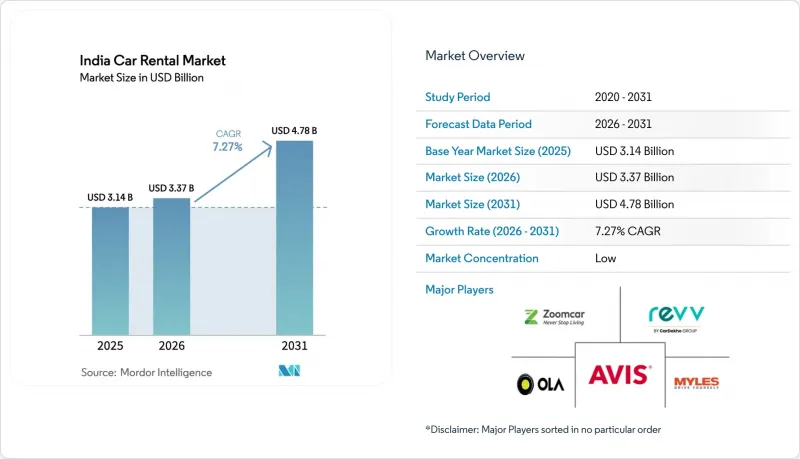
本報告按預訂類型(線上、線下)、用途(旅遊、通勤/日常出行)、服務模式(自駕、代駕、其他)、車輛類型(豪華車/高階車和經濟型/預算型車)、租賃期限(短期、長期)和租賃管道(機場、機場外)進行分類。市場預測以美元計價。
印度汽車租賃市場的趨勢和洞察
國內和入境旅遊趨勢不斷擴大
預計2025會計年度,國內度假旅客將大幅提升旅遊相關企業的收入,促使租車公司逐步增加在宗教場所、沿海地區和歷史遺蹟的車輛數量。靈活的短期租賃服務正受到尋求公共交通無法覆蓋的微型度假行程的遊客的青睞。隨著2024年飯店運轉率接近68%,機場與地面交通之間的綜效再次增強。中小型活動和會議需求的穩定成長提高了工作日的使用率,並緩解了季節性波動。公路和鐵路交通的便利化,以及政府對旅遊推廣的投入,正使符合規範、法規驅動的租賃車輛的需求翻倍。
企業商務旅行和零工經濟對移動性的需求不斷成長。
印度商務旅行市場預計將在2025年恢復到2019年之前的支出水準。根據全球商務旅行協會(GBTA)預測,到2024年,印度的商務旅遊支出預計將達到383億美元,使其成為全球第八大市場,亞太地區第四大市場。隨著混合辦公模式的興起,企業正在縮減長期駕駛人契約,從而催生了對不定期但高品質的門到門交通服務日益成長的需求。目前,員工專職司機和專車租賃服務僅佔印度潛在市場(價值10萬盧比)的五分之一,這意味著參與企業空間。零工經濟從業者更傾向於選擇按日或按週計費的套餐,這些套餐包含無限里程和可預測的價格,這在印度汽車租賃市場創造了一個新的中期細分市場。人工智慧驅動的路線最佳化技術使營運商即使在都市區擁擠的情況下也能實現準時到達的目標。
向一線城市以外地區擴張受到限制。
Ecos(印度)Mobility的收入僅來自四個大都會圈,這凸顯了在小規模的市場中提升服務品質的難度,因為這些市場的維修供應商和道路救援系統覆蓋範圍仍然有限。地方稅收的差異、不一致的駕照類別以及不便的機場交通,都導致二線城市需要大量車輛才能達到收支平衡。然而,這些城市二手車保有量的快速成長表明,透過特許經營合作和低價合作車隊,有組織的汽車租賃企業可以挖掘潛在的市場需求。
細分市場分析
2025年,印度汽車租賃市場中,透過網站和應用程式進行的線上預訂佔比將達到66.85%,預計在預測期(2026-2031年)內將以7.60%的複合年成長率成長。平台與導航套件的整合簡化了搜尋過程,這些數據會被回饋到車輛規劃演算法中。在鐵路樞紐,由於許多旅客更喜歡面對面服務,線下櫃檯仍然存在,但自助服務終端和QR碼解鎖正在迅速縮小便利性方面的差距。
P2P平台正在推動車輛配置多樣化,並滲透到傳統租車門市尚未覆蓋的住宅和科技園區。人工智慧聊天機器人處理了大部分服務諮詢,顯著縮短了平均解決時間。與電子錢包掛鉤的現金回饋宣傳活動吸引了注重預算的旅行者,而包含智慧型手機升級的訂閱方案則展現出跨產業合作的跡象。
即使到了2025年,旅遊業預計仍將佔印度汽車租賃市場57.74%的佔有率。然而,隨著居住者逐漸放棄私家車,平日通勤租車預計將呈現最快的成長軌跡,在預測期(2026-2031年)內複合年成長率將達到8.42%。到本十年末,通勤租車在印度汽車租賃市場的佔有率可能會顯著成長,從而縮小與休閒租車市場的差距。與企業差旅平台整合的系統化租賃協議可確保價格可預測並符合安全義務。
精神旅遊和微度假文化的興起導致旅遊旺季延長,車輛運轉率在各季度分佈更加均衡。同時,微型、小型和中型企業(MSMEs)的成長增加了對專車接送服務的需求,用於往返郊區工廠和交通樞紐的員工通勤。一日通票通常包含在一定距離內的四次城市通勤,其收費系統反映了營運商的創新思維。
其他好處:
- Excel格式的市場預測(ME)表
- 3個月的分析師支持
目錄
第1章:引言
- 研究假設和市場定義
- 調查範圍
第2章:調查方法
第3章執行摘要
第4章 市場狀況
- 市場概覽
- 市場促進因素
- 國內和入境旅遊的擴張
- 商務旅行和零工經濟對旅行的需求日益成長。
- 行動應用程式預訂平台的日益普及。
- FAME II獎勵將促使電動車進入租賃車隊。
- 簡化商品及服務稅(GST)流程,並建立無縫銜接的州際許可製度
- 租賃服務與多模態生態系的整合
- 市場限制因素
- 在主要城市以外地區的擴張受到限制。
- 叫車比多日租車更有價格優勢。
- 車輛所有者面臨沉重的保險和合規負擔。
- 租車業缺乏電動車充電網路
- 價值供應鏈分析
- 監理情勢
- 技術展望
- 波特五力模型
第5章 市場規模與成長預測
- 按預訂類型
- 線上
- 離線
- 按用途
- 觀光
- 通勤和日常旅行
- 按服務模式
- 自駕
- 帶司機
- 企業租賃/訂閱
- 車輛類型
- 豪華車/高級車
- 經濟型轎車
- 租賃期
- 短期(少於30天)
- 長期(超過30天)
- 租賃頻道
- 飛機場
- 機場外
第6章 競爭情勢
- 市場集中度
- 策略趨勢
- 市佔率分析
- 公司簡介
- Zoomcar
- Revv
- Drivezy
- MyChoize
- Myles
- Vroom Drive
- Eco Rent A Car
- Ola Drive
- Avis India
- Carzonrent
- Savaari Car Rentals
- Hertz India
- Europcar-Eco Mobility
- IndusGo
- FastTrack Tours & Travels
- One Way Cab
第7章 市場機會與未來展望
According to Mordor Intelligence, the India car rental market size is expected to grow from USD 3.14 billion in 2025 to USD 3.37 billion in 2026 and is forecast to reach USD 4.78 billion by 2031 at 7.27% CAGR over 2026-2031.
This report is Segmented by Booking Type (Online and Offline), Application Type (Tourism and Commuting/Daily Mobility), Service Model (Self-Drive, Chauffeur-Driven, and More), Vehicle Type (Luxury/Premium Cars and Economy/Budget Cars), Rental Duration (Short-Term, Long-Term), and Rental Channel (Airport and Off-Airport). The Market Forecasts are Provided in Terms of Value (USD).
India Car Rental Market Trends and Insights
Expanding Domestic and Inbound Tourism Flow
Domestic holidaymakers are projected to drive a considerable revenue growth for tourism enterprises in FY25, prompting rental firms to deploy an incremental fleet in spiritual, coastal, and heritage destinations. Flexible short-duration hires appeal to travelers seeking "micro-holiday" itineraries that public transit cannot cover. Hotel occupancy approaching 68% in 2024 resurrects airport-ground transport synergies. Small-and medium-sized events and a steady rise in meetings demand amplify weekday utilization rates, cushioning seasonal volatility. Government investment in roads, rail connectivity, and destination marketing multiplies demand for legally compliant, tech-enabled car rentals.
Growth of Corporate Travel and Gig-Economy Mobility Demand
India's business travel sector is projected to recover to pre-2019 spending levels by 2025. In 2024, business travel spending in India reached an estimated USD 38.3 billion, making it the 8th largest market globally and 4th in the Asia-Pacific (APAC) region, according to the Global Business Travel Association (GBTA). Hybrid work has increased the need for sporadic yet premium door-to-door transport as firms curtail long-term chauffeur contracts. Employee transportation and chauffeur-car rental services currently penetrate only one-fifth of an addressable INR 1 lakh-crore opportunity, leaving wide space for organized entrants. Gig-economy workers favor daily or weekly packages that blend unlimited kilometers with predictable rates, generating a new mid-duration niche within the Indian car rental market. AI-driven routing helps operators hit punctuality targets despite urban congestion.
Limited Presence Beyond Tier-I Cities
Ecos (India) Mobility derives 60% of its turnover from just four metros, highlighting the difficulty of scaling service quality in smaller markets where maintenance vendors and roadside assistance coverage remain thin. Fragmented local taxes, divergent driver-license categories, and gaps in airport connectivity combine to raise the break-even fleet size in Tier-II towns. Yet used-car ownership is rising rapidly in these cities, signaling latent demand that organized rentals could unlock through franchise partnerships and asset-light peer fleets.
Other drivers and restraints analyzed in the detailed report include:
- Rising Penetration of Mobile-App Based Booking Platforms
- EV Adoption in Rental Fleets Fueled by FAME II Incentives
- Ride-Hailing Price Advantage Over Multi-Day Rentals
For complete list of drivers and restraints, kindly check the Table Of Contents.
Segment Analysis
The India car rental market accounts for a 66.85% share in the India Car Rental Market in 2025, as bookings through websites or apps, and that are expected to grow with a 7.60% CAGR during the forecast period (2026-2031). Platform integrations with navigation suites reduce discovery friction and feed data back to fleet-planning algorithms. Offline counters persist at railway hubs where walk-up travelers favor human assistance, but automated kiosks and QR code unlocks are rapidly closing the convenience gap.
Peer-to-peer engines diversify fleet make-up and penetrate housing societies and tech parks where traditional rental storefronts are absent. AI chatbots handle most service queries, significantly reducing the average resolution time. Cashback campaigns tied to e-wallets lure budget travelers, while subscription bundles with smartphone upgrades signal cross-industry alliances.
Tourism still supplied a 57.74% share in the India Car Rental Market in 2025, but weekday commuting packages show the fastest trajectory at an 8.42% CAGR during the forecast period (2026-2031), as city dwellers pivot away from private ownership. The Indian car rental market share for commuting could rise significantly by the decade-end, narrowing the gap with leisure segments. Organized rental agreements tied to corporate travel platforms ensure predictable pricing and duty-of-care compliance.
Spiritual tourism and "micro-holiday" culture elongate peak seasons, smoothing fleet utilization across quarters. Meanwhile, growth in micro, small, and medium enterprises translates into demand for chauffeur-driven shuttles to ferry staff between suburban factories and transit nodes. Daily subscription passes bundle four intra-city trips under a fixed kilometer cap, reflecting operators' creative packaging.
Complete Report Scope:
- By Booking Type
- Online
- Offline
- By Application Type
- Tourism
- Commuting / Daily Mobility
- By Service Model
- Self-Drive
- Chauffeur-Driven
- Corporate Leasing / Subscription
- By Vehicle Type
- Luxury / Premium Cars
- Economy / Budget Cars
- By Rental Duration
- Short-Term (Less than 30 Days)
- Long-Term (Greater than/equals 30 Days)
- By Rental Channel
- Airport
- Off-Airport
List of Companies Covered in this Report:
- Zoomcar
- Revv
- Drivezy
- MyChoize
- Myles
- Vroom Drive
- Eco Rent A Car
- Ola Drive
- Avis India
- Carzonrent
- Savaari Car Rentals
- Hertz India
- Europcar-Eco Mobility
- IndusGo
- FastTrack Tours & Travels
- One Way Cab
Additional Benefits:
- The market estimate (ME) sheet in Excel format
- 3 months of analyst support
TABLE OF CONTENTS
1 Introduction
- 1.1 Study Assumptions & Market Definition
- 1.2 Scope of the Study
2 Research Methodology
3 Executive Summary
4 Market Landscape
- 4.1 Market Overview
- 4.2 Market Drivers
- 4.2.1 Expanding Domestic and Inbound Tourism Flow
- 4.2.2 Growth of Corporate Travel and Gig-Economy Mobility Demand
- 4.2.3 Rising Penetration of Mobile-App Based Booking Platforms
- 4.2.4 EV Adoption in Rental Fleets Fueled by FAME II Incentives
- 4.2.5 GST Rationalization and Seamless Inter-State Permits
- 4.2.6 Integration of Rentals with Multimodal Travel Ecosystems
- 4.3 Market Restraints
- 4.3.1 Limited Presence Beyond Tier-I Cities
- 4.3.2 Ride-Hailing Price Advantage Over Multi-Day Rentals
- 4.3.3 High Insurance and Compliance Burden for Fleet Operators
- 4.3.4 Sparse EV-Charging Network for Rental Operations
- 4.4 Value / Supply-Chain Analysis
- 4.5 Regulatory Landscape
- 4.6 Technological Outlook
- 4.7 Porter's Five Forces
- 4.7.1 Threat of New Entrants
- 4.7.2 Bargaining Power of Buyers
- 4.7.3 Bargaining Power of Suppliers
- 4.7.4 Threat of Substitutes
- 4.7.5 Competitive Rivalry
5 Market Size & Growth Forecasts (Value, USD)
- 5.1 By Booking Type
- 5.1.1 Online
- 5.1.2 Offline
- 5.2 By Application Type
- 5.2.1 Tourism
- 5.2.2 Commuting / Daily Mobility
- 5.3 By Service Model
- 5.3.1 Self-Drive
- 5.3.2 Chauffeur-Driven
- 5.3.3 Corporate Leasing / Subscription
- 5.4 By Vehicle Type
- 5.4.1 Luxury / Premium Cars
- 5.4.2 Economy / Budget Cars
- 5.5 By Rental Duration
- 5.5.1 Short-Term (Less than 30 Days)
- 5.5.2 Long-Term (Greater than/equals 30 Days)
- 5.6 By Rental Channel
- 5.6.1 Airport
- 5.6.2 Off-Airport
6 Competitive Landscape
- 6.1 Market Concentration
- 6.2 Strategic Moves
- 6.3 Market Share Analysis
- 6.4 Company Profiles (includes Global Level Overview, Market Level Overview, Core Segments, Financials as Available, Strategic Information, Market Rank/Share for Key Companies, Products and Services, SWOT Analysis, and Recent Developments)
- 6.4.1 Zoomcar
- 6.4.2 Revv
- 6.4.3 Drivezy
- 6.4.4 MyChoize
- 6.4.5 Myles
- 6.4.6 Vroom Drive
- 6.4.7 Eco Rent A Car
- 6.4.8 Ola Drive
- 6.4.9 Avis India
- 6.4.10 Carzonrent
- 6.4.11 Savaari Car Rentals
- 6.4.12 Hertz India
- 6.4.13 Europcar-Eco Mobility
- 6.4.14 IndusGo
- 6.4.15 FastTrack Tours & Travels
- 6.4.16 One Way Cab
7 Market Opportunities & Future Outlook
- 7.1 White-space & Unmet-Need Assessment
- 7.2 Road-Infrastructure Investment Impact

 汽車租賃:市場佔有率分析、產業趨勢與統計及成長預測(2026-2031)北美汽車租賃:市場佔有率分析、產業趨勢與統計及成長預測(2026-2031 年)印尼汽車租賃市場:市場佔有率分析、產業趨勢與統計及成長預測(2026-2031)新加坡汽車租賃:市場佔有率分析、產業趨勢與統計及成長預測(2026-2031)法國汽車租賃市場:市場佔有率分析、產業趨勢與統計及成長預測(2026-2031)泰國汽車租賃市場:市場佔有率分析、產業趨勢與統計及成長預測(2026-2031)英國汽車租賃:市場佔有率分析、產業趨勢與統計及成長預測(2026-2031)馬來西亞汽車租賃市場:市場佔有率分析、產業趨勢與統計及成長預測(2026-2031)印度電動自行車租賃:市場佔有率分析、產業趨勢與統計及成長預測(2026-2031)東協汽車租賃市場:市場佔有率分析、產業趨勢與統計及成長預測(2026-2031)