


 |
市場調查報告書
商品編碼
2116661
馬來西亞汽車租賃市場:市場佔有率分析、產業趨勢與統計及成長預測(2026-2031)Malaysia Car Rental - Market Share Analysis, Industry Trends & Statistics, Growth Forecasts (2026 - 2031) |
||||||

※ 本網頁內容可能與最新版本有所差異。詳細情況請與我們聯繫。
根據 Mordor Intelligence 預測,馬來西亞汽車租賃市場規模將從 2025 年的 6.2 億美元成長到 2026 年的 6.7 億美元,然後在 2031 年達到 10.1 億美元,2026 年至 2031 年的複合年成長率為 8.42%。
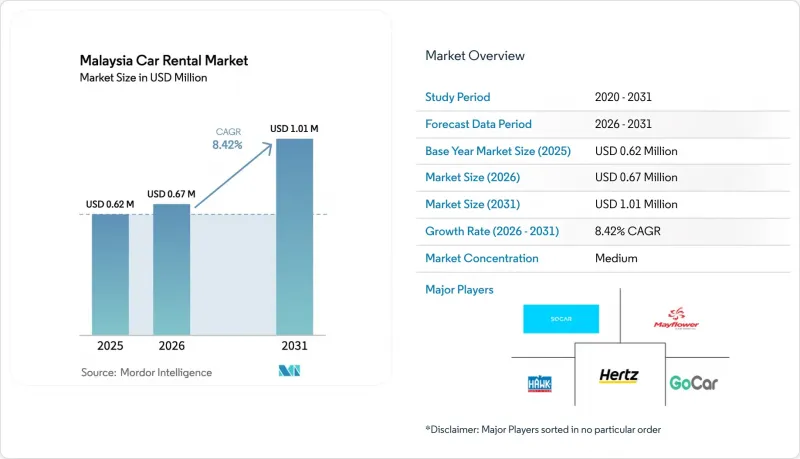
本報告按預訂類型(線上和線下)、租賃期限(短期和長期/租賃)、車輛類型(掀背車/經濟型、轎車、SUV、MPV)、租賃管道(機場內和機場外)、用途(旅遊/休閒、通勤/商務)以及客戶類型(個人、企業/車隊)進行分類。市場預測以美元計價。
馬來西亞汽車租賃市場的趨勢與洞察
入境旅遊增加及國內旅遊復甦
預計馬來西亞將在2024年迎來3,800萬遊客,比最初目標超出31%,這清楚顯示旅遊需求正在成長。政府的「2026馬來西亞旅遊年」宣傳活動目前的目標是吸引3,560萬遊客,這為出行服務需求奠定了堅實的基礎。馬來西亞機場控股有限公司營運的機場客運量在2023年已恢復至2019年的77.8%。隨著上海和金邊新航線的開通,國際連通性正在復甦。這些趨勢進一步推動了馬來西亞的汽車租賃市場,因為越來越多的遊客選擇在公共運輸網路仍然不完善的區域城市延長停留時間。機場外租車點目前已佔據汽車租賃交易的很大一部分,預計隨著旅客尋求航站樓外更經濟實惠的出行方式,這些租車點的交易量將進一步成長。
消費者對SUV的日益偏好正在提升車隊組成的獲利能力。
在馬來西亞,SUV 佔新車銷售的近三分之一,反映出消費者對更高駕駛位置和多功能載貨空間的需求。對於租車公司而言,SUV 具有顯著優勢,因為它們可以保持較高的運轉率,同時允許租車公司收取高出 40% 至 60% 的日租金。寶騰 (Proton) 和第二國產車 (Perodua) 計劃在 2025 年推出幾款價格更低的 SUV,其中包括一款售價在 5 萬至 9 萬馬幣(約合 10,700 至 19,300馬幣)之間的電動跨界車,這將使運營商能夠在不影響 SUV 吸引力的前提下,提供更多環保的選擇。由於利潤率高,預計此類車型的市場將持續成長至 2030 年。
叫車和叫車之間的競爭加劇。
Grab在都市區的廣泛應用消除了自駕租車的許多障礙,例如停車和保險。透過與飯店和航空公司商品搭售銷售,該平台能夠抓住突如其來的需求。傳統租車公司目前專注於短期休閒旅行、家庭度假以及叫車成本效益較低的特殊車型,但日益激烈的競爭正在削弱它們在短期定價方面的議價能力。
細分市場分析
2025年,離線通路(例如與旅行社和飯店預訂櫃檯建立的牢固關係)將佔據馬來西亞汽車租賃市場佔有率的56.48%。對行動預訂引擎和非接觸式自助服務終端的投資,正幫助現有業者在其生態系統內留住客戶,同時提升提升銷售率。在馬來西亞汽車租賃市場,隨著營運商整合QR碼支付和即時車輛追蹤功能,線上預訂市場預計將以11.68%的複合年成長率成長。隨著搜尋廣告市場接近飽和,純線上平台正面臨不斷上漲的獲客成本。營運商正在轉向全通路模式,將實體觸點與雲端原生庫存管理系統結合,使客戶能夠在應用程式、客服中心和櫃檯之間無縫切換。
數位化優先的品牌透過在動態定價引擎中利用精細的遠端資訊處理數據來最大化單車收益,從而保持數據優勢。此外,室內地圖API可縮短購物中心和機場的取車時間,並提高使用者滿意度。在整個預測期內,預計線上入口網站將加強與航空公司和旅遊超級應用的合作,拓展客戶獲取管道。然而,隨著成長曲線進入成熟階段,市場佔有率預計將逐步成長。已完成數位轉型的線下營運商可能會削弱純線上平台的優勢,尤其是在國內回頭客群體中。
至2025年,30天或以下的短期租賃將佔馬來西亞汽車租賃市場佔有率的69.62%。這主要得益於旅遊需求的復甦以及國內週末短途旅行的增加。旺季的日租金比淡季高出30%,為汽車租賃公司提供了收入對沖機制。雖然隨著入境需求的成長,馬來西亞汽車租賃市場短期合約的規模預計將會擴大,但其複合年成長率(CAGR)仍將低於長期合約市場。如今,企業和外籍人士將租賃視為調整營運成本(OPEX)的一種手段,這推動了長期合約和訂閱模式的複合年成長率達到9.31%。這些方案對管理輪調企劃團隊的人力資源部門來說極具吸引力,因為它們簡化了行政流程和套餐維護。
訂閱用戶的解約率低於按日租賃用戶,從而保證了車輛運轉率的可預測性,這有利於與銀行達成融資協議。此外,長期需求與零工出行的蓬勃發展密切相關,叫車司機往往更傾向於租賃而非購車,儘管租賃也會帶來一些麻煩。將業務拓展至3至24個月的合約期限,有助於企業緩解季節性波動,並保護其業務免受旅遊需求突變的影響,從而在不同合約期限內建立均衡的業務組合。
其他好處
- Excel格式的市場預測(ME)表
- 3個月的分析師支持
目錄
第1章:引言
- 研究假設和市場定義
- 調查範圍
第2章:調查方法
第3章執行摘要
第4章 市場狀況
- 市場概覽
- 市場促進因素
- 入境旅遊增加及國內旅遊復甦
- 消費者對SUV的日益偏好正在提升車隊組成的獲利能力。
- 加速向「線上優先」預訂平台轉型
- 企業零工出行需求(租賃駕駛提供叫車服務)
- 政府推出電動車獎勵,以促進電動汽車租賃服務的推廣。
- 外籍人士和數位遊牧者的訂閱式租賃方案正在興起。
- 市場限制因素
- 叫車和叫車之間的競爭加劇。
- 燃油價格持續波動
- 保險費和超額免賠額負擔加重
- 都市區。
- 價值供應鏈分析
- 監理情勢
- 技術展望(車載資訊系統、人工智慧驅動的車輛管理)
- 波特五力模型
第5章 市場規模與成長預測
- 按預訂類型
- 線上預訂
- 線下預訂
- 租賃期
- 短期(30天或更短)
- 長期租賃(30天或以上)
- 按車輛類型
- 掀背車/經濟型
- 轎車
- 運動型多用途車(SUV)
- 多用途汽車(MPV)
- 租賃頻道
- 機場內部
- 機場外
- 透過使用
- 旅遊休閒
- 通勤/商務
- 依客戶類型
- 個人
- 企業/車隊
第6章 競爭情勢
- 市場集中度
- 策略趨勢
- 市佔率分析
- 公司簡介
- The Hertz Corporation
- Hawk Rent A Car
- Mayflower Car Rental Sdn. Bhd.
- SOCAR Malaysia
- GoCar Malaysia
- Europcar Mobility Group
- Avis Budget Group
- SIXT SE
- Galaxy Asia Car Rental
- Paradise Rent-A-Car
- Orix Leasing Malaysia Berhad
- Green Matrix Rental Car
- Drive MY
- Insas Pacific Rent-A-Car Sdn. Bhd
- Agtran Rent a Car
- Kasina Baru(M)Sdn Bhd
第7章 市場機會與未來展望
According to Mordor Intelligence, the malaysian car rental market size is expected to grow from USD 0.62 billion in 2025 to USD 0.67 billion in 2026 and is forecast to reach USD 1.01 billion by 2031 at 8.42% CAGR over 2026-2031.
This report is Segmented by Booking Type (Online Booking and Offline Booking), Rental Duration (Short-Term and Long-Term/Leasing), Vehicle Type (Hatchback/Economy, Sedan, SUV, and MPV), Rental Channel (On-Airport and Off-Airport), Application (Tourism and Leisure and Commuting/Business), and Customer Type (Individual and Corporate/Fleet). The Market Forecasts are Provided in Terms of Value (USD).
Malaysia Car Rental Market Trends and Insights
Rising Inbound and Domestic Tourism Rebound
Malaysia welcomed 38 million visitors in 2024, a 31% jump over earlier targets and a clear signal of pent-up travel demand. The government's Visit Malaysia 2026 campaign now targets 35.6 million arrivals, underpinning a solid pipeline for mobility services. Passenger throughput across Malaysia Airports Holdings Berhad assets reached 77.8% of 2019 levels in 2023, with new routes from Shanghai and Phnom Penh restoring international connectivity. These trends reinforce the Malaysian car rental market as tourists extend stays into secondary cities where public transport density remains thin. Off-airport outlets that already command the majority of rental transactions stand to harvest additional volumes as travelers search for cost-efficient options outside terminals.
SUV Preference Boosting Higher-Margin Fleet Mix
SUVs' share in Malaysia's new-car sales accounts for nearly one-third of total sales, reflecting consumer appetite for higher seating positions and multipurpose cargo space. Rental agencies benefit because SUVs yield 40 to 60% higher daily rates yet sustain strong utilization. Proton and Perodua plan several budget SUVs for 2025, including an electric crossover priced between RM50,000 and RM90,000 (USD 10,700-19,300), allowing operators to offer greener options without sacrificing the SUV flavor. Superior profit margins should keep this body style growing through 2030.
Intensifying Competition from Ride-Hailing and E-Hailing
Grab's ubiquity in urban corridors removes many friction points of self-drive rentals, such as parking and insurance. Price bundling with hotels and airlines lets platforms siphon spontaneous demand. Traditional agencies now focus on multi-day leisure trips, family tours, and specialty vehicles where ride-hailing is less cost-effective, yet the competitive overhang trims near-term pricing power.
Other drivers and restraints analyzed in the detailed report include:
- Accelerating Shift to Online-First Booking Platforms
- Corporate Gig-Mobility Demand (Ride-Hailing Driver Leasing)
- Persistent Fuel-Price Volatility
For complete list of drivers and restraints, kindly check the Table Of Contents.
Segment Analysis
Offline channels controlled 56.48% of the Malaysian car rental market share in 2025 due to entrenched travel-agency relationships and walk-in hotel counters. Investments in mobile booking engines and contactless kiosks let these incumbents keep clients inside proprietary ecosystems while boosting upsell rates. The Malaysian car rental market size for online reservations is projected to expand at a 11.68% CAGR as operators integrate QR-code payments and real-time fleet tracking. Purely online portals face rising acquisition costs as search advertising grows crowded. Operators converge on omnichannel models, blending physical touchpoints with cloud-native inventory so customers can toggle seamlessly between app, call center, and counter.
Digital-first brands retain a data advantage because granular telematics feed dynamic-pricing engines that maximize yield per vehicle. Indoor-mapping APIs also shorten pick-up times at malls and airports, improving user satisfaction. Over the forecast horizon, online portals will deepen ties with airlines and travel-super-apps to widen funnel reach, yet mature growth curves suggest incremental share gains will be moderate. Offline operators that finish their digital overhaul could erode the perceived edge of pure-play platforms, especially among repeat domestic travelers.
Short-term hires under 30 days generated 69.62% of the Malaysian car rental market share in 2025, leveraging the tourism upswing and spontaneous domestic weekend trips. Peak-season daily rates can climb 30% above shoulder months, giving agencies a revenue hedge. The Malaysian car rental market size for short-term contracts will grow in line with inbound traffic, though its CAGR trails the long-term segment. Corporations and expatriates now view leasing as an OPEX lever, pushing long-term and subscription models toward a 9.31% CAGR. These plans trim paperwork and bundle maintenance, making them attractive for HR departments managing rotating project teams.
Subscription customers show lower churn than day-to-day renters, yielding predictable fleet-utilization ratios that support financing agreements with banks. Long-term demand is also linked to the gig-mobility boom as ride-hailing drivers prefer hassle-free leases over vehicle ownership. Operators diversifying into 3-to-24-month contracts can smooth seasonality and shield against tourism shocks, anchoring a balanced portfolio across tenure buckets.
Complete Report Scope:
- By Booking Type
- Online Booking
- Offline Booking
- By Rental Duration
- Short-Term (Less than 30 days)
- Long-Term/Leasing (>=30 days)
- By Vehicle Type
- Hatchback/Economy
- Sedan
- Sport-Utility Vehicles (SUV)
- Multi-Purpose Vehicles (MPV)
- By Rental Channel
- On-Airport
- Off-Airport
- By Application
- Tourism and Leisure
- Commuting / Business
- By Customer Type
- Individual
- Corporate / Fleet
List of Companies Covered in this Report:
- The Hertz Corporation
- Hawk Rent A Car
- Mayflower Car Rental Sdn. Bhd.
- SOCAR Malaysia
- GoCar Malaysia
- Europcar Mobility Group
- Avis Budget Group
- SIXT SE
- Galaxy Asia Car Rental
- Paradise Rent-A-Car
- Orix Leasing Malaysia Berhad
- Green Matrix Rental Car
- Drive MY
- Insas Pacific Rent-A-Car Sdn. Bhd
- Agtran Rent a Car
- Kasina Baru (M) Sdn Bhd
Additional Benefits:
- The market estimate (ME) sheet in Excel format
- 3 months of analyst support
TABLE OF CONTENTS
1 Introduction
- 1.1 Study Assumptions & Market Definition
- 1.2 Scope of the Study
2 Research Methodology
3 Executive Summary
4 Market Landscape
- 4.1 Market Overview
- 4.2 Market Drivers
- 4.2.1 Rising Inbound and Domestic Tourism Rebound
- 4.2.2 SUV Preference Boosting Higher-Margin Fleet Mix
- 4.2.3 Accelerating Shift to Online-First Booking Platforms
- 4.2.4 Corporate Gig-Mobility Demand (Ride-Hailing Driver Leasing)
- 4.2.5 Government EV Incentives Catalyzing Electric Rental Fleets
- 4.2.6 Emergence of Subscription-Based Rental Plans for Expatriates and Digital Nomads
- 4.3 Market Restraints
- 4.3.1 Intensifying Competition from Ride-Hailing and E-Hailing
- 4.3.2 Persistent Fuel-Price Volatility
- 4.3.3 Rising Insurance and Excess-Waiver Cost Burden
- 4.3.4 Urban Parking Shortages Inflating Operating Costs
- 4.4 Value / Supply-Chain Analysis
- 4.5 Regulatory Landscape
- 4.6 Technological Outlook (Telematics, AI fleet-management)
- 4.7 Porter's Five Forces
- 4.7.1 Threat of New Entrants
- 4.7.2 Bargaining Power of Buyers/Consumers
- 4.7.3 Bargaining Power of Suppliers
- 4.7.4 Threat of Substitutes
- 4.7.5 Intensity of Competitive Rivalry
5 Market Size & Growth Forecasts (Value (USD))
- 5.1 By Booking Type
- 5.1.1 Online Booking
- 5.1.2 Offline Booking
- 5.2 By Rental Duration
- 5.2.1 Short-Term (Less than 30 days)
- 5.2.2 Long-Term/Leasing (>=30 days)
- 5.3 By Vehicle Type
- 5.3.1 Hatchback/Economy
- 5.3.2 Sedan
- 5.3.3 Sport-Utility Vehicles (SUV)
- 5.3.4 Multi-Purpose Vehicles (MPV)
- 5.4 By Rental Channel
- 5.4.1 On-Airport
- 5.4.2 Off-Airport
- 5.5 By Application
- 5.5.1 Tourism and Leisure
- 5.5.2 Commuting / Business
- 5.6 By Customer Type
- 5.6.1 Individual
- 5.6.2 Corporate / Fleet
6 Competitive Landscape
- 6.1 Market Concentration
- 6.2 Strategic Moves
- 6.3 Market Share Analysis
- 6.4 Company Profiles (Includes Global Level Overview, Market Level Overview, Core Segments, Financials as Available, Strategic Information, Market Rank/Share for Key Companies, Products and Services, SWOT Analysis, and Recent Developments)
- 6.4.1 The Hertz Corporation
- 6.4.2 Hawk Rent A Car
- 6.4.3 Mayflower Car Rental Sdn. Bhd.
- 6.4.4 SOCAR Malaysia
- 6.4.5 GoCar Malaysia
- 6.4.6 Europcar Mobility Group
- 6.4.7 Avis Budget Group
- 6.4.8 SIXT SE
- 6.4.9 Galaxy Asia Car Rental
- 6.4.10 Paradise Rent-A-Car
- 6.4.11 Orix Leasing Malaysia Berhad
- 6.4.12 Green Matrix Rental Car
- 6.4.13 Drive MY
- 6.4.14 Insas Pacific Rent-A-Car Sdn. Bhd
- 6.4.15 Agtran Rent a Car
- 6.4.16 Kasina Baru (M) Sdn Bhd
7 Market Opportunities & Future Outlook
- 7.1 White-space & Unmet-Need Assessment

 印度汽車租賃市場:市場佔有率分析、產業趨勢與統計及成長預測(2026-2031)汽車租賃:市場佔有率分析、產業趨勢與統計及成長預測(2026-2031)北美汽車租賃:市場佔有率分析、產業趨勢與統計及成長預測(2026-2031 年)印尼汽車租賃市場:市場佔有率分析、產業趨勢與統計及成長預測(2026-2031)新加坡汽車租賃:市場佔有率分析、產業趨勢與統計及成長預測(2026-2031)法國汽車租賃市場:市場佔有率分析、產業趨勢與統計及成長預測(2026-2031)泰國汽車租賃市場:市場佔有率分析、產業趨勢與統計及成長預測(2026-2031)英國汽車租賃:市場佔有率分析、產業趨勢與統計及成長預測(2026-2031)印度電動自行車租賃:市場佔有率分析、產業趨勢與統計及成長預測(2026-2031)東協汽車租賃市場:市場佔有率分析、產業趨勢與統計及成長預測(2026-2031)