


 |
市場調查報告書
商品編碼
2115845
東協汽車租賃市場:市場佔有率分析、產業趨勢與統計及成長預測(2026-2031)ASEAN Car Rental - Market Share Analysis, Industry Trends & Statistics, Growth Forecasts (2026 - 2031) |
||||||

※ 本網頁內容可能與最新版本有所差異。詳細情況請與我們聯繫。
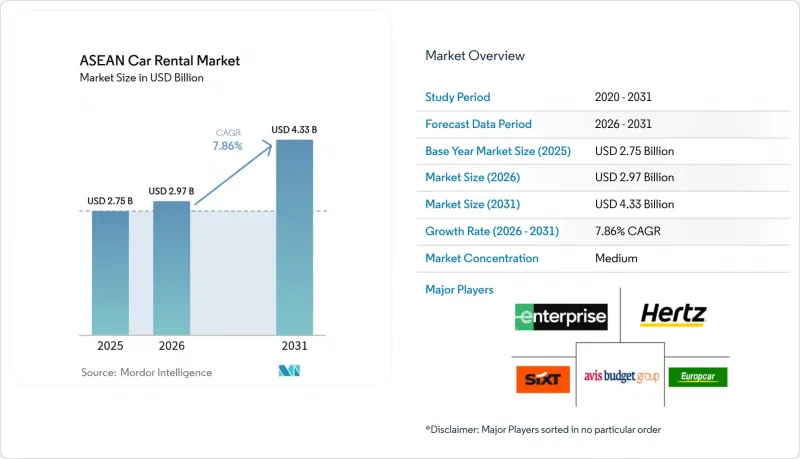
據 Mordor Intelligence 稱,東協汽車租賃市場預計到 2026 年價值 29.7 億美元,高於 2025 年的 27.5 億美元,預計到 2031 年將達到 43.3 億美元。
預計從 2026 年到 2031 年,其複合年成長率將達到 7.86%。
本報告按預訂類型(離線、線上)、租賃期間(短期、長期/訂閱)、服務類型(自駕、代駕、其他)、車輛類型(經濟型/小型車、緊湊型/中型車、其他)、應用領域(旅遊、商務旅行、其他)、最終用戶(個人、大/小型企業、其他)和國家細分。市場預測以美元計價。
東協汽車租賃市場趨勢與洞察
旅遊需求的復甦速度超過了車輛數量的成長速度。
儘管2023年國際觀光數量超過1億,恢復到疫情前水準的70%,但租車數量的成長速度卻明顯放緩。旺季車輛運轉率從疫情前的65%上升至目前的85%以上,這使得營運商能夠實施動態定價,並跨境調配車輛以最佳化收益。連接泰國各區域城市的鐵路和公路新路線進一步加劇了車輛供應緊張的局面,尤其是在通往寮國的旅遊路線上。因此,擁有現有車隊的成熟營運商能夠獲得更高的利潤率,並更快地收回新車投資。投資人正投入資金擴大車隊規模,但由於新車(尤其是電動車)訂單長期積壓,供應問題並未即時緩解。
透過線上旅行社/超級應用程式預訂的訂單量激增。
智慧型手機的高普及率和完善的數位經濟以及強大的支付基礎設施正在推動線上預訂量的成長。 Grab、Traveloka 和 Agoda 等平台將租車服務與機票和飯店服務一同上線,並透過折扣和積分套餐提升轉換率。對於企業而言,透過這些平台銷售產品可以降低分店營運成本,並支援即時收入管理。隨著財務部門對整合費用管理工作流程的需求日益成長,企業自有的預訂入口網站進一步推動了數位轉型。預計到 2024 年,東協租車市場的網路和應用程式預訂量將達到 42.7%,並在 2028 年超過線下交易量。數據視覺性的提升使保險公司能夠根據使用情況為產品定價,從而為短期用戶拓展了保險選擇。
許可和保險碎片化
在東南亞國協,許可證類型、責任限額和課稅標準仍然存在差異,迫使企業在每個司法管轄區設立獨立的法律實體。在馬來西亞,自2025年7月起,將對租賃汽車徵收8%的銷售和服務稅,這將導致租賃價格高於免稅的新加坡,並削弱區域內的價格透明度。不同保險公司不同的免賠額限制了跨境租賃汽車的使用,並降低了遊客的便利性。中小企業缺乏大型成熟企業所具備的合規資源,這減緩了新參與企業的擴張速度和區域內的競爭,尤其是在消費者選擇本就有限的省會城市。
細分市場分析
預計到2025年,東協汽車租賃市場中,線下通路將佔總收入的56.74%,而線上通路的複合年成長率將達到8.31%。線下分店在區域市場和傳統企業客戶中仍佔據主導地位,但分店極少的模式可以透過在機場和購物中心安裝取車櫃來降低固定成本並擴大地理覆蓋範圍。超級應用程式透過整合外送、支付服務和優惠券等功能來聚合流量並確保用戶高參與度。以企業為導向的自助預訂工具整合了政策管理功能,以提高合規性並實現費用報告自動化。對於營運商而言,更豐富的資料流能夠實現預測性維護計劃和人工智慧驅動的價格彈性測試,從而提高運轉率和獲利能力。
在東協汽車租賃市場,隨著數位原生代逐漸成長為高消費群體,預計到2031年,基於應用程式的預訂比例將超過54.60%。旅行社正在整合Direct Connect API,將預訂流程簡化至只需輕按兩下即可完成。受區塊鏈保護的智慧合約在P2P交易中日益普及,可望實現更快的支付速度和防篡改的損失記錄。為了減少網路詐騙,行業組織正在攜手合作,共用黑名單,建立平台信任,並最大限度地減少扣回爭議帳款。
到2025年,短期租賃將佔總收入的80.62%,主導東協汽車租賃市場。同時,在旅遊業復甦和零星本地需求的推動下,訂閱模式正以7.75%的複合年成長率成長。營運商正在實施能夠根據航班到達模式和飯店運轉率數據即時回應的可變定價機制。各公司正在採用包含多種車型的捆綁套餐,從而能夠靈活最佳化車輛數量,而無需承擔殘值風險。
在新加坡,車輛所有權證書(CE)制度推高了車輛擁有成本,使得訂閱模式成為更具經濟效益的選擇。消費者被涵蓋保險、保養、道路救援系統,甚至電動汽車家用充電樁等全方位服務的月費模式所吸引。服務提供者利用遙測技術監控駕駛行為,並據此調整續費條款,降低車輛損失率,並鼓勵更安全的駕駛。當地銀行正與車隊營運商合作,擴大庫存融資額度,並為以固定訂閱現金流為抵押的資產購買提供承銷。
其他好處:
- Excel格式的市場預測(ME)表
- 3個月的分析師支持
目錄
第1章:引言
- 研究假設和市場定義
- 調查範圍
第2章:調查方法
第3章執行摘要
第4章 市場狀況
- 市場概覽
- 市場促進因素
- 旅遊業的復甦速度超過了車輛數量的成長速度。
- 透過超級應用程式進行的OTA/預訂激增
- 企業對出行即服務 (MaaS) 合約的需求
- 政府支持措施促進電動車的引入
- P2P平台重振閒置供應鏈。
- 東協數位貿易和保險法規的協調統一
- 市場限制因素
- 許可和保險的碎片化
- 叫車的替代方案
- 車輛供應和資金籌措的限制
- 充電器的引入被推遲了。
- 價值供應鏈分析
- 監理情勢
- 技術展望
- 波特五力模型
第5章 市場規模與成長預測
- 按預訂類型
- 離線
- 線上
- 租賃期
- 短期(少於30天)
- 長期/訂閱(30天或以上)
- 按服務類型
- 自駕
- 帶司機
- P2P汽車共享
- 企業車隊租賃
- 按車輛類型
- 經濟型/小型汽車
- 小型和中型汽車
- 運動型多用途車
- 多用途車輛
- 奢華尊貴
- 透過使用
- 旅遊休閒
- 商務旅行
- 通勤
- 機場接送
- 為叫車司機提供租賃服務
- 最終用戶
- 個人
- 大型企業/中小企業
- 政府/公共部門
- 外籍人士/外交官
- 國家
- 印尼
- 泰國
- 馬來西亞
- 新加坡
- 越南
- 菲律賓
- 其他東南亞國協
第6章 競爭情勢
- 市場集中度
- 策略趨勢
- 市佔率分析
- 公司簡介
- Avis Budget Group
- Hertz Global Holdings
- Enterprise Holdings Inc.
- Sixt SE
- Europcar Mobility Group
- GrabRentals(Grab Holdings)
- SOCAR Mobility Malaysia
- Tribecar Pte Ltd
- Thai Rent a Car
- Bluebird Group/IndoRent
- Asco Car Rent
- Hawk Rent A Car
- DriveLah
- Carro Leasing
- GoCar Malaysia
第7章 市場機會與未來展望
According to Mordor Intelligence, the ASEAN car rental market size in 2026 is estimated at USD 2.97 billion, growing from 2025 value of USD 2.75 billion with 2031 projections showing USD 4.33 billion, growing at 7.86% CAGR over 2026-2031.
This report is Segmented by Booking Type (Offline and Online), Rental Duration (Short Term and Long Term), Service Type (Self-Drive, Chauffeur-Drive, and More), Vehicle Type (Economy and Mini, Compact and Mid-Size, and More), Application (Tourism, Business Travel, and More), End-Customer (Individuals, Corporates and SMEs, and More), and Country. The Market Forecasts are Provided in Terms of Value (USD).
ASEAN Car Rental Market Trends and Insights
Tourism Rebound Out-Paces Fleet Growth
International arrivals surpassed 100 million in 2023, equal to 70% of pre-pandemic flows, yet rental fleets grew at a markedly slower pace. Utilization now exceeds 85% at peak seasons, compared with 65% before the pandemic, allowing operators to implement dynamic pricing and redeploy vehicles across borders for yield optimization. Thailand's new rail and road corridors connecting secondary cities magnify the strain on limited fleets, particularly in Laos-bound tourist circuits. Established providers with existing inventory therefore enjoy higher margins and faster payback on new vehicles. Investors channel capital toward fleet expansion, but lengthy order backlogs for new cars, especially EVs, curtail immediate supply relief.
Surge in OTA / Super-App Bookings
Heavy smartphone penetration and a payment-ready digital economy propel online reservation volumes. Grab, Traveloka, and Agoda embed rental offers next to flights and hotels, raising conversion by bundling discounts and loyalty points. For operators, platform distribution trims branch overheads and supports real-time revenue management. Corporate self-booking portals further widen digital adoption as finance teams demand integrated expense workflows. The share of web- and app-based reservations in the ASEAN car rental market climbed to 42.7% in 2024 and is on course to overtake offline transactions before 2028.Enhanced data visibility empowers insurers to price usage-based products, improving coverage availability for short-term renters.
Fragmented Licensing and Insurance
ASEAN nations retain divergent permit classes, liability ceilings, and taxation triggers, forcing operators to run discrete legal entities for each jurisdiction. Malaysia's July 2025 8% sales and service tax on rentals raises headline prices compared with duty-free Singapore, complicating regional rate transparency. Insurance carriers apply different excess thresholds, limiting cross-border rentals and curbing tourist convenience. Smaller firms lack the compliance resources of larger incumbents, slowing new-entrant expansion and local competition, especially in secondary cities where consumer choice is already thin.
Other drivers and restraints analyzed in the detailed report include:
- Corporate Demand for Mobility-as-a-Service Contracts
- EV-Ready Government Incentives
- Ride-Hailing Substitutes
For complete list of drivers and restraints, kindly check the Table Of Contents.
Segment Analysis
Offline Channel reservations contributed 56.74% of 2025 revenues share in the ASEAN car Rental Market, whereas Online Channel is set to grow at 8.31% CAGR. Offline branches still dominate rural markets and legacy corporate accounts, but branch-light models lower fixed costs and extend geographic reach via pickup lockers at airports and malls. Super-apps funnel traffic by bundling vouchers with food delivery and payments, ensuring high engagement. Corporate self-booking tools integrate policy controls that improve compliance and automate expense reconciliation. For operators, richer data flows enable predictive maintenance scheduling and AI-driven price elasticity testing, boosting both uptime and yield.
The share of app-based reservations in the ASEAN car rental market is expected to surpass 54.60% by 2031 as younger digital-native travelers mature into higher-spending cohorts. Travel resellers embed direct-connect APIs, shortening booking flows to two taps. Blockchain-secured smart contracts gain traction for P2P transactions, promising faster settlements and tamper-proof damage logs. To mitigate digital fraud, industry associations collaborate on shared blacklists, enhancing platform trust and minimizing chargebacks.
Short-term rentals dominated the ASEAN car rental market with 80.62% revenue share in 2025, while subscription models are climbing at 7.75% CAGR, buoyed by tourism rebounds and sporadic local demand. Operators deploy variable-rate engines that adjust instantly to flight arrival patterns and hotel occupancy data. Corporations adopt plans that bundle multiple car classes, enabling flexible fleet rightsizing without residual-value risk.
In Singapore, the Certificate of Entitlement system inflates ownership costs, making subscriptions an economically viable substitute. Consumers value all-inclusive monthly pricing that covers insurance, servicing, roadside assistance, and often home charging for EVs. Providers leverage telemetry to monitor driving behavior and vary renewal terms accordingly, reducing loss ratios and rewarding safe usage. Regional banks partner with fleets to extend inventory financing lines, underwriting asset purchases backed by locked-in subscription cash flows.
Complete Report Scope:
- By Booking Type
- Offline
- Online
- By Rental Duration
- Short-term (Less than 30 days)
- Long-term / Subscription (More than or equal to 30 days)
- By Service Type
- Self-Drive
- Chauffeur-Drive
- Peer-to-Peer Car-Sharing
- Corporate Fleet Leasing
- By Vehicle Type
- Economy & Mini
- Compact & Mid-size
- Sport Utility Vehicle
- Multi-Purpose Vehicle
- Luxury & Premium
- By Application
- Tourism / Leisure
- Business Travel
- Daily Commuting
- Airport Transport
- Ride-hail Driver Rentals
- By End-Customer
- Individuals
- Corporates & SMEs
- Government & Public Sector
- Expat / Diplomat
- By Country
- Indonesia
- Thailand
- Malaysia
- Singapore
- Vietnam
- Philippines
- Rest of the ASEAN Countries
List of Companies Covered in this Report:
- Avis Budget Group
- Hertz Global Holdings
- Enterprise Holdings Inc.
- Sixt SE
- Europcar Mobility Group
- GrabRentals (Grab Holdings)
- SOCAR Mobility Malaysia
- Tribecar Pte Ltd
- Thai Rent a Car
- Bluebird Group / IndoRent
- Asco Car Rent
- Hawk Rent A Car
- DriveLah
- Carro Leasing
- GoCar Malaysia
Additional Benefits:
- The market estimate (ME) sheet in Excel format
- 3 months of analyst support
TABLE OF CONTENTS
1 Introduction
- 1.1 Study Assumptions & Market Definition
- 1.2 Scope of the Study
2 Research Methodology
3 Executive Summary
4 Market Landscape
- 4.1 Market Overview
- 4.2 Market Drivers
- 4.2.1 Tourism rebound out-paces fleet growth
- 4.2.2 Surge in OTA / super-app bookings
- 4.2.3 Corporate demand for mobility-as-a-service contracts
- 4.2.4 EV-ready government incentives
- 4.2.5 P2P platforms unlock idle supply
- 4.2.6 Harmonising ASEAN digital trade & insurance rules
- 4.3 Market Restraints
- 4.3.1 Fragmented licensing & insurance
- 4.3.2 Ride-hailing substitutes
- 4.3.3 Vehicle supply & financing constraints
- 4.3.4 Slow charger roll-out
- 4.4 Value / Supply-Chain Analysis
- 4.5 Regulatory Landscape
- 4.6 Technological Outlook
- 4.7 Porter's Five Forces
- 4.7.1 Threat of New Entrants
- 4.7.2 Bargaining Power of Buyers
- 4.7.3 Bargaining Power of Suppliers
- 4.7.4 Threat of Substitutes
- 4.7.5 Competitive Rivalry
5 Market Size & Growth Forecasts (Value (USD))
- 5.1 By Booking Type
- 5.1.1 Offline
- 5.1.2 Online
- 5.2 By Rental Duration
- 5.2.1 Short-term (Less than 30 days)
- 5.2.2 Long-term / Subscription (More than or equal to 30 days)
- 5.3 By Service Type
- 5.3.1 Self-Drive
- 5.3.2 Chauffeur-Drive
- 5.3.3 Peer-to-Peer Car-Sharing
- 5.3.4 Corporate Fleet Leasing
- 5.4 By Vehicle Type
- 5.4.1 Economy & Mini
- 5.4.2 Compact & Mid-size
- 5.4.3 Sport Utility Vehicle
- 5.4.4 Multi-Purpose Vehicle
- 5.4.5 Luxury & Premium
- 5.5 By Application
- 5.5.1 Tourism / Leisure
- 5.5.2 Business Travel
- 5.5.3 Daily Commuting
- 5.5.4 Airport Transport
- 5.5.5 Ride-hail Driver Rentals
- 5.6 By End-Customer
- 5.6.1 Individuals
- 5.6.2 Corporates & SMEs
- 5.6.3 Government & Public Sector
- 5.6.4 Expat / Diplomat
- 5.7 By Country
- 5.7.1 Indonesia
- 5.7.2 Thailand
- 5.7.3 Malaysia
- 5.7.4 Singapore
- 5.7.5 Vietnam
- 5.7.6 Philippines
- 5.7.7 Rest of the ASEAN Countries
6 Competitive Landscape
- 6.1 Market Concentration
- 6.2 Strategic Moves
- 6.3 Market Share Analysis
- 6.4 Company Profiles (includes Global Level Overview, Market Level Overview, Core Segments, Financials as Available, Strategic Information, Market Rank/Share for Key Companies, Products and Services, SWOT Analysis, and Recent Developments)
- 6.4.1 Avis Budget Group
- 6.4.2 Hertz Global Holdings
- 6.4.3 Enterprise Holdings Inc.
- 6.4.4 Sixt SE
- 6.4.5 Europcar Mobility Group
- 6.4.6 GrabRentals (Grab Holdings)
- 6.4.7 SOCAR Mobility Malaysia
- 6.4.8 Tribecar Pte Ltd
- 6.4.9 Thai Rent a Car
- 6.4.10 Bluebird Group / IndoRent
- 6.4.11 Asco Car Rent
- 6.4.12 Hawk Rent A Car
- 6.4.13 DriveLah
- 6.4.14 Carro Leasing
- 6.4.15 GoCar Malaysia
7 Market Opportunities & Future Outlook
- 7.1 White-space & Unmet-Need Assessment

 印度汽車租賃市場:市場佔有率分析、產業趨勢與統計及成長預測(2026-2031)汽車租賃:市場佔有率分析、產業趨勢與統計及成長預測(2026-2031)北美汽車租賃:市場佔有率分析、產業趨勢與統計及成長預測(2026-2031 年)印尼汽車租賃市場:市場佔有率分析、產業趨勢與統計及成長預測(2026-2031)新加坡汽車租賃:市場佔有率分析、產業趨勢與統計及成長預測(2026-2031)法國汽車租賃市場:市場佔有率分析、產業趨勢與統計及成長預測(2026-2031)泰國汽車租賃市場:市場佔有率分析、產業趨勢與統計及成長預測(2026-2031)英國汽車租賃:市場佔有率分析、產業趨勢與統計及成長預測(2026-2031)馬來西亞汽車租賃市場:市場佔有率分析、產業趨勢與統計及成長預測(2026-2031)印度電動自行車租賃:市場佔有率分析、產業趨勢與統計及成長預測(2026-2031)