


 |
市場調查報告書
商品編碼
2124264
德國瓷磚:市場佔有率分析、產業趨勢與統計及成長預測(2026-2031)Germany Ceramic Tiles - Market Share Analysis, Industry Trends & Statistics, Growth Forecasts (2026 - 2031) |
||||||

※ 本網頁內容可能與最新版本有所差異。詳細情況請與我們聯繫。
據 Mordor Intelligence 稱,德國瓷磚市場預計到 2026 年價值 20.8 億美元,高於 2025 年的 20.2 億美元,預計到 2031 年將達到 24.1 億美元。
預計 2026 年至 2031 年的複合年成長率為 2.98%。
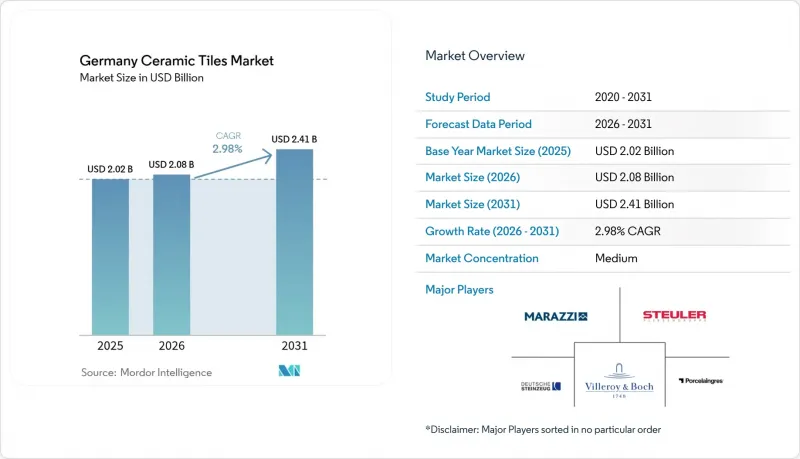
本報告按產品類型(陶瓷瓷磚、其他)、應用領域(地板、其他)、最終用戶(住宅、商業)、建築類型(新建建築、其他)、分銷管道(瓷磚和石材專賣店、其他)以及地區(德國南部、其他)進行細分。市場預測以美元計價。
德國瓷磚市場的趨勢和洞察
新冠疫情後時代,住宅維修需求增加。
由於居家時間延長,德國的房屋翻新趨勢正在加速,家庭紛紛將儲蓄用於提升居住舒適度和能源效率。根據德國的「建築節能計畫」(BEG),瓷磚安裝服務每戶可獲得高達4萬歐元(約4.28萬美元)的稅額扣抵,鼓勵在浴室、廚房和外牆保溫等區域安裝瓷磚。隨著2024年建築許可數量的大幅下降,翻新工程目前佔建設活動的61.99%,遠超過新建工程。學術模型分析表明,要實現2045年的氣候目標,每年需要對2.5%的住宅存量存量(按占地面積計算)進行全面維修。這些法規的明確為德國瓷磚市場,特別是室內空間的需求帶來了穩健的前景,因為瓷磚具有耐用、衛生和美觀百搭的優點。隨著材料價格上漲的放緩,先前延期的項目預計將陸續恢復,進一步推動銷售量成長。
改用大尺寸磁磚
據零售商稱,尺寸超過 150 x 300 公分的 XXL 超大尺寸瓷磚銷量激增,顧客看重其無縫外觀和僅 3 毫米的勾縫寬度。如今,數位噴墨系統能夠以照片級的逼真度再現木材、石材和混凝土的紋理,提高了人們對其在高階住宅和旗艦商業建築中應用的期望。德國首個採用 3 x 1.5 公尺大尺寸瓷磚的通風幕牆已在 Fliesen Thomas展示室安裝完畢,充分展現了此類產品在外牆應用方面的卓越性能。隨著磁磚厚度降至 6 毫米以下,安裝人員的培訓和專用搬運工具的需求也在增加。這雖然降低了結構荷載,但也增加了運輸過程中損壞的風險。大尺寸陶瓷瓷磚的高價位推高了平均售價,從而推動了德國瓷磚市場價值的成長。
天然氣價格波動推高了窯爐的燃燒成本。
天然氣約佔瓷磚窯爐能源需求的85%,近期價格波動導致生產成本較上一季飆升達40%。德國多家工廠目前正在試行改用液化石油氣(LPG),預計液化石油氣價格更為穩定,但這需要大型儲氣庫和汽化設備。餘熱回收技術也日益普及,新推出的熱能電池可儲存多餘的餘熱並重新用於乾燥生產線。雖然這些維修可以緩解成本波動,但需要資金籌措投入,這對小規模生產商而言難以承受。持續的價格波動持續嚴重擠壓德國瓷磚市場的利潤空間。
細分市場分析
至2025年,磁磚將佔德國陶瓷磚市場45.12%的佔有率。這主要歸功於瓷磚的耐凍性和低吸水率,使其能夠在高階項目中取代天然石材。低調的大尺寸瓷磚預計將以9.18%的複合年成長率成長,這主要得益於其在建築外立面應用的增加以及極簡主義室內設計趨勢的興起。釉藥瓷磚佔了38.35%的市場佔有率,並在注重成本的翻新市場中持續受到青睞。同時,無釉瓷磚在需要高耐磨性的工業地板材料市場中佔據主導地位。馬賽克瓷磚雖然仍屬於小眾市場,但在旅館業的翻新工程中,其每平方公尺價格仍居高不下。抗菌瓷磚的日益普及進一步推高了瓷磚的平均售價,推動了銷售成長,而銷售成長則相對落後。
該公司在其德國工廠投資引進了第三代數位印刷機,支援多達12色條和紋理映射功能,從而提升了設計的靈活性。防滑微結構和光催化塗層則增強了磁磚在潮濕環境下的性能。生產自動化使得同一條生產線上即可切換生產6毫米厚和傳統的10毫米厚瓷磚,進一步提高了生產的柔軟性。這些技術進步鞏固了瓷磚的高階定位,並強化了其在德國瓷磚市場的主導地位。
地板材料佔2025年需求的70.05%,反映了德國氣候區典型的機械應力和凍融循環。大尺寸瓷磚採用改良邊緣設計,幾乎可以實現無縫安裝,從而減少了開放式室內空間的勾縫維護。牆磚佔21.15%的市場佔有率,主要得益於浴室和廚房維修對抗菌易清潔釉藥的需求。外牆的複合年成長率最高,達到7.86%,這主要得益於低矮瓷磚覆層系統,該系統整合了隔熱和雨幕設計。屋頂材料仍然傾向於傳統風格,陶瓷屋面板常用於地標性建築修復和高檔鄉村住宅。
能源法規推動了外牆維修,將保溫板與輕質陶瓷相結合,因此,幕牆專家正在積極尋求獲得DIBt認證的錨固裝置和粘合砂漿。這些技術進步正使帷幕牆成為德國瓷磚市場結構成長的重要支柱。
其他好處:
- Excel格式的市場預測(ME)表
- 3個月的分析師支持
目錄
第1章:引言
第2章:調查範圍
第3章:調查方法
第4章執行摘要
第5章 市場狀況
- 市場促進因素
- 新冠疫情後,住宅維修需求增加
- 過渡到大尺寸瓷磚
- 薄型瓷磚在建築外觀上的應用正在加速成長。
- 政府對節能維修提供補貼
- 對抗菌處理玻璃表面的需求不斷成長(酒店和醫療保健行業)
- 市場限制因素
- 天然氣價格波動推高了爐灶燃料燃燒成本。
- 歐盟加強對重型陶瓷的碳排放監管。
- 德國建設產業人手不足
- 價值供應鏈分析
- 監理情勢
- 技術展望
- 波特五力模型
第6章 市場規模與成長預測
- 釉藥磁磚
- 無釉陶瓷磚
- 馬賽克瓷磚
- 其他(裝飾性、圖案性、手工製作)
- 透過使用
- 地面
- 牆
- 屋頂材料
- 最終用戶
- 住宅
- 商業的
- 飯店業(飯店、度假村)
- 零售空間
- 辦公室和公共設施
- 衛生保健
- 教育設施
- 交通樞紐(機場、捷運、客運站)
- 其他商業用戶
- 依建築類型
- 新建工程
- 維修和重建
- 透過分銷管道
- 磁磚和石材專賣店
- 家居裝修商店和DIY專賣店
- 線上零售
- 直接向承包商銷售
第7章 競爭情勢
- 策略趨勢
- 市佔率分析
- 公司簡介
- ABC-Fliesen GmbH
- Agrob Buchtal GmbH
- Villeroy and Boch AG
- Deutsche Steinzeug Cremer and Breuer AG
- Porcelaingres GmbH
- Marazzi Group(Germany)
- Ragno Deutschland
- Ceramiche Piemme(Germany)
- Florim Deutschland
- Emilgroup Deutschland
- Iris Ceramica Group(Germany)
- FAP Ceramiche(Germany)
- Leonardo Ceramica(Germany)
- Steuler Fliesen GmbH
- Jasba Mosaik GmbH
- Kerateam GmbH and Co. KG
- NordCeram GmbH
- Interbau-Blink Fliesen GmbH
- Equipe Ceramicas(Germany)
- Design Industry Tiles(Germany)
第8章 市場機會與未來展望
- 預製模組化住宅的快速發展帶動了對輕質、大容量瓷質面板的需求。
- 用於高階商業設施室內環境監測的智慧感測器嵌入式地磚
According to Mordor Intelligence, the Germany ceramic tiles market size in 2026 is estimated at USD 2.08 billion, growing from 2025 value of USD 2.02 billion with 2031 projections showing USD 2.41 billion, growing at 2.98% CAGR over 2026-2031.
This report is Segmented by Product Type (Porcelain Tiles, and Others), Application (Floor, and Others), End-User (Residential, Commercial), Construction Type (New Construction, and Others), Distribution Channel (Specialty Tile and Stone Stores, and Others), and Geography (South Germany, and Others). The Market Forecasts are Provided in Terms of Value (USD). .
Germany Ceramic Tiles Market Trends and Insights
Rising Renovation Demand in Post-COVID Housing Upgrades
Germany's retrofit momentum is accelerating as households channel savings into comfort and energy-efficiency measures after an extended time at home. Under the BEG scheme, tile-laying services qualify for a tax reduction of up to EUR 40,000 (USD 42,800) per property, bolstering installations in bathrooms, kitchens, and insulated facades. Renovation now accounts for 61.99% of construction activity, dwarfing new builds as approvals declined sharply in 2024. Academic modeling shows the housing stock must undergo full-scale renovation of 2.5% of floor area annually to align with 2045 climate targets. This regulatory clarity locks in demand visibility for the Germany ceramic tiles market, especially in interior spaces where ceramics deliver durability, hygiene, and aesthetic versatility. As material inflation eases, postponed projects are expected to resume, further underpinning volume growth.
Shift Toward Large-Format Porcelain Slabs
Retailers report surging purchases of XXL formats exceeding 150 X 300 cm, valued for seamless looks and minimal 3 mm joints . Digital inkjet systems now replicate wood, stone, and concrete with near-photographic detail, raising design expectations in premium homes and flagship commercial venues. Germany's first ventilated facade using 3 X 1.5 m maxi-slabs was installed at the Fliesen Thomas showroom, validating exterior suitability of these products. Installer training and specialist handling tools are expanding as slab thickness drops below 6 mm, reducing structural loads yet increasing breakage risk during transport. The premium pricing of large-format porcelain lifts average selling prices, strengthening value growth within the Germany ceramic tiles market.
Volatile Natural-Gas Prices Inflating Kiln Firing Costs
Gas supplies cover roughly 85% of energy demand in tile kilns, and recent price swings have driven production-cost spikes of up to 40% quarter-on-quarter. Several German plants now trial LPG conversions that promise steadier pricing but require bulk-storage yards and vaporizer systems. Waste-heat recovery is gaining traction; new thermal-battery installations store surplus exhaust heat for use in drying lines. While these retrofits temper cost volatility, they necessitate capital outlays that smaller producers find difficult to finance. Persistent price instability continues to weigh on margins across the Germany ceramic tiles market.
Other drivers and restraints analyzed in the detailed report include:
- Accelerated Adoption of Thin Tiles for Facades
- Government Subsidies for Energy-Efficient Refurbishments
- Tightening EU Carbon Regulations on Heavy Ceramics Manufacturing
For complete list of drivers and restraints, kindly check the Table Of Contents.
Segment Analysis
Porcelain tiles captured 45.12% of the Germany ceramic tiles market size in 2025 as frost resistance and low water absorption allowed them to displace natural stone in upscale projects. Thin large-format porcelain panels are forecast to expand at a 9.18% CAGR, propelled by rising facade applications and minimalist interior trends. Glazed ceramic holds a 38.35% share and continues to serve budget-conscious renovations, while unglazed bodies dominate industrial floors requiring high abrasion resistance. Mosaic tiles remain niche but command elevated prices per square meter in hospitality refurbishments. Growing acceptance of antibacterial porcelain further elevates porcelain's average selling price, boosting revenue growth ahead of volume gains.
German plants are investing in third-generation digital printers that support up to 12 color bars and texture-mapping, broadening design latitude. Slip-resistant micro-structures and photocatalytic coatings amplify performance in wet environments. Production automation now allows same-line switching between 6 mm panels and classic 10 mm formats, sharpening flexibility. These technical gains anchor porcelain's premium positioning and reinforce its leadership in the Germany ceramic tiles market.
Flooring represented 70.05% of demand in 2025, reflecting the mechanical loads and frost cycles typical of German climate zones. Large-format porcelain with rectified edges supports near-seamless installations that reduce grout maintenance in open-plan interiors. Wall tiles secured a 21.15% share, fueled by bathroom and kitchen upgrades that leverage antibacterial and easy-clean glazes. Facades recorded the fastest CAGR at 7.86%, driven by thin-tile cladding systems that integrate insulation layers and rain-screen designs. Roofing remains heritage-focused, with ceramic shingles specified on landmark restorations and premium countryside homes.
Energy codes encourage exterior retrofits that combine thermal panels with lightweight ceramics, prompting facade specialists to certify anchor devices and adhesive mortars with DIBt approvals. This engineering progress positions facades as a structural growth pillar for the Germany ceramic tiles market.
Complete Report Scope:
- Glazed Ceramic Tiles
- Unglazed Ceramic Tiles
- Mosaic Tiles
- Others (Decorative, Patterned, Handmade)
- By Application
- Floor
- Wall
- Roofing
- By End-User
- Residential
- Commercial
- Hospitality (Hotels, Resorts)
- Retail Spaces
- Offices and Institutions
- Healthcare
- Educational Facilities
- Transport Hubs (Airports, Metro, Bus Terminals)
- Other Commercial Users
- By Construction Type
- New Construction
- Renovation and Replacement
- By Distribution Channel
- Specialty Tile and Stone Stores
- Home Improvement and DIY Stores
- Online Retail
- Direct Sales to Contractors
List of Companies Covered in this Report:
- ABC-Fliesen GmbH
- Agrob Buchtal GmbH
- Villeroy and Boch AG
- Deutsche Steinzeug Cremer and Breuer AG
- Porcelaingres GmbH
- Marazzi Group (Germany)
- Ragno Deutschland
- Ceramiche Piemme (Germany)
- Florim Deutschland
- Emilgroup Deutschland
- Iris Ceramica Group (Germany)
- FAP Ceramiche (Germany)
- Leonardo Ceramica (Germany)
- Steuler Fliesen GmbH
- Jasba Mosaik GmbH
- Kerateam GmbH and Co. KG
- NordCeram GmbH
- Interbau-Blink Fliesen GmbH
- Equipe Ceramicas (Germany)
- Design Industry Tiles (Germany)
Additional Benefits:
- The market estimate (ME) sheet in Excel format
- 3 months of analyst support
TABLE OF CONTENTS
1 Introduction
2 Scope of the Study
3 Research Methodology
4 Executive Summary
5 Market Landscape
- 5.1 Market Drivers
- 5.1.1 Rising renovation demand in post-COVID housing upgrades
- 5.1.2 Shift toward large-format porcelain slabs
- 5.1.3 Accelerated adoption of thin tiles for facades
- 5.1.4 Government subsidies for energy-efficient refurbishments
- 5.1.5 Growing preference for antibacterial glazed surfaces (hospitality and healthcare)
- 5.2 Market Restraints
- 5.2.1 Volatile natural-gas prices inflating kiln firing costs
- 5.2.2 Tightening EU carbon regulations on heavy ceramics manufacturing
- 5.2.3 Labor shortages in German construction sector
- 5.3 Value / Supply-Chain Analysis
- 5.4 Regulatory Landscape
- 5.5 Technological Outlook
- 5.6 Porter's Five Forces
- 5.6.1 Bargaining Power of Suppliers
- 5.6.2 Bargaining Power of Buyers
- 5.6.3 Threat of New Entrants
- 5.6.4 Threat of Substitutes
- 5.6.5 Competitive Rivalry
6 Market Size and Growth Forecasts
- 6.1 Glazed Ceramic Tiles
- 6.1.1 Unglazed Ceramic Tiles
- 6.1.2 Mosaic Tiles
- 6.1.3 Others (Decorative, Patterned, Handmade)
- 6.2 By Application
- 6.2.1 Floor
- 6.2.2 Wall
- 6.2.3 Roofing
- 6.3 By End-User
- 6.3.1 Residential
- 6.3.2 Commercial
- 6.3.2.1 Hospitality (Hotels, Resorts)
- 6.3.2.2 Retail Spaces
- 6.3.2.3 Offices and Institutions
- 6.3.2.4 Healthcare
- 6.3.2.5 Educational Facilities
- 6.3.2.6 Transport Hubs (Airports, Metro, Bus Terminals)
- 6.3.2.7 Other Commercial Users
- 6.4 By Construction Type
- 6.4.1 New Construction
- 6.4.2 Renovation and Replacement
- 6.5 By Distribution Channel
- 6.5.1 Specialty Tile and Stone Stores
- 6.5.2 Home Improvement and DIY Stores
- 6.5.3 Online Retail
- 6.5.4 Direct Sales to Contractors
7 Competitive Landscape
- 7.1 Strategic Moves
- 7.2 Market Share Analysis
- 7.3 Company Profiles (includes Global level Overview, Market level overview, Core Segments, Financials as available, Strategic Information, Market Rank/Share for key companies, Products and Services, and Recent Developments)
- 7.3.1 ABC-Fliesen GmbH
- 7.3.2 Agrob Buchtal GmbH
- 7.3.3 Villeroy and Boch AG
- 7.3.4 Deutsche Steinzeug Cremer and Breuer AG
- 7.3.5 Porcelaingres GmbH
- 7.3.6 Marazzi Group (Germany)
- 7.3.7 Ragno Deutschland
- 7.3.8 Ceramiche Piemme (Germany)
- 7.3.9 Florim Deutschland
- 7.3.10 Emilgroup Deutschland
- 7.3.11 Iris Ceramica Group (Germany)
- 7.3.12 FAP Ceramiche (Germany)
- 7.3.13 Leonardo Ceramica (Germany)
- 7.3.14 Steuler Fliesen GmbH
- 7.3.15 Jasba Mosaik GmbH
- 7.3.16 Kerateam GmbH and Co. KG
- 7.3.17 NordCeram GmbH
- 7.3.18 Interbau-Blink Fliesen GmbH
- 7.3.19 Equipe Ceramicas (Germany)
- 7.3.20 Design Industry Tiles (Germany)
8 Market Opportunities and Future Outlook
- 8.1 Rapid growth in prefabricated modular housing driving demand for lightweight large-format porcelain panels
- 8.2 Smart sensor-embedded tiles for indoor environmental monitoring in premium commercial spaces

 法國陶瓷磚:市場佔有率分析、產業趨勢與統計及成長預測(2026-2031)泰國瓷磚市場:市佔率分析、產業趨勢與統計及成長預測(2026-2031)英國磁磚市場:市佔率分析、產業趨勢與統計及成長預測(2026-2031)日本陶瓷磚:市佔率分析、產業趨勢與統計及成長預測(2026-2031)義大利瓷磚:市佔率分析、產業趨勢與統計及成長預測(2026-2031)中國瓷磚市場:市場佔有率分析、行業趨勢與統計及成長預測(2026-2031年)印尼陶瓷磚市場:市場佔有率分析、產業趨勢與統計及成長預測(2026-2031)印度瓷磚市場:市場佔有率分析、行業趨勢與統計及成長預測(2026-2031)越南瓷磚市場:市場佔有率分析、產業趨勢與統計及成長預測(2026-2031)
 2026-2030年全球陶瓷磚市場