


 |
市場調查報告書
商品編碼
2115102
英國磁磚市場:市佔率分析、產業趨勢與統計及成長預測(2026-2031)United Kingdom Ceramic Tiles - Market Share Analysis, Industry Trends & Statistics, Growth Forecasts (2026 - 2031) |
||||||

※ 本網頁內容可能與最新版本有所差異。詳細情況請與我們聯繫。
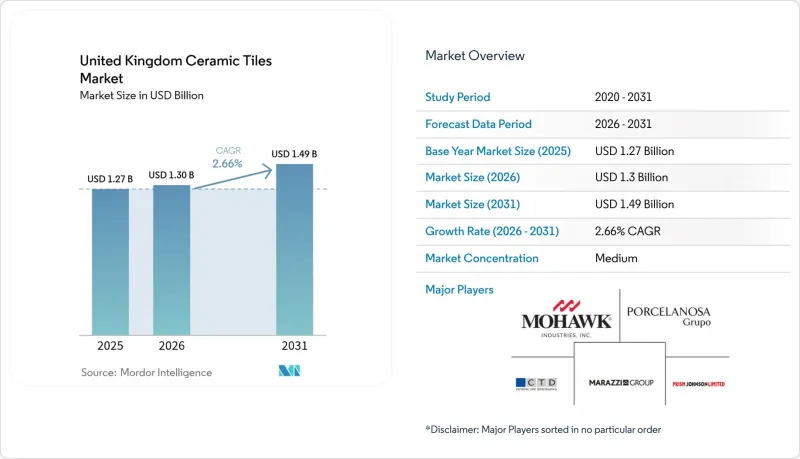
根據 Mordor Intelligence 預測,英國磁磚市場規模將從 2025 年的 12.7 億美元成長到 2026 年的 13 億美元,到 2031 年將達到 14.9 億美元,2026 年至 2031 年的複合年成長率為 2.66%。
本報告按產品類型(陶瓷瓷磚、釉藥等)、應用領域(地面、牆面、屋頂)、最終用戶(住宅、商業)、施工類型(新建、維修/更換)、配銷通路(專賣店、DIY商店、線上零售、直銷)和地區進行細分。市場預測以美元計價。
英國瓷磚市場的趨勢和洞察
疫情後住宅維修熱潮提振了磁磚的零售需求。
2020年至2022年居家隔離的延長促使家庭支出轉向房屋裝修。儘管宏觀經濟不確定性,但預計這一趨勢將持續到2025年。 2024年下半年,與住宅維修相關的非食品零售增1.9%,其中,對電商網站進行升級改造的磁磚零售商貢獻了相當大一部分成長。消費者越來越重視耐用、易於維護且能提升房屋轉售價值的地板材料,在廚房和浴室裝修中,瓷磚正逐漸取代壽命較短的複合地板,成為更受歡迎的選擇。 Johnson Tiles和British Ceramic Tile公司運作的高清噴墨生產線,使得大理石和木紋系列產品能夠快速生產,並可根據不同的室內設計主題進行客製化。這些因素共同支撐了穩定的住宅需求基礎,從而緩解了新建建設活動的波動。
高階商業設施內部裝修中大尺寸瓷磚的應用正在迅速增加。
在旗艦店整修、機場和高階零售連鎖店中,尺寸超過 1200 x 600 毫米的大型瓷磚正逐漸成為標準配置,以在最大限度降低維護成本的同時,打造和諧統一的美感。蓋特威克機場車站的重建項目充分展現了大型瓷磚能夠承受頻繁的人流,同時簡化清潔工作,因此贏得了建築師和設施管理人員的廣泛信賴。當飯店整修大廳和水療中心時,也傾向於選擇能夠模仿天然石材的大尺寸瓷磚,這些瓷磚無需密封,即可滿足衛生和防滑標準。精準的切割邊緣和極少的勾縫也有助於縮短高價值項目的工期,減少停工時間。隨著企業業主尋求打造令人印象深刻的室內空間以吸引員工重返辦公室,預計未來十年對優質陶瓷瓷磚的需求將持續成長。
天然氣價格波動推高了窯爐燒製成本。
從2021年底到2023年中期,天然氣現貨價格加倍多,推高了瓷磚的生產成本,因為1,200度C的燒製成本約佔工廠營運成本的35%。因此,玻璃、陶瓷和石材產業的附加價值毛額較2021年第一季下降了46.5%,給資本投資的營運資金帶來了壓力。生產商正在試行使用生物甲烷和氫氣混合的窯爐,以減少對天然氣的依賴,但由於基礎設施不足和資金籌措,全面推廣仍受到阻礙。儘管能源成本的不確定性導致一些買家轉向進口,但國內產能的重要性仍然存在,因為對中國瓷磚徵收的反傾銷稅限制了替代效應。持續的價格波動可能會延遲對下一代壓平機的投資,減緩產品創新,並略微降低英國瓷磚市場的成長速度。
細分市場分析
瓷質磚吸水率低於0.5%,具有抗凍性和高抗張強度,適用於室外和人流量大的室內場所。到2025年,磁磚已佔據英國磁磚市場38.12%的佔有率。預計到2025年,英國瓷磚市場規模將達到4.841億美元,並在2031年之前以2.78%的複合年成長率成長,這主要得益於瓷磚尺寸的增大和每平方公尺價格的提高。馬賽克磚雖然銷量僅佔4.6%,但其複合年成長率最高,達3.04%。浴室和廚房設計師偏好使用符合永續性要求的再生玻璃馬賽克來打造獨特的裝飾牆。釉面瓷磚仍然是住宅牆面裝飾的主要選擇,而無釉藥瓷磚則主導著地板材料市場,尤其是在醫療機構和交通樞紐等對釉藥要求較高的場所,這些場所必須符合EN 16165防滑等級標準。
需求差異較源自於消費者對維護成本和安裝經濟性的預期,而非單價本身。瓷磚的生命週期成本優於天然大理石,因此在透過長期釉藥協議分攤室內裝修成本的商業房地產所有者中越來越受歡迎。馬賽克進口商依賴義大利製造商的即時訂單,但近期物流瓶頸促使人們對英國製造的玻璃馬賽克產生了興趣,因為玻璃馬賽克可以將前置作業時間縮短40%。釉面牆磚的消費仍然極易受潮流週期的影響,迫使製造商利用柔軟性的噴墨生產線,每六個月推出一次季節性顏色變化。
至2025年,地板材料將佔英國瓷磚市場62.54%的佔有率。這是因為在人流量相當的情況下,磁磚的使用壽命比乙烯基材料長20年,降低了整體設施維護成本。牆面裝飾雖然規模較小(4.086億美元),但由於開放式生活空間的普及以及用於區域分類的特色牆的興起,其複合年成長率(CAGR)為2.94%。屋頂瓦片是一個專注於傳統粘土瓦的專業細分市場,主要用於歷史建築和結構的修復項目,但這一領域正面臨來自現代屋頂材料的壓力。地板材料市場的主導地位反映了瓷磚在商業應用中的技術優勢,在商業應用中,能夠承受高強度使用並保持美觀的材料從生命週期成本的角度來看更受歡迎。在住宅地板材料領域,磁磚與地暖系統的兼容性是一項優勢,符合優先考慮導熱性和保溫性的節能趨勢。
在商業維修,設施管理人員擴大用大尺寸瓷磚取代地毯大廳,他們認為瓷磚便於衛生管理,這在疫情期間尤其明顯。隨著地暖的普及,住宅地板材料市場也呈現成長勢頭,因為陶瓷材料的快速導熱性提高了能源性能證書(EPC)評估中的舒適度評分。數位行銷達人展示的大理石紋理全高淋浴設備間也推動了牆磚市場的成長,促使千禧世代的住宅購買此類產品。輕質蜂窩板等安裝技術的創新,降低了結構荷載,並擴大了陶瓷材料在以往因重量限制而無法使用的維修項目中的應用。
其他好處:
- Excel格式的市場預測(ME)表
- 3個月的分析師支持
目錄
第1章:引言
- 研究假設和市場定義
- 調查範圍
第2章:調查方法
第3章執行摘要
第4章 市場狀況
- 市場概覽
- 市場促進因素
- 疫情後的住宅維修熱潮支撐了瓷磚零售需求。
- 高階商業設施室內裝修中大尺寸陶瓷瓷磚的使用正在迅速增加。
- 英國各地正在推廣使用節能型地板相容磁磚。
- 數位噴墨印刷技術能夠縮短小眾市場生產商的設計週期並降低成本。
- 採用輕質瓦片的模組化異地建造技術發展迅速
- 醫療機構和交通樞紐防滑性能的強制性標準。
- 市場限制因素
- 天然氣價格波動推高了窯爐燃料燃燒成本。
- 大型貨車駕駛人短缺正在擾亂從西班牙和義大利的進口。
- 來自LVT替代品和特殊硬質地板的競爭。
- 由於國內黏土蘊藏量有限,當地黏土生產的擴張受到限制。
- 產業價值鏈分析
- 波特五力分析
- 洞察最新市場趨勢與創新
- 近期產業趨勢分析(新產品發布、策略性舉措、投資、合作、合資、業務擴張、併購等)
第5章 市場規模與成長預測
- 依產品類型
- 瓷質磚
- 釉藥磁磚
- 無釉陶瓷磚
- 馬賽克瓷磚
- 其他(裝飾性、圖案性、手工製作)
- 透過使用
- 地面
- 牆
- 屋頂材料
- 最終用戶
- 住宅
- 商業
- 飯店業(飯店、度假村)
- 零售空間
- 辦公室和公共設施
- 衛生保健
- 教育設施
- 交通樞紐(機場、捷運、客運站)
- 其他商業用戶
- 依建築類型
- 新建工程
- 維修和重建
- 透過分銷管道
- 磁磚和石材專賣店
- 家居裝修商店和DIY專賣店
- 線上零售
- 直接向承包商銷售
- 按地區
- 英格蘭
- 蘇格蘭
- 威爾斯
- 北愛爾蘭
第6章 競爭情勢
- 市場集中度
- 策略趨勢
- 市佔率分析
- 公司簡介
- Atlas Concorde
- Ceramica Marazzi
- Ceramica Saloni
- Craven Dunnill
- CTD Tiles
- Domus Tiles
- Grupo STN
- Interceramic UK
- Keraben Grupo
- Mohawk Industries
- Pamesa Ceramica
- Porcelanosa Grupo
- Porcelanosa Grupo
- Prism Johnson Limited(Johnson Tiles)
- RAK Ceramics
- Roca Tile
- Tile Giant
第7章 市場機會與未來展望
According to Mordor Intelligence, the United Kingdom ceramic tiles market size is expected to grow from USD 1.27 billion in 2025 to USD 1.3 billion in 2026 and is forecast to reach USD 1.49 billion by 2031 at 2.66% CAGR over 2026-2031.
This report is Segmented by Product Type (Porcelain Tiles, Glazed Ceramic Tiles, and More), Application (Floor, Wall, Roofing), End-User (Residential, Commercial), Construction Type (New Construction, Renovation and Replacement), Distribution Channel (Specialty Stores, DIY Stores, Online Retail, Direct Sales), and Geography. The Market Forecasts are Provided in Terms of Value (USD).
United Kingdom Ceramic Tiles Market Trends and Insights
Post-pandemic home-improvement boom sustains retail tile demand
Extended periods of home occupancy during 2020-2022 recalibrated household spending toward renovation, a pattern that has endured through 2025 despite macroeconomic uncertainty. Non-food retail volumes tied to home improvement rose 1.9% year-on-year in late 2024, and ceramic retailers with upgraded e-commerce sites captured a disproportionate share of that growth. Consumers increasingly prioritize durable, low-maintenance surfaces that add resale value, positioning ceramic tiles ahead of short-lived laminates in kitchen and bathroom upgrades. HD ink-jet lines commissioned at Johnson Tiles and British Ceramic Tile enable rapid roll-outs of marble- and wood-look collections that cater to bespoke interior themes. Together, these elements underpin a stable residential demand base that cushions cyclical swings in new-build activity.
Surge in large-format porcelain adoption for upscale commercial fit-outs
Flagship commercial refurbishments, airports, and premium retail chains now routinely specify 1,200 X 600 mm or larger porcelain panels to achieve monolithic aesthetics with lower maintenance outlays. The Gatwick Airport Station redevelopment demonstrated large-format tiles' ability to handle continuous footfall while simplifying cleaning regimes, reinforcing confidence among architects and facility managers. Hotels upgrading lobbies and spas prefer expansive slabs that emulate natural stone yet comply with hygiene and slip-resistance standards without sealing treatments. Precision-cut edges and minimal grout lines also shorten installation times on high-value projects where shutdown windows are tight. As corporate real-estate owners pursue statement interiors to lure employees back on-site, demand for premium porcelain is forecast to extend well into the next decade.
Volatile natural-gas prices inflating kiln firing costs
Spot natural-gas quotations more than doubled between late 2021 and mid-2023, inflating ceramic tile production costs because firing at 1,200 °C accounts for roughly 35% of factory operating expenses. The glass, ceramics, and stone sector's gross value added consequently sank 46.5% from Q1 2021 levels, eroding working capital for capex upgrades. Producers are piloting hybrid kilns that blend biomethane or hydrogen to curb gas dependency, yet commercial deployment remains hampered by infrastructure gaps and funding hurdles. Energy-cost uncertainty steers some buyers toward import sourcing, though anti-dumping duties on Chinese tiles limit substitution effects and keep domestic capacity relevant. Persistent volatility could delay investment in next-generation presses, slowing product innovation and marginally tempering the United Kingdom ceramic tiles market trajectory.
Other drivers and restraints analyzed in the detailed report include:
- UK-wide push for energy-efficient under-floor heating compatible tiles
- Digital ink-jet printing cuts design cycle and cost for niche producers
- Shortage of HGV drivers disrupting imports from Spain and Italy
For complete list of drivers and restraints, kindly check the Table Of Contents.
Segment Analysis
Porcelain tiles secured 38.12% United Kingdom ceramic tiles market share in 2025 owing to less than 0.5% water absorption, frost resistance, and high breaking strength that suit both external facades and heavy-traffic interiors. The United Kingdom ceramic tiles market size for porcelain reached USD 484.1 million in 2025 and is projected to expand at a 2.78% CAGR through 2031 as format enlargement drives value per square meter. Mosaic tiles, although only 4.6% of volume, register the fastest 3.04% CAGR as bathroom and kitchen designers favor personalized accent walls with recycled-glass mosaics that satisfy sustainability briefs. Glazed ceramic remains the workhorse for residential wall cladding, while unglazed variants dominate safety-critical floors where EN 16165 slip ratings are mandatory in healthcare and transport hubs.
Demand differentials reflect maintenance expectations and installation economics rather than unit price alone. Porcelain's life-cycle cost advantage over natural marble strengthens its appeal among commercial landlords who amortize interiors across long leases. Mosaic importers lean on just-in-time ordering from Italian producers; however, recent logistics bottlenecks spur interest in UK-made glass mosaics that cut lead times by 40%. Glazed wall tile consumption remains sensitive to fashion cycles, compelling manufacturers to roll out seasonal colorways every six months using agile ink-jet lines.
Flooring represented 62.54% United Kingdom ceramic tiles market share in 2025 because tiles outlast vinyl by up to 20 years under comparable foot traffic, reducing total facilities-management expense. Wall cladding, while smaller at USD 408.6 million, outpaces with a 2.94% CAGR due to expansion of open-plan living spaces that employ feature walls for zoning purposes. Roofing applications represent a specialized niche focused on traditional clay tiles for heritage and architectural restoration projects, though this segment faces pressure from modern roofing alternatives. The floor segment's dominance reflects ceramic tiles' technical advantages in commercial applications, where lifecycle cost considerations favor materials that withstand heavy use while maintaining aesthetic appeal. Residential floor applications benefit from ceramic tiles' compatibility with underfloor heating systems, aligning with energy efficiency trends that prioritize thermal conductivity and heat retention properties.
Within commercial refurbishments, facility managers increasingly convert carpeted lobbies into large-format porcelain for easier sanitation, a priority highlighted during the pandemic. Residential floors gain additional momentum from the under-floor heating boom, where ceramic rapid heat transfer improves comfort ratings in EPC assessments. Wall tile growth is bolstered by digital influencers showcasing full-height shower enclosures clad in marble-look slabs, spurring retail pickups among millennial homeowners. Installation innovations such as lightweight honeycomb-backed panels reduce structural loads, extending ceramic use to refurbishments previously deterred by weight constraints.
Complete Report Scope:
- By Product Type
- Porcelain Tiles
- Glazed Ceramic Tiles
- Unglazed Ceramic Tiles
- Mosaic Tiles
- Others (Decorative, Patterned, Handmade)
- By Application
- Floor
- Wall
- Roofing
- By End-User
- Residential
- Commercial
- Hospitality (Hotels, Resorts)
- Retail Spaces
- Offices & Institutions
- Healthcare
- Educational Facilities
- Transport Hubs (Airports, Metro, Bus Terminals)
- Other Commercial Users
- By Construction Type
- New Construction
- Renovation and Replacement
- By Distribution Channel
- Specialty Tile & Stone Stores
- Home Improvement & DIY Stores
- Online Retail
- Direct Sales to Contractors
- By Geography
- England
- Scotland
- Wales
- Northern Ireland
List of Companies Covered in this Report:
- Atlas Concorde
- Ceramica Marazzi
- Ceramica Saloni
- Craven Dunnill
- CTD Tiles
- Domus Tiles
- Grupo STN
- Interceramic UK
- Keraben Grupo
- Mohawk Industries
- Pamesa Ceramica
- Porcelanosa Grupo
- Porcelanosa Grupo
- Prism Johnson Limited (Johnson Tiles)
- RAK Ceramics
- Roca Tile
- Tile Giant
Additional Benefits:
- The market estimate (ME) sheet in Excel format
- 3 months of analyst support
TABLE OF CONTENTS
1 Introduction
- 1.1 Study Assumptions & Market Definition
- 1.2 Scope of the Study
2 Research Methodology
3 Executive Summary
4 Market Landscape
- 4.1 Market Overview
- 4.2 Market Drivers
- 4.2.1 Post-Pandemic Home-Improvement Boom Sustains Retail Tile Demand
- 4.2.2 Surge In Large-Format Porcelain Adoption For Upscale Commercial Fit-Outs
- 4.2.3 UK-Wide Push For Energy-Efficient Under-Floor Heating Compatible Tiles
- 4.2.4 Digital Ink-Jet Printing Cuts Design Cycle & Cost For Niche Producers
- 4.2.5 Growth Of Modular Off-Site Construction Using Lightweight Tile Panels
- 4.2.6 Mandatory Slip-Resistance Norms In Healthcare & Transport Hubs
- 4.3 Market Restraints
- 4.3.1 Volatile Natural-Gas Prices Inflating Kiln Firing Costs
- 4.3.2 Shortage Of HGV Drivers Disrupting Imports From Spain & Italy
- 4.3.3 Competition From LVT & Spc Rigid-Core Flooring Alternatives
- 4.3.4 Limited Domestic Clay Reserves Restricting Scale-Up Of Local Production
- 4.4 Industry Value Chain Analysis
- 4.5 Porter's Five Forces Analysis
- 4.5.1 Threat of New Entrants
- 4.5.2 Bargaining Power of Suppliers
- 4.5.3 Bargaining Power of Buyers
- 4.5.4 Threat of Substitutes
- 4.5.5 Competitive Rivalry
- 4.6 Insights into the Latest Trends and Innovations in the Market
- 4.7 Insights on Recent Developments (New Product Launches, Strategic Initiatives, Investments, Partnerships, JVs, Expansion, M&As, etc.) in the Industry
5 Market Size & Growth Forecasts (Value in USD)
- 5.1 By Product Type
- 5.1.1 Porcelain Tiles
- 5.1.2 Glazed Ceramic Tiles
- 5.1.3 Unglazed Ceramic Tiles
- 5.1.4 Mosaic Tiles
- 5.1.5 Others (Decorative, Patterned, Handmade)
- 5.2 By Application
- 5.2.1 Floor
- 5.2.2 Wall
- 5.2.3 Roofing
- 5.3 By End-User
- 5.3.1 Residential
- 5.3.2 Commercial
- 5.3.2.1 Hospitality (Hotels, Resorts)
- 5.3.2.2 Retail Spaces
- 5.3.2.3 Offices & Institutions
- 5.3.2.4 Healthcare
- 5.3.2.5 Educational Facilities
- 5.3.2.6 Transport Hubs (Airports, Metro, Bus Terminals)
- 5.3.2.7 Other Commercial Users
- 5.4 By Construction Type
- 5.4.1 New Construction
- 5.4.2 Renovation and Replacement
- 5.5 By Distribution Channel
- 5.5.1 Specialty Tile & Stone Stores
- 5.5.2 Home Improvement & DIY Stores
- 5.5.3 Online Retail
- 5.5.4 Direct Sales to Contractors
- 5.6 By Geography
- 5.6.1 England
- 5.6.2 Scotland
- 5.6.3 Wales
- 5.6.4 Northern Ireland
6 Competitive Landscape
- 6.1 Market Concentration
- 6.2 Strategic Moves
- 6.3 Market Share Analysis
- 6.4 Company Profiles (includes Global level Overview, Market level overview, Core Segments, Financials as available, Strategic Information, Market Rank/Share for key companies, Products & Services, and Recent Developments)
- 6.4.1 Atlas Concorde
- 6.4.2 Ceramica Marazzi
- 6.4.3 Ceramica Saloni
- 6.4.4 Craven Dunnill
- 6.4.5 CTD Tiles
- 6.4.6 Domus Tiles
- 6.4.7 Grupo STN
- 6.4.8 Interceramic UK
- 6.4.9 Keraben Grupo
- 6.4.10 Mohawk Industries
- 6.4.11 Pamesa Ceramica
- 6.4.12 Porcelanosa Grupo
- 6.4.13 Porcelanosa Grupo
- 6.4.14 Prism Johnson Limited (Johnson Tiles)
- 6.4.15 RAK Ceramics
- 6.4.16 Roca Tile
- 6.4.17 Tile Giant
7 Market Opportunities & Future Outlook
- 7.1 Increased Use of Sustainable and Recycled Materials
- 7.2 Expansion of Oversized and Slim-Slab Tiles

 德國瓷磚:市場佔有率分析、產業趨勢與統計及成長預測(2026-2031)法國陶瓷磚:市場佔有率分析、產業趨勢與統計及成長預測(2026-2031)泰國瓷磚市場:市佔率分析、產業趨勢與統計及成長預測(2026-2031)日本陶瓷磚:市佔率分析、產業趨勢與統計及成長預測(2026-2031)義大利瓷磚:市佔率分析、產業趨勢與統計及成長預測(2026-2031)中國瓷磚市場:市場佔有率分析、行業趨勢與統計及成長預測(2026-2031年)印尼陶瓷磚市場:市場佔有率分析、產業趨勢與統計及成長預測(2026-2031)印度瓷磚市場:市場佔有率分析、行業趨勢與統計及成長預測(2026-2031)越南瓷磚市場:市場佔有率分析、產業趨勢與統計及成長預測(2026-2031)
 2026-2030年全球陶瓷磚市場