


 |
市場調查報告書
商品編碼
2123066
印度瓷磚市場:市場佔有率分析、行業趨勢與統計及成長預測(2026-2031)India Ceramic Tiles - Market Share Analysis, Industry Trends & Statistics, Growth Forecasts (2026 - 2031) |
||||||

※ 本網頁內容可能與最新版本有所差異。詳細情況請與我們聯繫。
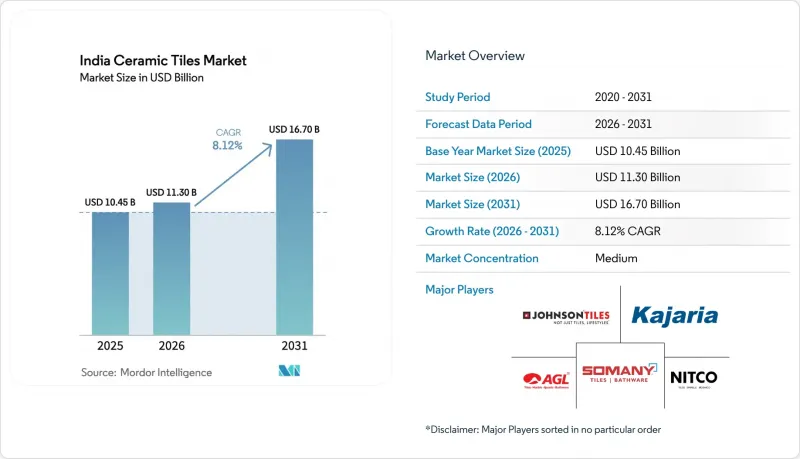
根據 Mordor Intelligence 預測,印度瓷磚市場預計將從 2025 年的 104.5 億美元成長到 2026 年的 113 億美元,到 2031 年達到 167 億美元,2026 年至 2031 年的複合年成長率為 8.12%。
本報告按產品類型(陶瓷瓷磚、釉藥陶瓷磚及其他)、應用領域(地面、牆面、屋頂)、最終用戶(住宅、商業)、施工類型(新建、維修/更換)、配銷通路(瓷磚石材專賣店、家居裝建材/DIY商店及其他)和地區(印度北部、南部、西部、東部)進行細分。市場預測以美元計價。
印度瓷磚市場的趨勢和洞察
經濟適用住宅和智慧城市計畫的擴建
截至2024年6月,總理住房計畫城市計畫(PMAY-U)在實現其提供經濟適用住宅的目標方面取得了顯著進展,全國範圍內已批准並交付數百萬套住宅,反映出都市區住宅供應的穩步成長。大型、組織完善的企業在這些時間緊迫的專案中具有優勢,因為它們更傾向於能夠準時交貨的供應商。在智慧城市的公共空間中,防滑等級為R10-R13的瓷質磚符合印度標準局(BIS)的標準。由於安全性和耐用性比初始成本更重要,產品組合正向高階瓷磚轉變。政府對經濟適用住宅和智慧城市基礎設施的持續投資確保了大型高價值項目的穩定供應,對瓷磚的需求仍然強勁。在都市化加快和消費者對品質和安全標準意識不斷提高的推動下,製造商有望從住宅和商業領域的持續成長中獲益。
都市區中產階級的房屋翻新熱潮
印度建築師和專案規範制定者對瓷磚的需求正日益從傳統的 600 毫米 x 600 毫米瓷磚轉向最大尺寸達 1600 毫米 x 3200 毫米的大尺寸板材瓷磚。這主要是由於高階商業空間(例如豪華住宅開發項目和酒店大廳)對無縫、美觀外觀的追求。為了滿足這一需求,印度本土製造商投資引進了先進的義大利壓制技術,該技術能夠最大限度地減少翹曲,並確保即使在大尺寸尺寸瓷磚上也能保持穩定的品質。這些技術升級使製造商能夠在保持相對較低的人事費用的同時,將大規格板材瓷磚的價格提高約 15% 至 25%。大規格板材磁磚正成為重要的高階收入來源,並在高階市場中佔據越來越重要的戰略地位。此外,大規格瓷磚瓷磚還有助於實現綠色建築目標,因為它可以減少灌漿的使用,從而降低揮發性有機化合物 (VOC) 的排放,並符合印度《節能建築標準法》的要求。在提高產能方面落後的製造商,將面臨失去印度瓷磚市場高階市場佔有率的風險。
天然氣價格大幅波動
天然氣價格波動對印度瓷磚製造商構成重大挑戰,尤其是在古吉拉突邦莫爾比等能源密集地區。燃料成本的不確定性使得製造商難以向建築商提供固定價格契約,迫使他們加入季度價格調整條款。這可能會疏遠經濟適用住宅領域對價格敏感的客戶。例如,2024年7月,古吉拉特天然氣公司將工業用氣價格上調了2-2.48印度盧比(0.023-0.029美元/標準立方米),導致當地製造商的能源成本增加8-12%,具體增幅取決於窯爐效率。由於天然氣成本佔變動成本的30%至35%,10%的價格波動可能導致毛利率下降3%至3.5%,直接影響2025年到期現有合約的獲利能力。此外,價格波動還會阻礙新的窯爐資本投資,因為貸款機構會要求更高的負債權益比率,而且投資回收前景也變得不明朗。一些生產商正透過轉向燃煤窯爐或安裝太陽能預熱系統來降低風險,並將成本波動降低5%至8%,但此類維修每條生產線需要15至25千瓦(180萬至300萬美元)的成本,並且需要18至24個月才能投入運作,這限制了其短期可行性。
細分市場分析
到2025年,釉藥瓷磚將佔據印度瓷磚市場39.75%的佔有率,鞏固其在中檔住宅項目中的主導地位,因為在這些項目中,建築商更注重成本而非美觀。然而,預計到2031年,磁磚的複合年成長率將達到11.33%。這一快速成長主要得益於建築師在豪華公寓、飯店大廳和機場航站大樓對低孔隙率、高強度材料的偏好。磁磚的吸水率低於0.5%,是建築物外牆和潮濕區域的理想選擇。像Somany Ceramics和H&R Johnson這樣的製造商採用義大利乾壓技術,能夠生產尺寸達1600毫米 x 3200毫米且翹曲度極低的瓷磚板材。無釉瓷磚正在工業和戶外環境中開闢出屬於自己的利基市場,在這些環境中,防滑性能比美觀更為重要。相較之下,馬賽克瓷磚更受精品室內設計師的青睞,也常用於歷史建築的修復。
磁磚利潤率可觀,平均售價比釉藥陶瓷磚高出20%至30%。同時,長石、高嶺土和石英等原料成本上漲了12%至15%。這些趨勢導致毛利率顯著提升了500至700個基點。正是基於這些經濟因素,卡爾加里亞陶瓷公司決定在2024會計年度投資20億印度盧比(約2,400萬美元),用於擴建其位於蓋爾布爾和馬魯特的兩家工廠的瓷磚產能。該公司計劃在2027會計年度將瓷磚在其總產量中的佔比提高到25%。雖然釉藥陶瓷磚目前仍主導著經濟適用住宅和二線城市市場,但其市場佔有率預計將會下降。這一轉變歸因於建築商提高了建築規範,而建築商的規範又受到社群媒體和住宅翻新節目的影響,從而改變了購屋者的預期。
到2025年,地磚將佔印度整個陶瓷磚市場的62.26%。這主要得益於地磚在住宅客廳、廚房和浴室等場所的廣泛應用,這些場所對耐用性和易清潔性要求極高。同時,牆磚預計將以9.37%的複合年成長率穩定成長至2031年。這一快速成長歸功於都市區住宅和商業房地產開發商擴大選擇採用數位噴墨印刷技術製作的圖案。這些圖案能夠以遠低於天然材料的成本,複製大理石、木材和織物的紋理。牆磚市場的這種轉變凸顯了市場優質化的大趨勢。如今,消費者比以往任何時候都更傾向於為特色牆面,特別是主臥和起居室的牆面,投入更多預算。山區度假勝地和沿海地區的政府法規強制要求使用黏土或混凝土屋頂瓦,強調其抗颶風和隔熱性能。
牆磚市場的成長與人均住宅裝修支出增加密切相關。根據ICRA報告顯示,預計這筆支出將從2020會計年度的18,000印度盧比(約216美元)增加至2024會計年度的26,000印度盧比(約312美元),尤其是在年收入超過10,000印度盧比(約合12,000美元)的都市區中。為了迎合千禧世代的喜好,建築商開始在開放式廚房和家庭辦公室等空間中使用牆磚。在這些曾經以油漆和壁紙為主的區域,牆磚使用量的增加使得每個項目的牆磚用量增加了8%至10%。地磚也受益於翻新需求的成長,但住宅正在顯著延長地板更換週期,他們用防滑瓷質磚替換使用了10至15年的玻璃磚。同時,屋頂瓦片正面臨金屬板和聚碳酸酯板的競爭,尤其是在工業倉庫領域。
其他好處:
- Excel格式的市場預測(ME)表
- 3個月的分析師支持
目錄
第1章:引言
- 研究假設和市場定義
- 調查範圍
第2章:調查方法
第3章執行摘要
第4章 市場狀況
- 市場概覽
- 市場促進因素
- 經濟適用住宅和智慧城市計畫的擴建
- 都市區中產階級的房屋翻新熱潮
- 大尺寸板材磁磚越來越受歡迎。
- Morbi Clusters 的氫氣相容型爐可顯著降低能源成本。
- 中小建築公司正在引入使用數位噴墨技術的批量客製化方案。
- 薄層砂漿覆蓋系統的應用正在不斷擴大。
- 市場限制因素
- 天然氣價格波動劇烈。
- 主要出口目的地國家正在徵收反傾銷稅。
- 蒙德拉港面臨物流瓶頸
- 商業領域向LVT/SPC地板的過渡
- 產業價值鏈分析
- 波特五力分析
- 洞察最新市場趨勢與創新
- 近期產業趨勢分析(新產品發布、策略性舉措、投資、合作、合資、業務擴張、併購等)
第5章 市場規模與成長預測
- 依產品類型
- 陶瓷瓷磚
- 釉藥磁磚
- 無釉陶瓷磚
- 馬賽克瓷磚
- 其他(裝飾性、圖案性、手工製作)
- 透過使用
- 地面
- 牆
- 屋頂材料
- 最終用戶
- 住宅
- 商業
- 飯店業(飯店、度假村)
- 零售空間
- 辦公室和公共設施
- 衛生保健
- 教育設施
- 交通樞紐(機場、捷運、客運站)
- 其他商業用戶
- 依建築類型
- 新建工程
- 維修和重建
- 透過分銷管道
- 磁磚和石材專賣店
- 家居裝修商店和DIY專賣店
- 線上零售
- 直接向承包商銷售
- 按地區
- 印度北部
- 南印度
- 西印度群島
- 東印度
第6章 競爭情勢
- 市場集中度
- 策略趨勢
- 市佔率分析
- 公司簡介
- Kajaria Ceramics Ltd
- Somany Ceramics Ltd
- H&R Johnson(India)
- Asian Granito India Ltd
- Nitco Ltd
- Orient Bell Ltd
- RAK Ceramics India
- Exxaro Tiles Ltd
- Varmora Granito
- Simpolo Ceramics
- Johnson Pedder
- Murudeshwar Ceramics(Naveen)
- Pavit Ceramics
- Grindwell Norton(Saint-Gobain India)
- Astral Tiles
- Cera Sanitaryware Ltd
- Capron Granito
- Metro City Tiles
- Itaca Ceramics
- Regent Granito
第7章 市場機會與未來展望
According to Mordor Intelligence, the India ceramic tiles market size is expected to increase from USD 10.45 billion in 2025 to USD 11.30 billion in 2026 and reach USD 16.70 billion by 2031, growing at a CAGR of 8.12% over 2026-2031.
This report is Segmented by Product Type (Porcelain, Glazed Ceramic, Others), Application (Floor, Wall, Roofing), End-User (Residential, Commercial), Construction Type (New, Renovation and Replacement), Distribution Channel (Specialty Tile & Stone Stores, Home Improvement & DIY Stores, Others), and Geography (North, South, West, East India). The Market Forecasts are Provided in Terms of Value (USD).
India Ceramic Tiles Market Trends and Insights
Growth in Affordable Housing and Smart City Projects
As of June 2024, the Pradhan Mantri Awas Yojana-Urban (PMAY-U) has made substantial progress toward its objective of delivering affordable housing, with several million homes sanctioned and delivered nationwide, reflecting steady advancement in urban housing supply. Builders working on these time-sensitive projects prefer suppliers that can deliver just-in-time, giving larger, organized players an edge. In smart-city public spaces, slip-resistant porcelain tiles rated R10-R13 comply with Bureau of Indian Standards norms. Product mixes are therefore tilting to premium slabs because safety and longevity outweigh upfront cost. Ongoing government investment in affordable housing and smart-city infrastructure ensures a steady pipeline of large-scale, high-value projects, supporting consistent demand for ceramic tiles. Coupled with increasing urbanization and rising consumer awareness of quality and safety standards, manufacturers are positioned to benefit from sustained growth in both residential and commercial segments.
Renovation Boom Among Urban Middle-Class
Demand from architects and project specifiers in India is increasingly moving away from conventional 600 mm X 600 mm tiles toward large-format slab tiles measuring up to 1,600 mm X 3,200 mm, driven by preferences for seamless aesthetics in luxury residential developments and premium commercial spaces such as hotel lobbies. To meet this demand, domestic manufacturers have invested in advanced Italian pressing technology that minimizes warpage and enables consistent quality at larger sizes. These technological upgrades allow producers to command price premiums of approximately 15%-25% over standard tiles, while incremental labor costs remain relatively contained. Large slabs are becoming a meaningful contributor to premium revenue streams, reinforcing their strategic importance within the higher-value segment of the market. Additionally, large-format tiles support green-building objectives by reducing grout usage, which in turn lowers volatile organic compound emissions and aligns with India's Energy Conservation Building Code. Manufacturers that fail to upgrade production capabilities risk losing share in the premium segment of the Indian ceramic tiles market.
Natural Gas Prices Experience Significant Fluctuations
Volatility in natural-gas prices poses a significant challenge for ceramic tile manufacturers in India, particularly those in energy-intensive regions like Morbi, Gujarat. Unpredictable fuel costs make it difficult for producers to offer fixed-price contracts to builders, forcing the inclusion of quarterly price-revision clauses that can alienate cost-sensitive customers in the affordable-housing segment. For instance, in July 2024, Gujarat Gas raised industrial gas prices by INR2-INR2.48 (USD 0.023-USD 0.029) per SCM, increasing energy bills for local manufacturers by 8% to 12% depending on kiln efficiency. Since gas accounts for 30%-35% of variable costs, a 10% price change can erode 3%-3.5% of gross margins, while legacy contracts expiring in 2025 face immediate margin pressure. Price volatility also discourages investment in new kiln capacity, as lenders require higher debt-service coverage and payback assumptions become uncertain. While some producers have mitigated risk by diversifying into coal-fired kilns or installing solar thermal pre-heaters, achieving 5%-8% lower cost variability, these retrofits demand INR15-25 crore (USD 1.8-3 million) per line and take 18-24 months to commission, limiting their short-term feasibility.
Other drivers and restraints analyzed in the detailed report include:
- Small Builders Embrace Digital-Inkjet Mass Customization
- Thin-Set Overlay Systems See Rising Adoption
- Commercial Shift Towards LVT/SPC Flooring
For complete list of drivers and restraints, kindly check the Table Of Contents.
Segment Analysis
In 2025, glazed ceramic tiles held a 39.75% India ceramic tiles market share, solidifying their dominance in mid-range residential projects where builders prioritize cost over aesthetics. However, porcelain tiles are set to grow at 11.33% CAGR through 2031. This surge is fueled by architects' preference for low-porosity, high-strength materials in luxury apartments, hotel lobbies, and airport terminals. With a water absorption rate below 0.5%, porcelain is ideal for exterior facades and wet areas. Manufacturers like Somany Ceramics and H&R Johnson have adopted Italian dry-pressing technology, enabling them to produce porcelain slabs measuring up to 1,600 mm X 3,200 mm with minimal warpage. Unglazed ceramic tiles find their niche in industrial and outdoor settings, prioritizing slip resistance over aesthetics. In contrast, mosaic tiles are favored by boutique interior designers and for heritage restoration.
Porcelain tiles boast an attractive margin profile: they achieve average selling prices 20% to 30% higher than glazed ceramics. Meanwhile, the rise in raw material costs for feldspar, kaolin, and quartz hovers between 12% to 15%. This dynamic results in an impressive 500 to 700 basis points of incremental gross margin. Such economics shed light on Kajaria Ceramics' decision to invest INR200 crore (USD 24 million) in fiscal 2024, aiming to boost porcelain capacity at its Gailpur and Maloot plants. The company targets a 25% contribution from porcelain to its total volumes by fiscal 2027. While glazed ceramics continue to dominate affordable housing and demand in tier-2 cities, their market share is poised to decline. This shift is attributed to builders elevating specifications, influenced by buyer expectations shaped by social media and home-improvement shows.
In 2025, floor tiles accounted for 62.26% of the total India ceramic tiles market size, primarily driven by their use in residential living rooms, kitchens, and bathrooms, where durability and ease of cleaning are paramount. Wall tiles, however, are set to experience a robust growth rate of 9.37% CAGR through 2031. This surge is attributed to urban homeowners and commercial developers increasingly opting for digital-inkjet patterns. These patterns mimic the aesthetics of marble, wood, and fabric textures, all at a fraction of the cost of their natural counterparts. This shift towards wall tiles underscores a broader trend of premiumization in the market. Buyers are now willing to allocate larger budgets for feature walls, especially in master bedrooms and reception areas. Government mandates in hill stations and coastal zones specify clay or concrete roofing tiles, emphasizing their cyclone resistance and thermal insulation properties.
The growth of wall tiles is closely linked to an uptick in per-capita spending on home interiors. This spending rose from INR18,000 (USD 216) in fiscal 2020 to INR26,000 (USD 312) in fiscal 2024, as reported by ICRA, and is particularly notable among urban households earning above INR10 lakh (USD 12,000) annually. Builders, keenly attuned to millennial preferences, are now installing wall tiles in spaces like open kitchens and home offices. These areas, once dominated by paint or wallpaper, have seen an 8% to 10% increase in wall-tile volumes per project due to this expanded usage. While floor tiles are riding the wave of renovations, homeowners are swapping 10- to 15-year-old vitrified tiles for anti-skid porcelain; the replacement cycle for floors is notably longer. On the other hand, roofing tiles are facing competition from metal sheets and polycarbonate panels, especially in industrial sheds.
Complete Report Scope:
- By Product Type
- Porcelain Tiles
- Glazed Ceramic Tiles
- Unglazed Ceramic Tiles
- Mosaic Tiles
- Others (Decorative, Patterned, Handmade)
- By Application
- Floor
- Wall
- Roofing
- By End-User
- Residential
- Commercial
- Hospitality (Hotels, Resorts)
- Retail Spaces
- Offices & Institutions
- Healthcare
- Educational Facilities
- Transport Hubs (Airports, Metro, Bus Terminals)
- Other Commercial Users
- By Construction Type
- New Construction
- Renovation and Replacement
- By Distribution Channel
- Specialty Tile & Stone Stores
- Home Improvement & DIY Stores
- Online Retail
- Direct Sales to Contractors
- By Geography
- North India
- South India
- West India
- East India
List of Companies Covered in this Report:
- Kajaria Ceramics Ltd
- Somany Ceramics Ltd
- H&R Johnson (India)
- Asian Granito India Ltd
- Nitco Ltd
- Orient Bell Ltd
- RAK Ceramics India
- Exxaro Tiles Ltd
- Varmora Granito
- Simpolo Ceramics
- Johnson Pedder
- Murudeshwar Ceramics (Naveen)
- Pavit Ceramics
- Grindwell Norton (Saint-Gobain India)
- Astral Tiles
- Cera Sanitaryware Ltd
- Capron Granito
- Metro City Tiles
- Itaca Ceramics
- Regent Granito
Additional Benefits:
- The market estimate (ME) sheet in Excel format
- 3 months of analyst support
TABLE OF CONTENTS
1 Introduction
- 1.1 Study Assumptions & Market Definition
- 1.2 Scope of the Study
2 Research Methodology
3 Executive Summary
4 Market Landscape
- 4.1 Market Overview
- 4.2 Market Drivers
- 4.2.1 Growth in Affordable Housing and Smart City Projects
- 4.2.2 Renovation Boom Among Urban Middle-Class
- 4.2.3 Large-Format Slab Tiles Gain Popularity
- 4.2.4 Morbi Clusters' Hydrogen-Ready Kilns Slash Energy Costs
- 4.2.5 Small Builders Embrace Digital-Inkjet Mass Customization
- 4.2.6 Thin-Set Overlay Systems See Rising Adoption
- 4.3 Market Restraints
- 4.3.1 Natural Gas Prices Experience Significant Fluctuations
- 4.3.2 Key Export Destinations Impose Anti-Dumping Duties
- 4.3.3 Mundra Port Faces Logistics Bottlenecks
- 4.3.4 Commercial Shift Towards LVT/SPC Flooring
- 4.4 Industry Value Chain Analysis
- 4.5 Porter's Five Forces Analysis
- 4.5.1 Threat of New Entrants
- 4.5.2 Bargaining Power of Suppliers
- 4.5.3 Bargaining Power of Buyers
- 4.5.4 Threat of Substitutes
- 4.5.5 Competitive Rivalry
- 4.6 Insights into the Latest Trends and Innovations in the Market
- 4.7 Insights on Recent Developments (New Product Launches, Strategic Initiatives, Investments, Partnerships, JVs, Expansion, M&As, etc.) in the Industry
5 Market Size & Growth Forecasts (Value in USD)
- 5.1 By Product Type
- 5.1.1 Porcelain Tiles
- 5.1.2 Glazed Ceramic Tiles
- 5.1.3 Unglazed Ceramic Tiles
- 5.1.4 Mosaic Tiles
- 5.1.5 Others (Decorative, Patterned, Handmade)
- 5.2 By Application
- 5.2.1 Floor
- 5.2.2 Wall
- 5.2.3 Roofing
- 5.3 By End-User
- 5.3.1 Residential
- 5.3.2 Commercial
- 5.3.2.1 Hospitality (Hotels, Resorts)
- 5.3.2.2 Retail Spaces
- 5.3.2.3 Offices & Institutions
- 5.3.2.4 Healthcare
- 5.3.2.5 Educational Facilities
- 5.3.2.6 Transport Hubs (Airports, Metro, Bus Terminals)
- 5.3.2.7 Other Commercial Users
- 5.4 By Construction Type
- 5.4.1 New Construction
- 5.4.2 Renovation and Replacement
- 5.5 By Distribution Channel
- 5.5.1 Specialty Tile & Stone Stores
- 5.5.2 Home Improvement & DIY Stores
- 5.5.3 Online Retail
- 5.5.4 Direct Sales to Contractors
- 5.6 By Geography
- 5.6.1 North India
- 5.6.2 South India
- 5.6.3 West India
- 5.6.4 East India
6 Competitive Landscape
- 6.1 Market Concentration
- 6.2 Strategic Moves
- 6.3 Market Share Analysis
- 6.4 Company Profiles (includes Global level Overview, Market level overview, Core Segments, Financials as available, Strategic Information, Market Rank/Share for key companies, Products & Services, and Recent Developments)
- 6.4.1 Kajaria Ceramics Ltd
- 6.4.2 Somany Ceramics Ltd
- 6.4.3 H&R Johnson (India)
- 6.4.4 Asian Granito India Ltd
- 6.4.5 Nitco Ltd
- 6.4.6 Orient Bell Ltd
- 6.4.7 RAK Ceramics India
- 6.4.8 Exxaro Tiles Ltd
- 6.4.9 Varmora Granito
- 6.4.10 Simpolo Ceramics
- 6.4.11 Johnson Pedder
- 6.4.12 Murudeshwar Ceramics (Naveen)
- 6.4.13 Pavit Ceramics
- 6.4.14 Grindwell Norton (Saint-Gobain India)
- 6.4.15 Astral Tiles
- 6.4.16 Cera Sanitaryware Ltd
- 6.4.17 Capron Granito
- 6.4.18 Metro City Tiles
- 6.4.19 Itaca Ceramics
- 6.4.20 Regent Granito
7 Market Opportunities & Future Outlook
- 7.1 Rapid Adoption of Large-Format and Premium Aesthetic Tiles
- 7.2 Expansion of Digital Sales Channels and Customized Tile Solutions

 德國瓷磚:市場佔有率分析、產業趨勢與統計及成長預測(2026-2031)法國陶瓷磚:市場佔有率分析、產業趨勢與統計及成長預測(2026-2031)泰國瓷磚市場:市佔率分析、產業趨勢與統計及成長預測(2026-2031)英國磁磚市場:市佔率分析、產業趨勢與統計及成長預測(2026-2031)日本陶瓷磚:市佔率分析、產業趨勢與統計及成長預測(2026-2031)義大利瓷磚:市佔率分析、產業趨勢與統計及成長預測(2026-2031)中國瓷磚市場:市場佔有率分析、行業趨勢與統計及成長預測(2026-2031年)印尼陶瓷磚市場:市場佔有率分析、產業趨勢與統計及成長預測(2026-2031)越南瓷磚市場:市場佔有率分析、產業趨勢與統計及成長預測(2026-2031)
 2026-2030年全球陶瓷磚市場