

 |
市場調查報告書
商品編碼
2114945
日本陶瓷磚:市佔率分析、產業趨勢與統計及成長預測(2026-2031)Japan Ceramic Tiles - Market Share Analysis, Industry Trends & Statistics, Growth Forecasts (2026 - 2031) |
||||||

※ 本網頁內容可能與最新版本有所差異。詳細情況請與我們聯繫。
根據 Mordor Intelligence 估計,2026 年日本瓷磚市場價值為 118.1 億美元,預計在預測期(2026-2031 年)內將以 3.32% 的複合年成長率成長,到 2031 年達到 139.1 億美元。
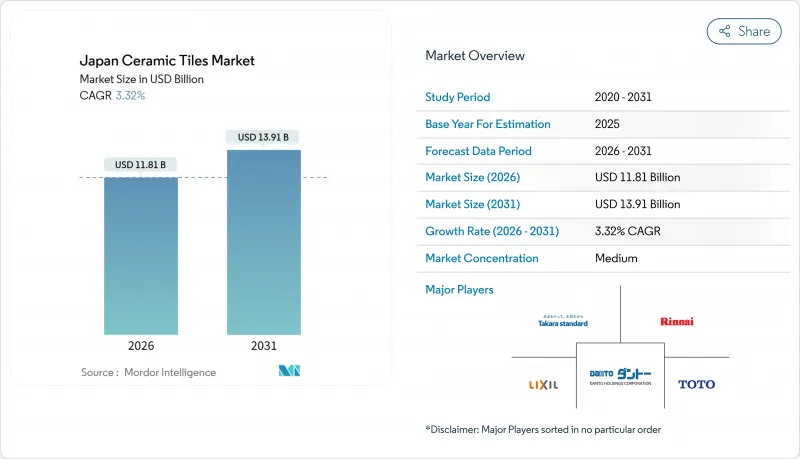
本報告按產品類型(陶瓷瓷磚、釉藥等)、應用領域(地面、牆面等)、最終用戶(住宅、商業)、施工類型(新建、維修)、配銷通路(瓷磚石材專賣店、家居建材店、DIY商店等)和地區(東京都會區、關西地區等)進行細分。市場預測以以金額為準呈現。
日本瓷磚市場的趨勢與洞察
新冠疫情爆發後,對抗菌和抗病毒釉藥的需求激增。
在後疫情時代,日本醫療和旅館業對抗菌抗病毒陶瓷表面材料的需求日益成長,推動了高階瓷磚產品的持續需求。領先的製造商正積極回應,推出光催化技術和易維護陶瓷技術等創新解決方案,在滿足感染控制標準的同時,兼顧高人流環境的耐用性和實用性。在東京和大阪的大規模維修和新開業項目中,尤其是在豪華酒店和醫療機構中,抗菌牆面和地面系統正被列為指定配置,進一步提升了以衛生為優先的應用領域的重要性。抗菌抗病毒瓷磚兼具更高的耐用性、符合衛生標準和易於維護等優點,必將繼續在醫療機構和高階酒店項目中發揮重要作用。
政府對零能耗住宅的補貼正在促進高性能陶瓷瓷磚的普及。
日本的公共政策和產業措施正在加速零能耗住宅標準的普及,從而帶動了對高性能建築材料(例如高檔陶瓷和瓷磚)的需求。大型住宅開發人員正在大幅增加零能耗住宅的供應,這不僅反映了政府的獎勵,也反映了市場對節能建築的偏好。例如,2023年,日本最大的住宅建設公司之一積水住宅在全國範圍內供應了數萬套淨零能耗獨棟住宅。在最近一個會計年度,該公司建造的獨棟住宅幾乎全部(約93%)都符合日本的淨零能耗(ZEH)標準,這體現了該公司對節能住宅的重視以及其「綠色優先零能耗」模式在全國範圍內的推廣。這種對節能和脫碳的持續投入正從獨棟住宅擴展到其他領域,例如租賃住宅和公寓項目,這些領域的零能耗住宅普及率都在不斷提高。這些項目的廣泛實施凸顯了政府補貼和法規結構在促進節能建築方面的有效性。隨著建築公司不斷實現並超越零能耗目標,對高隔熱性和耐用性建築材料(例如用於高性能建築圍護結構的優質陶瓷瓷磚)的需求,仍然是支撐日本瓷磚市場的重要趨勢。
農村地區新開工住宅數量減少
近年來,日本的住宅建設活動持續下滑,尤其是在農村地區和中等城市。這抑制了大都會圈以外地區新建住宅對瓷磚的需求。這一趨勢對與新建獨棟住宅密切相關的通用牆地磚的銷售量造成了壓力,縮小了這些地區的成長空間。高度依賴本地新建住宅市場的瓷磚製造商面臨利潤率壓力,並被要求轉向高附加價值產品和開發出口市場。由於人口結構的變化,未來的需求預計將更多地依賴翻新和維修項目,而非新建住宅。因此,擁有專門針對翻新專案的產品線和靈活物流網路的供應商在滿足小規模、專案型需求方面具有優勢。農村地區新建住宅開工量的持續下降是限制日本瓷磚市場整體擴張的主要阻礙因素。
細分市場分析
預計到2025年,瓷磚將佔日本陶瓷磚市場銷售量的46.15%,成為住宅和商業項目中高階、高性能瓷磚的整體。節能法規和零能耗住宅的興起,推動了這個細分市場的發展,這些趨勢強調低吸水率、高熱容量和長使用壽命。驪住(LIXIL)的「ViCORE」系列地磚等大尺寸產品,進一步提升了磁磚在高人流區域和模組化施工流程的適用性。設計師也將磁磚應用於室外空間以及溫度變化劇烈和磨損嚴重的區域,從而增強了這一品類的實用性和可靠性。同時,通用型釉藥陶瓷磚,尤其是在浴室和廚房等中等預算和翻新需求領域,繼續保持穩定的市場地位。
儘管馬賽克瓷磚的市場規模較小,但預計將成為成長最快的細分市場,複合年成長率 (CAGR) 為 3.48%。這主要歸功於日本瓷磚行業的數位印刷技術提高了單位成本,並實現了前置作業時間。像名古屋馬賽克這樣的專業製造商正在擴展其手工馬賽克片和橢圓形瓷磚的產品線,以滿足裝飾牆和緊湊型浴室空間的需求。在防滑和耐油性至關重要的工業和物流設施中,無釉馬賽克仍然需求旺盛,其性能優於瓷磚和釉藥產品。裝飾性和手工馬賽克在高階市場仍然備受青睞,強調豐富的紋理和與設計師合作精心挑選的色彩搭配。這些趨勢共同作用,使瓷磚在注重性能的應用領域佔據核心地位,而馬賽克則越來越受到高曝光區域的青睞,成為一種以設計主導的解決方案。
到2025年,地磚將佔安裝總量的52.13%,繼續成為浴室、廚房、走廊和公共區域等對耐用性和防滑性要求極高的場所的標準配置。這佔據了日本瓷磚市場相當大的佔有率。住宅和養老機構改造中地暖的引入,進一步強化了人們對瓷磚和高階陶瓷磚的偏好。在商業室內空間,地板系統的維護效率是關鍵考慮因素,更大的模組尺寸可以減少勾縫線數量,簡化清潔流程。減少停機時間和降低現場複雜性的安裝方法,有助於在有人使用的空間內進行可靠的更換工作。在人手不足的情況下,地板系統精簡的工作流程是維持日本各地高需求都市區安裝能力的切實可行的解決方案。
牆磚市場預計將以3.36%的複合年成長率成長。這主要得益於酒店和零售商的整修需求,他們傾向於選擇大尺寸瓷磚和設計精美的馬賽克瓷磚來打造大廳、特色走廊和提升品牌形象的背景牆。在廚房和浴室中,牆磚不僅提升了衛生便利性,還能與地板材料保持視覺上的統一,並透過紋理和圖案營造空間深度。在公共空間,人們越來越重影片繁接觸的垂直表面的耐用性和安全性,抗菌防污的飾面也變得越來越普遍。屋頂鋪設仍然是一個小眾領域,主要用於傳統和歷史建築的維修,其材料選擇取決於當地法規和文化習俗。整體而言,在日本瓷磚市場,地磚在面積上佔據主導地位,但在注重設計的豪華項目中,牆磚的平方公尺價值更高。
其他好處:
- Excel格式的市場預測(ME)表
- 3個月的分析師支持
目錄
第1章:引言
- 研究假設和市場定義
- 調查範圍
第2章:調查方法
第3章執行摘要
第4章 市場狀況
- 市場概覽
- 市場促進因素
- 新冠疫情後,對抗菌和抗病毒處理過的玻璃表面的需求激增。
- 政府對零能耗住宅的補貼鼓勵了高性能陶瓷瓷磚的採用。
- 住宅存量老化導致地板瓷磚需要更換,這是房屋翻新的一部分。
- 預製模組化建築的快速發展需要輕質、大尺寸的磁磚。
- 數位印刷技術正在降低室內設計師定製圖案的成本。
- 利用奧運遺產,透過旅遊投資升級酒店設施的內部裝潢,這項計劃將持續到 2028 年。
- 市場限制因素
- 地方政府新開工住宅數量減少
- 天然氣價格飆升推高了窯爐的能源成本。
- 當地勞動市場緊張,限制了瓷磚工的工作能力。
- 在價格敏感型市場,LVT和SPC硬芯地板面臨競爭。
- 產業價值鏈分析
- 監理情勢
- 技術展望
- 波特五力分析
- 洞察最新市場趨勢與創新
- 近期產業趨勢分析(新產品發布、策略性舉措、投資、合作、合資、業務擴張、併購等)
第5章 市場規模與成長預測
- 依產品類型
- 瓷質磚
- 釉藥磁磚
- 無釉陶瓷磚
- 馬賽克瓷磚
- 裝飾性/圖案性/手工瓷磚
- 透過使用
- 地面
- 牆
- 屋頂材料
- 最終用戶
- 住宅
- 商業
- 飯店業(飯店、度假村)
- 零售空間
- 辦公室和公共設施
- 衛生保健
- 教育設施
- 交通樞紐(機場、捷運、客運站)
- 其他商業用戶
- 依建築類型
- 新建工程
- 維修和重建
- 透過分銷管道
- 磁磚和石材專賣店
- 家居裝修商店和DIY商店
- 線上零售
- 直接向承包商銷售
- 按地區
- 大東京地區(東京都、神奈川縣、埼玉縣和千葉縣)
- 關西地區(大阪、京都、兵庫)
- 中部地區(愛知縣、岐阜縣、三重縣)
- 日本其他地區
第6章 競爭情勢
- 市場集中度
- 策略趨勢
- 市佔率分析
- 公司簡介
- LIXIL Corporation(INAX)
- Rinnai Ceramic Tiles
- Danto Tile Co., Ltd.
- TOTO Ltd.
- Takara Standard Co., Ltd.
- Nagoya Mosaic-Tile Co., Ltd.
- Maristo Co., Ltd.
- Kajaria Ceramics(Japan arm)
- Mohawk Industries
- RAK Ceramics PJSC
- SCG Ceramics
- Iris Ceramica Group(Fiandre Japan)
- Crossville Inc.(Japan reps)
- Pamesa Grupo(Japan agents)
- Grupo Lamosa(Japan)
- Portobello Grupo(Japan)
- Florim Ceramiche
- Panaria Group(Japan)
- China Ceramics Co., Ltd.
- Shinagawa Refractories Co., Ltd.
第7章 市場機會與未來展望
According to Mordor Intelligence, the Japan ceramic tiles market size is estimated at USD 11.81 billion in 2026, and is expected to reach USD 13.91 billion by 2031, at a CAGR of 3.32% during the forecast period (2026-2031).
This report is Segmented by Product Type (Porcelain, Glazed Ceramic, and More), Application (Floor, Wall, and More), End-User (Residential, Commercial), Construction Type (New Construction, Renovation), Distribution Channel (Specialty Tile & Stone Stores, Home Improvement & DIY Stores, and More), and Geography (Greater Tokyo, Kansai, and More). Market Forecasts are Provided in Value Terms.
Japan Ceramic Tiles Market Trends and Insights
Surging Demand for Antibacterial & Antiviral Glazed Surfaces Post-COVID-19
In the post-COVID-19 landscape, Japan's healthcare and hospitality sectors increasingly require ceramic surfaces with antibacterial and antiviral properties, driving sustained demand for premium tile products. Leading manufacturers have responded with innovative solutions such as photocatalytic and easy-to-maintain ceramic technologies that meet infection-control standards while remaining durable and practical for high-traffic environments. Major renovations and new openings in Tokyo and Osaka, particularly in luxury hotels and healthcare facilities, are specifying antibacterial wall and floor systems, reinforcing the importance of hygiene-focused applications. The combination of enhanced durability, hygiene compliance, and ease of maintenance ensures that antibacterial and antiviral tiles continue to support value-added specifications in both healthcare and premium hospitality projects.
Government Subsidies for Zero-Energy Homes Boosting High-Spec Porcelain Adoption
Public policy and industry initiatives in Japan are accelerating the adoption of zero-energy housing standards, which in turn support demand for high-performance building materials such as premium ceramic and porcelain tiles. Leading housing developers have significantly increased their delivery of zero-energy homes, reflecting both government incentives and market preference for energy-efficient construction. For example, in 2023, Sekisui House, one of Japan's largest homebuilders, supplied tens of thousands of net-zero energy detached homes across the country. In the most recent fiscal year, nearly all of its newly built single-family houses, about 93%, met Japan's net zero energy ZEH standards, reflecting the company's focus on energy-efficient homes and nationwide adoption of its Green First ZERO model. This sustained focus on energy conservation and decarbonization has extended beyond detached houses to other segments, including rental housing and condominium projects, with high rates of zero-energy adoption across these categories. The broad implementation of these projects underscores the effectiveness of government subsidy programs and regulatory frameworks in driving energy-efficient construction. As builders continue to meet and exceed zero-energy targets, the requirement for thermally efficient and durable materials such as premium porcelain tiles within high-performance building envelopes remains a key trend supporting the Japan ceramic tiles market.
Declining New-Build Housing Starts in Provincial Prefectures
The residential activity in Japan has been declining in recent years, particularly in provincial and secondary cities, which limits demand for new-build ceramic tiles outside major metropolitan areas. This trend constrains volumes for commodity wall and floor tiles tied to new detached housing, reducing growth opportunities in these regions. Tile manufacturers with heavy exposure to local new-build channels face margin pressure and are increasingly required to pivot toward higher-value products or explore export markets. Structural demographic shifts suggest that future demand will rely more on renovation and retrofit activity rather than new housing construction. Consequently, suppliers with integrated renovation-focused product ranges and flexible logistics networks are better positioned to address smaller, project-based demand. This ongoing decline in provincial new-build activity acts as a key restraint on overall market expansion for ceramic tiles in Japan.
Other drivers and restraints analyzed in the detailed report include:
- Aging Housing Stock Driving Renovation-Led Floor-Tile Replacement
- Rapid Growth of Prefabricated Modular Construction Requiring Lightweight Large-Format Tiles
- Rising Natural-Gas Prices Inflating Kiln Energy Costs
For complete list of drivers and restraints, kindly check the Table Of Contents.
Segment Analysis
Porcelain held 46.15% of the 2025 volume, anchoring premium and performance-led specifications across residential and commercial projects within the Japan ceramic tiles market. The segment benefits from energy-saving regulations and the adoption of zero-energy homes, which favor low water absorption, thermal mass, and long service life. Large-format offerings, such as LIXIL's ViCORE floor range, reinforce porcelain's suitability for high-traffic areas and modular construction workflows. Designers also choose porcelain for exterior envelopes and spaces exposed to temperature fluctuations or heavy wear, adding depth and reliability to the category. Meanwhile, commodity glazed ceramics continue to serve mid-tier budgets and renovation-heavy applications, particularly in bathrooms and kitchens, maintaining a stable base in the market.
Mosaic tiles post the fastest projected growth at a 3.48% CAGR on a smaller base, as digital printing enables bespoke patterns with improved unit economics and faster lead times in the Japan ceramic tiles industry. Specialty producers like Nagoya Mosaic have expanded artisanal sheets and small-format lines, catering to feature walls and compact wet areas. Unglazed mosaics maintain relevance in industrial and logistics settings where slip resistance and oil resistance are critical, outperforming porcelain or glazed options. Decorative and handmade mosaics continue to serve the luxury segment, emphasizing tactile finishes and curated color palettes through designer collaborations. Together, these trends position porcelain at the center of performance-driven applications, while mosaics grow as the preferred design-led solution in high-visibility areas.
Floor tiles accounted for 52.13% of 2025 application volume and remain the baseline in bathrooms, kitchens, corridors, and public areas where durability and slip resistance are non-negotiable; this level indicates a notable portion of the Japan ceramic tiles market share. Radiant floor heating integrations in residential and elder-care upgrades further reinforce the preference for porcelain and higher-grade ceramics. In commercial interiors, floor systems prioritize maintenance efficiency, with larger modules reducing grout lines and simplifying cleaning cycles. Installation methods that shorten downtime and lower on-site complexity support steady replacement activity in occupied spaces. Persistent labor constraints make streamlined floor-system workflows a practical solution for maintaining throughput in high-demand urban areas across Japan.
Wall tiles are forecast to grow at a 3.36% CAGR, supported by hospitality and retail upgrades that favor large-format porcelain and high-design mosaics for lobbies, feature corridors, and branded backdrops. In kitchens and bathrooms, wall tiles extend hygiene and visual continuity with flooring while creating depth through texture and pattern. Public spaces increasingly specify antibacterial and stain-resistant finishes for high-touch vertical surfaces, emphasizing durability and safety. Roofing remains a niche segment, mainly in traditional and heritage renovations where local regulations or cultural expectations dictate material choice. Overall, floor tiles dominate by area, while wall tiles capture a higher per-square-meter value in premium, design-led projects in the Japan ceramic tiles market.
Complete Report Scope:
- By Product Type
- Porcelain Tiles
- Glazed Ceramic Tiles
- Unglazed Ceramic Tiles
- Mosaic Tiles
- Decorative / Patterned / Handmade Tiles
- By Application
- Floor
- Wall
- Roofing
- By End-User
- Residential
- Commercial
- Hospitality (Hotels, Resorts)
- Retail Spaces
- Offices & Institutions
- Healthcare
- Educational Facilities
- Transport Hubs (Airports, Metro, Bus Terminals)
- Other Commercial Users
- By Construction Type
- New Construction
- Renovation & Replacement
- By Distribution Channel
- Specialty Tile & Stone Stores
- Home Improvement & DIY Stores
- Online Retail
- Direct Sales to Contractors
- By Geography
- Greater Tokyo Area (Tokyo, Kanagawa, Saitama, Chiba)
- Kansai Region (Osaka, Kyoto, Hyogo)
- Chubu Region (Aichi, Gifu, Mie)
- Rest of Japan
List of Companies Covered in this Report:
- LIXIL Corporation (INAX)
- Rinnai Ceramic Tiles
- Danto Tile Co., Ltd.
- TOTO Ltd.
- Takara Standard Co., Ltd.
- Nagoya Mosaic-Tile Co., Ltd.
- Maristo Co., Ltd.
- Kajaria Ceramics (Japan arm)
- Mohawk Industries
- RAK Ceramics PJSC
- SCG Ceramics
- Iris Ceramica Group (Fiandre Japan)
- Crossville Inc. (Japan reps)
- Pamesa Grupo (Japan agents)
- Grupo Lamosa (Japan)
- Portobello Grupo (Japan)
- Florim Ceramiche
- Panaria Group (Japan)
- China Ceramics Co., Ltd.
- Shinagawa Refractories Co., Ltd.
Additional Benefits:
- The market estimate (ME) sheet in Excel format
- 3 months of analyst support
TABLE OF CONTENTS
1 Introduction
- 1.1 Study Assumptions & Market Definition
- 1.2 Scope of the Study
2 Research Methodology
3 Executive Summary
4 Market Landscape
- 4.1 Market Overview
- 4.2 Market Drivers
- 4.2.1 Surging demand for antibacterial & antiviral glazed surfaces post-COVID-19
- 4.2.2 Government subsidies for zero-energy homes boosting high-spec porcelain adoption
- 4.2.3 Aging housing stock driving renovation-led floor-tile replacement
- 4.2.4 Rapid growth of prefabricated modular construction requiring lightweight large-format tiles
- 4.2.5 Digital-printing technology lowering custom-pattern costs for interior designers
- 4.2.6 Olympics-legacy tourism investments upgrading hospitality interiors through 2028
- 4.3 Market Restraints
- 4.3.1 Declining new-build housing starts in provincial prefectures
- 4.3.2 Rising natural-gas prices inflating kiln energy costs
- 4.3.3 Tight local labour market limiting tile-setter capacity
- 4.3.4 Competition from LVT and SPC rigid-core flooring in price-sensitive segments
- 4.4 Industry Value Chain Analysis
- 4.5 Regulatory Landscape
- 4.6 Technological Outlook
- 4.7 Porter's Five Forces Analysis
- 4.7.1 Threat of New Entrants
- 4.7.2 Bargaining Power of Suppliers
- 4.7.3 Bargaining Power of Buyers
- 4.7.4 Threat of Substitutes
- 4.7.5 Competitive Rivalry
- 4.8 Insights into the Latest Trends and Innovations in the Market
- 4.9 Insights on Recent Developments (New Product Launches, Strategic Initiatives, Investments, Partnerships, JVs, Expansion, M&As, etc.) in the Industry
5 Market Size & Growth Forecasts
- 5.1 By Product Type
- 5.1.1 Porcelain Tiles
- 5.1.2 Glazed Ceramic Tiles
- 5.1.3 Unglazed Ceramic Tiles
- 5.1.4 Mosaic Tiles
- 5.1.5 Decorative / Patterned / Handmade Tiles
- 5.2 By Application
- 5.2.1 Floor
- 5.2.2 Wall
- 5.2.3 Roofing
- 5.3 By End-User
- 5.3.1 Residential
- 5.3.2 Commercial
- 5.3.2.1 Hospitality (Hotels, Resorts)
- 5.3.2.2 Retail Spaces
- 5.3.2.3 Offices & Institutions
- 5.3.2.4 Healthcare
- 5.3.2.5 Educational Facilities
- 5.3.2.6 Transport Hubs (Airports, Metro, Bus Terminals)
- 5.3.2.7 Other Commercial Users
- 5.4 By Construction Type
- 5.4.1 New Construction
- 5.4.2 Renovation & Replacement
- 5.5 By Distribution Channel
- 5.5.1 Specialty Tile & Stone Stores
- 5.5.2 Home Improvement & DIY Stores
- 5.5.3 Online Retail
- 5.5.4 Direct Sales to Contractors
- 5.6 By Geography
- 5.6.1 Greater Tokyo Area (Tokyo, Kanagawa, Saitama, Chiba)
- 5.6.2 Kansai Region (Osaka, Kyoto, Hyogo)
- 5.6.3 Chubu Region (Aichi, Gifu, Mie)
- 5.6.4 Rest of Japan
6 Competitive Landscape
- 6.1 Market Concentration
- 6.2 Strategic Moves
- 6.3 Market Share Analysis
- 6.4 Company Profiles (includes Global level Overview, Market level overview, Core Segments, Financials as available, Strategic Information, Market Rank/Share, Products & Services, Recent Developments)
- 6.4.1 LIXIL Corporation (INAX)
- 6.4.2 Rinnai Ceramic Tiles
- 6.4.3 Danto Tile Co., Ltd.
- 6.4.4 TOTO Ltd.
- 6.4.5 Takara Standard Co., Ltd.
- 6.4.6 Nagoya Mosaic-Tile Co., Ltd.
- 6.4.7 Maristo Co., Ltd.
- 6.4.8 Kajaria Ceramics (Japan arm)
- 6.4.9 Mohawk Industries
- 6.4.10 RAK Ceramics PJSC
- 6.4.11 SCG Ceramics
- 6.4.12 Iris Ceramica Group (Fiandre Japan)
- 6.4.13 Crossville Inc. (Japan reps)
- 6.4.14 Pamesa Grupo (Japan agents)
- 6.4.15 Grupo Lamosa (Japan)
- 6.4.16 Portobello Grupo (Japan)
- 6.4.17 Florim Ceramiche
- 6.4.18 Panaria Group (Japan)
- 6.4.19 China Ceramics Co., Ltd.
- 6.4.20 Shinagawa Refractories Co., Ltd.
7 Market Opportunities & Future Outlook
- 7.1 Carbon-neutral kilns leveraging hydrogen blending to meet 2030 Tokyo cap-and-trade targets
- 7.2 Smart anti-slip IoT-enabled floor tiles for elder-care facilities addressing falls-prevention mandates

 德國瓷磚:市場佔有率分析、產業趨勢與統計及成長預測(2026-2031)法國陶瓷磚:市場佔有率分析、產業趨勢與統計及成長預測(2026-2031)泰國瓷磚市場:市佔率分析、產業趨勢與統計及成長預測(2026-2031)英國磁磚市場:市佔率分析、產業趨勢與統計及成長預測(2026-2031)義大利瓷磚:市佔率分析、產業趨勢與統計及成長預測(2026-2031)中國瓷磚市場:市場佔有率分析、行業趨勢與統計及成長預測(2026-2031年)印尼陶瓷磚市場:市場佔有率分析、產業趨勢與統計及成長預測(2026-2031)印度瓷磚市場:市場佔有率分析、行業趨勢與統計及成長預測(2026-2031)越南瓷磚市場:市場佔有率分析、產業趨勢與統計及成長預測(2026-2031)
 2026-2030年全球陶瓷磚市場