


 |
市場調查報告書
商品編碼
2124081
義大利瓷磚:市佔率分析、產業趨勢與統計及成長預測(2026-2031)Italy Ceramic Tiles - Market Share Analysis, Industry Trends & Statistics, Growth Forecasts (2026 - 2031) |
||||||

※ 本網頁內容可能與最新版本有所差異。詳細情況請與我們聯繫。
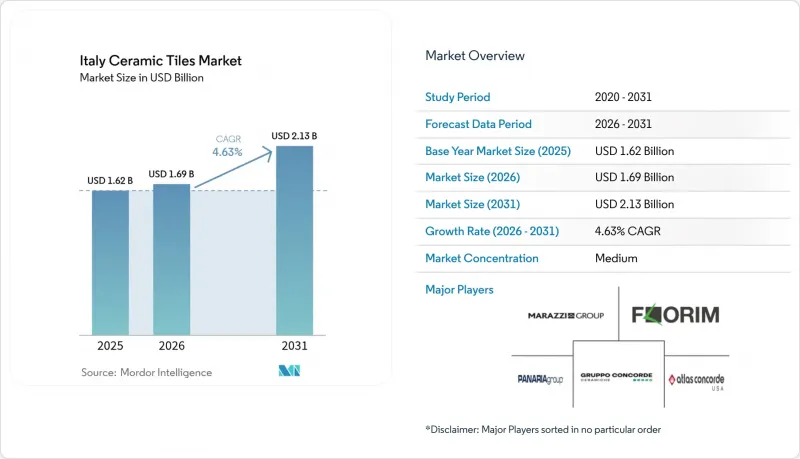
根據 Mordor Intelligence 預測,義大利瓷磚市場規模將從 2025 年的 16.2 億美元成長到 2026 年的 16.9 億美元,到 2031 年將達到 21.3 億美元,2026 年至 2031 年的複合年成長率為 4.63%。
本報告按產品類型(陶瓷瓷磚、釉藥等)、應用領域(地面、牆面、屋頂)、最終用戶(住宅、商業)、施工類型(新建、維修/更換)、配銷通路(專賣店、家居建材中心、線上零售、直銷)和地區進行細分。市場預測以美元計價。
義大利瓷磚市場的趨勢和洞察
政府對節能維修的獎勵
「2025浴室維修提供高達48,000歐元的50%稅額扣抵,直接刺激了維修項目中對瓷磚的需求。系統化的支付和文件規則有利於專業承包商和成熟的零售通路。該計劃在義大利北部地區最為活躍,因為那裡的高房價促使人們選擇更高檔的裝修材料和更大的維修預算。該計畫與歐盟「綠色住宅指令」的契合,進一步加速了節能型維修,將提升隔熱性能與美觀性結合。合規程序的透明度提高,有助於形成可預測的浴室維修週期,從而促進中期市場穩定。越來越多的業主將瓷磚鋪設視為一項雙贏的投資,既滿足了法規要求,也提升了設計美感。該計劃的文件要求,包括發票保存和許可證合規性,更有利於成熟的瓷磚零售商和專業承包商,而非非正規市場管道。
老舊住宅存量是推動維修的主要動力。
義大利戰後重建時期建造的住宅如今已達到15-20年的維護週期,這推動了瓷磚飾面的可預測更換週期。在都市區,老住宅與較高的可支配收入並存,儘管面臨經濟逆風,但仍推動了高檔瓷磚的普及。住宅除了關注結構維修外,也越來越重視設計品質,推高了平均交易價格。多層建築的無障礙維修增加了浴室的占地面積,並提高了每平方公尺的需求。這些因素使瓷磚市場保持了成長勢頭,不受新建市場波動的影響。從功能性驅動型維修轉向設計性主導改造,反映了住宅優先事項的改變,他們傾向於選擇高檔建材而非普通的替換材料。老舊建築對無障礙標準的要求為瓷磚更換創造了更多機會,維修在浴室和公共區域,因為防滑性和維護性已成為材料選擇的關鍵因素。
天然氣價格波動導致燃氣爐運作成本上升。
能源成本約佔生產成本的30%,使得製造商極易受到天然氣價格波動的影響。由於窯爐必須連續運行,因此在價格上漲期間調整產量的柔軟性有限。雖然已有28家公司實施了汽電共生系統以降低成本,但由於其資本密集的特點,普及速度緩慢。成本上漲會轉嫁到銷售價格上,在家庭預算緊張的情況下,這可能導致需求放緩。氫氣窯爐被認為是長期解決方案,但仍需進一步驗證。義大利境內各地區的能源價格差異造成了製造地之間的競爭失衡,這可能會影響生產地點的長期分佈。替代能源和氫氣窯爐技術是長期解決方案,但需要大量的基礎投資和技術驗證。能源成本與瓷磚價格之間的相關性意味著,在成本急劇上漲時期,消費者可能會產生抵觸情緒,這可能會在能源市場波動期間抑制需求成長。
細分市場分析
2025年,陶瓷瓷磚在義大利陶瓷磚市場佔了45.55%的佔有率。這主要得益於其吸水率低於0.5%以及抗凍性等特性。數位印刷技術在保持陶瓷耐用性的同時,實現了石材和木材般的美感,進一步提升了瓷磚的高階定位。大尺寸瓷磚的應用範圍正從地面擴展到檯面,從而推高了平均售價。馬賽克磚的複合年成長率高達5.02%,成為成長最快的磁磚類型,這主要得益於高階浴室設計中對紋理細節的日益重視。諸如再生玻璃和超薄技術等創新技術,不僅增強了磁磚的永續性,也拓展了其在建築外觀的應用前景。
釉藥陶瓷產品在注重預算的消費者中保持需求,但在入門級市場面臨來自LVT(聚氯乙烯地板材料)的競爭壓力。手工製品和裝飾性陶瓷產品則迎合了高階裝修市場對傳統工藝的重視,從而促進了出口業務的成功。富含鐵質的黏土配方拓寬了原料來源,並減少了對烏克蘭本土資源的依賴。高達63%的再生材料含量反映了循環經濟的發展趨勢。整體而言,產品多樣性使製造商既能滿足主流裝修市場的需求,又能從小眾設計專案中挖掘價值。在手工製品領域,義大利產品在全球奢侈品市場中脫穎而出的傳統工藝得以傳承。為了符合平均結晶質二氧化矽含量為21%的瓷質炻器監管標準,製造商正在研發替代配方,以在維持性能的同時降低健康風險。
到2025年,地板材料將佔義大利瓷磚市場的61.02%,預計到2031年將以4.95%的複合年成長率成長。無縫大尺寸地板材料在開放式室內設計中越來越受歡迎,因為它減少了勾縫線,並降低了維護成本。由於義大利氣候條件多樣,防滑產品在戶外和酒店業的應用日益廣泛。輕質板材簡化了歷史建築的維修工作,其在牆面裝飾上的應用也日益增多。由於陶土屋頂的傳統和相關保護法規,其在小眾市場中仍佔有重要地位。數位印刷技術使地板磚能夠逼真地再現木材、石材和織物的紋理,在保持陶瓷獨特性能優勢的同時,拓展了設計可能性。 ClickLock系統和黏合劑創新等安裝效率的提升,降低了地板材料安裝的人事費用和所需時間。
數位紋理技術使地磚能夠完美復刻實木紋理,同時具備卓越的耐磨性和防潮性。超薄面板無需結構加固即可輕鬆覆蓋牆面,從而降低工程成本。熱水地暖與磁磚的導熱性能相得益彰,進一步提升了舒適度。抗菌釉藥在醫療和餐飲場所的翻新改造中備受關注,這些場所對衛生標準要求極高。這些技術優勢的結合不僅鞏固了地板材料的卓越性能,也對其他領域產生了積極影響。對於戶外地板材料應用,瓷磚的抗凍性和低吸水率優勢顯著,即使在義大利多變的氣候條件下也能確保長期穩定運作。抗菌表面處理的引入有效解決了商業地板材料,特別是醫療和餐飲場所的衛生問題。
其他好處:
- Excel格式的市場預測(ME)表
- 3個月的分析師支持
目錄
第1章:引言
- 研究假設和市場定義
- 調查範圍
第2章:調查方法
第3章執行摘要
第4章 市場狀況
- 市場概覽
- 市場促進因素
- 政府對節能維修的獎勵
- 住宅存量老化加劇了房屋翻新需求。
- 出口導向國內生產正在提升本土品牌的品牌價值。
- 消費者對大尺寸瓷磚的偏好
- 在家工作的趨勢推高了住宅維修成本。
- 數位印刷客製化服務可實現高價定價。
- 市場限制因素
- 天然氣價格的劇烈波動推高了窯爐的營運成本。
- 來自豪華乙烯基瓷磚(LVT)替代品的競爭
- 主要地區熟練瓦工人手不足
- 對二氧化矽粉塵的更嚴格監管增加了安裝成本。
- 產業價值鏈分析
- 波特五力分析
- 洞察最新市場趨勢與創新
- 近期產業趨勢分析(新產品發布、策略性舉措、投資、合作、合資、業務擴張、併購等)
第5章 市場規模與成長預測
- 依產品類型
- 瓷質磚
- 釉藥磁磚
- 無釉陶瓷磚
- 馬賽克瓷磚
- 其他(裝飾性、圖案性、手工製作)
- 透過使用
- 地面
- 牆
- 屋頂材料
- 最終用戶
- 住宅
- 商業的
- 飯店業(飯店、度假村)
- 零售空間
- 辦公室和公共設施
- 衛生保健
- 教育設施
- 交通樞紐(機場、捷運、客運站)
- 其他商業用戶
- 依建築類型
- 新建工程
- 維修和重建
- 透過分銷管道
- 磁磚和石材專賣店
- 家居裝修商店和DIY專賣店
- 線上零售
- 直接向承包商銷售
- 按地區
- 義大利西北部
- 義大利東北部
- 義大利中部
- 南部和島嶼
第6章 競爭情勢
- 市場集中度
- 策略趨勢
- 市佔率分析
- 公司簡介
- Marazzi Group
- Florim SpA
- Gruppo Concorde
- Panariagroup Industrie Ceramiche SpA
- Atlas Concorde
- Casalgrande Padana
- Italcer Group
- Emilgroup
- Ceramiche Refin Spa
- Ceramiche Caesar
- Lea Ceramiche
- Cooperativa Ceramica d'Imola
- ABK Group
- Ceramiche Keope
- RAK Ceramics
- Fincibec Group
- Ceramiche Gardenia Orchidea
- Rondine Group
- Kronos Ceramiche
- Mirage Granito Ceramico
第7章 市場機會與未來展望
According to Mordor Intelligence, the Italy ceramic tiles market size is expected to grow from USD 1.62 billion in 2025 to USD 1.69 billion in 2026 and is forecast to reach USD 2.13 billion by 2031 at 4.63% CAGR over 2026-2031.
This report is Segmented by Product Type (Porcelain Tiles, Glazed Ceramic Tiles, and More), Application (Floor, Wall, Roofing), End-User (Residential, Commercial), Construction Type (New Construction, Renovation and Replacement), Distribution Channel (Specialty Stores, Home Improvement Stores, Online Retail, Direct Sales), and Geography. The Market Forecasts are Provided in Terms of Value (USD).
Italy Ceramic Tiles Market Trends and Insights
Government Incentives for Energy-Efficient Renovations
The Bonus Bagno 2025 program grants 50% tax deductions on bathroom upgrades up to EUR 48,000, directly lifting ceramic tile demand in renovation projects. Structured payment and documentation rules favor professional installers and formal retail channels. Uptake is strongest in Northern Italy where property values justify premium finishes and higher renovation budgets. The scheme's alignment with EU green-home directives further accelerates energy-efficient refurbishments that bundle thermal and aesthetic upgrades. As compliance processes grow more transparent, predictable cycles of bathroom remodeling underpin mid-term market stability. Property owners increasingly view ceramic tile installations as dual-purpose investments that satisfy both regulatory compliance and design enhancement objectives. The program's documentation requirements, including invoice retention and permit compliance, favor established tile retailers and professional installation services over informal market channels.
Aging Residential Building Stock Driving Renovation Activity
Italian housing completed during post-war reconstruction now hits its 15-20-year maintenance window, driving predictable replacement cycles for ceramic finishes. Urban centers combine older housing with higher disposable income, facilitating premium tile adoption despite economic headwinds. Homeowners increasingly elevate design quality alongside structural fixes, lifting average transaction values. Accessibility retrofits in multi-storey buildings enlarge bathroom surface areas, boosting square-meter demand. These factors extend growth momentum beyond new-build volatility. The shift from functional to design-driven renovations reflects changing homeowner priorities, favoring premium materials over basic replacements. Accessibility compliance requirements in aging buildings create additional tile replacement opportunities, particularly in bathroom and common area applications where slip resistance and maintenance considerations drive material selection.
Volatile Natural-Gas Prices Raising Kiln Operating Costs
Energy accounts for roughly 30% of production costs, exposing manufacturers to gas-price swings. Kilns must run continuously, limiting flexibility to throttle output during price spikes. Although 28 firms have installed cogeneration units to trim bills, capital intensity delays widespread adoption. Higher costs flow into selling prices, risking demand softness when home budgets tighten. Long-term hydrogen-fired kilns promise relief but need further validation. Regional energy price variations within Italy create competitive imbalances between manufacturing locations, potentially influencing long-term production geography. Alternative energy sources and hydrogen kiln technologies represent long-term solutions but require substantial infrastructure investments and technological validation. The correlation between energy costs and ceramic tile pricing creates consumer resistance during periods of rapid cost increases, potentially constraining demand growth during energy market volatility.
Other drivers and restraints analyzed in the detailed report include:
- Consumer Preference for Large-Format Porcelain Slabs
- Work-From-Home Trend Elevating Home-Improvement Spending
- Competition from Luxury-Vinyl-Tile (LVT) Alternatives
For complete list of drivers and restraints, kindly check the Table Of Contents.
Segment Analysis
Porcelain tiles held 45.55% of the Italy ceramic tiles market share in 2025, reflecting their <=0.5% water absorption and frost resistance. Digital printing delivers stone or wood aesthetics while preserving ceramic durability, pushing premium positioning. Large-format porcelain slabs expand architectural uses from floors to countertops, raising average selling prices. Mosaic tiles log the fastest 5.02% CAGR on design trends that favor textural detail in high-end bathrooms. Recycled-glass and thin-gauge innovations deepen sustainability credentials and open facade opportunities.
Glazed ceramics retain demand among budget-oriented buyers yet face LVT pressure in entry ranges. Handmade and decorative categories cater to luxury renovations that value artisanal heritage, supporting export success. Iron-rich clay formulations widen raw-material sourcing and mitigate reliance on Ukrainian supplies. Up to 63% recycled content collections signal progress toward circularity. Collectively, product diversity enables manufacturers to address mainstream renovation while extracting value from niche design projects. The handmade segment preserves traditional craftsmanship techniques that differentiate Italian products in global luxury markets. Regulatory compliance with crystalline silica content averaging 21% in porcelain stoneware drives research into alternative formulations that maintain performance while reducing health exposure risks
Floor coverings captured 61.02% of the Italy ceramic tiles market size in 2025 and are projected to grow at a 4.95% CAGR through 2031. Seamless large-format floors reduce grout lines and maintenance, increasing appeal for open-plan interiors. Slip-resistant finishes expand outdoor and hospitality deployment across Italy's varied climates. Wall applications rise on lightweight panels that simplify retrofits in historic buildings. Roofing retains niche relevance through terracotta traditions and preservation rules. Digital printing technologies enable floor tiles to achieve realistic wood, stone, and fabric textures that expand design possibilities while maintaining ceramic performance advantages. Installation efficiency improvements, including click-lock systems and adhesive innovations, reduce labor costs and installation time for floor applications.
Digital textures let floor tiles replicate hardwood while outperforming it on wear and moisture resistance. Ultra-thin panels ease wall overlays without structural reinforcement, lowering project costs. Hydronic floor heating pairs well with porcelain's thermal conductivity, boosting comfort upgrades. Antimicrobial glazes attract healthcare and food-service refurbishments seeking hygiene compliance. Together, these technical attributes secure flooring's lead while allowing cross-category spillovers. Outdoor flooring applications benefit from porcelain's frost resistance and low water absorption properties that ensure long-term performance in Italy's varied climate conditions. The integration of antimicrobial surface treatments addresses hygiene concerns in commercial floor applications, particularly in healthcare and food service environments.
Complete Report Scope:
- By Product Type
- Porcelain Tiles
- Glazed Ceramic Tiles
- Unglazed Ceramic Tiles
- Mosaic Tiles
- Others (Decorative, Patterned, Handmade)
- By Application
- Floor
- Wall
- Roofing
- By End-User
- Residential
- Commercial
- Hospitality (Hotels, Resorts)
- Retail Spaces
- Offices & Institutions
- Healthcare
- Educational Facilities
- Transport Hubs (Airports, Metro, Bus Terminals)
- Other Commercial Users
- By Construction Type
- New Construction
- Renovation and Replacement
- By Distribution Channel
- Specialty Tile & Stone Stores
- Home Improvement & DIY Stores
- Online Retail
- Direct Sales to Contractors
- By Geography
- Northwest Italy
- Northeast Italy
- Central Italy
- South & Islands
List of Companies Covered in this Report:
- Marazzi Group
- Florim S.p.A.
- Gruppo Concorde
- Panariagroup Industrie Ceramiche S.p.A
- Atlas Concorde
- Casalgrande Padana
- Italcer Group
- Emilgroup
- Ceramiche Refin Spa
- Ceramiche Caesar
- Lea Ceramiche
- Cooperativa Ceramica d'Imola
- ABK Group
- Ceramiche Keope
- RAK Ceramics
- Fincibec Group
- Ceramiche Gardenia Orchidea
- Rondine Group
- Kronos Ceramiche
- Mirage Granito Ceramico
Additional Benefits:
- The market estimate (ME) sheet in Excel format
- 3 months of analyst support
TABLE OF CONTENTS
1 Introduction
- 1.1 Study Assumptions & Market Definition
- 1.2 Scope of the Study
2 Research Methodology
3 Executive Summary
4 Market Landscape
- 4.1 Market Overview
- 4.2 Market Drivers
- 4.2.1 Government Incentives For Energy-Efficient Renovations
- 4.2.2 Aging Residential Building Stock Driving Renovation Activity
- 4.2.3 Export-Aligned Domestic Production Boosting Local Brand Equity
- 4.2.4 Consumer Preference For Large-Format Porcelain Slabs
- 4.2.5 Work-From-Home Trend Elevating Home-Improvement Spending
- 4.2.6 Digital-Printing Customization Enabling Premium Pricing
- 4.3 Market Restraints
- 4.3.1 Volatile Natural-Gas Prices Raising Kiln Operating Costs
- 4.3.2 Competition From Luxury-Vinyl-Tile (LVT) Alternatives
- 4.3.3 Skilled Tile-Layer Labour Shortages In Key Regions
- 4.3.4 Stricter Silica-Dust Regulations Increasing Installation Costs
- 4.4 Industry Value Chain Analysis
- 4.5 Porter's Five Forces Analysis
- 4.5.1 Threat of New Entrants
- 4.5.2 Bargaining Power of Suppliers
- 4.5.3 Bargaining Power of Buyers
- 4.5.4 Threat of Substitutes
- 4.5.5 Competitive Rivalry
- 4.6 Insights into the Latest Trends and Innovations in the Market
- 4.7 Insights on Recent Developments (New Product Launches, Strategic Initiatives, Investments, Partnerships, JVs, Expansion, M&As, etc.) in the Industry
5 Market Size & Growth Forecasts (Value)
- 5.1 By Product Type
- 5.1.1 Porcelain Tiles
- 5.1.2 Glazed Ceramic Tiles
- 5.1.3 Unglazed Ceramic Tiles
- 5.1.4 Mosaic Tiles
- 5.1.5 Others (Decorative, Patterned, Handmade)
- 5.2 By Application
- 5.2.1 Floor
- 5.2.2 Wall
- 5.2.3 Roofing
- 5.3 By End-User
- 5.3.1 Residential
- 5.3.2 Commercial
- 5.3.2.1 Hospitality (Hotels, Resorts)
- 5.3.2.2 Retail Spaces
- 5.3.2.3 Offices & Institutions
- 5.3.2.4 Healthcare
- 5.3.2.5 Educational Facilities
- 5.3.2.6 Transport Hubs (Airports, Metro, Bus Terminals)
- 5.3.2.7 Other Commercial Users
- 5.4 By Construction Type
- 5.4.1 New Construction
- 5.4.2 Renovation and Replacement
- 5.5 By Distribution Channel
- 5.5.1 Specialty Tile & Stone Stores
- 5.5.2 Home Improvement & DIY Stores
- 5.5.3 Online Retail
- 5.5.4 Direct Sales to Contractors
- 5.6 By Geography
- 5.6.1 Northwest Italy
- 5.6.2 Northeast Italy
- 5.6.3 Central Italy
- 5.6.4 South & Islands
6 Competitive Landscape
- 6.1 Market Concentration
- 6.2 Strategic Moves
- 6.3 Market Share Analysis
- 6.4 Company Profiles (includes Global level Overview, Market level overview, Core Segments, Financials as available, Strategic Information, Market Rank/Share for key companies, Products & Services, and Recent Developments)
- 6.4.1 Marazzi Group
- 6.4.2 Florim S.p.A.
- 6.4.3 Gruppo Concorde
- 6.4.4 Panariagroup Industrie Ceramiche S.p.A
- 6.4.5 Atlas Concorde
- 6.4.6 Casalgrande Padana
- 6.4.7 Italcer Group
- 6.4.8 Emilgroup
- 6.4.9 Ceramiche Refin Spa
- 6.4.10 Ceramiche Caesar
- 6.4.11 Lea Ceramiche
- 6.4.12 Cooperativa Ceramica d'Imola
- 6.4.13 ABK Group
- 6.4.14 Ceramiche Keope
- 6.4.15 RAK Ceramics
- 6.4.16 Fincibec Group
- 6.4.17 Ceramiche Gardenia Orchidea
- 6.4.18 Rondine Group
- 6.4.19 Kronos Ceramiche
- 6.4.20 Mirage Granito Ceramico
7 Market Opportunities & Future Outlook
- 7.1 Rise Of Modular Thin-Tile Systems For Facade Retrofits
- 7.2 Expansion Of Carbon-Neutral Tile Production Using Hydrogen Kilns

 德國瓷磚:市場佔有率分析、產業趨勢與統計及成長預測(2026-2031)法國陶瓷磚:市場佔有率分析、產業趨勢與統計及成長預測(2026-2031)泰國瓷磚市場:市佔率分析、產業趨勢與統計及成長預測(2026-2031)英國磁磚市場:市佔率分析、產業趨勢與統計及成長預測(2026-2031)日本陶瓷磚:市佔率分析、產業趨勢與統計及成長預測(2026-2031)中國瓷磚市場:市場佔有率分析、行業趨勢與統計及成長預測(2026-2031年)印尼陶瓷磚市場:市場佔有率分析、產業趨勢與統計及成長預測(2026-2031)印度瓷磚市場:市場佔有率分析、行業趨勢與統計及成長預測(2026-2031)越南瓷磚市場:市場佔有率分析、產業趨勢與統計及成長預測(2026-2031)
 2026-2030年全球陶瓷磚市場