


 |
市場調查報告書
商品編碼
2123064
印尼陶瓷磚市場:市場佔有率分析、產業趨勢與統計及成長預測(2026-2031)Indonesia Ceramic Tiles - Market Share Analysis, Industry Trends & Statistics, Growth Forecasts (2026 - 2031) |
||||||

※ 本網頁內容可能與最新版本有所差異。詳細情況請與我們聯繫。
據 Mordor Intelligence 稱,2025 年印尼瓷磚市場價值 13.6 億美元,預計到 2031 年將從 2026 年的 14.2 億美元成長至 17.9 億美元,預測期(2026-2031 年)複合年成長率為 4.63%。
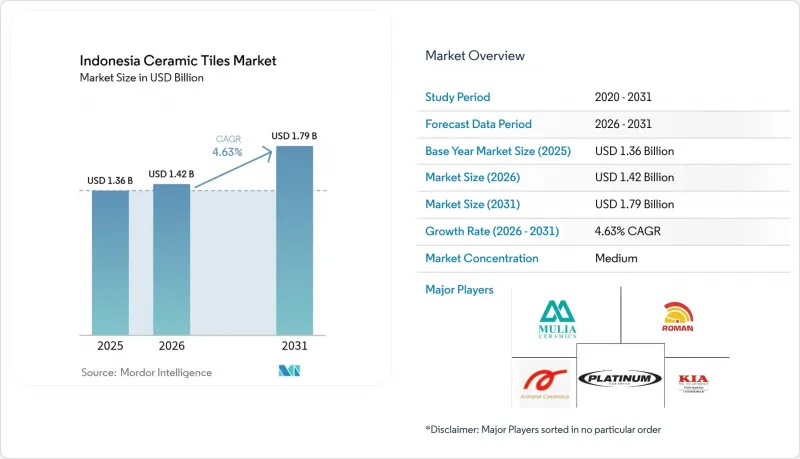
本報告按產品類型(例如瓷質磚)、應用領域(地板、牆面、屋頂)、最終用戶(住宅、商業)、施工類型(新建、維修/更換)、配銷通路(瓷磚石材專賣店、家居建材商店、DIY商店等)以及地區(例如爪哇島、蘇門答臘島)進行細分。市場預測以美元計價。
印尼瓷磚市場趨勢與洞察
能源密集陶瓷產業的天然氣價格上限
根據“特定天然氣定價政策”,每百萬英熱單位(MMBTU)6.75美元的天然氣價格上限已使瓷磚廠的窯爐運作成本降低了約30%,為國內生產商帶來了顯著的成本優勢。由於補貼政策將持續到2025年,工廠更容易規劃原料採購和設備升級,並對生產力計畫更有信心。這項優勢主要集中在爪哇島和蘇門答臘島,儘管全國供不應求,但這些地區的管道基礎設施仍能支持較高的運轉率。天然氣補貼有助於工廠緩解印尼幣疲軟對進口原料的影響。然而,目前供應量仍僅為合約水準的65-70%,燃料供應是短期內擴大生產規模的瓶頸。政府利用能源補貼支持國內製造業的整體策略與印尼的產業政策目標一致,將陶瓷磚產業定位為進口替代和出口擴張策略中的重要一環。
疫情後爪哇島和峇里島的住宅市場繁榮
優惠的房屋抵押貸款利率和稅收激勵措施重啟了停滯的住宅項目,而旅行限制的放寬也促進了新住宅開發活性化。爪哇島的都市區佔全國人口的60%和GDP的58%,瓷磚需求主要集中在高密度公寓和獨棟住宅項目。在峇里島的豪華別墅建設項目中,大大尺寸、設計精美的瓷磚更受青睞,因為它們可以提高平均售價。此外,遠距辦公的持續普及也促使住宅繼續翻新廚房和浴室。這些因素共同推動了2027年瓷磚總銷售量成長的一半以上。智慧家居技術和永續建築實踐在新住宅開發中的應用,為瓷磚製造商創造了機遇,使其能夠開發出滿足不斷變化的消費者期望和節能建築監管要求的創新產品。
工業氣體供應瓶頸
由於管網容量有限,許多窯爐被迫以低於設計負載70%的功率運作,削弱了規模經濟效益。頻繁的壓力下降會中斷燒製週期,導致更高的缺陷率。分配過程中的尋租行為進一步加劇了生產計畫的不確定性。不具備雙燃料能力的製造商被迫承擔閒置成本或延後交貨日期。投資者正在推遲產能擴張計劃,直到電網升級確保穩定的供應。正如淺木先生所報導的那樣,外國投資者正在重新考慮其在陶瓷行業的投資,這表明對供應可靠性的擔憂正在導致資本形成和技術創新減少,而這些原本可以支持市場擴張和提高競爭力。
細分市場分析
預計到2025年,磁磚將佔據印尼陶瓷磚市場46.58%的佔有率。這反映了瓷磚在購物中心、酒店和交通樞紐等場所的廣泛應用,這些場所對瓷磚的耐磨性要求很高。隨著雅加達和泗水商業房地產的快速發展,印尼瓷磚市場預計將進一步擴張。馬賽克瓷磚雖然起步較小,但其複合年成長率高達5.28%,這主要得益於業主在浴室和廚房裝修中對個性化設計的需求不斷成長。住宅企業正利用噴墨印刷和大型壓板壓平機來複製大理石和木材的紋理,從而搶佔了原本流向天然石材的市場需求。此外,對低VOC釉藥的更嚴格監管促使製造商開發更環保的配方,進一步提升了瓷磚的高階形象。
市場對更大尺寸模組(60 x 120 公分和 80 x 80 公分)的需求成長,有助於提高安裝效率,並滿足建築師對現代美學的需求。無釉防滑產品在工業地面和戶外露台領域越來越受歡迎,在這些場所,功能安全性比視覺美觀更為重要。手工瓷磚在峇里島的豪華度假村中佔據著一定的市場佔有率,規模雖小但利潤率高。在印尼瓷磚市場,能夠兼顧技術特性和潮流美學的供應商仍然備受青睞,尤其是那些擁有 SNI 認證的供應商,因為 SNI 認證能夠讓買家對產品的耐用性更有信心。節能型快速燒製窯進一步降低了每平方公尺的成本,即使在燃料價格波動的情況下,也能保持價格競爭力。
到2025年,地板材料將佔印尼瓷磚市場佔有率的61.48%。這主要得益於熱帶潮濕氣候下,家居環境對瓷磚防水性和易清潔性的日益重視。開發商擴大採用3毫米的縫隙寬度和精細的邊緣處理,以在高人流量的零售空間中實現無縫外觀。屋頂瓦的複合年成長率(CAGR)為5.44%,滿足了易受惡劣天氣影響的省會城市對隔熱性和抗颶風屋頂材料日益成長的需求。牆磚則受益於醫院和教育機構日益嚴格的衛生要求,這些場所對可清洗表面的需求至關重要。此外,印尼瓷磚行業在模組化高架系統領域也取得了成長,該系統整合了通風和佈線功能,可用於滿足未來辦公大樓的需求。
抗菌釉藥等持續的設計創新正在推動醫院和食品加工行業對瓷磚的需求成長。瓷磚鋪路材料被用於戶外露台,其耐磨性和抗季風雨性能優於木材。曾經僅限於溫帶地區的瓷磚與地暖系統的兼容性,如今已應用於印尼的豪華別墅,進一步提升了瓷磚的重要性。符合經合組織(OECD)韌性指南的要求,使得瓦片屋頂成為公共住宅維修中鍍鋅鋼板屋頂的首選替代品。這種細分市場凸顯了功能需求和不斷發展的建築規範如何支持各種用途的多元化成長路徑。
其他好處:
- Excel格式的市場預測(ME)表
- 3個月的分析師支持
目錄
第1章:引言
- 研究假設和市場定義
- 調查範圍
第2章:調查方法
第3章執行摘要
第4章 市場狀況
- 市場概覽
- 市場促進因素
- 高耗能陶瓷產業天然氣價格上限
- 疫情後爪哇島和峇里島的住宅市場繁榮
- 對來自中國的進口商品提高關稅
- 政府的「百萬套住宅」計劃
- 區域城市的快速都市化
- 中產階級房屋裝潢支出增加
- 市場限制因素
- 工業氣體供應瓶頸
- 印尼幣疲軟導致進口原料成本上升。
- 國內產能過剩導致價格競爭。
- 整個群島島嶼間的物流成本很高
- 產業價值鏈分析
- 波特五力分析
- 洞察最新市場趨勢與創新
- 近期產業趨勢分析(新產品發布、策略性舉措、投資、合作、合資、業務擴張、併購等)
第5章 市場規模與成長預測
- 依產品類型
- 瓷質磚
- 釉藥磁磚
- 無釉陶瓷磚
- 馬賽克瓷磚
- 其他(裝飾性、圖案性、手工製作)
- 透過使用
- 地面
- 牆
- 屋頂材料
- 最終用戶
- 住宅
- 商業的
- 飯店業(飯店、度假村)
- 零售商店
- 辦公室和公共設施
- 衛生保健
- 教育設施
- 交通樞紐(機場、捷運、客運站)
- 其他商業用戶
- 依建築類型
- 新建工程
- 維修和重建
- 透過分銷管道
- 磁磚和石材專賣店
- 家居裝修商店和DIY商店
- 線上零售
- 直接向承包商銷售
- 按地區
- Java
- 蘇門答臘
- 加里曼丹
- 蘇拉威西
- 峇裡島和努沙登加拉
- 巴布亞及西巴布亞
- 馬魯古群島
第6章 競爭情勢
- 市場集中度
- 策略趨勢
- 市佔率分析
- 公司簡介
- Arwana Citramulia Tbk
- Mulia Keramik Indahraya
- Roman Ceramic International
- Platinum Ceramics Industry
- KIA Keramik Tbk
- Granito(PT Citra Granito)
- Diamond Keramik Indonesia
- Indogress(PT Inti Keramik Sejahtera)
- Indopenta Sakti Teguh
- Sun Power Ceramics
- Satyaraya Keramindo Indah(SRK)
- Candra Jaya Surya
- Royalboard Ceramics
- Sandimas Intimitra
- Terracotta Indonesia
- Muliakeramik Industri Indah
- Intikeramik Alamasri Industri Tbk
- Surya Toto Indonesia Tbk(Tile division)
- Dekkson Ceramics
- Madana Tiles Surabaya
第7章 市場機會與未來展望
According to Mordor Intelligence, the Indonesia ceramic tiles market size was valued at USD 1.36 billion in 2025 and estimated to grow from USD 1.42 billion in 2026 to reach USD 1.79 billion by 2031, at a CAGR of 4.63% during the forecast period (2026-2031).
This report is Segmented by Product Type (Porcelain Tiles and More), Application (Floor, Wall, Roofing), End-User (Residential, Commercial), Construction Type (New Construction, Renovation and Replacement), Distribution Channel (Specialty Tile & Stone Stores, Home Improvement & DIY Stores, and More) and Geography (Java, Sumatra and More). The Market Forecasts are Provided in Terms of Value (USD).
Indonesia Ceramic Tiles Market Trends and Insights
Gas-price cap for energy-intensive ceramics
The USD 6.75 per MMBTU ceiling under the Certain Natural Gas Price Policy trims roughly 30% of kiln operating costs for tile plants, granting domestic producers a decisive cost edge. Capacity-planning confidence rises because the subsidy runs through 2025, enabling factories to lock in feedstock and schedule equipment upgrades. The benefit concentrates in Java and Sumatra, where pipeline infrastructure supports high utilization despite national supply gaps. Subsidized gas helps plants counter rupiah depreciation impacts on imported raw materials. However, deliveries cover only 65-70% of contracted volumes, turning fuel availability into a gating constraint for near-term output growth. The government's broader strategy of using energy subsidies to support domestic manufacturing aligns with Indonesia's industrial policy objectives, positioning ceramic tiles as a strategic sector for import substitution and export development initiatives.
Post-pandemic residential boom in Java & Bali
Mortgage rate incentives and tax relief revived stalled housing projects and spurred new launches once mobility restrictions eased. Java's urban centers account for 60% of population and 58% of GDP, funneling a large portion of tile demand into high-density apartment and landed-housing schemes. Bali's premium villa pipeline favors large-format, design-rich tiles that lift average selling prices. The renovation wave also stays strong as remote work habits push home-owners to upgrade kitchens and bathrooms. Collectively, these drivers underpin more than half of all volume additions through 2027. The integration of smart home technologies and sustainable building practices in new residential developments creates opportunities for ceramic tile manufacturers to develop innovative products that meet evolving consumer expectations and regulatory requirements for energy-efficient construction.
Industrial gas-supply bottlenecks
Pipeline network limits force many kilns to operate below 70% of design loads, eroding economies of scale. Frequent pressure drops interrupt firing cycles and raise reject rates. Rent-seeking behavior in allocation processes adds further uncertainty to production planning. Manufacturers without dual-fuel capability must absorb idle costs or delay deliveries. Investors defer capacity expansion until transmission upgrades assure steady volume. Foreign investors' reconsideration of ceramic industry investments, as reported by Asaki, demonstrates how supply reliability concerns translate into reduced capital formation and technological upgrading that could otherwise support market expansion and competitiveness improvements.
Other drivers and restraints analyzed in the detailed report include:
- Duty hike on Chinese imports
- Government "One Million Houses" program
- Depreciating rupiah inflates imported raw-material costs
For complete list of drivers and restraints, kindly check the Table Of Contents.
Segment Analysis
Porcelain tiles held a 46.58% share of the Indonesia ceramic tiles market in 2025, reflecting widespread acceptance in malls, hotels, and transit hubs where high abrasion resistance is crucial. The Indonesia ceramic tiles market size for porcelain is projected to widen alongside rapid commercial real-estate expansion in Jakarta and Surabaya. Mosaic formats, though starting at a smaller base, exhibit the highest 5.28% CAGR as homeowners embrace design individuality in bathroom and kitchen revamps. Domestic firms leverage ink-jet printing and large-slab presses to mimic marble and wood, capturing spend that once flowed to natural stone. Regulatory emphasis on low-VOC glazes also nudges producers toward eco-friendlier formulations, reinforcing porcelain's premium tag.
Value migration toward larger modules (60X120 cm and 80X80 cm) benefits efficient installation and modern aesthetics sought by architects. Unglazed and anti-slip variants gain traction in industrial floors and outdoor patios where functional safety tops visual preference. Handmade artisanal tiles retain a niche among luxury resorts in Bali, commanding high margins despite limited scale. The Indonesia ceramic tiles market continues to reward suppliers able to mesh technical attributes with on-trend looks, especially when backed by SNI certification that reassures buyers on durability benchmarks. Energy-efficient fast-firing kilns further lower cost per square meter, allowing competitive pricing even under fuel volatility.
Flooring captured 61.48% of the Indonesia ceramic tiles market share in 2025 because households value waterproofing and ease of cleaning amid tropical humidity. Developers increasingly specify 3-mm grout lines and rectified edges to achieve seamless visuals in high-traffic retail settings. Roofing tiles, expanding at 5.44% CAGR, meet rising demand for thermally stable, cyclone-resistant coverings in secondary cities prone to severe weather. Wall cladding benefits from heightening hygiene requirements in hospitals and educational premises where washable surfaces are mandatory. The Indonesia ceramic tiles industry also finds upside in modular raised-floor systems integrating airflow and cabling for future-ready office towers.
Continuous design innovation such as antibacterial glazes widens hospital and food-processing appeal. Outdoor decks adopt porcelain pavers that tolerate heavy footfall and monsoon deluges better than timber. Underfloor-heating compatibility, once limited to temperate markets, now appears in premium Indonesian villas, boosting ceramic relevance. Compliance with OECD resilience guidelines positions tile roofing as a preferred alternative to galvanized sheets in public housing upgrades. The segmentation underscores how functional imperatives and evolving building codes sustain diversified growth paths across applications.
Complete Report Scope:
- By Product Type
- Porcelain Tiles
- Glazed Ceramic Tiles
- Unglazed Ceramic Tiles
- Mosaic Tiles
- Others (Decorative, Patterned, Handmade)
- By Application
- Floor
- Wall
- Roofing
- By End-User
- Residential
- Commercial
- Hospitality (Hotels, Resorts)
- Retail Spaces
- Offices & Institutions
- Healthcare
- Educational Facilities
- Transport Hubs (Airports, Metro, Bus Terminals)
- Other Commercial Users
- By Construction Type
- New Construction
- Renovation and Replacement
- By Distribution Channel
- Specialty Tile & Stone Stores
- Home Improvement & DIY Stores
- Online Retail
- Direct Sales to Contractors
- By Geography
- Java
- Sumatra
- Kalimantan
- Sulawesi
- Bali & Nusa Tenggara
- Papua & West Papua
- Maluku Islands
List of Companies Covered in this Report:
- Arwana Citramulia Tbk
- Mulia Keramik Indahraya
- Roman Ceramic International
- Platinum Ceramics Industry
- KIA Keramik Tbk
- Granito (PT Citra Granito)
- Diamond Keramik Indonesia
- Indogress (PT Inti Keramik Sejahtera)
- Indopenta Sakti Teguh
- Sun Power Ceramics
- Satyaraya Keramindo Indah (SRK)
- Candra Jaya Surya
- Royalboard Ceramics
- Sandimas Intimitra
- Terracotta Indonesia
- Muliakeramik Industri Indah
- Intikeramik Alamasri Industri Tbk
- Surya Toto Indonesia Tbk (Tile division)
- Dekkson Ceramics
- Madana Tiles Surabaya
Additional Benefits:
- The market estimate (ME) sheet in Excel format
- 3 months of analyst support
TABLE OF CONTENTS
1 Introduction
- 1.1 Study Assumptions & Market Definition
- 1.2 Scope of the Study
2 Research Methodology
3 Executive Summary
4 Market Landscape
- 4.1 Market Overview
- 4.2 Market Drivers
- 4.2.1 Gas-price cap for energy-intensive ceramics
- 4.2.2 Post-pandemic residential boom in Java & Bali
- 4.2.3 Duty hike on Chinese imports
- 4.2.4 Government "One Million Houses" program
- 4.2.5 Rapid urbanisation of secondary cities
- 4.2.6 Rising middle-class renovation spending
- 4.3 Market Restraints
- 4.3.1 Industrial gas-supply bottlenecks
- 4.3.2 Depreciating rupiah inflates imported raw-material costs
- 4.3.3 Domestic over-capacity drives price wars
- 4.3.4 High inter-island logistics costs across the archipelago
- 4.4 Industry Value Chain Analysis
- 4.5 Porter's Five Forces Analysis
- 4.5.1 Threat of New Entrants
- 4.5.2 Bargaining Power of Suppliers
- 4.5.3 Bargaining Power of Buyers
- 4.5.4 Threat of Substitutes
- 4.5.5 Competitive Rivalry
- 4.6 Insights into the Latest Trends and Innovations in the Market
- 4.7 Insights on Recent Developments (New Product Launches, Strategic Initiatives, Investments, Partnerships, JVs, Expansion, M&As, etc.) in the Industry
5 Market Size & Growth Forecasts (Value in USD)
- 5.1 By Product Type
- 5.1.1 Porcelain Tiles
- 5.1.2 Glazed Ceramic Tiles
- 5.1.3 Unglazed Ceramic Tiles
- 5.1.4 Mosaic Tiles
- 5.1.5 Others (Decorative, Patterned, Handmade)
- 5.2 By Application
- 5.2.1 Floor
- 5.2.2 Wall
- 5.2.3 Roofing
- 5.3 By End-User
- 5.3.1 Residential
- 5.3.2 Commercial
- 5.3.2.1 Hospitality (Hotels, Resorts)
- 5.3.2.2 Retail Spaces
- 5.3.2.3 Offices & Institutions
- 5.3.2.4 Healthcare
- 5.3.2.5 Educational Facilities
- 5.3.2.6 Transport Hubs (Airports, Metro, Bus Terminals)
- 5.3.2.7 Other Commercial Users
- 5.4 By Construction Type
- 5.4.1 New Construction
- 5.4.2 Renovation and Replacement
- 5.5 By Distribution Channel
- 5.5.1 Specialty Tile & Stone Stores
- 5.5.2 Home Improvement & DIY Stores
- 5.5.3 Online Retail
- 5.5.4 Direct Sales to Contractors
- 5.6 By Geography
- 5.6.1 Java
- 5.6.2 Sumatra
- 5.6.3 Kalimantan
- 5.6.4 Sulawesi
- 5.6.5 Bali & Nusa Tenggara
- 5.6.6 Papua & West Papua
- 5.6.7 Maluku Islands
6 Competitive Landscape
- 6.1 Market Concentration
- 6.2 Strategic Moves
- 6.3 Market Share Analysis
- 6.4 Company Profiles (includes Global level Overview, Market level overview, Core Segments, Financials as available, Strategic Information, Market Rank/Share for key companies, Products & Services, and Recent Developments)
- 6.4.1 Arwana Citramulia Tbk
- 6.4.2 Mulia Keramik Indahraya
- 6.4.3 Roman Ceramic International
- 6.4.4 Platinum Ceramics Industry
- 6.4.5 KIA Keramik Tbk
- 6.4.6 Granito (PT Citra Granito)
- 6.4.7 Diamond Keramik Indonesia
- 6.4.8 Indogress (PT Inti Keramik Sejahtera)
- 6.4.9 Indopenta Sakti Teguh
- 6.4.10 Sun Power Ceramics
- 6.4.11 Satyaraya Keramindo Indah (SRK)
- 6.4.12 Candra Jaya Surya
- 6.4.13 Royalboard Ceramics
- 6.4.14 Sandimas Intimitra
- 6.4.15 Terracotta Indonesia
- 6.4.16 Muliakeramik Industri Indah
- 6.4.17 Intikeramik Alamasri Industri Tbk
- 6.4.18 Surya Toto Indonesia Tbk (Tile division)
- 6.4.19 Dekkson Ceramics
- 6.4.20 Madana Tiles Surabaya
7 Market Opportunities & Future Outlook
- 7.1 Rapid-set thin-tile technology for high-rise retrofits
- 7.2 "Smart-surface" IoT-embedded floor tiles

 德國瓷磚:市場佔有率分析、產業趨勢與統計及成長預測(2026-2031)法國陶瓷磚:市場佔有率分析、產業趨勢與統計及成長預測(2026-2031)泰國瓷磚市場:市佔率分析、產業趨勢與統計及成長預測(2026-2031)英國磁磚市場:市佔率分析、產業趨勢與統計及成長預測(2026-2031)日本陶瓷磚:市佔率分析、產業趨勢與統計及成長預測(2026-2031)義大利瓷磚:市佔率分析、產業趨勢與統計及成長預測(2026-2031)中國瓷磚市場:市場佔有率分析、行業趨勢與統計及成長預測(2026-2031年)印度瓷磚市場:市場佔有率分析、行業趨勢與統計及成長預測(2026-2031)越南瓷磚市場:市場佔有率分析、產業趨勢與統計及成長預測(2026-2031)
 2026-2030年全球陶瓷磚市場