


 |
市場調查報告書
商品編碼
2114401
中國瓷磚市場:市場佔有率分析、行業趨勢與統計及成長預測(2026-2031年)China Ceramic Tiles - Market Share Analysis, Industry Trends & Statistics, Growth Forecasts (2026 - 2031) |
||||||

※ 本網頁內容可能與最新版本有所差異。詳細情況請與我們聯繫。
根據 Mordor Intelligence 預測,中國瓷磚市場規模預計將從 2025 年的 489.1 億美元成長到 2026 年的 493.9 億美元,到 2031 年達到 539.5 億美元,2026 年至 2031 年的複合年預計成長率為 1.78%。
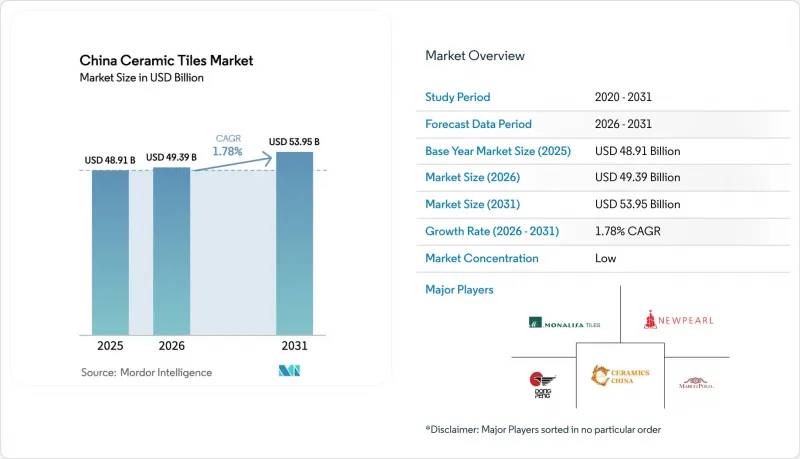
本報告按產品類型(陶瓷瓷磚、釉藥等)、應用領域(地面、牆面等)、最終用戶(住宅、商業)、施工類型(新建、維修/更換)、配銷通路(瓷磚石材專賣店等)和地區(華東、華南等)進行細分。市場預測以美元計價。
中國瓷磚市場趨勢與洞察
都市區住宅維修和改造的蓬勃發展
2025年1月至11月,中國啟動了25,800個老舊城區住宅社區的維修項目,超額完成年度目標。這進一步強化了城市更新的政策力度,並將穩定提升居民生活水準。 2025年下半年,政府強調將都市更新作為最佳化城市形態、轉變成長引擎、提升綠色生活水準的結構性手段。這為未來幾年中高階生活空間及衛浴瓷磚的持續需求奠定了基礎。維修涵蓋了管道升級、社區設施改善和無障礙設施建設等,自然會促使人們購買耐用、衛生的地板材料和牆壁材料,以滿足人們對安全性、易清潔性和全生命週期成本的期望。此外,維修與都市區廚房和浴室的翻新週期密切相關,即使在新房開工量放緩的情況下,也能確保牆磚和地磚的穩定再訂購量。
政府推廣綠建築瓷磚
《建築節能和可再生能源利用通用規定》強制規定了建築物的碳排放強度和能源效率標準,鼓勵採用低排放材料,包括帶有環境產品聲明(EPD)的瓷磚,作為項目規範。 2024年3月,中國建築材料協會推出了全國碳標籤和EPD計畫。該計畫試點階段涵蓋陶瓷磚,旨在「十四五」期間擴大標籤覆蓋範圍,加速標準化和數據公開。中國東部地區的生命週期評估表明,生產階段佔從搖籃到大門碳足跡的大部分,因此,燃料轉換、低溫燒製和余熱回收等措施成為瓷磚生產商的優先事項。 「十四五」綜合工作規劃中的國家能源和排放目標正在推動陶瓷產業逐步淘汰煤炭,進一步凸顯了為天然氣燃燒、電力驅動製程和未來氫能利用做好準備的重要性。隨著採購系統開始將碳排放閾值及相關文件作為決策依據,投資可衡量減排的製造商將在公共和私人專案的競標中獲得競爭優勢。這很可能加速中國瓷磚市場向高規格陶瓷瓷磚和環保產品的轉變,尤其是在綠色建築普及程度最高的大都會圈。
房地產市場長期低迷和供應過剩
2024年,國內磁磚消費量下降,而產能仍維持高位,導致運轉率約48%,市場競爭加劇。 2024年全球數據顯示,磁磚產量萎縮,凸顯了住宅銷售疲軟和開發人員融資緊張對建材市場持續造成的壓力。 2022年至2024年,生產商數量和運作中生產線數量均有所減少,但由於生產線升級改造,產能削減被推遲,導致供應持續過剩,利潤率承壓。 2025年,資產拍賣加速進行,為領先營運商提供了機會,使其在多次競標後以折扣價獲得產能和許可證。 2026年及以後,儘管有跡象顯示政府訂定政策旨在穩定房地產市場和促進城市更新,但需求恢復正常水準的時間表仍不明朗,因為市場復甦取決於庫存減少和專案資金到位。因此,在住宅銷售週期恢復正常之前,中國瓷磚市場目前依賴裝修需求和公共投資作為過渡。
細分市場分析
預計到2025年,瓷磚將佔中國瓷磚市場銷售額的54.45%,充分展現了其卓越的性能和對綠色建築規範的適用性。這一市場地位源自於瓷磚的低吸水率、高密度和耐用性,滿足了主要城市住宅和商業建築室內外應用的需求。數位印刷和釉藥技術的進步使得瓷磚能夠大規模生產出奢華的仿石飾面,同時保持切割的柔軟性並精確控制釉藥用量。製造商正加大對色彩研究和飾面選擇的投入,為建築師和設計師提供支持,並提供工具包以提升瓷磚產品的感知價值。這種豐富的產品系列使品牌即使在供應過剩的情況下也能更容易地維持價格,並降低了對中國瓷磚行業基礎通用產品線的依賴。
預計到2031年,馬賽克瓷磚的複合年成長率將達到1.98%,成為中國瓷磚市場成長最快的產品類型。這一成長與高階酒店和豪華住宅對客製化設計的需求密切相關,在這些場所,橢圓形和豐富的圖案可用於打造特色牆和獨特裝飾。數位化工作流程簡化了小批量生產,使製造商能夠在避免庫存風險的情況下提供豐富的色彩選擇,並快速回應設計需求。其衛生和抗菌特性進一步拓展了馬賽克瓷磚在潮濕環境中的應用,強化了馬賽克瓷磚在浴室、水療中心和商用廚房等場所的地位。這些特性,加上全通路銷售策略,正穩步擴大兼具視覺敘事性和觸覺體驗的裝飾瓷磚的市場佔有率。
2025年,地磚佔陶瓷磚總銷量的63.43%,屋面瓦預計到2031年將以1.86%的複合年成長率成長,凸顯了耐用型地板材料在中國陶瓷磚市場的持續主導地位。其耐用性和衛生優勢符合最新的建築和物業管理標準,使地板材料成為生活空間、零售商店和公共場所的常用選擇。住宅,其中地板和浴室牆面的維修在提升生活品質方面發揮著至關重要的作用。大尺寸瓷磚在交通運輸和公共工程中繼續被應用,以減少接縫和維護工作,從而推高了商業項目的平均售價。隨著市政當局規範公共建築戶外材料的使用,以延長使用壽命並統一城市景觀,屋瓦市場也不斷擴張。
牆磚在中國瓷磚市場佔據著重要的二級市場佔有率,受益於設計主導的升級,例如3D紋理、金屬釉藥和超大尺寸瓷磚,這些應用正從豪華酒店擴展到住宅市場。數位印刷技術能夠為浴室和大廳等需要高清潔性和視覺衝擊力的場所打造逼真的石材和木紋飾面。在屋頂應用方面,增強抗紫外線和熱穩定性的燒製和釉藥技術正被用於打造涼棚和公共遮蔽設施的耐用表面。游泳池內襯和外牆等特殊應用也不斷擴展,需求主要集中在氣候溫暖的地區和商業設施的升級改造。這些應用趨勢共同推動了中國瓷磚行業向更高附加價值規格的穩步轉型。
其他好處:
- Excel格式的市場預測(ME)表
- 3個月的分析師支持
目錄
第1章:引言
- 研究假設和市場定義
- 調查範圍
第2章:調查方法
第3章執行摘要
第4章 市場狀況
- 市場概覽
- 市場促進因素
- 都市區住宅維修和改造的蓬勃發展
- 政府推廣綠建築磁磚的措施(十四五規劃能源標準)
- 電子商務和直播帶動零售業的爆炸性成長。
- 數位印刷技術使得大規模客製化裝飾表面成為可能。
- 恢復「一帶一路」建設市場的出口
- 廢熱回收爐可降低成本和排放。
- 市場限制因素
- 房地產市場長期低迷和供應過剩
- 更嚴格的環境法規所帶來的成本
- 對中國瓷磚出口徵收反傾銷稅
- 來自印度和越南生產商的競爭日益加劇
- 產業價值鏈分析
- 監理情勢
- 技術展望
- 波特五力分析
- 洞察最新市場趨勢與創新
- 近期產業趨勢分析(新產品發布、策略性舉措、投資、合作、合資、業務擴張、併購等)
第5章 市場規模與成長預測
- 依產品類型
- 瓷質磚
- 釉藥磁磚
- 無釉陶瓷磚
- 馬賽克瓷磚
- 其他(裝飾性、圖案性、手工製作)
- 透過使用
- 地面
- 牆
- 屋頂材料
- 最終用戶
- 住宅
- 商業
- 飯店業(飯店、度假村)
- 零售空間
- 辦公室和公共設施
- 衛生保健
- 教育設施
- 交通樞紐(機場、捷運、客運站)
- 其他商業用戶
- 依建築類型
- 新建工程
- 維修和重建
- 透過分銷管道
- 磁磚和石材專賣店
- 家居裝修商店和DIY專賣店
- 線上零售
- 直接向承包商銷售
- 按地區
- 華東地區(上海、江蘇、浙江、安徽)
- 中國南方(廣東省、廣西壯族自治區、海南省)
- 中國北方(北京、天津、河北、山西、內蒙古)
- 華中地區(河南、湖北、湖南)
- 中國其他地區(東北、西南、西北)
第6章 競爭情勢
- 市場集中度
- 策略趨勢
- 市佔率分析
- 公司簡介
- Dongpeng Ceramic
- Marco Polo Holdings
- Monalisa Group
- New Pearl Ceramics
- Ceramics China
- Nabel(Kito)
- Xinzhongyuan(New Zhong Yuan)
- Champion Building Materials
- Eagle Brand Holdings
- Guangdong Overland
- Foshan Oceano
- Guangdong Marco Polo(JieSheng)
- Guangdong Haoshuo
- Guangdong Xinjincheng
- Guangxi Xinquan
- Foshan Gold Medal Ceramics
- Guangdong Xinmingzhu
- Guangdong Henglitai
- Huida Sanitary Ware & Tiles
- Shenghua Ceramics
第7章 市場機會與未來展望
According to Mordor Intelligence, the China ceramic tiles market size is expected to increase from USD 48.91 billion in 2025 to USD 49.39 billion in 2026 and reach USD 53.95 billion by 2031, growing at a CAGR of 1.78% over 2026-2031.
This report is Segmented by Product Type (Porcelain Tiles, Glazed Ceramic Tiles, and More), Application (floor, Wall, and More), End-User (Residential, Commercial), Construction Type (New Construction, Renovation and Replacement), Distribution Channel (Specialty Tile & Stone Stores, and More), and Geography (East China, South China, and More). The Market Forecasts are Provided in Terms of Value (USD).
China Ceramic Tiles Market Trends and Insights
Urban-Home Upgrade & Renovation Boom
China launched renovation projects at 25,800 old urban residential communities during January to November 2025, surpassing the annual target and reinforcing the policy commitment to urban renewal as a steady driver of household-quality improvements. Government communications in late 2025 emphasized urban renewal as a structural lever to optimize urban form, transform growth engines, and advance green living standards, which sets a multi-year demand runway for mid-grade and premium tiles in living spaces and sanitary areas. The scope of renovation, such as pipeline upgrades, community amenities, and accessibility improvements, naturally channels spend toward durable and hygienic surfaces that meet safety, ease-of-cleaning, and lifecycle cost expectations. Renovation aligns with kitchen and bathroom refresh cycles for urban households, which supports steady reorder volumes for wall and floor tiles even when new housing starts remain subdued.
Government Push for Green-Building Tiles
The General Code for Building Energy Conservation and Renewable Energy Utilization established mandatory carbon-intensity controls in buildings and tighter energy-saving thresholds, which steer project specifications toward low-emission materials, including tiles with environmental product declarations. The China Building Materials Federation launched a national carbon labelling and EPD project in March 2024 that includes ceramic tiles in trial operations and targets wider label issuance during the 14th Five-Year Plan, accelerating standardization and data disclosure. Lifecycle assessments for Eastern China show cradle-to-gate footprints dominated by the production phase, which prioritizes fuel switching, lower-temperature firing, and afterheat recovery interventions by tile producers. National energy and emission targets under the 14th Five-Year Comprehensive Work Plan reinforce a shift away from coal in ceramics, which raises the relevance of natural gas combustion, electricity-based processes, and eventual hydrogen readiness. As procurement systems start to reference carbon thresholds and documentation, manufacturers that invest in measurable reductions position themselves for bid advantages on public and private projects. The net effect is a nudge toward higher-spec porcelain and eco-aligned products in the China ceramic tiles market, especially in metro areas where green building adoption is most advanced.
Prolonged Real-Estate Slowdown and Oversupply
Domestic ceramic tile consumption declined in 2024 while installed capacity remained high, which kept utilization near 48% and intensified price competition. Global data for 2024 confirms output contraction and underscores how weak home sales and constrained developer liquidity continued to weigh on building materials. Producer counts and active production lines fell between 2022 and 2024, yet capacity reductions lagged due to line upgrades, so overhang and margin compression persisted. Asset auctions accelerated in 2025, creating opportunities for stronger players to acquire capacity and permits at discounts after repeated rounds. Despite policy signals to stabilize real estate and promote urban renewal from 2026, the timeline to normal absorption remains uncertain as market repair depends on inventory clearance and funding transmission to projects. The China ceramic tiles market, therefore, leans on renovation and public investment as bridges while residential sales cycles normalize.
Other drivers and restraints analyzed in the detailed report include:
- E-Commerce & Live-Stream Tile Retailing Growth
- Waste-Heat-Recovery Kilns Adoption
- Stricter Environmental Compliance Costs
For complete list of drivers and restraints, kindly check the Table Of Contents.
Segment Analysis
Porcelain tiles held 54.45% of 2025 revenues, confirming their leadership in performance attributes and alignment with green-building specifications in the China ceramic tiles market. This position reflects low water absorption, high density, and durability that meet indoor and outdoor application needs for residential and commercial builds in major cities. Digital printing and glazing advances are enabling premium, stone-like finishes at scale while preserving cutover flexibility and controlling glaze consumption at precise levels. Producers are investing in color research and finish curation to support architects and designers with toolkits that raise the perceived value of porcelain assortments. This portfolio depth helps brands defend pricing amid overcapacity and reduces reliance on basic commodity lines in the China ceramic tiles industry.
Mosaic tiles are forecast to post a 1.98% CAGR through 2031, making them the fastest-growing product type in the China ceramic tiles market. Growth is tied to customized design demand in high-end hospitality and luxury residential spaces, where accent walls and feature installations allow small-format and pattern-rich designs. As digital workflows streamline short-run production, manufacturers can offer broader palettes without inventory risk and respond faster to design briefs. Sanitary and antimicrobial features add further use cases in wet zones, reinforcing the role of mosaics in bathrooms, spas, and commercial kitchens. These attributes, combined with omnichannel merchandising, support steady share gains for decorative formats that benefit from visual storytelling and tactile experiences.
Floor tiles captured 63.43% of 2025 application revenues, and roofing applications are projected to record a 1.86% CAGR through 2031, highlighting the continued dominance of heavy-duty surfaces in the China ceramic tiles market. Floors remain the default in living areas, retail, and public spaces due to durability and hygiene benefits that align with updated codes and property-management standards. Urban renewal is adding steady replacement demand in older homes, where upgrading floors and wet-area walls is central to quality-of-life improvements. Transport and civic projects continue to specify large-format porcelain slabs to reduce grout lines and maintenance, which pushes up average selling prices in commercial jobs. Roofing tiles are expanding as municipalities standardize outdoor-rated materials on public structures to extend lifecycle value and unify urban aesthetics.
Wall tiles hold a significant secondary share and benefit from design-led upgrades as 3D textures, metallic glazes, and extra-large panels are migrating from high-end hospitality into mainstream residential formats in the China ceramic tiles market. Digital printing allows realistic stone and wood effects for feature walls in bathrooms and lobbies that require visual impact with high cleanability. Roof applications benefit from the same firing and glaze technologies that increase UV resistance and thermal stability, creating durable surfaces for pergolas and public shelters. Specialty uses like pool linings and exterior facades add variety, with demand skewed to warmer provinces and commercial complexes upgrading visitor amenities. Collectively, these application trends support a steady shift toward value-added specifications within the China ceramic tiles industry.
Complete Report Scope:
- By Product Type
- Porcelain Tiles
- Glazed Ceramic Tiles
- Unglazed Ceramic Tiles
- Mosaic Tiles
- Others (Decorative, Patterned, Handmade)
- By Application
- Floor
- Wall
- Roofing
- By End-User
- Residential
- Commercial
- Hospitality (Hotels, Resorts)
- Retail Spaces
- Offices & Institutions
- Healthcare
- Educational Facilities
- Transport Hubs (Airports, Metro, Bus Terminals)
- Other Commercial Users
- By Construction Type
- New Construction
- Renovation and Replacement
- By Distribution Channel
- Specialty Tile & Stone Stores
- Home Improvement & DIY Stores
- Online Retail
- Direct Sales to Contractors
- By Geography
- East China (Shanghai, Jiangsu, Zhejiang, Anhui)
- South China (Guangdong, Guangxi, Hainan)
- North China (Beijing, Tianjin, Hebei, Shanxi, Inner Mongolia)
- Central China (Henan, Hubei, Hunan)
- Rest of China (Northeast, Southwest,Northwest)
List of Companies Covered in this Report:
- Dongpeng Ceramic
- Marco Polo Holdings
- Monalisa Group
- New Pearl Ceramics
- Ceramics China
- Nabel (Kito)
- Xinzhongyuan (New Zhong Yuan)
- Champion Building Materials
- Eagle Brand Holdings
- Guangdong Overland
- Foshan Oceano
- Guangdong Marco Polo (JieSheng)
- Guangdong Haoshuo
- Guangdong Xinjincheng
- Guangxi Xinquan
- Foshan Gold Medal Ceramics
- Guangdong Xinmingzhu
- Guangdong Henglitai
- Huida Sanitary Ware & Tiles
- Shenghua Ceramics
Additional Benefits:
- The market estimate (ME) sheet in Excel format
- 3 months of analyst support
TABLE OF CONTENTS
1 Introduction
- 1.1 Study Assumptions & Market Definition
- 1.2 Scope of the Study
2 Research Methodology
3 Executive Summary
4 Market Landscape
- 4.1 Market Overview
- 4.2 Market Drivers
- 4.2.1 Urban-home upgrade & renovation boom
- 4.2.2 Government push for green-building tiles (14th Five-Year energy-benchmarks)
- 4.2.3 E-commerce & live-stream tile retailing explosion
- 4.2.4 Digital-printing enables mass-customised decor surfaces
- 4.2.5 Export recovery to Belt-and-Road construction markets
- 4.2.6 Waste-heat-recovery kilns cut costs & emissions
- 4.3 Market Restraints
- 4.3.1 Prolonged real-estate slowdown & oversupply
- 4.3.2 Stricter environmental compliance costs
- 4.3.3 Anti-dumping duties on Chinese tile exports
- 4.3.4 Rising competition from Indian & Vietnamese producers
- 4.4 Industry Value Chain Analysis
- 4.5 Regulatory Landscape
- 4.6 Technological Outlook
- 4.7 Porter's Five Forces Analysis
- 4.7.1 Bargaining Power of Suppliers
- 4.7.2 Bargaining Power of Buyers
- 4.7.3 Threat of New Entrants
- 4.7.4 Threat of Substitutes
- 4.7.5 Intensity of Competitive Rivalry
- 4.8 Insights into the Latest Trends and Innovations in the Market
- 4.9 Insights on Recent Developments (New Product Launches, Strategic Initiatives, Investments, Partnerships, JVs, Expansion, M&As, etc.) in the Industry
5 Market Size & Growth Forecasts
- 5.1 By Product Type
- 5.1.1 Porcelain Tiles
- 5.1.2 Glazed Ceramic Tiles
- 5.1.3 Unglazed Ceramic Tiles
- 5.1.4 Mosaic Tiles
- 5.1.5 Others (Decorative, Patterned, Handmade)
- 5.2 By Application
- 5.2.1 Floor
- 5.2.2 Wall
- 5.2.3 Roofing
- 5.3 By End-User
- 5.3.1 Residential
- 5.3.2 Commercial
- 5.3.2.1 Hospitality (Hotels, Resorts)
- 5.3.2.2 Retail Spaces
- 5.3.2.3 Offices & Institutions
- 5.3.2.4 Healthcare
- 5.3.2.5 Educational Facilities
- 5.3.2.6 Transport Hubs (Airports, Metro, Bus Terminals)
- 5.3.2.7 Other Commercial Users
- 5.4 By Construction Type
- 5.4.1 New Construction
- 5.4.2 Renovation and Replacement
- 5.5 By Distribution Channel
- 5.5.1 Specialty Tile & Stone Stores
- 5.5.2 Home Improvement & DIY Stores
- 5.5.3 Online Retail
- 5.5.4 Direct Sales to Contractors
- 5.6 By Geography
- 5.6.1 East China (Shanghai, Jiangsu, Zhejiang, Anhui)
- 5.6.2 South China (Guangdong, Guangxi, Hainan)
- 5.6.3 North China (Beijing, Tianjin, Hebei, Shanxi, Inner Mongolia)
- 5.6.4 Central China (Henan, Hubei, Hunan)
- 5.6.5 Rest of China (Northeast, Southwest,Northwest)
6 Competitive Landscape
- 6.1 Market Concentration
- 6.2 Strategic Moves
- 6.3 Market Share Analysis
- 6.4 Company Profiles {(includes Global level Overview, Market level overview, Core Segments, Financials as available, Strategic Information, Market Rank/Share for key companies, Products & Services, and Recent Developments)}
- 6.4.1 Dongpeng Ceramic
- 6.4.2 Marco Polo Holdings
- 6.4.3 Monalisa Group
- 6.4.4 New Pearl Ceramics
- 6.4.5 Ceramics China
- 6.4.6 Nabel (Kito)
- 6.4.7 Xinzhongyuan (New Zhong Yuan)
- 6.4.8 Champion Building Materials
- 6.4.9 Eagle Brand Holdings
- 6.4.10 Guangdong Overland
- 6.4.11 Foshan Oceano
- 6.4.12 Guangdong Marco Polo (JieSheng)
- 6.4.13 Guangdong Haoshuo
- 6.4.14 Guangdong Xinjincheng
- 6.4.15 Guangxi Xinquan
- 6.4.16 Foshan Gold Medal Ceramics
- 6.4.17 Guangdong Xinmingzhu
- 6.4.18 Guangdong Henglitai
- 6.4.19 Huida Sanitary Ware & Tiles
- 6.4.20 Shenghua Ceramics
7 Market Opportunities & Future Outlook
- 7.1 Demand surge for large-format thin porcelain slabs
- 7.2 Smart & antimicrobial tiles for public-health infrastructure

 德國瓷磚:市場佔有率分析、產業趨勢與統計及成長預測(2026-2031)法國陶瓷磚:市場佔有率分析、產業趨勢與統計及成長預測(2026-2031)泰國瓷磚市場:市佔率分析、產業趨勢與統計及成長預測(2026-2031)英國磁磚市場:市佔率分析、產業趨勢與統計及成長預測(2026-2031)日本陶瓷磚:市佔率分析、產業趨勢與統計及成長預測(2026-2031)義大利瓷磚:市佔率分析、產業趨勢與統計及成長預測(2026-2031)印尼陶瓷磚市場:市場佔有率分析、產業趨勢與統計及成長預測(2026-2031)印度瓷磚市場:市場佔有率分析、行業趨勢與統計及成長預測(2026-2031)越南瓷磚市場:市場佔有率分析、產業趨勢與統計及成長預測(2026-2031)
 2026-2030年全球陶瓷磚市場