


 |
市場調查報告書
商品編碼
2114399
越南瓷磚市場:市場佔有率分析、產業趨勢與統計及成長預測(2026-2031)Vietnam Ceramic Tiles - Market Share Analysis, Industry Trends & Statistics, Growth Forecasts (2026 - 2031) |
||||||

※ 本網頁內容可能與最新版本有所差異。詳細情況請與我們聯繫。
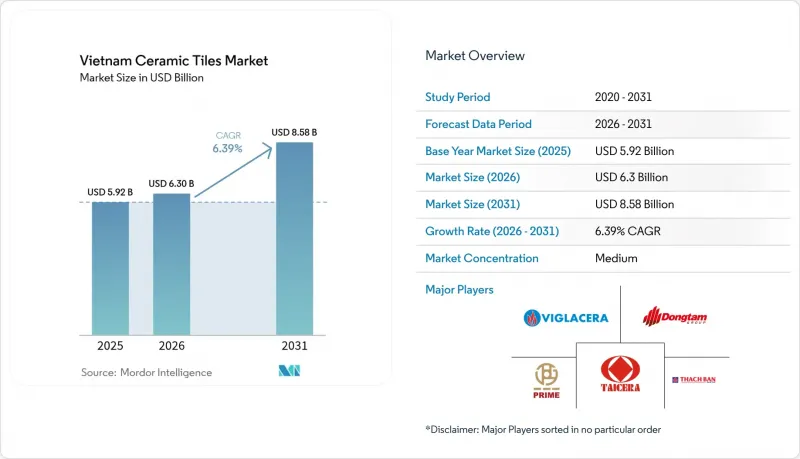
根據 Mordor Intelligence 預測,越南瓷磚市場規模將從 2025 年的 59.2 億美元成長到 2026 年的 63 億美元,然後在 2031 年達到 85.8 億美元,2026 年至 2031 年的複合年成長率為 6.39%。
本報告按產品類型(陶瓷瓷磚、釉面陶瓷磚及其他)、應用領域(地面、牆面、屋頂)、最終用戶(住宅、商業)、施工類型(新建、維修/改造)、配銷通路(瓷磚石材專賣店及其他)和地區(越南北部及其他)進行細分。市場預測以美元計價。
越南瓷磚市場的趨勢和洞察
都市化和住宅需求增加
全國都市化正朝著2030年達到60-65%的官方目標穩步邁進,各省總體規劃正在加速高層住宅和衛星城的建設。 2024年,北部城市將新增3萬多套公寓,河內一手房市場的平均售價預計將上漲36%,這標誌著市場正朝著品牌化、高附加價值的裝修材料方向發生決定性轉變。僅在東安區,一項耗資16兆越南盾的社會住宅大型企劃就計分類兩期交付約6900套住房,預計將為中檔瓷磚的需求提供支撐。新頒布的《土地法》和《住宅法》相關規定的明確化正在縮短專案前置作業時間,並增強開發人員的信心。因此,在越南瓷磚市場,面向大眾住宅小區的地板材料鋪裝產品(其耐用性和即時供貨是關鍵的購買因素)在銷售方面仍然佔據主導地位。
政府基礎設施投資和智慧城市計劃
2025年8月,創紀錄的230個公共工程項目同時啟動,彰顯了政府對交通、教育和城市韌性建設的重視。數位化管治改革使得95%的建築許可證線上辦理,顯著減少了行政延誤,並為本地瓷磚製造商拓展了競標機會。諸如佔地2870公頃的「Vinhomes Green Paradise」等領先的綜合用途開發項目,強調永續性和高階建築外立面,並積極採用瓷磚板材。目前,省級政府正主導智慧城市建設,吸引來自香港和深圳的投資者開發配備感測器的區域,這些區域需要經久耐用、易於維護的陶瓷覆層。這股資金流入帶動了越南瓷磚市場的蓬勃發展,為國內製造商帶來了未來多年的訂單前景。
能源成本波動會影響生產利潤率。
由於窯爐消耗大量天然氣和煤炭,現貨價格的飆升將直接影響越南1,200家瓷磚廠的盈利。許多中小企業仍在運作熱效率低於40%的過時隧道窯,進一步加劇了成本波動。探索引入氫燃料燃燒器和屋頂太陽能發電的先導計畫或許能夠緩解這個問題,但這需要大量資金投入,微企業難以迅速承擔。 77號決議中提案的進口窯爐零件稅收優惠政策可能有助於轉型,但預計短期內利潤率仍將面臨壓力。因此,只有節能型製造商才能保持成本競爭力,這可能導致越南瓷磚市場進一步的產業結構調整。
細分市場分析
在越南瓷磚市場,陶瓷瓷磚已在高階市場佔據主導地位,預計到2031年將以8.01%的複合年成長率成長,因為建築商擴大在豪華別墅和甲級辦公室中使用大尺寸尺寸瓷磚。釉藥憑藉其設計多樣性和價格優勢,即使到2025年仍將保持越南瓷磚市場51.62%的主導佔有率。製造技術的進步,例如通體油墨浸漬工藝,使得瓷磚能夠以400 DPI的精度複製大理石紋理,同時實現卓越的抗彎強度。越南本土品牌正利用這一性能優勢進軍日本和澳洲等對耐凍性和吸水率要求嚴格的細分出口市場。同時,手工藝產業叢集的文化復興運動也推動了對裝飾馬賽克的需求,用於點綴精品旅館和住宅的特色牆。
無釉重型瓷磚在物流園區仍有需求,但隨著瓷磚價格趨於接近,其市場佔有率正在逐漸下降。馬賽克和圖案瓷磚等細分市場受益於旅遊綜合體的客製化訂單,這些訂單透過大廳和外觀展現當地傳統。對濕度響應陶瓷的研究表明,未來可能會出現兼具美觀性和被動冷卻功能的跨界產品,為成熟的瓷磚市場注入新的活力。隨著創新週期的加速,那些將設計、耐用性和隔熱性能融為一體的製造商正在鞏固其定價權。總體而言,產品層面的多元化正在推動越南瓷磚市場的價值創造。
預計2025年,地磚將佔越南國內瓷磚市場總量的60.35%。這主要得益於新建公寓和零售商店對耐用且易於維護的地面材料的偏好。這個核心細分市場保持了越南瓷磚市場的穩健性和可預測性。抗菌奈米釉藥等創新技術正幫助本土品牌在地板材料範圍內銷售價格較高的產品。相比之下,屋頂瓦的複合年成長率高達6.54%。這主要歸功於人口密集城市推行的「冷屋頂」法規,該法規鼓勵使用能夠反射陽光的外牆材料。示範計畫已證實,室內溫度可降低攝氏3-5度C,促進了市政部門對公立學校和診所的採購。
儘管牆面裝飾材料仍保持穩定的中檔市場地位,但隨著玻璃和鋁製系統成本的不斷上漲,瓷磚帷幕牆板正吸引投資者的目光。在咖啡館和共享辦公空間的裝飾牆上,擴大採用數位印刷圖案,以模仿水磨石和水磨石的質感,從而避免了現場鋪設水磨石所造成的廢棄物。在浴室中,防滑表面和無縫瓷磚簡化了清潔工作,並縮短了酒店和餐廳翻新時的瓷磚更換週期。隨著開發商在成本、能源和維護標準之間尋求平衡,瓷磚的應用範圍日益多元化,推動著越南瓷磚市場的均衡發展。
其他好處
- Excel格式的市場預測(ME)表
- 3個月的分析師支持
目錄
第1章:引言
- 研究假設和市場定義
- 調查範圍
第2章:調查方法
第3章執行摘要
第4章 市場狀況
- 市場概覽
- 市場促進因素
- 都市化和住宅需求增加
- 政府基礎建設投資與智慧城市規劃
- 中階對高階美學的偏好日益成長。
- 商業地產和旅遊設施的擴張
- 節能型大尺寸磁磚,用於冷卻
- 透過本地數位噴墨印刷降低進口依賴。
- 市場限制因素
- 能源成本波動對生產利潤率的影響
- 低價進口商品導致競爭加劇
- 產能過剩導致價格壓力。
- 加強環境和水資源利用法規
- 產業價值鏈分析
- 波特五力分析
- 洞察最新市場趨勢與創新
- 近期產業趨勢分析(新產品發布、策略性舉措、投資、合作、合資、業務擴張、併購等)
第5章 市場規模與成長預測
- 依產品類型
- 陶瓷瓷磚
- 釉面磁磚
- 無釉陶瓷磚
- 馬賽克瓷磚
- 其他(裝飾性、圖案性、手工製作)
- 透過使用
- 地面
- 牆
- 屋頂材料
- 最終用戶
- 住宅
- 商業
- 飯店業(飯店、度假村)
- 零售空間
- 辦公室和公共設施
- 衛生保健
- 教育設施
- 交通樞紐(機場、捷運、客運站)
- 其他商業用戶
- 依建築類型
- 新建工程
- 維修和重建
- 透過分銷管道
- 磁磚和石材專賣店
- 家居裝修商店和DIY專賣店
- 線上零售
- 直接向承包商銷售
- 按地區
- 越南北部
- 越南中部
- 越南南部
第6章 競爭情勢
- 市場集中度
- 策略趨勢
- 市佔率分析
- 公司簡介
- Viglacera Corporation
- Prime Group
- Dong Tam Group
- Taicera Enterprise Company
- 石族
- 白馬陶瓷
- CMC JSC(Catalan Tiles)
- Hoang Gia Royal Group
- Mikado Ceramic
- Vitto Group
- Trung Do Ceramic
- Thanh Thanh Ceramic
- Dong Nai Ceramic Tiles
- Cong Thanh Ceramic
- Hoa Binh Minh Ceramics
- Tasa Ceramic
- Kim Phong Tiles
- 環美陶瓷
- Toko Vietnam Co. Ltd.
第7章 市場機會與未來展望
According to Mordor Intelligence, the Vietnam ceramic tiles market size is expected to grow from USD 5.92 billion in 2025 to USD 6.3 billion in 2026 and is forecast to reach USD 8.58 billion by 2031 at 6.39% CAGR over 2026-2031.
This report is Segmented by Product Type (Porcelain Tiles, Glazed Ceramic Tiles, and More), Application (Floor, Wall, Roofing), End-User (Residential, Commercial), Construction Type (New Construction, Renovation and Replacement), Distribution Channel (Specialty Tile & Stone Stores, and More), and Geography (Northern Vietnam, and More). The Market Forecasts are Provided in Terms of Value (USD).
Vietnam Ceramic Tiles Market Trends and Insights
Rising Urbanization & Residential Housing Demand
National urbanization is moving toward the official 60-65% target by 2030, with provincial master plans spurring high-rise neighborhoods and satellite townships . More than 30,000 new condominium units were delivered in northern cities during 2024, and average selling prices in Hanoi's primary market jumped 36%, signaling a decisive shift toward branded, higher-value finishes. Social-housing mega-schemes worth 16,000 billion VND in Dong Anh alone will add almost 6,900 units in two phases, anchoring volume for mid-priced tiles. Regulatory clarity from newly enacted Land and Housing Laws is shortening project lead times and bolstering developer confidence. As a result, the Vietnam ceramic tiles market continues to derive its core volume from flooring packages in mass-housing blocks where purchase decisions hinge on durability and ready availability.
Government Infrastructure Investment & Smart-City Programs
A record 230 public works broke ground simultaneously in August 2025, illustrating the government's commitment to transport, education, and urban resilience. Digital governance reforms have pushed 95% of construction permits online, slashing administrative delays and widening tender opportunities for local tile makers. Flagship mixed-use ventures such as the 2,870-hectare Vinhomes Green Paradise emphasize sustainability and premium building envelopes that heavily specify porcelain slabs. Provincial authorities now steward their smart-city plans, attracting Hong Kong and Shenzhen investors to develop sensor-enabled districts that require long-life, low-maintenance ceramic cladding. Such capital flows ripple across the Vietnam ceramic tiles market and create multi-year order visibility for domestic producers.
Volatile Energy Costs Impacting Production Margins
Kilns consume large volumes of natural gas or coal, so spot-price spikes directly erode profitability for Vietnam's 1,200 tile factories. Many smaller operators still run legacy tunnel kilns with thermal efficiency below 40%, magnifying cost swings. Pilot projects exploring hydrogen-ready burners or rooftop photovoltaics promise relief but demand capital outlays that micro-enterprises cannot shoulder quickly. Resolution 77's proposed tax relief on imported kiln parts may ease transition, yet short-term margin compression remains likely. Consequently, the Vietnamese ceramic tiles market could experience consolidation as only energy-savvy producers maintain cost competitiveness.
Other drivers and restraints analyzed in the detailed report include:
- Growing Middle-Class Preference for Premium Aesthetics
- Large-Format Porcelain Slabs for Energy-Efficient Cooling
- Intensifying Competition from Low-Cost Imports
For complete list of drivers and restraints, kindly check the Table Of Contents.
Segment Analysis
Porcelain already fuels the premium story within the Vietnam ceramic tiles market, growing at 8.01% CAGR through 2031 as builders pivot to large-format slabs for upscale villas and grade-A offices. Glazed tiles retained a dominant 51.62% Vietnam ceramic tiles market share in 2025 because of their design versatility and competitive price points. Production advances, such as full-body ink-penetration technology, enable porcelain panels to mimic marble veins with 400 DPI precision while delivering superior flexural strength. Domestic brands leverage this performance edge to access export niches in Japan and Australia, where frost resistance and water absorption limits are stringent. In parallel, cultural revival in craft clusters feeds demand for decorative mosaics that enrich boutique hotels and residential accent walls.
Unglazed heavy-duty formats maintain relevance for logistics parks, yet their share gradually declines as porcelain achieves cost parity. Mosaic and patterned subsegments benefit from bespoke orders tied to tourism complexes that narrate regional heritage in lobbies and facades. Research on humidity-responsive ceramics signals future cross-over products that combine aesthetics with passive cooling, potentially refreshing mature categories. As innovation cycles accelerate, producers that integrate design, durability and thermal performance secure pricing power. Overall, product-level diversification is reinforcing value capture inside the Vietnam ceramic tiles market.
Floor tiles contributed 60.35% of national volume in 2025 because every new apartment and retail outlet prioritizes resilient, easy-clean surfaces underfoot; this anchor segment keeps the Vietnam ceramic tiles market size substantial and predictable. Innovations such as nano-glaze antibacterial finishes help local brands upsell within flooring budgets. In contrast, roofing tiles headline growth at 6.54% CAGR thanks to cool-roof mandates in dense cities where energy codes now reward solar-reflective claddings. Demonstration projects record indoor temperature drops of 3-5 °C, driving municipal procurement for public schools and clinics.
Wall cladding remains a stable mid-volume category, but porcelain facade panels gain investor interest as glass-aluminum systems face cost inflation. Feature walls in cafes and coworking hubs increasingly use digitally printed motifs that replicate terrazzo or terrazul aesthetics without on-site terrazzo waste. Inside bathrooms, slip-rated surfaces and integrated groutless sheets simplify cleaning, supporting tile replacement cycles in hospitality revamps. As developers juggle cost, energy, and maintenance criteria, application choice becomes multidimensional, reinforcing balanced expansion within the Vietnam ceramic tiles market.
Complete Report Scope:
- By Product Type
- Porcelain Tiles
- Glazed Ceramic Tiles
- Unglazed Ceramic Tiles
- Mosaic Tiles
- Others (Decorative, Patterned, Handmade)
- By Application
- Floor
- Wall
- Roofing
- By End-User
- Residential
- Commercial
- Hospitality (Hotels, Resorts)
- Retail Spaces
- Offices & Institutions
- Healthcare
- Educational Facilities
- Transport Hubs (Airports, Metro, Bus Terminals)
- Other Commercial Users
- By Construction Type
- New Construction
- Renovation and Replacement
- By Distribution Channel
- Specialty Tile & Stone Stores
- Home Improvement & DIY Stores
- Online Retail
- Direct Sales to Contractors
- By Geography
- Northern Vietnam
- Central Vietnam
- Southern Vietnam
List of Companies Covered in this Report:
- Viglacera Corporation
- Prime Group
- Dong Tam Group
- Taicera Enterprise Company
- Thạch Ban Group
- Bạch Ma (White Horse Ceramics)
- CMC JSC (Catalan Tiles)
- Hoang Gia Royal Group
- Mikado Ceramic
- Vitto Group
- Trung Do Ceramic
- Thanh Thanh Ceramic
- Dong Nai Ceramic Tiles
- Cong Thanh Ceramic
- Hoa Binh Minh Ceramics
- Tasa Ceramic
- Kim Phong Tiles
- Hoan Mỹ Ceramics
- Toko Vietnam Co. Ltd.
Additional Benefits:
- The market estimate (ME) sheet in Excel format
- 3 months of analyst support
TABLE OF CONTENTS
1 Introduction
- 1.1 Study Assumptions & Market Definition
- 1.2 Scope of the Study
2 Research Methodology
3 Executive Summary
4 Market Landscape
- 4.1 Market Overview
- 4.2 Market Drivers
- 4.2.1 Rising urbanization & residential housing demand
- 4.2.2 Government infrastructure investment & smart-city programmes
- 4.2.3 Growing middle-class preference for premium aesthetics
- 4.2.4 Expansion of commercial real-estate & tourism facilities
- 4.2.5 Large-format porcelain slabs for energy-efficient cooling
- 4.2.6 Localised digital ink-jet printing cuts import dependence
- 4.3 Market Restraints
- 4.3.1 Volatile energy costs impacting production margins
- 4.3.2 Intensifying competition from low-cost imports
- 4.3.3 Production overcapacity driving price pressures
- 4.3.4 Tightening environmental & water-use regulations
- 4.4 Industry Value Chain Analysis
- 4.5 Porter's Five Forces Analysis
- 4.5.1 Threat of New Entrants
- 4.5.2 Bargaining Power of Suppliers
- 4.5.3 Bargaining Power of Buyers
- 4.5.4 Threat of Substitutes
- 4.5.5 Competitive Rivalry
- 4.6 Insights into the Latest Trends and Innovations in the Market
- 4.7 Insights on Recent Developments (New Product Launches, Strategic Initiatives, Investments, Partnerships, JVs, Expansion, M&As, etc.) in the Industry
5 Market Size & Growth Forecasts (Value in USD)
- 5.1 By Product Type
- 5.1.1 Porcelain Tiles
- 5.1.2 Glazed Ceramic Tiles
- 5.1.3 Unglazed Ceramic Tiles
- 5.1.4 Mosaic Tiles
- 5.1.5 Others (Decorative, Patterned, Handmade)
- 5.2 By Application
- 5.2.1 Floor
- 5.2.2 Wall
- 5.2.3 Roofing
- 5.3 By End-User
- 5.3.1 Residential
- 5.3.2 Commercial
- 5.3.2.1 Hospitality (Hotels, Resorts)
- 5.3.2.2 Retail Spaces
- 5.3.2.3 Offices & Institutions
- 5.3.2.4 Healthcare
- 5.3.2.5 Educational Facilities
- 5.3.2.6 Transport Hubs (Airports, Metro, Bus Terminals)
- 5.3.2.7 Other Commercial Users
- 5.4 By Construction Type
- 5.4.1 New Construction
- 5.4.2 Renovation and Replacement
- 5.5 By Distribution Channel
- 5.5.1 Specialty Tile & Stone Stores
- 5.5.2 Home Improvement & DIY Stores
- 5.5.3 Online Retail
- 5.5.4 Direct Sales to Contractors
- 5.6 By Geography
- 5.6.1 Northern Vietnam
- 5.6.2 Central Vietnam
- 5.6.3 Southern Vietnam
6 Competitive Landscape
- 6.1 Market Concentration
- 6.2 Strategic Moves
- 6.3 Market Share Analysis
- 6.4 Company Profiles (includes Global level Overview, Market level overview, Core Segments, Financials as available, Strategic Information, Market Rank/Share for key companies, Products & Services, and Recent Developments)
- 6.4.1 Viglacera Corporation
- 6.4.2 Prime Group
- 6.4.3 Dong Tam Group
- 6.4.4 Taicera Enterprise Company
- 6.4.5 Thạch Ban Group
- 6.4.6 Bạch Ma (White Horse Ceramics)
- 6.4.7 CMC JSC (Catalan Tiles)
- 6.4.8 Hoang Gia Royal Group
- 6.4.9 Mikado Ceramic
- 6.4.10 Vitto Group
- 6.4.11 Trung Do Ceramic
- 6.4.12 Thanh Thanh Ceramic
- 6.4.13 Dong Nai Ceramic Tiles
- 6.4.14 Cong Thanh Ceramic
- 6.4.15 Hoa Binh Minh Ceramics
- 6.4.16 Tasa Ceramic
- 6.4.17 Kim Phong Tiles
- 6.4.18 Hoan Mỹ Ceramics
- 6.4.19 Toko Vietnam Co. Ltd.
7 Market Opportunities & Future Outlook
- 7.1 Hydrogen-ready & solar-assisted kilns for decarbonisation
- 7.2 Circular-economy tile recycling & take-back programmes

 德國瓷磚:市場佔有率分析、產業趨勢與統計及成長預測(2026-2031)法國陶瓷磚:市場佔有率分析、產業趨勢與統計及成長預測(2026-2031)泰國瓷磚市場:市佔率分析、產業趨勢與統計及成長預測(2026-2031)英國磁磚市場:市佔率分析、產業趨勢與統計及成長預測(2026-2031)日本陶瓷磚:市佔率分析、產業趨勢與統計及成長預測(2026-2031)義大利瓷磚:市佔率分析、產業趨勢與統計及成長預測(2026-2031)中國瓷磚市場:市場佔有率分析、行業趨勢與統計及成長預測(2026-2031年)印尼陶瓷磚市場:市場佔有率分析、產業趨勢與統計及成長預測(2026-2031)印度瓷磚市場:市場佔有率分析、行業趨勢與統計及成長預測(2026-2031)
 2026-2030年全球陶瓷磚市場