


 |
市場調查報告書
商品編碼
2124229
中東和北非行動虛擬網路營運商:市場佔有率分析、行業趨勢和統計數據以及成長預測(2026-2031 年)MENA Mobile Virtual Network Operator - Market Share Analysis, Industry Trends & Statistics, Growth Forecasts (2026 - 2031) |
||||||

※ 本網頁內容可能與最新版本有所差異。詳細情況請與我們聯繫。
據 Mordor Intelligence 稱,中東和北非地區行動虛擬網路營運商 (MVNO) 的市場規模預計將從 2025 年的 7.8 億美元成長到 2026 年的 8.3 億美元。
此外,預計到 2031 年,該產業的價值將達到 11.4 億美元,並且預計從 2026 年到 2031 年的複合年成長率將達到 6.5%。
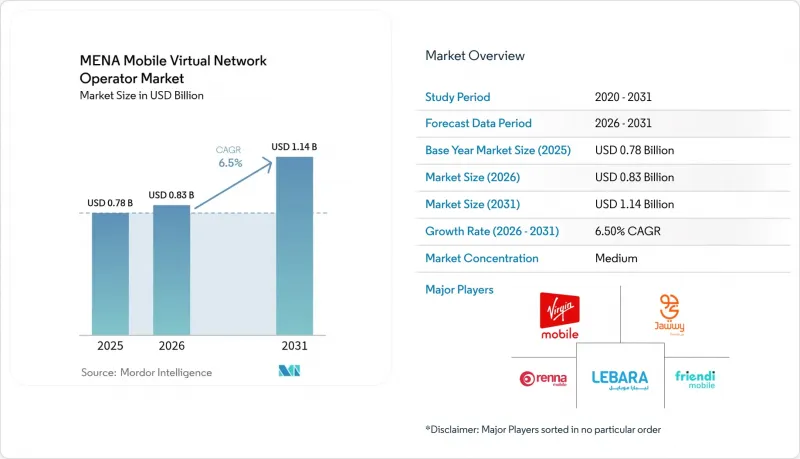
本報告按部署模式(雲端、本地部署)、營運模式(服務供應商、其他)、用戶類型(消費者、企業、其他)、應用領域(折扣、其他)、網路技術(2G/3G、其他)、分銷管道(線上/純數位管道、其他)和國家/地區進行細分。市場預測以價值(美元)和規模(用戶數量)為單位呈現。
中東和北非地區行動虛擬網路營運商 (MVNO) 市場的趨勢和見解。
向對價格敏感的外籍人士和年輕人推廣從虛擬業者 (MVNO)轉換用預付合約。
沙烏地阿拉伯約有1000萬居住者,海灣合作理事會(GCC)成員國也擁有大規模的青年人口,他們尋求合約期限更短的預付套餐,這促使用戶不斷轉向行動虛擬網路營運商(MVNO)服務,這些服務將低價國際通話與靈活的數據流量相結合。號碼可攜性改革和全面數位化的註冊流程消除了轉換的障礙,加速了現有營運商的用戶流失。 Virgin Mobile在該地區用戶數量激增至350萬,充分展現了簡化的收費系統和應用程式內服務能夠快速擴展的規模。由此產生的壓力迫使業者重新談判批發條款以維持國際流量,間接提高了MVNO的盈利。因此,這種居住者和青年人口主導的成長,在無需大量行銷投入的情況下,為中東和北非MVNO市場奠定了穩定的需求基礎。
利用 eSIM 和僅限應用程式啟動的 5G 相容數位品牌
中東和北非地區的eSIM連線正以每年20%的速度成長,預計2028年活躍用戶數將達到1.35億人。這將使行動虛擬網路營運商(MVNO)無需實體分銷,即可在幾分鐘內啟動使用者。諸如stc的「Jawwy」等平台利用雲端原生收費技術,向客戶應用程式提供即時優惠和策略控制,從而降低獲客成本並實現精細化的用戶細分。 5G網路切片和eSIM配置的整合,使得微套餐、每日千兆流量路徑或延遲最佳化串流媒體等功能成為可能,創造了SIM卡管道中不存在的可獲利用例。因此,即使基本費率較低,純數位品牌也能提高用戶留存率和每用戶平均收入(ARPU),進而推動中東和北非地區MVNO市場的成長。
海灣國家較高的行動資料通訊最低價格給行動虛擬網路營運商 (MVNO) 的平均每用戶收入 (ARPU) 帶來了壓力。
由於阿拉伯聯合大公國和科威特的最低批發資料定價法規,當地的行動虛擬網路營運商(MVNO)每GB的收費通常比歐洲同類服務高出15-20%,這限制了其提供的表面折扣,也限制了其目標大眾市場。雖然增值功能可以部分彌補利潤率的下降,但營運商在為數據密集型消費者提供比現有供應商更低的價格方面仍然面臨挑戰。因此,競爭差異化策略正從激進的價格戰轉向生活風格品牌、忠誠度計畫和基於金融科技的附加服務,這限制了中東和北非地區MVNO市場的短期成長潛力。
細分市場分析
2025年,雲端採用將佔營收的62.30%,推動中東和北非地區行動虛擬網路營運商(MVNO)市場以11.45%的複合年成長率成長。這種營運模式無需行動交換節點等大量資本支出(CAPEX),從而實現「按需付費」的擴展模式,使新品牌能夠在不到18個月的時間內達到盈虧平衡點。大多數超大規模服務都標配了人工智慧驅動的詐欺偵測和即時策略引擎,有助於提升服務品質。
在資料主權條款要求本地處理的情況下,本地部署環境仍然存在,尤其是在國家能源和國防領域。雖然這些部署引進週期較長,但它們能夠實現用於服務等級保障的緊密網路整合。供應商正在推動混合解決方案,將中間處理、分析和收費功能遷移到多租戶環境,同時將關鍵任務功能保留在私有雲端中,這有助於傳統行動虛擬網路營運商 (MVNO) 的遷移過程。
到2025年,在中東和北非地區,經銷商/輕量級/品牌模式將佔據MVNO市場佔有率的62.85%,這主要得益於品牌方利用現有主機資源快速推出服務。然而,能夠管理核心網路元素和SIM卡配置的完整MVNO框架預計將實現23.6%的複合年成長率,這表明市場正朝著服務自主化的方向發展。
像「紅牛移動」這樣的品牌模式正在嘗試使用永久的「GigaCoin」數據錢包,這種機制在限制性的經銷商協議下是無法實現的。完全的控制權使得營運商可以獨立漫遊協定,並基於5G網路切片建立按需服務等級。隨著時間的推移,更高的利潤率和差異化的功能集有望提升全功能虛擬網路營運商(MVNO)的吸引力,從而鞏固其在中東和北非MVNO市場的長期競爭力。
其他好處
- Excel格式的市場預測(ME)表
- 3個月的分析師支持
目錄
第1章:引言
- 研究假設和市場定義
- 調查範圍
第2章:調查方法
第3章執行摘要
第4章 市場狀況
- 市場概覽
- 市場促進因素
- 向對價格敏感的外籍人士和年輕人推廣從虛擬業者 (MVNO)轉換用預付合約。
- 利用相容 5G 的數位品牌,僅透過 eSIM 和應用程式啟動使用。
- 監管機構強制要求網路共用,並設定批發價格上限,以提高行動虛擬網路營運商 (MVNO) 的盈利。
- 跨境匯款商品搭售(例如,通話時間和現金的兌換路線)
- 為偏遠地區的油氣設施提供衛星和NTN連接。
- 透過結合綠色金融科技和行動虛擬網路營運商 (MVNO) 的混合模式,實現碳權額度微交易的貨幣化。
- 市場限制因素
- 海灣國家較高的行動資料通訊最低價格給行動虛擬網路營運商 (MVNO) 的平均每用戶收入 (ARPU) 帶來了壓力。
- 北非地區對號碼可攜性的限制阻礙了用戶轉換其他業者。
- 5G 切片批發價格上漲及與傳統 4G 價格的比較。
- 由於地緣政治因素(例如利比亞、葉門)導致的頻率分配延遲
- 價值鏈分析
- 監理情勢
- 波特五力分析
- 對影響市場的宏觀經濟因素進行評估
第5章 市場規模與成長預測
- 按部署模式
- 雲
- 現場
- 按操作模式
- 經銷商/輕量級/品牌虛擬營運商
- 服務提供者
- 完整的虛擬營運商
- 用戶類型
- 一般消費者
- 公司
- 物聯網專用
- 透過使用
- 折扣
- 商業
- 細胞M2M
- 其他
- 透過網路技術
- 2G/3G
- 4G/LTE
- 5G
- 衛星/NTN
- 透過分銷管道
- 僅限線上/數位版
- 傳統零售店
- 開利子品牌商店
- 第三方/批發
- 按地區
- 中東
- 沙烏地阿拉伯
- 阿拉伯聯合大公國
- 土耳其
- 其他中東國家
- 北非
- 埃及
- 摩洛哥
- 突尼西亞
- 阿爾及利亞
- 其他北非國家
- 中東
第6章 競爭情勢
- 市場集中度
- 策略趨勢
- 市佔率分析
- 公司簡介
- Virgin Mobile Middle East and Africa(Beyond ONE)
- Lebara Mobile KSA
- FRiENDi Mobile Oman(Beyond ONE)
- Renna Mobile Oman
- Jawwy(Saudi Telecom Company)
- Salam Mobile
- Red Bull MOBILE Bahrain
- Swyp(阿拉伯聯合大公國電信公司)
- Lyca Mobile Tunisia
第7章 市場機會與未來展望
According to Mordor Intelligence, MENA mobile virtual network operator market size in 2026 is estimated at USD 0.83 billion, growing from 2025 value of USD 0.78 billion with 2031 projections showing USD 1.14 billion, growing at 6.5% CAGR over 2026-2031.
This report is Segmented by Deployment Model (Cloud, and On-Premise), Operational Mode (Service Operator, and More), Subscriber Type (Consumer, Enterprise, and More), Application (Discount, and More), Network Technology (2G/3G, and More), Distribution Channel (Online/Digital-only, and More), and Country. The Market Forecasts are Provided in Terms of Value (USD) and Volume (Subscribers).
MENA Mobile Virtual Network Operator Market Trends and Insights
Price-Sensitive Expatriate and Youth Segments Fuel Prepaid Churn
Roughly 10 million expatriates in Saudi Arabia and large youth cohorts across the GCC seek low-commitment prepaid plans, prompting steady subscriber migration toward MVNO offers that combine cheaper international minutes with flexible data allocations. Number-portability reforms and fully digital onboarding remove switching friction, accelerating churn away from incumbents. Virgin Mobile's jump to 3.5 million regional users illustrates how simplified tariffs plus in-app servicing capture scale quickly. The resulting pressure forces host operators to renegotiate wholesale terms to retain outbound traffic, indirectly improving MVNO economics. Expat and youth-led growth, therefore, secures a stable demand base for the MENA MVNO market without heavy marketing spend.
5G-Enabled Digital Brands Leverage eSIM and App-Only Onboarding
Regional eSIM connections are tracking 20% annual growth, with projections of 135 million active profiles by 2028, allowing MVNOs to forgo physical distribution and activate users in minutes. Platforms such as Jawwy by stc rely on cloud-native charging stacks that push real-time offers and policy controls to customer apps, lowering acquisition costs and supporting granular segmentation. The convergence of 5G network slicing with eSIM provisioning enables micro-bundles, daily gigabyte passes, or latency-optimized streams, creating monetizable use cases absent from SIM card channels. As a result, digital-only brands enhance stickiness and lift ARPU even when headline tariffs remain low, reinforcing growth prospects for the MENA MVNO market.
High Mobile-Data Floor Prices in Gulf States Squeeze ARPU
Wholesale data-floor regulations mean MVNOs in the UAE and Kuwait often pay per-gigabyte rates that are 15-20% above European comparables, constraining headline discounts and limiting addressable mass-market segments. While value-added features can offset some margin loss, operators struggle to undercut incumbents on data-hungry consumer plans. Competitive differentiation, therefore, shifts to lifestyle branding, loyalty perks, and fintech add-ons rather than aggressive price moves, tempering near-term upside for the MENA MVNO market.
Other drivers and restraints analyzed in the detailed report include:
- Regulator-Mandated Network-Sharing and Wholesale Price Caps Improve Economics
- Satellite-NTN Connectivity for Remote Oil and Gas Sites
- Limited Number-Portability in North Africa Curbs Switching
For complete list of drivers and restraints, kindly check the Table Of Contents.
Segment Analysis
Cloud implementations held 62.30% revenue in 2025 and pushed the MENA MVNO market size forward with an 11.45% CAGR. The operating model removes hefty capex items such as mobile switching nodes and allows pay-as-you-grow scaling, creating a breakeven horizon under 18 months for greenfield brands. AI-assisted fraud checks and real-time policy engines come bundled with most hyperscale offerings, reinforcing service quality.
On-premise environments persist where data-sovereignty clauses require local processing, notably in sovereign energy and defense verticals. These deployments impose longer deployment cycles yet deliver tight network integration for service-level commitments. Vendors are increasingly hybridizing solutions by anchoring mission-critical functions on private clouds while shifting mediation, analytics, and billing to multitenant regions, smoothing migration paths for legacy MVNOs.
Reseller/light/brand formats accounted for 62.85% of the MENA MVNO market share in 2025 as quick-launch brands leveraged existing host assets. Yet full MVNO frameworks, controlling core network elements and SIM profiles, are set to record 23.6% CAGR, signaling the market's march toward service autonomy.
Branded concepts like Red Bull Mobile experiment with perpetual Gigacoin data wallets, a structure unviable under restrictive reseller contracts. Full control allows independent roaming deals and on-demand quality tiers built atop 5G network slices. Over time, richer margins and differentiated feature sets propel full MVNO appeal, anchoring long-term competitiveness inside the MENA MVNO market.
Complete Report Scope:
- By Deployment Model
- Cloud
- On-premise
- By Operational Mode
- Reseller / Light / Brand MVNO
- Service Operator
- Full MVNO
- By Subscriber Type
- Consumer
- Enterprise
- IoT-specific
- By Application
- Discount
- Business
- Cellular M2M
- Others
- By Network Technology
- 2G/3G
- 4G/LTE
- 5G
- Satellite/NTN
- By Distribution Channel
- Online / Digital-only
- Traditional Retail Stores
- Carrier Sub-brand Stores
- Third-Party / Wholesale
- By Geography
- Middle East
- Saudi Arabia
- United Arab Emirates
- Turkey
- Rest of Middle East
- North Africa
- Egypt
- Morocco
- Tunisia
- Algeria
- Rest of North Africa
- Middle East
List of Companies Covered in this Report:
- Virgin Mobile Middle East and Africa (Beyond ONE)
- Lebara Mobile KSA
- FRiENDi Mobile Oman (Beyond ONE)
- Renna Mobile Oman
- Jawwy (Saudi Telecom Company)
- Salam Mobile
- Red Bull MOBILE Bahrain
- Swyp (Etisalat UAE)
- Lyca Mobile Tunisia
Additional Benefits:
- The market estimate (ME) sheet in Excel format
- 3 months of analyst support
TABLE OF CONTENTS
1 INTRODUCTION
- 1.1 Study Assumptions and Market Definition
- 1.2 Scope of the Study
2 RESEARCH METHODOLOGY
3 EXECUTIVE SUMMARY
4 MARKET LANDSCAPE
- 4.1 Market Overview
- 4.2 Market Drivers
- 4.2.1 Price-sensitive expatriate and youth segments fuel prepaid churn towards MVNOs
- 4.2.2 5G-enabled digital brands leverage eSIM and app-only onboarding
- 4.2.3 Regulator-mandated network-sharing/wholesale price caps improve MVNO economics
- 4.2.4 Cross-border remittance bundling (e.g., airtime-to-cash corridors)
- 4.2.5 Satellite-NTN connectivity for remote oil and gas sites
- 4.2.6 Green fintech-MVNO hybrids monetize carbon-credit micro-transactions
- 4.3 Market Restraints
- 4.3.1 High mobile-data floor prices in Gulf states squeeze MVNO ARPU
- 4.3.2 Limited number-portability in North Africa curbs subscriber switching
- 4.3.3 Rising wholesale 5G slicing fees vs. legacy 4G rates
- 4.3.4 Geopolitical spectrum-allocation delays (e.g., Libya, Yemen)
- 4.4 Value Chain Analysis
- 4.5 Regulatory Landscape
- 4.6 Porter's Five Forces Analysis
- 4.6.1 Threat of New Entrants
- 4.6.2 Bargaining Power of Buyers
- 4.6.3 Bargaining Power of Suppliers
- 4.6.4 Threat of Substitutes
- 4.6.5 Intensity of Competitive Rivalry
- 4.7 Assessment of Macroeconomic Factors on the Market
5 MARKET SIZE AND GROWTH FORECASTS (VALUE)
- 5.1 By Deployment Model
- 5.1.1 Cloud
- 5.1.2 On-premise
- 5.2 By Operational Mode
- 5.2.1 Reseller / Light / Brand MVNO
- 5.2.2 Service Operator
- 5.2.3 Full MVNO
- 5.3 By Subscriber Type
- 5.3.1 Consumer
- 5.3.2 Enterprise
- 5.3.3 IoT-specific
- 5.4 By Application
- 5.4.1 Discount
- 5.4.2 Business
- 5.4.3 Cellular M2M
- 5.4.4 Others
- 5.5 By Network Technology
- 5.5.1 2G/3G
- 5.5.2 4G/LTE
- 5.5.3 5G
- 5.5.4 Satellite/NTN
- 5.6 By Distribution Channel
- 5.6.1 Online / Digital-only
- 5.6.2 Traditional Retail Stores
- 5.6.3 Carrier Sub-brand Stores
- 5.6.4 Third-Party / Wholesale
- 5.7 By Geography
- 5.7.1 Middle East
- 5.7.1.1 Saudi Arabia
- 5.7.1.2 United Arab Emirates
- 5.7.1.3 Turkey
- 5.7.1.4 Rest of Middle East
- 5.7.2 North Africa
- 5.7.2.1 Egypt
- 5.7.2.2 Morocco
- 5.7.2.3 Tunisia
- 5.7.2.4 Algeria
- 5.7.2.5 Rest of North Africa
- 5.7.1 Middle East
6 COMPETITIVE LANDSCAPE
- 6.1 Market Concentration
- 6.2 Strategic Moves
- 6.3 Market Share Analysis
- 6.4 Company Profiles (includes Global level Overview, Market level overview, Core Segments, Financials as available, Strategic Information, Market Rank/Share for key companies, Products and Services, and Recent Developments)
- 6.4.1 Virgin Mobile Middle East and Africa (Beyond ONE)
- 6.4.2 Lebara Mobile KSA
- 6.4.3 FRiENDi Mobile Oman (Beyond ONE)
- 6.4.4 Renna Mobile Oman
- 6.4.5 Jawwy (Saudi Telecom Company)
- 6.4.6 Salam Mobile
- 6.4.7 Red Bull MOBILE Bahrain
- 6.4.8 Swyp (Etisalat UAE)
- 6.4.9 Lyca Mobile Tunisia
7 MARKET OPPORTUNITIES AND FUTURE OUTLOOK
- 7.1 White-Space and Unmet-Need Assessment

 行動虛擬網路營運商(MVNO)市場:全球市場預測,2026-2032年
 中國行動網路業者(MNO):市佔率分析、產業趨勢與統計及成長預測(2026-2031)東協行動虛擬網路營運商:市場佔有率分析、產業趨勢與統計及成長預測(2026-2031)西班牙電信行動網路業者:市場佔有率分析、產業趨勢與統計、成長預測(2026-2031)馬來西亞電信行動網路業者:市場佔有率分析、產業趨勢與統計及成長預測(2026-2031 年)中東和非洲電信營運商(MNO):市場佔有率分析、行業趨勢和統計數據以及成長預測(2026-2031 年)印度電信行動網路業者:市場佔有率分析、產業趨勢與統計及成長預測(2026-2031 年)德國電信行動網路業者:市場佔有率分析、產業趨勢與統計及成長預測(2026-2031 年)日本行動網路業者(MNO):市佔率分析、產業趨勢與統計及成長預測(2026-2031)法國電信行動網路業者:市場佔有率分析、產業趨勢與統計及成長預測(2026-2031 年)