


 |
市場調查報告書
商品編碼
2123599
中國汽車租賃市場:市場佔有率分析、產業趨勢與統計及成長預測(2026-2031年)China Vehicle Rental - Market Share Analysis, Industry Trends & Statistics, Growth Forecasts (2026 - 2031) |
||||||

※ 本網頁內容可能與最新版本有所差異。詳細情況請與我們聯繫。
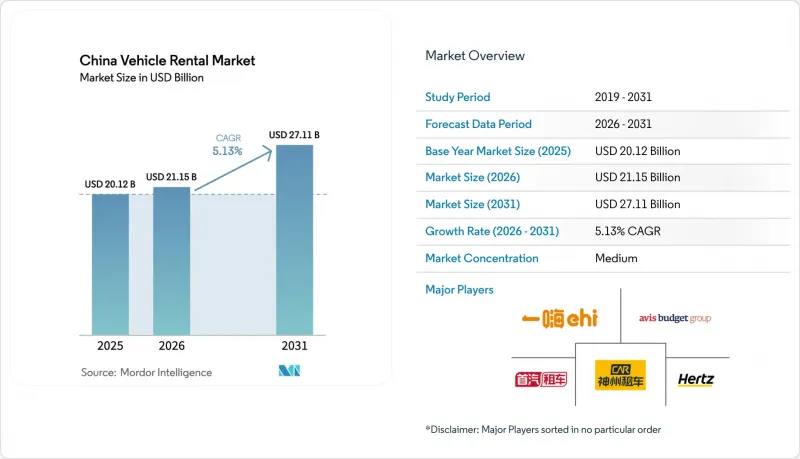
根據 Mordor Intelligence 的數據顯示,2025 年中國汽車租賃市場價值為 201.2 億美元,預計到 2031 年將達到 271.1 億美元,而 2026 年為 211.5 億美元,預測期內(2026-2031 年)複合年成長率為 5.13%。
本報告按應用領域(休閒/旅遊和商務旅行)、預訂方式(線下和線上預訂)、最終用戶類型(自駕和代駕)、車輛類型(乘用車及其他)、動力傳動系統(內燃機、混合動力和純電動汽車)、租賃期限(短期及其他)、服務管道(機場及其他)和地區進行細分。市場預測以美元計價。
中國汽車租賃市場趨勢與洞察
國內旅遊業的復甦帶動了休閒用車租賃需求。
根據中國文化和旅遊部透過國務院網站發布的報告,預計2025年上半年國內遊客數量將達到32.8億人次(年增20.6%),這將直接推動自駕遊需求的成長。旅遊旺季期間,各旅遊目的地的運轉率運轉率超過85%,但淡季入住率下降,促使旅遊目的地引入動態定價機制以平衡收入。由於行程安排的靈活性以及對衛生狀況的持續關注,自駕遊仍然比跟團遊更受歡迎。政府振興農村、推廣「紅色旅遊」的舉措正在加速旅客湧入區域城市,這要求旅遊業者擴大服務範圍。為了實現這種分散式服務模式,必須增加對道路救援系統救援和基礎設施網路的投入,以確保在主要樞紐以外的地區也能提供優質服務。
一線城市車牌的分配將刺激租車需求。
北京計劃在2025年發放10萬個乘用車牌照,其中8萬個將用於新能源汽車。預計這將進一步加劇內燃機汽車牌照短缺的局面。擁有大規模商用牌照車輛的企業能夠提供即時的運力,並在牌照有限的都市區獲得競爭優勢。然而,跨省法規限制了車輛在不同監管區域間的調配。因此,營運商需要儲備車輛以滿足都市區高峰期的需求,同時承擔其他地區車輛閒置的風險。
共乘和無人駕駛計程車作為替代方案的風險
百度已宣佈在包括北京、上海、深圳、重慶、武漢、長沙、合肥、烏鎮和陽泉在內的多個城市獲得實用化測試許可。免停車費的按需服務對都市區用戶極具吸引力,並正在蠶食短期租車市場的需求。現有租車公司正透過在應用程式中整合駕駛輔助功能以及與叫車巨頭達成交叉銷售協議來應對這項挑戰。儘管目前對完全自動駕駛營運的法規核准仍然有限,但該技術的快速成熟正使無人駕駛計程車成為中期內的顛覆性力量,迫使租車公司加快電氣化轉型並投資於差異化服務體驗。
細分市場分析
預計到2025年,休閒旅遊市場將佔總收入的54.67%,並以7.59%的複合年成長率成長,這主要得益於度假者對靈活行程和自駕遊的偏好。這種強勁的成長正在緩解疫情帶來的衝擊,並凸顯人們消費觀念轉向體驗式消費的趨勢。然而,黃金週和夏季等旺季期間租賃需求的季節性激增,導致車輛供給能力緊張,促使營運商實施動態定價和跨區域車輛調配服務。商務旅行仍然是市場的穩定支柱,這主要得益於高階車輛和補充保險的推動,從而保證了工作日運轉率的穩定,並提高了每次預訂的平均消費額。
此外,企業需求在淡季也推動了中國汽車租賃市場的規模成長,即使休閒需求下降,也能維持資產生產力。企業擴大將跨多個城市的長期合約整合起來,以規範員工通勤並確保穩定的收入來源。雖然這兩個細分市場如同「雙引擎」般並存,但就絕對值而言,休閒需求的成長速度超過了企業需求的成長速度,導致車輛結構向更符合家庭出行偏好的緊湊型轎車和跨界SUV傾斜。
預計到2025年,線上預訂將佔所有交易的63.78%,年複合成長率達8.29%,主要得益於流暢的應用程式內體驗和整合的支付生態系統。數位化介面能夠實現即時庫存可見性,促進高附加價值產品的銷售,並透過支援演算法定價來改善收入管理。用戶評論和忠誠度計畫進一步提高了轉換成本,增強了平台留存率。
剩餘部分由線下通路構成,主要分佈在機場櫃檯和數位化程度較低的三線城市門市。光顧這些門市的顧客重視面對面的服務,例如保險細節的講解和臨時變更等,這些優勢並非總能在線上實現。將行動端辦理登機手續與實體店的現場服務結合的策略,正是這種融合的典型例證。未來,實體店的服務點預計將從預訂中心轉移到車輛交付點,在保持面對面服務的同時降低固定成本。
預計到2025年,自駕租車將佔71.87%的市場佔有率,年複合成長率達8.03%,主要得益於其自主性、隱私性和成本效益。年輕用戶青睞流暢的應用程式體驗和數位化鑰匙交接,從而減少了櫃檯等待時間。車輛遠端資訊處理技術能夠即時監控里程和駕駛行為,減少因車輛損壞而造成的糾紛和保險索賠損失。社群媒體的口碑加速了新客戶的獲取,並有效降低了每位客戶的行銷成本。
儘管規模仍然較小,但專車服務在中國的商務人士、老年人和遊客中發展迅速。其高階定位使其能夠收取更高的日租金,並交叉銷售門房服務。然而,一線城市的人手不足推高了駕駛人工資,這給利潤率帶來了壓力。與叫車平台合作可以靈活駕駛人,但明確僱用分類仍然至關重要。雖然自動駕駛技術從長遠來看可能會減緩專車服務的成長,但對個人化服務的需求在短期內仍可能繼續支撐這一細分市場。
其他好處
- Excel格式的市場預測(ME)表
- 3個月的分析師支持
目錄
第1章:引言
- 研究假設和市場定義
- 調查範圍
第2章:調查方法
第3章執行摘要
第4章 市場狀況
- 市場概覽
- 市場促進因素
- 國內旅遊業的復甦帶動了休閒用車租賃需求。
- 一線城市車牌的分配將刺激租車需求。
- 向數位化和行動預訂平台過渡
- 擁有駕照的中產階級人數正在增加。
- 由於強制車輛電氣化,零排放區得以開放
- 透過企業ESG目標推動長期綠色訂閱
- 市場限制因素
- 共乘和無人駕駛計程車作為替代方案的風險
- 汽車購買和資金籌措成本不斷上漲
- 電動車殘值的不確定性給盈利。
- 由於區域車牌分配變更,導致車輛物流中斷。
- 價值供應鏈分析
- 監理情勢
- 技術展望
- 波特五力模型
第5章 市場規模與成長預測
- 透過使用
- 休閒/旅遊
- 商務旅行
- 按預訂類型
- 離線訪問
- 線上查詢
- 按最終用戶類型
- 自駕
- 帶司機
- 按車輛類型
- 搭乘用車
- 輕型商用車
- 中型和大型商用車輛
- 巴士和長途汽車
- 按動力傳動系統
- 內燃機(ICE)
- 混合動力電動車(HEV)
- 電池式電動車(BEV)
- 租賃期
- 短期(少於一週)
- 中期(1週至1個月)
- 長期(超過1個月)
- 服務管道
- 機場內部
- 機場外/市中心
- 按地區
- 中國東部
- 中國中南部
- 中國北方
- 中國西部
- 中國東北
第6章 競爭情勢
- 市場集中度
- 策略趨勢
- 市佔率分析
- 公司簡介
- Beijing China Auto Rental(CAR Inc.)
- eHi Car Service
- Shouqi Car Rental
- Avis Budget Group
- Hertz Corporation
- Shenzhen Topone Car Rental
- Didi Car Rental
- EVCard
- Gofun Travel
- Xiangdao Chuxing
- UCAR Inc.
- Zuzuche
- Caocao Mobility
- PonyCar
- T3 Go Mobility
- Shenzhou Joy Travel
- Tongcheng-Elong Car Rental
- Huizuche
- Hello Chuxing Car Rental
- Meituan Car Rental
第7章 市場機會與未來展望
According to Mordor Intelligence, the China vehicle rental market size was valued at USD 20.12 billion in 2025 and is estimated to grow from USD 21.15 billion in 2026 to reach USD 27.11 billion by 2031, at a CAGR of 5.13% during the forecast period (2026-2031).
This report is Segmented by Application (Leisure/Tourism and Business Travel), Booking Type (Offline Access and Online Access), End-User Type (Self-Driven and Chauffeur-Driven), Vehicle Type (Passenger Cars and More), Powertrain (ICE, HEV and BEV), Rental Duration (Short-Term and More), Service Channel (On-Airport and More), and Region. The Market Forecasts are Provided in Terms of Value (USD).
China Vehicle Rental Market Trends and Insights
Domestic Tourism Rebound Fuels Leisure Rentals
Domestic trips hit 3.28 billion in H1 2025 (+20.6% YoY), per China's Ministry of Culture and Tourism reporting via the State Council portal, which directly enlarged demand for self-drive vacations. Holiday peaks delivered utilization rates above 85% in scenic regions, while off-peak occupancy prompted dynamic-pricing adoption to balance yield. Flexible itineraries and ongoing hygiene concerns keep private car use preferred over group tours. Government promotion of rural revitalization and "red tourism" is driving travel flows into lower-tier cities, compelling operators to expand their service footprints. The dispersion strategy requires investment in roadside assistance and maintenance networks to uphold service levels outside core hubs.
License-Plate Quotas in Tier-1 Cities Spur Rental Demand
Beijing will issue 100,000 passenger-vehicle quotas in 2025, including 80,000 for new-energy vehicles (NEVs), which will intensify scarcity for internal-combustion registrations. Firms with large, commercially plated fleets offer immediate mobility, securing a competitive moat in quota-constrained centers. However, cross-provincial restrictions hamper fleet rebalancing when vehicles transit disparate regulatory zones. Operators must therefore maintain redundant fleets to meet urban peak demand while absorbing idle risk elsewhere.
Ride-Hailing & Robotaxi Substitution Risk
Baidu reported obtaining pilot commercialization qualifications across multiple cities, including Beijing, Shanghai, Shenzhen, Chongqing, Wuhan, Changsha, Hefei, Wuzhen, and Yangquan. On-demand convenience without parking costs appeals to urban travelers, diverting traffic from short-term rentals. Incumbents respond by embedding chauffeur options into apps and forging cross-selling agreements with ride-hailing leaders. While regulatory approvals for fully driverless operations remain confined, rapid tech maturation positions robotaxis as a medium-term disruptor, compelling rental firms to accelerate electrification and invest in differentiated service experiences.
Other drivers and restraints analyzed in the detailed report include:
- Shift to Digital and Mobile Booking Platforms
- Growing Licensed-Driver Middle Class
- Rising Vehicle Acquisition & Financing Costs
For complete list of drivers and restraints, kindly check the Table Of Contents.
Segment Analysis
Leisure and tourism accounted for 54.67% of the 2025 turnover, and the segment is forecasted to grow at a 7.59% CAGR as holidaymakers favor flexible itineraries and self-drive exploration. This strength mitigates the pandemic's aftereffects and underscores the cultural shift toward experiential consumption. Seasonal rental spikes, however, stretch fleet capacity during Golden Week and summer peaks, prompting operators to deploy dynamic pricing and cross-regional vehicle transfers. Business travel remains a counter-cyclical pillar, contributing to stable weekday utilization and higher average spend per booking, driven by premium car categories and ancillary insurance.
Corporate demand also reinforces the size of the Chinese vehicle rental market during off-season periods, sustaining asset productivity when leisure volumes decline. Enterprises increasingly bundle long-term contracts across multiple cities to standardize employee mobility and lock in predictable income streams. Both sub-segments will coexist as twin engines; however, leisure growth outpaces corporate expansion in absolute volume, reshaping the fleet mix toward compact passenger cars and crossover SUVs that align with family trip preferences.
Online reservations captured 63.78% of overall transactions in 2025 and are projected to grow at an 8.29% CAGR, driven by frictionless in-app experiences and integrated payment ecosystems. The digital interface provides real-time inventory visibility, boosts add-on sales, and supports algorithmic pricing to improve yield management. User reviews and loyalty programs further increase switching costs, reinforcing platform stickiness.
Offline channels accounted for the remainder and persist primarily at airport counters and tier-3 city storefronts, where digital adoption lags. Walk-in customers value face-to-face support for insurance clarification and last-minute changes, benefits not always replicable online. The blended mobile check-in strategy at physical outlets exemplifies convergence. Over the horizon, physical touchpoints will likely transition toward vehicle-handover nodes rather than booking centers, cutting fixed overhead without abandoning personal service.
Self-driven rentals accounted for 71.87% of the market in 2025 and are expected to post an 8.03% CAGR, driven by autonomy, privacy, and cost efficiency. Younger renters appreciate seamless app journeys and digital key handovers that reduce counter time. Vehicle telematics enable real-time monitoring of mileage and driving behavior, lowering damage-related disputes and insurance losses. Social media word of mouth accelerates acquisition, effectively lowering marketing spend per customer.
Chauffeur-driven services, while smaller, are growing faster among executives, senior citizens, and inbound tourists. Premium positioning supports higher daily rates and cross-sell of concierge services. Labor shortages, however, inflate driver wages in tier-1 cities, putting pressure on margins. Partnerships with ride-hailing platforms can unlock flexible driver supply, but regulatory clarity on employment classification remains pivotal. Autonomous technology may erode chauffeur growth in the long term, yet near-term demand for high-touch service sustains the niche.
Complete Report Scope:
- By Application
- Leisure / Tourism
- Business Travel
- By Booking Type
- Offline Access
- Online Access
- By End-User Type
- Self-Driven
- Chauffeur-Driven
- By Vehicle Type
- Passenger Cars
- Light Commercial Vehicles
- Medium and Heavy Duty Commercial Vehicles
- Buses and Coaches
- By Powertrain
- Internal Combustion Engine (ICE)
- Hybrid Electric Vehicle (HEV)
- Battery Electric Vehicle (BEV)
- By Rental Duration
- Short-Term (Less than 1 Week)
- Medium-Term (1 Week to 1 Month)
- Long-Term (Above 1 Month)
- By Service Channel
- On-Airport
- Off-Airport / Downtown
- By Region
- East China
- South-Central China
- North China
- West China
- Northeast China
List of Companies Covered in this Report:
- Beijing China Auto Rental (CAR Inc.)
- eHi Car Service
- Shouqi Car Rental
- Avis Budget Group
- Hertz Corporation
- Shenzhen Topone Car Rental
- Didi Car Rental
- EVCard
- Gofun Travel
- Xiangdao Chuxing
- UCAR Inc.
- Zuzuche
- Caocao Mobility
- PonyCar
- T3 Go Mobility
- Shenzhou Joy Travel
- Tongcheng-Elong Car Rental
- Huizuche
- Hello Chuxing Car Rental
- Meituan Car Rental
Additional Benefits:
- The market estimate (ME) sheet in Excel format
- 3 months of analyst support
TABLE OF CONTENTS
1 Introduction
- 1.1 Study Assumptions and Market Definition
- 1.2 Scope of the Study
2 Research Methodology
3 Executive Summary
4 Market Landscape
- 4.1 Market Overview
- 4.2 Market Drivers
- 4.2.1 Domestic Tourism Rebound Fuels Leisure Rentals
- 4.2.2 License-Plate Quotas in Tier-1 Cities Spur Rental Demand
- 4.2.3 Shift to Digital and Mobile Booking Platforms
- 4.2.4 Growing Licensed-Driver Middle Class
- 4.2.5 Fleet-Electrification Mandates Open Zero-Emission Zones
- 4.2.6 Corporate ESG Targets Drive Long-Term Green Subscriptions
- 4.3 Market Restraints
- 4.3.1 Ride-Hailing and Robotaxi Substitution Risk
- 4.3.2 Rising Vehicle Acquisition and Financing Costs
- 4.3.3 EV Residual-Value Uncertainty Pressures Profitability
- 4.3.4 Provincial Plate-Quota Volatility Disrupts Fleet Logistics
- 4.4 Value / Supply-Chain Analysis
- 4.5 Regulatory Landscape
- 4.6 Technological Outlook
- 4.7 Porter's Five Forces
- 4.7.1 Threat of New Entrants
- 4.7.2 Bargaining Power of Buyers
- 4.7.3 Bargaining Power of Suppliers
- 4.7.4 Threat of Substitutes
- 4.7.5 Intensity of Competitive Rivalry
5 Market Size and Growth Forecasts (Value (USD))
- 5.1 By Application
- 5.1.1 Leisure / Tourism
- 5.1.2 Business Travel
- 5.2 By Booking Type
- 5.2.1 Offline Access
- 5.2.2 Online Access
- 5.3 By End-User Type
- 5.3.1 Self-Driven
- 5.3.2 Chauffeur-Driven
- 5.4 By Vehicle Type
- 5.4.1 Passenger Cars
- 5.4.2 Light Commercial Vehicles
- 5.4.3 Medium and Heavy Duty Commercial Vehicles
- 5.4.4 Buses and Coaches
- 5.5 By Powertrain
- 5.5.1 Internal Combustion Engine (ICE)
- 5.5.2 Hybrid Electric Vehicle (HEV)
- 5.5.3 Battery Electric Vehicle (BEV)
- 5.6 By Rental Duration
- 5.6.1 Short-Term (Less than 1 Week)
- 5.6.2 Medium-Term (1 Week to 1 Month)
- 5.6.3 Long-Term (Above 1 Month)
- 5.7 By Service Channel
- 5.7.1 On-Airport
- 5.7.2 Off-Airport / Downtown
- 5.8 By Region
- 5.8.1 East China
- 5.8.2 South-Central China
- 5.8.3 North China
- 5.8.4 West China
- 5.8.5 Northeast China
6 Competitive Landscape
- 6.1 Market Concentration
- 6.2 Strategic Moves
- 6.3 Market Share Analysis
- 6.4 Company Profiles (includes Global level Overview, Market level Overview, Core Segments, Financials as available, Strategic Information, Market Rank/Share for key companies, Products and Services, SWOT Analysis, Recent Developments)
- 6.4.1 Beijing China Auto Rental (CAR Inc.)
- 6.4.2 eHi Car Service
- 6.4.3 Shouqi Car Rental
- 6.4.4 Avis Budget Group
- 6.4.5 Hertz Corporation
- 6.4.6 Shenzhen Topone Car Rental
- 6.4.7 Didi Car Rental
- 6.4.8 EVCard
- 6.4.9 Gofun Travel
- 6.4.10 Xiangdao Chuxing
- 6.4.11 UCAR Inc.
- 6.4.12 Zuzuche
- 6.4.13 Caocao Mobility
- 6.4.14 PonyCar
- 6.4.15 T3 Go Mobility
- 6.4.16 Shenzhou Joy Travel
- 6.4.17 Tongcheng-Elong Car Rental
- 6.4.18 Huizuche
- 6.4.19 Hello Chuxing Car Rental
- 6.4.20 Meituan Car Rental
7 Market Opportunities and Future Outlook
- 7.1 White-Space and Unmet-Need Assessment

 印度汽車租賃市場:市場佔有率分析、產業趨勢與統計及成長預測(2026-2031)汽車租賃:市場佔有率分析、產業趨勢與統計及成長預測(2026-2031)北美汽車租賃:市場佔有率分析、產業趨勢與統計及成長預測(2026-2031 年)新加坡汽車租賃:市場佔有率分析、產業趨勢與統計及成長預測(2026-2031)法國汽車租賃市場:市場佔有率分析、產業趨勢與統計及成長預測(2026-2031)泰國汽車租賃市場:市場佔有率分析、產業趨勢與統計及成長預測(2026-2031)英國汽車租賃:市場佔有率分析、產業趨勢與統計及成長預測(2026-2031)馬來西亞汽車租賃市場:市場佔有率分析、產業趨勢與統計及成長預測(2026-2031)印度電動自行車租賃:市場佔有率分析、產業趨勢與統計及成長預測(2026-2031)東協汽車租賃市場:市場佔有率分析、產業趨勢與統計及成長預測(2026-2031)