


 |
市場調查報告書
商品編碼
2122921
箱板紙:市場佔有率分析、產業趨勢與統計、成長預測(2026-2031)Containerboard - Market Share Analysis, Industry Trends & Statistics, Growth Forecasts (2026 - 2031) |
||||||

※ 本網頁內容可能與最新版本有所差異。詳細情況請與我們聯繫。
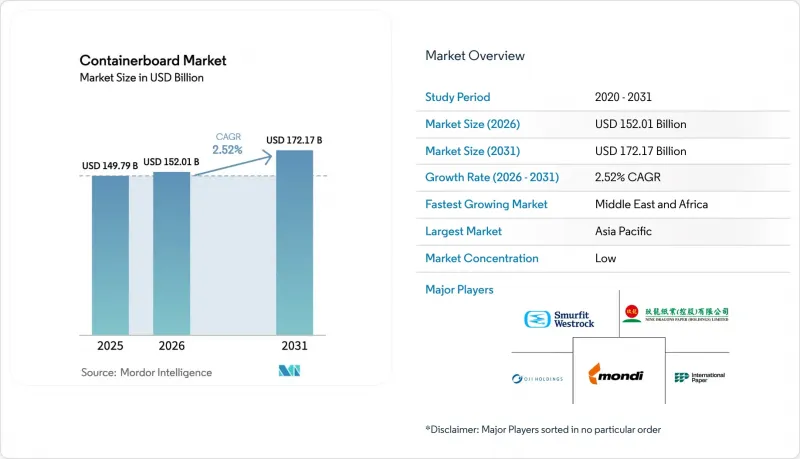
根據 Mordor Intelligence 預測,箱板紙市場規模將從 2025 年的 1,497.9 億美元成長到 2026 年的 1,520.1 億美元,到 2031 年將達到 1721.7 億美元,2026 年至 2031 年的複合年成長率為 2.52%。
本報告按材料(原生纖維、再生纖維、混紡纖維)、類型(牛皮紙襯墊、試驗襯墊、瓦楞紙板等)、紙張重量(小於150克/平方米、150-300克/平方米、300克/平方米及以上)、最終用戶(食品飲料、消費品、工業、其他)及地區(北美、歐洲)及其他地區(北美、歐洲)及地區細分。市場預測以美元計價。
全球箱板紙市場趨勢及洞察
電子商務出貨量增加
小包裹的爆炸式成長促使人們重新評估箱板紙的規格,因為托運人在自動化分揀和最後一公里配送過程中,箱板紙會承受來自跌落和擠壓的高強度應力。目前,綜合性巨頭企業擁有2400萬噸的箱板紙產能和2000多家瓦楞紙板工廠,能夠實現按需生產,並將產品尺寸的利用率控制在5毫米以內。因此,市場對耐破強度超過1100千帕的牛皮紙箱板的需求日益成長。而未經原生材料加固的再生紙箱板通常無法達到此閾值。
加工食品和飲料包裝市場的成長
在亞太地區和南美洲,都市化的中產階級消費者仍然偏好紙盒包裝的常溫食品。加工商正積極響應這一需求,採用防潮塗層和速冷內襯來保持紙盒在冷鏈物流中的強度。這種需求的激增在單份飲料多包裝中反映得尤為明顯。透過重新設計瓦楞紙板的形狀,在保持複合強度的同時減輕了重量,使得零售商可以設置更高的托盤高度。
再生紙價格波動
2025年某季度,廢紙箱現貨價格下跌16%,導致再生纖維生產商的利潤率下降約250個基點。這種價格波動迫使獨立生產商轉向垂直整合或簽訂長期供應契約,否則其季度纖維成本可能波動20%至30%。這一趨勢凸顯了成本管理策略對於維持盈利的重要性。
細分市場分析
預計到2025年,再生紙漿將佔市場佔有率的58.32%。歐洲和北美成熟的紙漿回收系統支撐了這個預測,這些地區的回收率超過90%。混合等級瓦楞紙板原紙市場預計將以3.43%的複合年成長率成長,增速將超過其他所有類別,直至2031年,這主要得益於加工商在成本和耐破強度之間尋求平衡。多層結構設計,即化學熱漿和牛皮紙纖維的結合,代表了造紙商在低紙張重量下實現高剛性的技術突破。
混合紙漿能夠即時應對再生紙價格的波動,從而降低依賴現貨採購的造紙商的利潤率波動。監管機構對再生纖維含量的最低標準迫使原生紙漿生產商添加再生材料,進一步加速了混合紙漿的普及。在應用方面,混合紙漿擴大用於生鮮食品包裝和出口集裝箱,這些場合需要防潮性能,但並不需要完全由原生紙漿構成。
牛皮紙襯紙因其對影像品質的高要求,成為零售和電商紙箱外襯紙的首選,預計到2025年將佔總銷售額的46.43%。同時,瓦楞紙板預計將以4.32%的年成長率成長,成為箱板紙市場中成長最快的部分。 73克/平方米的輕質半化學瓦楞紙板正在取代80-85克/平方米的再生紙中型,在保持4.0千牛/米或更高邊緣抗撞強度的同時,可實現高達16%的材料減量。
對瓦楞紙板的需求不斷成長,反映出加工商正從C型瓦楞紙板轉向更薄的B型和E型瓦楞紙板結構,這種結構在保持承載能力的同時,降低了紙板的消耗量。牛皮紙襯紙生產商也積極響應,推出了72-92克/平方米的等級產品,這些產品符合歐盟的爆破強度要求,並能降低運輸成本,從而鞏固了其在箱板紙高階覆材領域的領先地位。
區域分析
亞太地區以中國1.2億噸的產能為基礎,預計2025年將佔全球總產量的40.32%。然而,由於中國市場日趨成熟以及生產基地向東南亞轉移,該地區的成長速度正在放緩。在印度、越南和泰國,待開發區板生產設備正在引進,以將本地品牌商的前置作業時間從45-60天縮短至10天以內。在中國北方和印度部分地區面臨水資源短缺的背景下,相關投資正在進行,以接入封閉回路型污水處理系統和沿海海水淡化廠。
中東和非洲是成長最快的區域集團,預計到2031年複合年成長率將達到4.76%,這主要得益於沙烏地阿拉伯「2030願景」下的基礎建設以及埃及的產業多元化。沙烏地阿拉伯新增45萬噸產能,憑藉其國內低廉的天然氣價格和便利的港口,正在推動全部區域的接近性成長。撒哈拉以南非洲的需求受到薄弱的回收網路限制,在建立國內回收系統之前,需要從南美洲和歐洲進口原生纖維。
在歐洲和北美,高成本造紙廠正在進行精簡,而一體化造紙廠則採用生質熱電汽電共生。在美國,兩家造紙廠關閉,總合減少了25萬噸,但透過收購增加的再生紙產能彌補了這一損失。在歐洲,最低再生紙含量標準迫使造紙商轉向生產更輕、再生紙含量更高的紙張,但由於工業產出成長緩慢,整體產量成長較為溫和。
在南美洲,巴西垂直整合的林業資產持續發揮推動作用。這些林業資產為食品和飲料包裝箱提供紙板,這主要得益於都市化和快速食品配送的需求。儘管外匯波動持續影響出口競爭力,但國內需求仍強勁。
其他好處:
- Excel格式的市場預測(ME)表
- 3個月的分析師支持
目錄
第1章:引言
- 研究假設和市場定義
- 調查範圍
第2章:調查方法
第3章執行摘要
第4章 市場狀況
- 市場概覽
- 市場促進因素
- 電子商務出貨量增加
- 加工食品和飲料包裝市場的成長
- 向永續和可回收包裝解決方案轉型
- 新興市場瓦楞紙板廠的擴張
- 輕量貨櫃板材創新,降低運輸成本
- 洲際貿易中對耐用包裝的需求日益成長
- 市場限制因素
- 可供選擇的軟性包裝解決方案
- 再生紙價格波動
- 遵守能源和碳排放法規的成本不斷上升
- 水資源短缺限制了麵粉廠的運作。
- 產業價值鏈分析
- 宏觀經濟因素對市場的影響
- 監理情勢
- 技術展望
- 波特五力分析
- 投資分析
第5章 市場規模與成長預測
- 材料
- 原生光纖
- 再生纖維
- 混紡纖維
- 按類型
- Craftliner
- 測試線
- 凹槽
- 其他類型
- 基重
- 小於150克/平方米
- 150~300 gsm
- 300克/平方公尺或以上
- 最終用戶
- 食品/飲料
- 消費品
- 產業
- 其他最終用戶
- 按地區
- 北美洲
- 美國
- 加拿大
- 墨西哥
- 歐洲
- 德國
- 法國
- 英國
- 義大利
- 西班牙
- 其他歐洲國家
- 亞太地區
- 中國
- 日本
- 印度
- 韓國
- 澳洲和紐西蘭
- 其他亞太國家
- 南美洲
- 巴西
- 阿根廷
- 其他南美國家
- 中東
- 沙烏地阿拉伯
- 阿拉伯聯合大公國
- 土耳其
- 其他中東國家
- 非洲
- 南非
- 埃及
- 奈及利亞
- 其他非洲國家
- 北美洲
第6章 競爭情勢
- 市場集中度
- 策略趨勢
- 市佔率分析
- 公司簡介
- International Paper Company
- Smurfit WestRock
- Nine Dragons Paper Holdings
- Mondi plc
- Oji Holdings Corporation
- Cascades Inc.
- Stora Enso Oyj
- Sappi Limited
- Georgia-Pacific LLC
- Svenska Cellulosa Aktiebolaget SCA
- Lee and Man Paper Manufacturing
- Pratt Industries
- Klabin SA
- Rengo Co., Ltd.
- Packaging Corporation of America
- Asia Pulp and Paper(APP)
- Shanying International
- Visy Industries
第7章 市場機會與未來展望
According to Mordor Intelligence, the containerboard market size is expected to grow from USD 149.79 billion in 2025 to USD 152.01 billion in 2026 and is forecast to reach USD 172.17 billion by 2031 at a 2.52% CAGR over 2026-2031.
This report is Segmented by Material (Virgin Fibers, Recycled Fibers, and Blended Fibers), Type (Kraftliners, Testliners, Flutings, and More), Basis Weight (Below 150 Gsm, 150-300 Gsm, and Above 300 Gsm), End User (Food and Beverage, Consumer Goods, Industrial, and More), and Geography (North America, Europe, Asia-Pacific, South America, and More ). The Market Forecasts are Provided in Terms of Value (USD).
Global Containerboard Market Trends and Insights
Rising E-commerce Shipping Volumes
Explosive parcel growth is reshaping linerboard specifications as automated sortation and last-mile fulfillment subject shippers to higher drop and compression stresses. Integrated majors now combine 24 million tons of containerboard capacity with more than 2,000 box plants, enabling on-demand formats that achieve cube utilization within 5 millimeters of product dimensions. The result is elevated demand for kraftliners delivering burst strength above 1,100 kPa, a threshold that recycled testliners often miss without virgin reinforcement.
Growth in Processed Food and Beverage Packaging
Urbanizing middle-class consumers in Asia-Pacific and South America continue to favor shelf-stable foods packed in corrugated cases. Converters respond with moisture-resistant coatings and rapid-cooling liners that maintain board integrity through cold-chain logistics. The surge is most visible in single-serve beverage multipacks, where redesigned flute profiles cut weight yet uphold stacking strength, allowing retailers to run higher pallet heights.
Volatility in Recovered Paper Prices
Spot prices for old corrugated containers fell 16% in one quarter of 2025, compressing recycled-fiber mill margins by roughly 250 basis points. Such swings push independent producers toward vertical integration or long-term supply contracts, as quarterly fiber costs can otherwise fluctuate 20-30%. This trend highlights the importance of cost management strategies in maintaining profitability.
Other drivers and restraints analyzed in the detailed report include:
- Shift Toward Sustainable and Recyclable Packaging Solutions
- Lightweight Containerboard Innovations Reducing Shipping Costs
- Availability of Alternative Flexible Packaging Solutions
For complete list of drivers and restraints, kindly check the Table Of Contents.
Segment Analysis
Recycled fibers represented 58.32% of market share in 2025, anchored by mature collection loops in Europe and North America, where recovery rates exceed 90%. The containerboard market for blended grades is projected to outpace all others, with a 3.43% CAGR through 2031, as converters balance cost with burst strength. A multilayer concept pairing chemithermomechanical pulp with kraft fibers showcases how mills are engineering stiffness at lower grammages.
Blended formulations allow real-time adjustment to price shifts in recovered paper, smoothing margin swings for mills exposed to spot procurement. Regulatory minimums on recycled content compel virgin-fiber producers to integrate recovered furnish, further accelerating blend adoption. In application terms, blended liners increasingly ship fresh produce and export containers that require moisture resistance without full virgin composition.
Kraftliners held a 46.43% revenue share in 2025 as the favored outer liner for high-graphics retail and e-commerce cartons. Flutings, however, are forecast to grow 4.32% annually, the swiftest pace in the containerboard market. Lightweight semi-chemical flutings at 73 gsm are replacing 80-85 gsm recycled mediums, saving up to 16% material while keeping edge-crush values above 4.0 kN/m.
The uplift in fluting demand mirrors converter migration from C-flute to thinner B- and E-flute structures that trim board consumption yet uphold stacking performance. Kraftliner producers counter by launching 72-92 gsm grades that satisfy e-commerce burst requirements and reduce freight costs, reinforcing their dominance in premium outer facings of the containerboard market.
Complete Report Scope:
- By Material
- Virgin Fibers
- Recycled Fibers
- Blended Fibers
- By Type
- Kraftliners
- Testliners
- Flutings
- Other Types
- By Basis Weight
- Below 150 gsm
- 150 - 300 gsm
- Above 300 gsm
- By End User
- Food and Beverage
- Consumer Goods
- Industrial
- Other End Users
- By Geography
- North America
- United States
- Canada
- Mexico
- Europe
- Germany
- France
- United Kingdom
- Italy
- Spain
- Rest of Europe
- Asia-Pacific
- China
- Japan
- India
- South Korea
- Australia and New Zealand
- Rest of Asia-Pacific
- South America
- Brazil
- Argentina
- Rest of South America
- Middle East
- Saudi Arabia
- United Arab Emirates
- Turkey
- Rest of Middle East
- Africa
- South Africa
- Egypt
- Nigeria
- Rest of Africa
- North America
Geography Analysis
Asia-Pacific controlled 40.32% of 2025 output, anchored by China's 120 million-ton capacity. Nevertheless, maturation in China and relocations to Southeast Asia are moderating regional growth. India, Vietnam, and Thailand draw greenfield corrugators that cut lead times from 45-60 days to under 10 days for local brand owners. Water scarcity in northern China and parts of India is prompting investment in closed-loop effluent systems or coastal desalination tie-ins.
The Middle East and Africa comprise the fastest-growing bloc at 4.76% CAGR through 2031, propelled by Saudi Vision 2030 infrastructure and Egypt's industrial diversification. A 450,000-ton capacity increment in Saudi Arabia leverages low domestic gas prices and port proximity to broaden regional supply. Sub-Saharan demand is constrained by weak collection networks, necessitating virgin fiber imports from South America and Europe until domestic loops mature.
Europe and North America are rationalizing high-cost mills while upgrading integrated sites with biomass cogeneration. Two mill closures in the United States removed a combined 250,000 tons, but recycled capacity additions via acquisitions offset the cuts. In Europe, minimum recycled-content rules are nudging mills toward lighter, higher-recovered grades, though subdued industrial output keeps overall tonnage growth modest.
South America remains buoyed by Brazil's vertically integrated forestry assets that supply containerboard for food and beverage cases linked to urbanization and rapid grocery delivery. Currency volatility continues to influence export competitiveness, but local demand remains resilient.
- International Paper Company
- Smurfit WestRock
- Nine Dragons Paper Holdings
- Mondi plc
- Oji Holdings Corporation
- Cascades Inc.
- Stora Enso Oyj
- Sappi Limited
- Georgia-Pacific LLC
- Svenska Cellulosa Aktiebolaget SCA
- Lee and Man Paper Manufacturing
- Pratt Industries
- Klabin SA
- Rengo Co., Ltd.
- Packaging Corporation of America
- Asia Pulp and Paper (APP)
- Shanying International
- Visy Industries
Additional Benefits:
- The market estimate (ME) sheet in Excel format
- 3 months of analyst support
TABLE OF CONTENTS
1 INTRODUCTION
- 1.1 Study Assumptions and Market Definition
- 1.2 Scope of the Study
2 RESEARCH METHODOLOGY
3 EXECUTIVE SUMMARY
4 MARKET LANDSCAPE
- 4.1 Market Overview
- 4.2 Market Drivers
- 4.2.1 Rising E-commerce Shipping Volumes
- 4.2.2 Growth in Processed Food and Beverage Packaging
- 4.2.3 Shift Toward Sustainable and Recyclable Packaging Solutions
- 4.2.4 Expansion of Corrugated Box Plants in Emerging Markets
- 4.2.5 Lightweight Containerboard Innovations Reducing Shipping Costs
- 4.2.6 Increase in Intercontinental Trade Requiring Durable Packaging
- 4.3 Market Restraints
- 4.3.1 Availability of Alternative Flexible Packaging Solutions
- 4.3.2 Volatility in Recovered Paper Prices
- 4.3.3 Escalating Energy and Carbon Compliance Costs
- 4.3.4 Water Scarcity Constraints on Mill Operations
- 4.4 Industry Value Chain Analysis
- 4.5 Impact of Macroeconomic Factors on the Market
- 4.6 Regulatory Landscape
- 4.7 Technological Outlook
- 4.8 Porter's Five Forces Analysis
- 4.8.1 Bargaining Power of Suppliers
- 4.8.2 Bargaining Power of Consumers
- 4.8.3 Threat of New Entrants
- 4.8.4 Intensity of Competitive Rivalry
- 4.8.5 Threat of Substitutes
- 4.9 Investment Analysis
5 MARKET SIZE AND GROWTH FORECASTS(VALUE)
- 5.1 By Material
- 5.1.1 Virgin Fibers
- 5.1.2 Recycled Fibers
- 5.1.3 Blended Fibers
- 5.2 By Type
- 5.2.1 Kraftliners
- 5.2.2 Testliners
- 5.2.3 Flutings
- 5.2.4 Other Types
- 5.3 By Basis Weight
- 5.3.1 Below 150 gsm
- 5.3.2 150 - 300 gsm
- 5.3.3 Above 300 gsm
- 5.4 By End User
- 5.4.1 Food and Beverage
- 5.4.2 Consumer Goods
- 5.4.3 Industrial
- 5.4.4 Other End Users
- 5.5 By Geography
- 5.5.1 North America
- 5.5.1.1 United States
- 5.5.1.2 Canada
- 5.5.1.3 Mexico
- 5.5.2 Europe
- 5.5.2.1 Germany
- 5.5.2.2 France
- 5.5.2.3 United Kingdom
- 5.5.2.4 Italy
- 5.5.2.5 Spain
- 5.5.2.6 Rest of Europe
- 5.5.3 Asia-Pacific
- 5.5.3.1 China
- 5.5.3.2 Japan
- 5.5.3.3 India
- 5.5.3.4 South Korea
- 5.5.3.5 Australia and New Zealand
- 5.5.3.6 Rest of Asia-Pacific
- 5.5.4 South America
- 5.5.4.1 Brazil
- 5.5.4.2 Argentina
- 5.5.4.3 Rest of South America
- 5.5.5 Middle East
- 5.5.5.1 Saudi Arabia
- 5.5.5.2 United Arab Emirates
- 5.5.5.3 Turkey
- 5.5.5.4 Rest of Middle East
- 5.5.6 Africa
- 5.5.6.1 South Africa
- 5.5.6.2 Egypt
- 5.5.6.3 Nigeria
- 5.5.6.4 Rest of Africa
- 5.5.1 North America
6 COMPETITIVE LANDSCAPE
- 6.1 Market Concentration
- 6.2 Strategic Moves
- 6.3 Market Share Analysis
- 6.4 Company Profiles (Includes Global Level Overview, Market Level Overview, Core Segments, Financials as Available, Strategic Information, Market Rank/Share, Products and Services, and Recent Developments)
- 6.4.1 International Paper Company
- 6.4.2 Smurfit WestRock
- 6.4.3 Nine Dragons Paper Holdings
- 6.4.4 Mondi plc
- 6.4.5 Oji Holdings Corporation
- 6.4.6 Cascades Inc.
- 6.4.7 Stora Enso Oyj
- 6.4.8 Sappi Limited
- 6.4.9 Georgia-Pacific LLC
- 6.4.10 Svenska Cellulosa Aktiebolaget SCA
- 6.4.11 Lee and Man Paper Manufacturing
- 6.4.12 Pratt Industries
- 6.4.13 Klabin SA
- 6.4.14 Rengo Co., Ltd.
- 6.4.15 Packaging Corporation of America
- 6.4.16 Asia Pulp and Paper (APP)
- 6.4.17 Shanying International
- 6.4.18 Visy Industries
7 MARKET OPPORTUNITIES AND FUTURE OUTLOOK
- 7.1 White-space and Unmet-Need Assessment

 2026-2030年全球箱板紙市場
 菲律賓貨櫃紙板市場:市場佔有率分析、產業趨勢與統計、成長預測(2026-2031)越南貨櫃板材:市場佔有率分析、產業趨勢與統計、成長預測(2026-2031)馬來西亞箱板:市場佔有率分析、產業趨勢與統計、成長預測(2026-2031)中國瓦楞紙板原紙:市場佔有率分析、產業趨勢與統計及成長預測(2026-2031年)新加坡瓦楞紙板原紙:市佔率分析、產業趨勢與統計及成長預測(2026-2031)印度貨櫃紙板市場:市場佔有率分析、產業趨勢與統計、成長預測(2026-2031)日本瓦楞紙板原紙:市佔率分析、產業趨勢與統計及成長預測(2026-2031年)法國貨櫃紙板:市場佔有率分析、產業趨勢與統計、成長預測(2026-2031)義大利貨櫃紙板:市場佔有率分析、產業趨勢與統計數據、成長預測(2026-2031)