


 |
市場調查報告書
商品編碼
2121283
義大利發電:市佔率分析、產業趨勢與統計及成長預測(2026-2031 年)Italy Power - Market Share Analysis, Industry Trends & Statistics, Growth Forecasts (2026 - 2031) |
||||||

※ 本網頁內容可能與最新版本有所差異。詳細情況請與我們聯繫。
根據 Mordor Intelligence 預測,義大利發電市場(以裝置容量計算)預計將從 2026 年的 155.68 吉瓦成長到 2031 年的 199.10 吉瓦,在預測期(2026-2031 年)內複合年成長率為 5.04%。
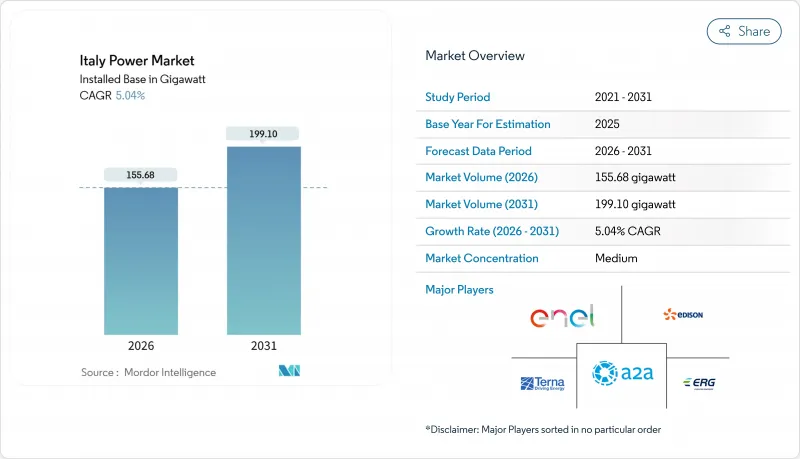
本報告按能源類型(火力發電、核能、可再生能源)和終端用戶(公共產業、商業/工業、住宅)進行分類。市場規模和預測以裝置容量(GW)為單位。
義大利發電市場趨勢與洞察
依199/2021號政府法令加速許可程序改革
199/2021號法令將10兆瓦以下太陽能和陸上風電計畫的核准週期從兩年多縮短至約六個月。 190/2024號法令進一步將此加速核准流程擴展至改造工程及混合儲能配置。 2024年至2025年初,共提交了超過15吉瓦的申請,其中許多集中在普利亞、西西里和Calabria。由於市政當局基於景觀考慮的否決,文化遺產地區的項目仍然被延誤,儘管義大利努力與歐盟131吉瓦的可再生能源目標保持一致,但仍造成了區域發展不平衡。目前,專案成功實施需要同步升級電網,以吸收間歇性電力輸入,同時避免增加棄風棄光。能夠快速應對區域規劃風險的市場參與企業將獲得稀缺的電網節點,並確保其開創性努力獲得回報。
電網級儲能容量市場競標(MACSE)
在Terna 2024年的MACSE競標中,為期10年、容量為2.3吉瓦的儲能供應合約中標,這標誌著義大利電力市場首個專門針對儲能的收入來源正式建立。得標計畫為50兆瓦的鋰離子電池儲能系統,與太陽能發電廠配套建設,主要位於普利亞和西西里島,旨在解決中午時段的電力供應過剩和晚間用電高峰問題。預計到2025年夏季,這兩個時段的電價差將超過100歐元/兆瓦時。此模式排除了需要數年建設週期的抽水蓄能電站提案,而是優先考慮可在18個月內完成安裝的模組化電池。 Terna 2026年的競標會預計將新增6-8小時的儲能時段,為液流電池和壓縮空氣儲能提供更多機會。提前參與的專案發起人既可以從套利和容量結算中獲益,又能保護其太陽能發電資產免受限電影響,從而即使在充滿挑戰的融資環境下,也能提升專案的資金籌措資金籌措。
普利亞和西西里島電網擁塞(延誤36個月或更久)
儘管超過40%的可再生能源開發計畫集中在普利亞和西西里島,但專為南北輸電設計的150千伏輸電線路目前正面臨反向過載問題,導致2024年發電量減少8%,並給發電企業造成超過2億歐元的收入損失。由於變電站加固工程積壓,2023年提交的併網申請面臨超過36個月的延誤,迫使開發商接受“可暫停合約”,將發電量減少的風險轉移到專案盈利上。 Terna公司斥資110億歐元的「超級電網」計畫旨在到2034年更換南部輸電線路並安裝動態額定值感測器,但除非透過臨時容量結算或併網逆變器來降低風險,否則中間的瓶頸可能會延緩實現可再生能源預計8.9%的複合年成長率。
細分市場分析
2025年,可再生能源裝置容量將佔義大利總裝置容量的56.1%,成為義大利電力市場最大的佔有率,預計到2031年將以8.9%的複合年成長率成長。 2023年,太陽能發電裝置容量激增5.3吉瓦,使義大利太陽能市場規模超過30吉瓦。其中超過60%的成長來自普利亞和西西里島的商業規模項目。預計到2025年,燃煤發電廠的逐步淘汰將使裝置容量減少5.7吉瓦,從而鞏固太陽能和陸上風電作為主要替代能源的地位,儘管電網瓶頸可能會減緩其成長。離岸風電在2028年之前仍將佔比極低,而水力發電的擴張受到歐盟水框架指令的限制,這限制了能源來源多元化的選擇。
水力發電目前仍佔義大利水庫和徑流式發電裝置容量的19吉瓦,托斯卡納地區的地熱發電裝置容量約為800兆瓦,生質能和垃圾焚化發電為4吉瓦,這使得義大利擁有歐洲最多元化的可再生能源組合之一。目前裝置容量為50吉瓦的聯合循環燃氣渦輪機發電廠預計將擴大發揮調峰作用,以彌補可再生能源的供不應求。開式循環燃氣調峰電廠正逐步被同步電容器取代,目前尚未討論核能計畫。總體而言,儘管可再生能源的激增有利於長期脫碳,但義大利迫切需要儲能和高壓直流輸電(HVDC)技術,以使義大利的電力市場能夠在不產生系統性風險的情況下應對電力供應波動。
其他好處
- Excel格式的市場預測(ME)表
- 3個月的分析師支持
目錄
第1章:引言
- 調查假設和市場定義
- 調查範圍
第2章:調查方法
第3章執行摘要
第4章 市場狀況
- 市場概覽
- 市場促進因素
- 依199/2021號政府法令加速許可程序改革
- 電網級儲能容量市場競標(Terna)
- 到 2025 年,隨著燃煤電廠逐步淘汰,將會出現供給能力缺口。
- 由 REPowerEU 資助的高壓直流輸電項目(例如,TyrrheniaLink)
- 主要快速日常消費品(FMCG) 公司之間的公司間購電協議 (PPA) 激增。
- 一項針對屋頂太陽能發電的「超級獎金 110%」激勵計畫。
- 市場限制因素
- 普利亞和西西里島電網擁塞(延誤36個月或更久)
- 離岸風力發電競標結果未達標(亞得里亞海)
- 天然氣進口易受地緣政治衝擊的影響(約90%)
- 涉及風力發電廠的景觀許可訴訟
- 供應鏈分析
- 監理展望
- 技術展望(數位化、高壓直流輸電、儲能)
- 波特五力模型
- PESTLE分析
第5章 市場規模與成長預測
- 透過電源
- 火力發電(煤炭、天然氣、石油、柴油)
- 核能
- 可再生能源(太陽能、風能、水能、地熱能、生質能/廢棄物、潮汐能)
- 最終用戶
- 公共產業
- 商業和工業用途
- 住宅
- 依輸配電電壓等級(僅定性分析)
- 高壓輸電(230千伏特或以上)
- 二次輸電(69-161千伏特)
- 中壓配電(13.2-34.5kV)
- 低壓配電(1kV或以下)
第6章 競爭情勢
- 市場集中度
- 策略趨勢(併購、聯盟、購電協議)
- 市場佔有率分析(主要公司的市場排名和佔有率)
- 公司簡介
- Enel SpA
- Terna SpA
- Edison SpA
- A2A SpA
- ERG SpA
- Acea SpA
- Sorgenia SpA
- Hera Group
- Eni Plenitude
- ENGIE SA(義大利)
- Renantis(Falck Renewables)
- Vestas Wind Systems A/S
- Siemens Gamesa Renewable Energy SA
- Prysmian Group
- Sonnedix Power Holdings Ltd
- SunPower Corporation
- RWE Renewables Italia
- Iberdrola Renovables Italia
- InterGen SpA
- PLT Energia SRL
第7章 市場機會與未來展望
According to Mordor Intelligence, the Italy power market size in terms of installed base is expected to grow from 155.68 gigawatt in 2026 to 199.10 gigawatt by 2031, at a CAGR of 5.04% during the forecast period (2026-2031).
This report is Segmented by Power Source (Thermal, Nuclear, and Renewables) and End-User (Utilities, Commercial and Industrial, and Residential). The Market Sizes and Forecasts are Provided in Terms of Installed Capacity (GW).
Italy Power Market Trends and Insights
Accelerated Permitting Reforms Under Legislative Decree 199/2021
Legislative Decree 199/2021 cut solar and onshore wind approval cycles from more than two years to roughly six months for projects under 10 MW, while Decree 190/2024 extended the fast track to repowering and hybrid storage configurations. Over 15 GW of applications were filed between 2024 and early 2025, concentrated in Apulia, Sicily, and Calabria, where resource quality is strongest. Municipal veto power on landscape grounds continues to slow projects in heritage zones, creating regional disparities even as Italy aligns with its EU-wide 131 GW renewable target. Successful execution now depends on synchronized transmission upgrades that absorb intermittent inflows without driving up curtailment. Market participants who navigate local planning risks first can secure scarce grid nodes and lock in early-mover returns.
Grid-scale Battery Capacity Market Auctions (MACSE)
Terna's 2024 MACSE auction awarded 2.3 GW of 10-year availability contracts, creating the first dedicated revenue stack for storage in the Italy power market. Winning projects, mainly 50 MW lithium-ion systems co-located with solar farms in Apulia and Sicily, address midday oversupply and evening peaks where price spreads topped EUR 100/MWh in summer 2025. The model sidelined pumped-hydro proposals that require multi-year construction and instead favored modular batteries deployable within 18 months. Terna's 2026 auction is expected to introduce a six-to-eight-hour category, opening opportunities for flow batteries and compressed-air storage. Early project sponsors gain dual upside from arbitrage and capacity payments while shielding solar assets from curtailment, strengthening project bankability in a tight financing environment.
Grid Congestion in Apulia & Sicily (>=36-Month Delays)
Apulia and Sicily host more than 40% of the renewable pipeline, yet 150 kV corridors designed for north-to-south flows now experience reverse overloads that triggered 8% curtailment in 2024, costing producers over EUR 200 million in lost revenue. Connection requests lodged in 2023 face >=36-month delays as substations queue for reinforcement, forcing developers to accept interruptible agreements that shift curtailment risk onto project economics. Terna's EUR 11 billion Hypergrid plan will reconductor southern lines and deploy dynamic-rating sensors by 2034, yet interim bottlenecks threaten to slow the forecast 8.9% renewable CAGR unless temporary capacity payments or grid-forming inverters mitigate risk.
Other drivers and restraints analyzed in the detailed report include:
- Coal Phase-Out by 2025 Creating Capacity Gap
- REPowerEU-funded HVDC Projects (Tyrrhenian Link)
- Gas-Import Exposure to Geopolitical Shocks
For complete list of drivers and restraints, kindly check the Table Of Contents.
Segment Analysis
Renewables accounted for 56.1% of installed capacity in 2025, the largest slice of the Italy power market, and are projected to grow at an 8.9% CAGR through 2031. Solar capacity surged by 5.3 GW in 2023, pushing the Italy power market size for solar past 30 GW; utility-scale projects in Apulia and Sicily contributed more than 60% of that buildout. The coal retirement removes 5.7 GW by 2025, cementing solar and onshore wind as primary replacements, though grid bottlenecks could temper momentum. Offshore wind remains marginal until 2028, and hydro expansion is capped by the EU Water Framework Directives, limiting diversification options.
Hydro still contributes 19 GW of reservoir and run-of-river assets, geothermal adds about 800 MW in Tuscany, and biomass-plus-waste holds 4 GW, giving Italy one of Europe's most diversified renewable stacks. Combined-cycle gas turbines, presently 50 GW, will increasingly swing-dispatch to cover renewable droughts. Open-cycle gas peakers are being phased into synchronous condensers, and no nuclear program is under discussion. Altogether, the renewable surge underpins long-run decarbonization but heightens the urgency of storage and HVDC delivery so that the Italy power market can accommodate variable inflows without systemic risk.
Complete Report Scope:
- By Power Source
- Thermal (Coal, Natural Gas, Oil and Diesel)
- Nuclear
- Renewables (Solar, Wind, Hydro, Geothermal, Biomass & Waste, Tidal)
- By End User
- Utilities
- Commercial and Industrial
- Residential
- By T&D Voltage Level (Qualitative Analysis only)
- High-Voltage Transmission (Above 230 kV)
- Sub-Transmission (69 to 161 kV)
- Medium-Voltage Distribution (13.2 to 34.5 kV)
- Low-Voltage Distribution (Up to 1 kV)
List of Companies Covered in this Report:
- Enel SpA
- Terna SpA
- Edison SpA
- A2A SpA
- ERG SpA
- Acea SpA
- Sorgenia SpA
- Hera Group
- Eni Plenitude
- ENGIE SA (Italy)
- Renantis (Falck Renewables)
- Vestas Wind Systems A/S
- Siemens Gamesa Renewable Energy SA
- Prysmian Group
- Sonnedix Power Holdings Ltd
- SunPower Corporation
- RWE Renewables Italia
- Iberdrola Renovables Italia
- InterGen SpA
- PLT Energia SRL
Additional Benefits:
- The market estimate (ME) sheet in Excel format
- 3 months of analyst support
TABLE OF CONTENTS
1 Introduction
- 1.1 Study Assumptions & Market Definition
- 1.2 Scope of the Study
2 Research Methodology
3 Executive Summary
4 Market Landscape
- 4.1 Market Overview
- 4.2 Market Drivers
- 4.2.1 Accelerated Permitting Reforms under Legislative Decree 199/2021
- 4.2.2 Grid-scale Battery Capacity Market Auctions (Terna)
- 4.2.3 Coal Phase-out by 2025 Creating Capacity Gap
- 4.2.4 REPowerEU-funded HVDC Projects (e.g., Tyrrhenian Link)
- 4.2.5 Corporate PPAs Surge among Luxury & FMCG Majors
- 4.2.6 Superbonus 110 % Stimulus for Rooftop PV
- 4.3 Market Restraints
- 4.3.1 Grid Congestion in Apulia & Sicily (>=36-month Delays)
- 4.3.2 Offshore Wind Tender Under-realisation (Adriatic)
- 4.3.3 Gas-Import Exposure to Geopolitical Shocks (≈90 %)
- 4.3.4 Landscape-related Permit Litigation for Wind Farms
- 4.4 Supply-Chain Analysis
- 4.5 Regulatory Outlook
- 4.6 Technological Outlook (Digitalisation, HVDC, Storage)
- 4.7 Porters Five Forces
- 4.7.1 Bargaining Power of Suppliers
- 4.7.2 Bargaining Power of Buyers
- 4.7.3 Threat of New Entrants
- 4.7.4 Threat of Substitutes
- 4.7.5 Competitive Rivalry
- 4.8 PESTLE Analysis
5 Market Size & Growth Forecasts
- 5.1 By Power Source
- 5.1.1 Thermal (Coal, Natural Gas, Oil and Diesel)
- 5.1.2 Nuclear
- 5.1.3 Renewables (Solar, Wind, Hydro, Geothermal, Biomass & Waste, Tidal)
- 5.2 By End User
- 5.2.1 Utilities
- 5.2.2 Commercial and Industrial
- 5.2.3 Residential
- 5.3 By T&D Voltage Level (Qualitative Analysis only)
- 5.3.1 High-Voltage Transmission (Above 230 kV)
- 5.3.2 Sub-Transmission (69 to 161 kV)
- 5.3.3 Medium-Voltage Distribution (13.2 to 34.5 kV)
- 5.3.4 Low-Voltage Distribution (Up to 1 kV)
6 Competitive Landscape
- 6.1 Market Concentration
- 6.2 Strategic Moves (M&A, Partnerships, PPAs)
- 6.3 Market Share Analysis (Market Rank/Share for key companies)
- 6.4 Company Profiles (includes Global level Overview, Market level overview, Core Segments, Financials as available, Strategic Information, Products & Services, and Recent Developments)
- 6.4.1 Enel SpA
- 6.4.2 Terna SpA
- 6.4.3 Edison SpA
- 6.4.4 A2A SpA
- 6.4.5 ERG SpA
- 6.4.6 Acea SpA
- 6.4.7 Sorgenia SpA
- 6.4.8 Hera Group
- 6.4.9 Eni Plenitude
- 6.4.10 ENGIE SA (Italy)
- 6.4.11 Renantis (Falck Renewables)
- 6.4.12 Vestas Wind Systems A/S
- 6.4.13 Siemens Gamesa Renewable Energy SA
- 6.4.14 Prysmian Group
- 6.4.15 Sonnedix Power Holdings Ltd
- 6.4.16 SunPower Corporation
- 6.4.17 RWE Renewables Italia
- 6.4.18 Iberdrola Renovables Italia
- 6.4.19 InterGen SpA
- 6.4.20 PLT Energia SRL
7 Market Opportunities & Future Outlook
- 7.1 White-space & Unmet-Need Assessment

 電力零售:市場佔有率分析、產業趨勢與統計、成長預測(2026-2031)日本電力產業:市場佔有率分析、產業趨勢與統計及成長預測(2026-2031年)歐洲電力市場:市場佔有率分析、產業趨勢與統計、成長預測(2026-2031 年)西班牙電力市場:市場佔有率分析、行業趨勢和統計數據、成長預測(2026-2031 年)電力:市場佔有率分析、行業趨勢和統計數據、成長預測(2026-2031 年)印度電力產業:市場佔有率分析、產業趨勢與統計、成長預測(2026-2031)馬來西亞電力:市場佔有率分析、產業趨勢與統計、成長預測(2026-2031)泰國電力市場:市場佔有率分析、產業趨勢與統計、成長預測(2026-2031)越南能源市場:市場佔有率分析、產業趨勢與統計、成長預測(2026-2031年)
 電力零售市場-全球產業規模、佔有率、趨勢、機會和預測:按市場結構、客戶類型、服務類型、支付方式、地區和競爭格局分類,2021-2031年