


 |
市場調查報告書
商品編碼
2120278
越南能源市場:市場佔有率分析、產業趨勢與統計、成長預測(2026-2031年)Vietnam Power - Market Share Analysis, Industry Trends & Statistics, Growth Forecasts (2026 - 2031) |
||||||

※ 本網頁內容可能與最新版本有所差異。詳細情況請與我們聯繫。
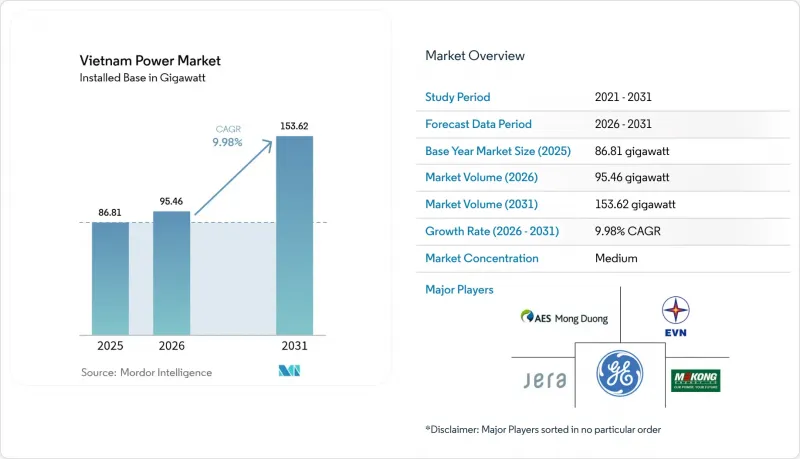
根據 Mordor Intelligence 預測,越南電力市場規模將從 2025 年的 86.81 吉瓦成長到 2026 年的 95.46 吉瓦,然後從 2026 年到 2031 年以 9.98% 的複合年成長率成長,到 2031 年達到 153.62 吉瓦。
本報告按能源類型(火力發電、核能、可再生能源)和終端用戶(公共產業、商業/工業、住宅)進行細分。市場規模和預測均以總裝置容量(GW)為基礎。
越南電力市場趨勢與洞察
快速的工業化導致電力需求激增。
2024年工業生產成長8.4%,截至5月底全國用電量已達10億度數時,越南電力集團(EVN)決定實施需量反應計畫。光是半導體產業預計到2024年產值就將達到182.3億美元,年複合成長率達11.48%。這得歸功於越南的「矽Delta」策略,該策略旨在到2030年使越南高科技產品產量佔全球45%。預計到2025年初,韓國將重奪最大投資國地位,SK集團將數十億美元投資於液化天然氣和小型模組化反應器。為實現政府設定的2025年GDP成長8%的目標,越南電力產能需要每年成長12%至16%,這將使越南電力市場更加依賴快速電網建設項目。目前,外國投資者將穩定的電力供應視為高科技工廠選址的位置因素。
政府可再生能源目標及上網電價補貼
修訂後的第八版電力發展計畫(PDP-8)將2030年的電力消耗量設定為5004億至5578億千瓦時,並強制要求可再生能源佔電力結構的28%至36%,這表明能源結構將逐步擺脫以煤炭主導的局面。新的價格上限設定為:北部陸上風電每千瓦時1959.4越南盾(約0.079美元),這在多年指南停滯不前之後,提振了投資者的信心。然而,追溯性地降低購電價格威脅到價值130億美元的已運作中太陽能和風能資產,引發了國際開發商的抗議。 57/2025號法令引入了直接購電協議(DPPA),允許私人發電企業直接與合格的消費者進行電力交易,無需通過越南電力集團(EVN)。這項改革可望減輕國家預算負擔,並加速可再生能源的普及應用。這些變化符合東協電網願景,該願景旨在到 2030 年使區域內高達 50% 的電力來自清潔能源。
PPA核准延遲和監管不確定性
審計機構發現上網電價補貼(FIT)規則有濫用情況,暫停了新的購電協議(PPA),直到審查完成,這使得價值約130億美元的風能和太陽能資產面臨風險。儘管越南制定了到2030年將發電量翻倍的宏偉計劃,但這起事件仍迫使Enel、Equinor和Olsted三家公司退出越南市場。最新版PDP-8草案中取消了6吉瓦離岸離岸風力發電項目,進一步加劇了人們對政策不穩定的擔憂。電網審核也同樣延誤;政府數據顯示,在16個強制性電網工程中,只有兩個按期在2024年完工。這些延誤在短期內抑制了越南電力市場的發展動能。
細分市場分析
2025年,可再生能源裝置容量將佔越南總裝置容量的56.85%,凸顯其在越南離岸風力發電市場中的基石地位。預計到2031年,該領域將以11.46%的複合年成長率成長,主要驅動力包括住宅太陽能發電的擴張、中部高原陸上風電的普及以及颱風多發沿海地區海上風力發電項目的啟動。儘管太陽能發電總裝置容量已達19.4吉瓦,但旱季期間當地輸電線路負載過重,導致寧順省和平順省的發電量上限超過15%。由於發電量上限較高,開發商擴大在新計畫中採用電池儲能技術,而第八屆越南電力發展計劃(PDP-8)提出的到本十年末安裝10-16吉瓦電池儲能容量的目標也進一步推動了這一趨勢。越南計畫在2030年實現離岸風電裝置容量6吉瓦的目標,相當於從2026年開始每年新增1.2吉瓦,這需要儘早發展港口設施並建立本地供應鏈。綜合考慮這些趨勢,預計越南電力市場規模將進一步擴大,並在三年內超過新建火電廠的裝置容量。
儘管火力發電容量仍然十分重要,但其比例正在下降。 2024年,燃煤發電廠的運轉率率僅68%。這主要是由於政府優先發展成本較低的風能和水力發電。新建燃煤電廠計畫面臨資金籌措的困境,而海上天然氣田的枯竭也阻礙了燃氣發電的發展。因此,政府再次將核能發電納入考慮範圍,並制定了2030年至2035年間4至6.4吉瓦的初步規劃,但資金籌措和社會接受度仍然是挑戰。短期內,聯合循環燃氣發電和大規模電池儲能有望彌補發電容量的不足,並支持電力輸出的調整,從而構建一種技術配置,使越南電力市場能夠在保持快速成長的同時降低排放強度。
其他好處:
- Excel格式的市場預測(ME)表
- 3個月的分析師支持
目錄
第1章:引言
- 研究假設和市場定義
- 調查範圍
第2章:調查方法
第3章執行摘要
第4章 市場狀況
- 市場概覽
- 市場促進因素
- 由於快速工業化,電力需求迅速成長
- 政府可再生能源目標及上網電價補貼計劃
- PDP-8 電力生產和輸電網領域的外國直接投資(FDI)流入
- 電網現代化改造資金(亞洲開發銀行、日本國際協力機構)
- 擴大離岸風力發電競標範圍
- 資料中心的快速成長增加了對靈活發電的需求。
- 市場限制因素
- PPA核准延遲和監管不確定性
- 受環境、社會及公司治理因素影響,煤炭產業融資規模縮小。
- 太陽能發電廠土地徵用糾紛
- 高壓設備的進口依賴性
- 供應鏈分析
- 監理情勢
- 技術展望
- 波特五力模型
- PESTLE分析
第5章 市場規模與成長預測
- 透過電源
- 火力發電(煤炭、天然氣、石油和天然氣、柴油)
- 核能
- 可再生能源(太陽能、風能、水能、地熱能、生質能/廢棄物、潮汐能)
- 最終用戶
- 公用事業
- 商業和工業用途
- 住宅
- 依輸配電電壓等級(僅定性分析)
- 高壓輸電(230千伏特或以上)
- 二次輸電(69-161千伏特)
- 中壓配電(13.2–34.5 kV)
- 低壓配電(1千伏特或以下)
第6章 競爭情勢
- 市場集中度
- 策略趨勢(併購、聯盟、購電協議)
- 市場佔有率分析(主要公司的市場排名和佔有率)
- 公司簡介
- Vietnam Electricity(EVN)
- PetroVietnam Power Corporation(PV Power)
- AES Corporation(Vietnam)
- JERA Co., Inc.
- Trung Nam Group
- Mekong Energy Company Ltd
- Vietnam Sunergy Joint Stock Company
- Sharp Energy Solutions Corporation
- B.Grimm Power(Vietnam)
- Siemens Energy Vietnam
- General Electric Vietnam
- Vestas Vietnam
- Orsted Vietnam
- Sunseap/EDP Renewables APAC
- Trina Solar Vietnam
- T&T Group Power
- Bamboo Capital Group(BCG Energy)
- Hitachi Energy Vietnam
- SP Group Vietnam
- Power Engineering Consulting JSC 2(PECC2)
第7章 市場機會與未來展望
According to Mordor Intelligence, the Vietnam power market size is expected to grow from 86.81 gigawatt in 2025 to 95.46 gigawatt in 2026 and is forecast to reach 153.62 gigawatt by 2031 at 9.98% CAGR over 2026-2031.
This report is Segmented by Power Source (Thermal, Nuclear, and Renewables) and End-User (Utilities, Commercial and Industrial, and Residential). The Market Sizes and Forecasts are Provided in Terms of Installed Capacity (GW).
Vietnam Power Market Trends and Insights
Rapid Industrialisation-Led Electricity Demand Surge
Industrial production jumped 8.4% 2024, lifting nationwide electricity use to 1 billion kWh in late May and prompting EVN to deploy demand-response programs. The semiconductor sector alone is valued at USD 18.23 billion in 2024 and is expanding at 11.48% CAGR, an outcome of Vietnam's "Silicon Delta" policy that targets 45% of output from high-tech goods by 2030. South Korea reclaimed the top-investor slot in early 2025, with SK Group allocating multibillion-dollar budgets to LNG and small-modular reactors. Meeting the government's 8% GDP objective for 2025 requires 12-16% yearly additions to generation, magnifying the Vietnam power market dependency on fast-track grid projects. Foreign investors now cite a stable electricity supply as a precondition for high-tech plant siting.
Government Renewable-Energy Targets & FITs
The revised PDP-8 sets a 500.4-557.8 billion kWh consumption band for 2030 while mandating that renewables claim 28-36% of the mix, signaling a pivot away from coal dominance. New price caps place onshore wind at VND 1,959.4/kWh (USD 0.078) in the north and near-shore projects at VND 1,987.4/kWh (USD 0.079), restoring investor visibility after years of stalled guidance.Yet simultaneous retroactive tariff cuts threaten USD 13 billion in operating solar and wind assets, sparking protests from international developers. Decree 57/2025 introduced DPPAs, allowing private generators to bypass EVN and transact directly with qualified consumers, a reform expected to lower state-budget strain and quicken renewable deployment. These shifts align Vietnam with the ASEAN Power Grid vision that foresees clean sources covering up to 50% of regional output by 2030.
Slow PPA Approval & Regulatory Uncertainty
Around USD 13 billion in wind and solar assets are at risk after auditors found misapplied FIT rules and suspended new PPAs pending review, prompting exits by Enel, Equinor, and Orsted despite Vietnam's headline plan to double capacity by 2030. A 6 GW offshore-wind zone was removed from the latest PDP-8 draft, deepening perceptions of policy volatility. Transmission approvals are equally sluggish; government data show only 2 of 16 mandated grid projects met 2024 timelines. These delays restrain the Vietnam power market's tempo in the short run.
Other drivers and restraints analyzed in the detailed report include:
- PDP-8-Driven FDI Inflow in Generation & Grid
- Grid-Modernisation Funding (ADB, JICA)
- ESG-Driven Coal-Financing Squeeze
For complete list of drivers and restraints, kindly check the Table Of Contents.
Segment Analysis
Renewables delivered 56.85% of installed capacity in 2025, underscoring their status as the anchor of the Vietnam power market. The segment is forecast to compound at 11.46% annually through 2031 as solar rooftops scale, onshore wind spreads across the Central Highlands, and offshore wind turbines begin to populate typhoon-exposed coastal waters. Solar already totals 19.4 GW, yet curtailment surpasses 15% in Ninh Thuan and Binh Thuan during the dry season when local lines overload. High curtailment has prompted developers to pair new projects with battery storage, a trend facilitated by PDP-8's target of 10-16 GW of batteries by decade-end. Offshore wind's 6 GW 2030 target equates to 1.2 GW of annual installs starting in 2026, demanding prompt port upgrades and localized supply chains. Together, these trends point to an expanded Vietnam power market size at the segment level that will eclipse thermal additions within three years.
Thermal capacity remains relevant but is losing ground. Coal units ran at a 68% capacity factor in 2024 as merit-order rules favored cheaper wind and hydropower. New coal projects lack financing, and depleting offshore gas fields hinder gas-fired growth. The government, therefore, places nuclear back on the table with preliminary 4-6.4 GW plans for the 2030-2035 horizon, though finance and public acceptance remain hurdles. In the interim, combined-cycle gas and large-scale batteries are set to bridge the capacity gap and provide ramping support, shaping a technology mix that allows the Vietnam power market to continue its rapid growth while lowering emissions intensity.
Complete Report Scope:
- By Power Source
- Thermal (Coal, Natural Gas, Oil and Diesel)
- Nuclear
- Renewables (Solar, Wind, Hydro, Geothermal, Biomass & Waste, Tidal)
- By End User
- Utilities
- Commercial and Industrial
- Residential
- By T&D Voltage Level (Qualitative Analysis only)
- High-Voltage Transmission (Above 230 kV)
- Sub-Transmission (69 to 161 kV)
- Medium-Voltage Distribution (13.2 to 34.5 kV)
- Low-Voltage Distribution (Up to 1 kV)
List of Companies Covered in this Report:
- Vietnam Electricity (EVN)
- PetroVietnam Power Corporation (PV Power)
- AES Corporation (Vietnam)
- JERA Co., Inc.
- Trung Nam Group
- Mekong Energy Company Ltd
- Vietnam Sunergy Joint Stock Company
- Sharp Energy Solutions Corporation
- B.Grimm Power (Vietnam)
- Siemens Energy Vietnam
- General Electric Vietnam
- Vestas Vietnam
- Orsted Vietnam
- Sunseap / EDP Renewables APAC
- Trina Solar Vietnam
- T&T Group Power
- Bamboo Capital Group (BCG Energy)
- Hitachi Energy Vietnam
- SP Group Vietnam
- Power Engineering Consulting JSC 2 (PECC2)
Additional Benefits:
- The market estimate (ME) sheet in Excel format
- 3 months of analyst support
TABLE OF CONTENTS
1 Introduction
- 1.1 Study Assumptions & Market Definition
- 1.2 Scope of the Study
2 Research Methodology
3 Executive Summary
4 Market Landscape
- 4.1 Market Overview
- 4.2 Market Drivers
- 4.2.1 Rapid industrialisation-led electricity demand surge
- 4.2.2 Government renewable-energy targets & FITs
- 4.2.3 PDP-8-driven FDI inflow in generation & grid
- 4.2.4 Grid-modernisation funding (ADB, JICA)
- 4.2.5 Offshore-wind auction pipeline unlock
- 4.2.6 Data-centre boom raising flexible-generation need
- 4.3 Market Restraints
- 4.3.1 Slow PPA approval & regulatory uncertainty
- 4.3.2 ESG-driven coal-financing squeeze
- 4.3.3 Land-acquisition conflicts for solar farms
- 4.3.4 Import-dependency for high-voltage equipment
- 4.4 Supply-Chain Analysis
- 4.5 Regulatory Landscape
- 4.6 Technological Outlook
- 4.7 Porters Five Forces
- 4.7.1 Threat of New Entrants
- 4.7.2 Bargaining Power of Suppliers
- 4.7.3 Bargaining Power of Buyers
- 4.7.4 Threat of Substitutes
- 4.7.5 Competitive Rivalry
- 4.8 PESTLE Analysis
5 Market Size & Growth Forecasts
- 5.1 By Power Source
- 5.1.1 Thermal (Coal, Natural Gas, Oil and Diesel)
- 5.1.2 Nuclear
- 5.1.3 Renewables (Solar, Wind, Hydro, Geothermal, Biomass & Waste, Tidal)
- 5.2 By End User
- 5.2.1 Utilities
- 5.2.2 Commercial and Industrial
- 5.2.3 Residential
- 5.3 By T&D Voltage Level (Qualitative Analysis only)
- 5.3.1 High-Voltage Transmission (Above 230 kV)
- 5.3.2 Sub-Transmission (69 to 161 kV)
- 5.3.3 Medium-Voltage Distribution (13.2 to 34.5 kV)
- 5.3.4 Low-Voltage Distribution (Up to 1 kV)
6 Competitive Landscape
- 6.1 Market Concentration
- 6.2 Strategic Moves (M&A, Partnerships, PPAs)
- 6.3 Market Share Analysis (Market Rank/Share for key companies)
- 6.4 Company Profiles (includes Global level Overview, Market level overview, Core Segments, Financials as available, Strategic Information, Products & Services, and Recent Developments)
- 6.4.1 Vietnam Electricity (EVN)
- 6.4.2 PetroVietnam Power Corporation (PV Power)
- 6.4.3 AES Corporation (Vietnam)
- 6.4.4 JERA Co., Inc.
- 6.4.5 Trung Nam Group
- 6.4.6 Mekong Energy Company Ltd
- 6.4.7 Vietnam Sunergy Joint Stock Company
- 6.4.8 Sharp Energy Solutions Corporation
- 6.4.9 B.Grimm Power (Vietnam)
- 6.4.10 Siemens Energy Vietnam
- 6.4.11 General Electric Vietnam
- 6.4.12 Vestas Vietnam
- 6.4.13 Orsted Vietnam
- 6.4.14 Sunseap / EDP Renewables APAC
- 6.4.15 Trina Solar Vietnam
- 6.4.16 T&T Group Power
- 6.4.17 Bamboo Capital Group (BCG Energy)
- 6.4.18 Hitachi Energy Vietnam
- 6.4.19 SP Group Vietnam
- 6.4.20 Power Engineering Consulting JSC 2 (PECC2)
7 Market Opportunities & Future Outlook
- 7.1 White-space & Unmet-Need Assessment

 電力零售:市場佔有率分析、產業趨勢與統計、成長預測(2026-2031)日本電力產業:市場佔有率分析、產業趨勢與統計及成長預測(2026-2031年)歐洲電力市場:市場佔有率分析、產業趨勢與統計、成長預測(2026-2031 年)西班牙電力市場:市場佔有率分析、行業趨勢和統計數據、成長預測(2026-2031 年)電力:市場佔有率分析、行業趨勢和統計數據、成長預測(2026-2031 年)印度電力產業:市場佔有率分析、產業趨勢與統計、成長預測(2026-2031)馬來西亞電力:市場佔有率分析、產業趨勢與統計、成長預測(2026-2031)義大利發電:市佔率分析、產業趨勢與統計及成長預測(2026-2031 年)泰國電力市場:市場佔有率分析、產業趨勢與統計、成長預測(2026-2031)
 電力零售市場-全球產業規模、佔有率、趨勢、機會和預測:按市場結構、客戶類型、服務類型、支付方式、地區和競爭格局分類,2021-2031年