


 |
市場調查報告書
商品編碼
2113219
泰國電力市場:市場佔有率分析、產業趨勢與統計、成長預測(2026-2031)Thailand Power - Market Share Analysis, Industry Trends & Statistics, Growth Forecasts (2026 - 2031) |
||||||

※ 本網頁內容可能與最新版本有所差異。詳細情況請與我們聯繫。
根據 Mordor Intelligence 預測,泰國電力市場規模將從 2025 年的 64.61 吉瓦擴大到 2026 年的 65.98 吉瓦,然後從 2026 年到 2031 年以 2.12% 的複合年成長率成長,到 2031 年達到 73.
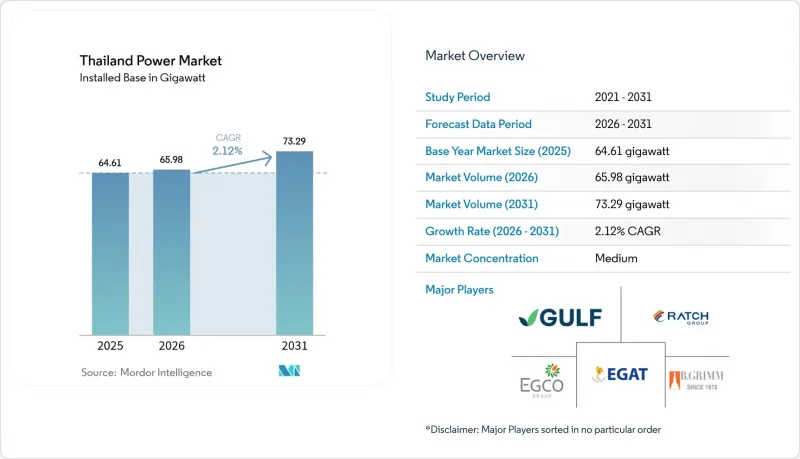
本報告按能源類型(火力發電、核能、可再生能源)和終端用戶(公共產業、商業/工業、住宅)進行細分。市場規模和預測以裝置容量(吉瓦)為單位。
泰國電力市場趨勢與洞察
增加新的可再生能源產能
2024年,泰國新增光伏發電裝置容量約3吉瓦,使太陽能發電累積設備容量達到11.875吉瓦,成為新增裝置容量的主要貢獻者。泰國國家電力局(EGAT)的浮體式太陽能發電藍圖計畫在九個水庫建造總合超過2700兆瓦的浮式太陽能發電計畫。該戰略避免了土地徵用限制,並透過現有的水電輸電節點加快併網速度。在2022年的上網電價補貼(FiT)競標中,共5吉瓦分配給了太陽能、風能和儲能項目,但南部地區的電網堵塞導致約500兆瓦的併網延遲,凸顯了發電和輸電之間的相互依存關係。儘管有優惠的上網電價補貼政策,但生質能和垃圾焚化發電仍處於小眾市場,受到原料供應季節性波動的限制。一旦第三方接入(TPA)規則在 2025 年最終確定,資料中心和出口導向製造群將有可能簽訂高達 2 GW 的直接購電協議(PPA),預計這將減少對公用事業公司電力採購的依賴。
老舊輸配電網路的現代化改造
2025年1月,泰國國家電力局(EGAT)採用Energy Exemplar公司的PLEXOS模型來最佳化發電並整合可再生能源,標誌著電網分析向數位轉型。耗資17.2億泰銖(約5000萬美元)的Van Bueng 2變電站維修凸顯了東部經濟走廊沿線電壓水準上升所帶來的資本密集度增加。三個總裝置容量總合2472兆瓦的抽水蓄能發電工程是增強電網柔軟性的關鍵,其裝置容量遠超現有的1531兆瓦發電容量,並彌補了燃煤發電廠退役造成的慣性損失。隨著智慧電錶普及率(目前少於10%)的提高,可再生能源預測中心和需量反應控制中心將調整發電限電措施。日立能源的併網逆變器目前正在進行試運行,以實現比同步電容器更快的頻率響應。
大規模電網升級需要大量資金投入
泰國國家電力局 (EGAT) 投資 900 億泰銖(約 26 億美元)的抽水蓄能水力發電計畫預計每兆瓦成本超過 100 萬美元,其中包括土木工程和環境保護費用。該公司投資 130 億泰銖(約 3.8 億美元)的浮體式太陽能發電專案進一步加劇了其財務困境,而多邊融資又使該專案面臨外匯波動風險。預計耗資 200 億泰銖(約 5.8 億美元)的南部 500 千伏輸電線路加固工程因土地徵用延誤而停滯不前,導致 500 兆瓦可再生能源併網受阻,迫使開發商在合約中加入發電量限制條款。 EGAT 的負債資本比率已接近監管上限,除非提高利率或註入資金,否則進一步借貸將受到限制。小規模的獨立發電公司 (IPP) 無法自行承擔輸電網擴建的資金,只能閒置發電能力,直到透過第三方接入實現私人輸電為止。
細分市場分析
到2025年,火力發電將佔總發電量的75.02%,但由於太陽能發電的成長,可再生能源發電正以5.05%的複合年成長率成長,這顯示隨著燃煤和燃油電廠的除役,能源結構正在轉型。天然氣發電佔57.74%,但對液化天然氣(LNG)的依賴性日益增強以及碳中和目標的實現,正迫使負責人限制新建燃氣電廠。太陽能發電裝置容量達到11.875吉瓦,這主要得益於總計2656兆瓦的浮體式太陽能發電競標,並且由於水庫水溫相對較低,其容量係數超過18%。水力發電佔15.63%,主要來自寮國人民民主共和國的進口,而泰國已成為寮國-泰國-馬來西亞-新加坡(LTMS-PIP)走廊的過境樞紐。風力發電規模仍然有限,但離岸風電可行性研究表明,到2028年以後,其潛在裝置容量可達2-3吉瓦。由於原料供應受限,生質能和垃圾焚化發電項目發展緩慢。核能和地熱能仍處於規劃階段,預計在2035年之前不太可能對泰國電力市場產生影響。
儲能對於能源轉型至關重要。如果鋰離子電池的價格降至每千瓦時100美元以下,太陽能發電與電池儲能結合的混合系統將比尖峰時段的燃氣發電廠更經濟,從而加速淘汰燃煤發電並減少液化天然氣採購。因此,預計在2026年至2031年間,泰國電力市場的可再生能源混合市場成長將超過任何火力發電產業。與現有水力發電設施結合的浮體式水庫型太陽能發電系統,無需新購置土地即可實現短期規模化,凸顯了綜合資產在應對電力供應波動方面的重要作用。
其他好處:
- Excel格式的市場預測(ME)表
- 3個月的分析師支持
目錄
第1章:引言
- 研究假設和市場定義
- 調查範圍
第2章:調查方法
第3章執行摘要
第4章 市場狀況
- 市場概覽
- 市場促進因素
- 新增可再生能源數量增加
- 老舊輸配電網路的現代化改造
- 隨著電動車的普及,電力需求穩定成長。
- 電池整合式混合太陽能發電的成本正在迅速下降。
- 2025 年屋頂光電上網電價補貼政策推動分散式太陽能發電蓬勃發展。
- 東協LTMS-PIP跨境電力交易走廊
- 市場限制因素
- 電網大規模升級需要大量資金投入。
- 面臨進口液化天然氣價格波動的風險
- 南部走廊電網擁塞導致可再生能源工程延誤。
- PDP-2024的延遲給投資者帶來了不確定性。
- 供應鏈分析
- 監理情勢
- 技術展望
- 波特五力模型
- PESTLE分析
第5章 市場規模與成長預測
- 透過電源
- 火力發電(煤炭、天然氣、石油和天然氣、柴油)
- 核能
- 可再生能源(太陽能、風能、水能、地熱能、生質能/廢棄物、潮汐能)
- 最終用戶
- 公共產業
- 商業和工業
- 住宅
- 依輸配電電壓等級(僅定性分析)
- 高壓輸電(230千伏特或以上)
- 半輸電線路(69-161千伏)
- 中壓配電(13.2–34.5 kV)
- 低壓配電(1千伏特或以下)
第6章 競爭情勢
- 市場集中度
- 策略趨勢(併購、聯盟、購電協議)
- 市場佔有率分析(主要公司的市場排名和佔有率)
- 公司簡介
- Electricity Generating Authority of Thailand(EGAT)
- Gulf Energy Development PLC
- RATCH Group Public Co. Ltd.
- Electricity Generating Public Co. Ltd.(EGCO)
- B.Grimm Power PLC
- Glow Energy PLC(GPSC)
- Siemens Gamesa Renewable Energy SA
- Vestas Wind Systems AS
- JinkoSolar Holding Co. Ltd.
- General Electric Company
- Schneider Electric SE
- Mitsubishi Heavy Industries Ltd.
- PTT Public Co. Ltd.
- BCPG PLC
- Wind Energy Holding Co. Ltd.
- Siam Solar Development Co. Ltd.
- Sungrow Power Supply Co. Ltd.
- Huawei Digital Power Thailand
- Hitachi Energy Thailand Ltd.
- SGS SA(Inspection & Certification)
第7章 市場機會與未來展望
According to Mordor Intelligence, the Thailand power market size is expected to grow from 64.61 gigawatt in 2025 to 65.98 gigawatt in 2026 and is forecast to reach 73.29 gigawatt by 2031 at 2.12% CAGR over 2026-2031.
This report is Segmented by Power Source (Thermal, Nuclear, and Renewables) and End-User (Utilities, Commercial and Industrial, and Residential). The Market Sizes and Forecasts are Provided in Terms of Installed Capacity (GW).
Thailand Power Market Trends and Insights
Rising Renewables Capacity Additions
Thailand installed nearly 3 GW of solar photovoltaic (PV) capacity in 2024, increasing cumulative solar capacity to 11.875 GW and making solar the leading contributor to incremental capacity. EGAT's floating-solar roadmap spans nine reservoirs totaling more than 2,700 MW, a strategy that sidesteps land constraints and speeds tie-ins via existing hydro grid nodes. The 2022 feed-in-tariff (FiT) auction awarded 5 GW across solar, wind, and battery projects, but southern congestion has delayed roughly 500 MW of grid connections, exposing generation-transmission interdependencies. Biomass and waste-to-energy remain niche, constrained by seasonal variability in feedstock availability despite supportive tariffs. Finalization of Third-Party Access (TPA) codes in 2025 is expected to unlock up to 2 GW of direct PPAs for data centers and export-manufacturing clusters, reducing reliance on utility offtake.
Modernization of Ageing T&D Grid
EGAT adopted Energy Exemplar's PLEXOS model in January 2025 to optimize dispatch and renewable integration, signaling a digital pivot toward advanced grid analytics. A THB 1.72 billion (USD 50 million) upgrade at the Ban Bueng 2 substation underscores capital intensity as voltage levels rise in the Eastern Economic Corridor. Three pumped-storage projects, totaling 2,472 MW, anchor the flexibility build-out, dwarfing the existing 1,531 MW fleet and providing the inertia lost from coal retirements. The Renewable Energy Forecast Center and Demand Response Control Center will coordinate curtailment once smart meter penetration, still below 10%, improves. Hitachi Energy's grid-forming inverters are being piloted to furnish rapid frequency response compared with synchronous condensers.
High Capex for Large-Scale Grid Upgrades
EGAT's THB 90 billion (USD 2.6 billion) pumped-storage program implies costs exceeding USD 1 million per MW when civil works and environmental mitigation are included. The utility's THB 13 billion (USD 380 million) floating-solar plan further stretches the balance sheet, and multilateral financing exposes projects to exchange-rate volatility. Southern 500 kV line reinforcements, priced at THB 20 billion (USD 580 million), are facing land-acquisition delays, stalling 500 MW of renewable connections and forcing developers into curtailment clauses. EGAT's debt-to-equity ratio is near regulatory ceilings, limiting incremental borrowing unless tariffs rise or equity injections are made. Smaller IPPs cannot self-finance grid extensions, creating stranded generation until Third-Party Access enables private wheeling.
Other drivers and restraints analyzed in the detailed report include:
- Steady Electricity-Demand Growth from EV Rollout
- Rapid Cost Decline of Battery-Integrated Hybrid PV
- Exposure to Volatile Imported LNG Pricing
For complete list of drivers and restraints, kindly check the Table Of Contents.
Segment Analysis
Thermal generation supplied 75.02% of capacity in 2025, yet solar additions lifted renewable output by 5.05% CAGR, signaling a pivot as coal and oil plants retire. Natural gas produced 57.74% of electricity; however, rising LNG dependence and carbon-neutrality targets are pressuring planners to cap new gas builds. Solar reached 11.875 GW on the back of floating-PV tenders totaling 2,656 MW, achieving capacity factors above 18% owing to cooler reservoir temperatures. Hydropower contributed 15.63% via Lao PDR imports, positioning Thailand as a transit hub in the Lao-Thai-Malaysia-Singapore (LTMS-PIP) corridor. Wind remains marginal, although offshore feasibility studies suggest a potential of 2-3 GW post-2028. Biomass and waste-to-energy projects expand slowly due to feedstock constraints. Nuclear and geothermal remain exploratory and are unlikely to influence the Thai power market before 2035.
Energy storage is the fulcrum of the transition: once lithium-ion breaches USD 100 per kWh, solar-plus-battery hybrids will undercut gas peakers, accelerating coal phase-outs and trimming LNG procurement. Consequently, the Thailand power market size for renewable hybrids is projected to grow faster than any thermal category over the 2026-2031 period. Reservoir-based floating solar, bundled with existing hydro tie-ins, offers near-term scale without new rights-of-way, highlighting the role of integrative assets in balancing variable supply.
Complete Report Scope:
- By Power Source
- Thermal (Coal, Natural Gas, Oil and Diesel)
- Nuclear
- Renewables (Solar, Wind, Hydro, Geothermal, Biomass & Waste, Tidal)
- By End User
- Utilities
- Commercial and Industrial
- Residential
- By T&D Voltage Level (Qualitative Analysis only)
- High-Voltage Transmission (Above 230 kV)
- Sub-Transmission (69 to 161 kV)
- Medium-Voltage Distribution (13.2 to 34.5 kV)
- Low-Voltage Distribution (Up to 1 kV)
List of Companies Covered in this Report:
- Electricity Generating Authority of Thailand (EGAT)
- Gulf Energy Development PLC
- RATCH Group Public Co. Ltd.
- Electricity Generating Public Co. Ltd. (EGCO)
- B.Grimm Power PLC
- Glow Energy PLC (GPSC)
- Siemens Gamesa Renewable Energy SA
- Vestas Wind Systems AS
- JinkoSolar Holding Co. Ltd.
- General Electric Company
- Schneider Electric SE
- Mitsubishi Heavy Industries Ltd.
- PTT Public Co. Ltd.
- BCPG PLC
- Wind Energy Holding Co. Ltd.
- Siam Solar Development Co. Ltd.
- Sungrow Power Supply Co. Ltd.
- Huawei Digital Power Thailand
- Hitachi Energy Thailand Ltd.
- SGS SA (Inspection & Certification)
Additional Benefits:
- The market estimate (ME) sheet in Excel format
- 3 months of analyst support
TABLE OF CONTENTS
1 Introduction
- 1.1 Study Assumptions & Market Definition
- 1.2 Scope of the Study
2 Research Methodology
3 Executive Summary
4 Market Landscape
- 4.1 Market Overview
- 4.2 Market Drivers
- 4.2.1 Rising renewables capacity additions
- 4.2.2 Modernization of ageing T&D grid
- 4.2.3 Steady electricity-demand growth from EV rollout
- 4.2.4 Rapid cost decline of battery-integrated hybrid PV
- 4.2.5 Rooftop FiT 2025 spurring distributed solar boom
- 4.2.6 ASEAN LTMS-PIP cross-border power-trade corridor
- 4.3 Market Restraints
- 4.3.1 High capex for large-scale grid upgrades
- 4.3.2 Exposure to volatile imported LNG pricing
- 4.3.3 Southern corridor grid congestion delaying RE projects
- 4.3.4 PDP-2024 postponement creating investor uncertainty
- 4.4 Supply-Chain Analysis
- 4.5 Regulatory Landscape
- 4.6 Technological Outlook
- 4.7 Porter's Five Forces
- 4.7.1 Threat of New Entrants
- 4.7.2 Bargaining Power of Suppliers
- 4.7.3 Bargaining Power of Buyers
- 4.7.4 Threat of Substitutes
- 4.7.5 Competitive Rivalry
- 4.8 PESTLE Analysis
5 Market Size & Growth Forecasts
- 5.1 By Power Source
- 5.1.1 Thermal (Coal, Natural Gas, Oil and Diesel)
- 5.1.2 Nuclear
- 5.1.3 Renewables (Solar, Wind, Hydro, Geothermal, Biomass & Waste, Tidal)
- 5.2 By End User
- 5.2.1 Utilities
- 5.2.2 Commercial and Industrial
- 5.2.3 Residential
- 5.3 By T&D Voltage Level (Qualitative Analysis only)
- 5.3.1 High-Voltage Transmission (Above 230 kV)
- 5.3.2 Sub-Transmission (69 to 161 kV)
- 5.3.3 Medium-Voltage Distribution (13.2 to 34.5 kV)
- 5.3.4 Low-Voltage Distribution (Up to 1 kV)
6 Competitive Landscape
- 6.1 Market Concentration
- 6.2 Strategic Moves (M&A, Partnerships, PPAs)
- 6.3 Market Share Analysis (Market Rank/Share for key companies)
- 6.4 Company Profiles (includes Global level Overview, Market level overview, Core Segments, Financials as available, Strategic Information, Products & Services, and Recent Developments)
- 6.4.1 Electricity Generating Authority of Thailand (EGAT)
- 6.4.2 Gulf Energy Development PLC
- 6.4.3 RATCH Group Public Co. Ltd.
- 6.4.4 Electricity Generating Public Co. Ltd. (EGCO)
- 6.4.5 B.Grimm Power PLC
- 6.4.6 Glow Energy PLC (GPSC)
- 6.4.7 Siemens Gamesa Renewable Energy SA
- 6.4.8 Vestas Wind Systems AS
- 6.4.9 JinkoSolar Holding Co. Ltd.
- 6.4.10 General Electric Company
- 6.4.11 Schneider Electric SE
- 6.4.12 Mitsubishi Heavy Industries Ltd.
- 6.4.13 PTT Public Co. Ltd.
- 6.4.14 BCPG PLC
- 6.4.15 Wind Energy Holding Co. Ltd.
- 6.4.16 Siam Solar Development Co. Ltd.
- 6.4.17 Sungrow Power Supply Co. Ltd.
- 6.4.18 Huawei Digital Power Thailand
- 6.4.19 Hitachi Energy Thailand Ltd.
- 6.4.20 SGS SA (Inspection & Certification)
7 Market Opportunities & Future Outlook
- 7.1 White-space & Unmet-Need Assessment

 電力零售:市場佔有率分析、產業趨勢與統計、成長預測(2026-2031)日本電力產業:市場佔有率分析、產業趨勢與統計及成長預測(2026-2031年)歐洲電力市場:市場佔有率分析、產業趨勢與統計、成長預測(2026-2031 年)西班牙電力市場:市場佔有率分析、行業趨勢和統計數據、成長預測(2026-2031 年)電力:市場佔有率分析、行業趨勢和統計數據、成長預測(2026-2031 年)印度電力產業:市場佔有率分析、產業趨勢與統計、成長預測(2026-2031)馬來西亞電力:市場佔有率分析、產業趨勢與統計、成長預測(2026-2031)義大利發電:市佔率分析、產業趨勢與統計及成長預測(2026-2031 年)越南能源市場:市場佔有率分析、產業趨勢與統計、成長預測(2026-2031年)
 電力零售市場-全球產業規模、佔有率、趨勢、機會和預測:按市場結構、客戶類型、服務類型、支付方式、地區和競爭格局分類,2021-2031年