


 |
市場調查報告書
商品編碼
2119663
越南資料中心建設:市場佔有率分析、產業趨勢與統計及成長預測(2026-2031年)Vietnam Data Center Construction - Market Share Analysis, Industry Trends & Statistics, Growth Forecasts (2026 - 2031) |
||||||

※ 本網頁內容可能與最新版本有所差異。詳細情況請與我們聯繫。
據 Mordor Intelligence 稱,越南資料中心建設市場在 2025 年的價值為 7.9 億美元,預計到 2031 年將達到 13.3 億美元,而 2026 年為 8.6 億美元,預測期(2026-2031 年)的複合年成長率為 9.03%。
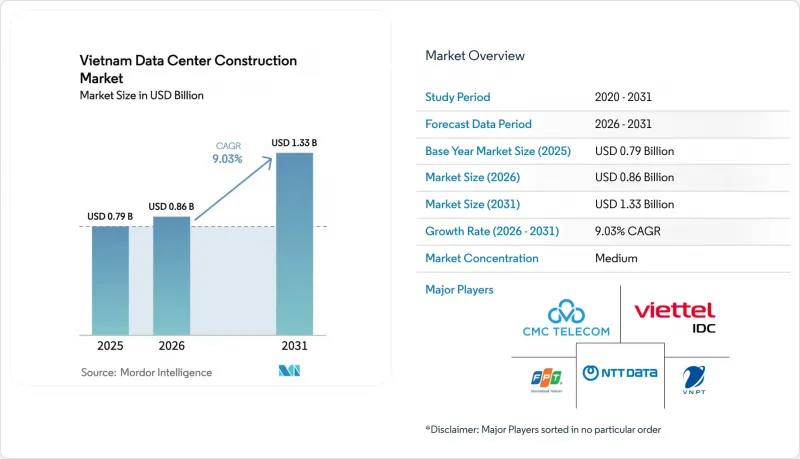
本報告按基礎設施(電力基礎設施、機械基礎設施、一般建築、服務)、等級(一級和二級、三級、四級)以及資料中心類型(託管、本地超大規模資料中心業者資料中心 (CSP) 等)對市場進行細分。所有上述細分市場的市場規模和預測均以美元 (USD) 表示。
越南資料中心建設市場趨勢及洞察
數據本地化義務正在推動需求成長。
越南第53號法令及將於2025年7月生效的《綜合資料法》要求全球平台將指定的關鍵和核心資料儲存在越南境內。隨著合規期限的臨近,設施採購工作正在推進,阿里巴巴從租用機架轉向自有設施便是例證。政府資助的國家資料中心計畫於2025年底竣工,該中心製定了通用的安全和冗餘標準,提高了企業的期望。谷歌計劃在越南建造首個超大規模資料中心,這清楚地表明了主權相關立法如何影響企業發展策略。這些政策共同為本地資料中心建構者創造了可預測且穩定的訂單來源。
雲端和OTT流量的激增正在擴大對基礎設施的需求。
2024年10月,越南全國正式推出商用5G服務。到2025年3月,平均下載速度已達247.78 Mbps。這使得超高清串流媒體和雲端遊戲成為可能,並帶動了後端運算需求的激增。政府已設定目標,到2025年,確保90%的家庭用戶能夠享受200 Mbps的固網速度,並為企業用戶提供對稱的1 Gbps線路。 Viettel正在建造的140 MW資料中心(配備60 kW機架)清晰地展示了服務供應商如何透過流量預測直接實現高密度設計。隨著最後一公里容量的逐步提升,本地處理工作負載也不斷增加,且利用率遠高於區域平均值。
高度依賴進口推高了成本。
越南的半導體產業基礎仍然高度依賴設計,這迫使其進口精密開關設備、冷卻器和GPU,使建築商面臨更高的運費和外匯波動風險。根據第409/QD-BXD號決客製化定的建設成本基準無法抵銷全球供應短缺時期設備價格的飆升。施耐德電機將生產重心轉移到美國擴大,這清楚地表明了供應商本地化程度的提高,使東南亞買家面臨前置作業時間的風險。
細分市場分析
即使到了2025年,三級資料中心仍維持著60.75%的市場佔有率。這是因為許多公司仍在權衡冗餘性和資本投資的謹慎性。因此,儘管三級資料中心仍佔據越南資料中心建設市場的最大佔有率,但四級資料中心業務的成長速度最快,預計到2031年將達到11.7%的複合年成長率。投資者將頻繁出現的電力品質問題視為將工作負載遷移到全平行系統的合理理由,即使這意味著更高的資本成本。 Viettel的140兆瓦Tan Phu Trung園區在力爭獲得三級認證的同時,也為其人工智慧叢集配備了四級就緒模組作為備份,這表明其設計理念正處於過渡階段。
向更高層級的轉變也反映了超大規模資料中心業者營運商可接受的閾值。 GPU訓練叢集無法承受停機風險,否則將危及持續數天的作業的執行。 NVIDIA與越南政府就建立人工智慧研發中心簽署的合作備忘錄,對供應鏈合作夥伴提出了Tier 4標準。隨著越南資料中心建設市場的擴張,Tier 4客製化建設合約正推動加值服務收入的成長,而Tier 1/2設施則在萎縮,更多地服務於開發、測試和本地邊緣應用場景。
即使到了2025年,託管服務仍將維持56.70%的市場佔有率,構成越南資料中心建設市場的基礎。然而,隨著Google、阿里巴巴和區域性OTT營運商優先考慮全端控制,自主建設的超大規模資料中心專案正以12.9%的複合年成長率成長。 2024年的市場放寬管制將允許100%外資控股,從而消除先前參與企業選擇託管租賃的投資限制。
合資模式依然可行。 STT GDC 與 VNG 的合作將本地授權和所擁有土地與基於國際最佳實踐的建設技術相結合。然而,大多數超大規模資料中心業者更傾向於待開發區建設,以便整合自身的網路架構、專業安全技術和客製化的 AI 晶片叢集。這一趨勢迫使現有託管服務供應商透過邊緣站點密度、自主雲層或特定產業合規性脫穎而出。
其他好處:
- Excel格式的市場預測(ME)表
- 3個月的分析師支持
目錄
第1章:引言
- 研究假設和市場定義
- 調查範圍
第2章:調查方法
第3章執行摘要
第4章 市場狀況
- 市場概覽
- 市場促進因素
- 資料本地化義務(內閣令第53號)
- 雲端和OTT流量激增
- 低電價和可再生能源購電協議
- 全國部署5G和光纖回程傳輸
- 海底電纜擴容(ADC2、SJC2)
- 為淨零排放資料中心提供綠色融資
- 市場限制因素
- 高額進口資本支出(CAPEX)/營運費用(OPEX)
- 機電試運行熟練人員短缺
- 水力發電量低時電網不穩定
- 過度建設投機性人工智慧資料中心存在泡沫風險
- 價值供應鏈分析
- 監理情勢
- 技術展望
- 波特五力模型
第5章 資料中心關鍵統計數據
- 越南資料中心營運商列表(按兆瓦計)
- 越南即將建造的主要資料中心項目清單(2025-2030 年)
- 越南資料中心建設中的資本支出和營運支出
- 越南主要城市資料中心2023年及2024年的電力消耗量(單位:兆瓦)。
第6章:將人工智慧(AI)引入越南資料中心建設
第7章 監理與合規框架
第8章 市場規模與成長預測
- 層級類型
- 一級和二級
- 三級
- 第四級
- 依資料中心類型
- 搭配
- 自主研發的超大規模資料中心業者(CSP)
- 企業和邊緣運算
- 透過基礎設施
- 透過電力基礎設施
- 配電解決方案
- 備用電源解決方案
- 透過機械基礎設施
- 冷卻系統
- 機架和機櫃
- 伺服器和儲存
- 其他
- 一般建築
- 服務(設計和諮詢、整合、支援和維護)
- 透過電力基礎設施
第9章 競爭情勢
- 市場集中度
- 策略趨勢
- 市佔率分析
- Data Center Infrastructure Investment Based on Megawatt(MW)Capacity, 2024 vs 2030
- Data Center Construction Landscape(Key Vendors Listings)
- 公司簡介
- Viettel IDC
- VNPT
- FPT Telecom
- CMC Telecom
- NTT GDC Vietnam
- ST Telemedia GDC Vietnam
- Keppel DC Vietnam
- GDS Holdings
- Digital Realty-Mapletree JV
- KDDI Telehouse Vietnam
- Gaw NP Industrial
- CotekCNS
- AECOM
- Obayashi Corp
- Turner Construction
- Rider Levett Bucknall
- Artelia Group
- Firstgreen Engineering
- Arup Vietnam
- Schneider Electric Vietnam
第10章 市場機會與未來展望
- 未開發市場和未滿足需求的評估
According to Mordor Intelligence, the Vietnam data center construction market size was valued at USD 0.79 billion in 2025 and estimated to grow from USD 0.86 billion in 2026 to reach USD 1.33 billion by 2031, at a CAGR of 9.03% during the forecast period (2026-2031).
This report Segments the Industry Into Infrastructure (By Electrical Infrastructure, by Mechanical Infrastructure, General Construction), by Tier Type (Tier 1 and 2, Tier 3, Tier 4), by Data Center Type (Colocation, Self-Built Hyperscalers (CSPs) and More). The Market Sizes and Forecasts are Provided in Terms of Value (USD Million) for all the Above Segments.
Vietnam Data Center Construction Market Trends and Insights
Data-Localization Mandate Drives Demand
Vietnam's Decree 53 and the comprehensive Data Law effective July 2025 oblige global platforms to store designated "important" and "core" data onshore. Compliance timelines accelerate facility sourcing, evidenced by Alibaba shifting from state-rented racks to dedicated builds. The government-funded National Data Center, due late-2025, sets common security and redundancy baselines that raise enterprise expectations. Google's plan for its first domestic hyperscale site underlines how sovereignty statutes now dictate footprint strategies. Together these policies create a predictable, captive pipeline for local construction contractors.
Cloud and OTT Traffic Surge Amplifies Infrastructure Needs
Commercial 5G went live nationwide in October 2024 and averaged 247.78 Mbps download by March 2025, enabling UHD streaming and cloud gaming that swell back-end compute demand. Government targets guarantee 200 Mbps fixed speeds for 90% of households by 2025, while enterprises gain symmetric 1 Gbps pipes. Viettel's ongoing 140 MW campus with 60 kW racks epitomizes how service-provider traffic forecasts translate directly into high-density design. Each incremental rise in last-mile capacity multiplies local processing workloads, sustaining utilization rates well above regional averages.
High Import Dependency Raises Costs
Vietnam's semiconductor base still emphasizes design, forcing imports of precision switchgear, chillers, and GPUs, exposing builders to freight surcharges and currency swings. Construction-cost benchmarks issued under Decision 409/QD-BXD cannot offset equipment price escalation when global supply tightens. Schneider Electric's pivot to expand manufacturing in the United States underscores how suppliers are regionalizing, leaving Southeast Asian buyers vulnerable to lead-time gaps
Other drivers and restraints analyzed in the detailed report include:
- Renewable-Energy Access Transforms Economics
- Nationwide 5G Rollout Creates Edge-Compute Demand
- MEP-Skills Shortage Delays Projects
For complete list of drivers and restraints, kindly check the Table Of Contents.
Segment Analysis
Tier 3 sites retained 60.75% market share in 2025 as most enterprises still balance redundancy and capex prudence. The Vietnam data center construction market size for Tier 3 therefore remained largest, while Tier 4 operations set the fastest 11.7% CAGR trajectory into 2031. Investors interpret frequent power-quality incidents as justification for moving workloads to fully concurrent systems, even when capital costs rise. Viettel's 140 MW Tan Phu Trung campus targets Tier III certification yet benches Tier IV-ready modules for AI clusters, signalling a transitional design mindset.
Higher-tier momentum also mirrors hyperscaler tolerance thresholds; GPU training clusters cannot risk downtime without jeopardizing multi-day job runs. NVIDIA's memorandum with the Vietnamese government to open an AI R&D center imposes Tier 4 baselines on supply-chain partners. As the Vietnam data center construction market broadens, Tier 4 build-to-suit contracts drive premium service revenues, while Tier 1/2 footprints contract toward dev-test and local-edge use cases.
Colocation retained 56.70% share in 2025, anchoring the Vietnam data center construction market. Nonetheless, self-build hyperscale programs clock a 12.9% CAGR as Google, Alibaba, and regional OTT players prioritize full-stack control. Deregulation in 2024 allowing 100% foreign ownership eliminates equity constraints that once steered entrants toward colocation leases.
Joint-venture blueprints remain relevant; STT GDC's alliance with VNG combines local permits and land banks with international best-practice construction. Yet most hyperscalers favor outright greenfield builds to integrate proprietary network fabrics, specialized security, and custom-AI chip clusters. The trend forces colocation incumbents to chase differentiation via edge-site density, sovereign-cloud tiers, or sector-specific compliance wrappers.
Complete Report Scope:
- By Tier Type
- Tier 1 and 2
- Tier 3
- Tier 4
- By Data Center Type
- Colocation
- Self-build Hyperscalers (CSPs)
- Enterprise and Edge
- By Infrastructure
- By Electrical Infrastructure
- Power Distribution Solution
- Power Backup Solutions
- By Mechanical Infrastructure
- Cooling Systems
- Racks and Cabinets
- Servers and Storage
- Other Mechanical Infrastructure
- General Construction
- Service - Design and Consulting, Integration, Support and Maintenance
- By Electrical Infrastructure
List of Companies Covered in this Report:
- Viettel IDC
- VNPT
- FPT Telecom
- CMC Telecom
- NTT GDC Vietnam
- ST Telemedia GDC Vietnam
- Keppel DC Vietnam
- GDS Holdings
- Digital Realty-Mapletree JV
- KDDI Telehouse Vietnam
- Gaw NP Industrial
- CotekCNS
- AECOM
- Obayashi Corp
- Turner Construction
- Rider Levett Bucknall
- Artelia Group
- Firstgreen Engineering
- Arup Vietnam
- Schneider Electric Vietnam
Additional Benefits:
- The market estimate (ME) sheet in Excel format
- 3 months of analyst support
TABLE OF CONTENTS
1 INTRODUCTION
- 1.1 Study Assumptions and Market Definition
- 1.2 Scope of the Study
2 RESEARCH METHODOLOGY
3 EXECUTIVE SUMMARY
4 MARKET LANDSCAPE
- 4.1 Market Overview
- 4.2 Market Drivers
- 4.2.1 Data-localization mandate (Decree 53)
- 4.2.2 Cloud and OTT traffic boom
- 4.2.3 Low power tariffs and renewable PPAs
- 4.2.4 Nationwide 5G + fibre backhaul rollout
- 4.2.5 Sub-sea cable expansion (ADC2, SJC2)
- 4.2.6 Green-finance access for "net-zero" DCs
- 4.3 Market Restraints
- 4.3.1 High imported CAPEX / OPEX
- 4.3.2 Skilled MEP commissioning talent gap
- 4.3.3 Grid-instability in hydropower-lean seasons
- 4.3.4 Speculative AI-DC overbuild bubble risk
- 4.4 Value / Supply-Chain Analysis
- 4.5 Regulatory Landscape
- 4.6 Technological Outlook
- 4.7 Porter's Five Forces
- 4.7.1 Bargaining Power of Suppliers
- 4.7.2 Bargaining Power of Consumers
- 4.7.3 Threat of New Entrants
- 4.7.4 Threat of Substitutes
- 4.7.5 Intensity of Competitive Rivalry
5 KEY DATA CENTER STATISTICS
- 5.1 Exhaustive Data Center Operators in Vietnam (in MW)
- 5.2 List of Major Upcoming Data Center Projects in Vietnam (2025-2030)
- 5.3 CAPEX and OPEX For Vietnam Data Center Construction
- 5.4 Data Center Power Capacity Absorption In MW, Selected Cities, Vietnam, 2023 and 2024
6 ARTIFICIAL INTELLIGENCE (AI) INCLUSION IN DATA CENTER CONSTRUCTION IN Vietnam
7 REGULATORY and COMPLIANCE FRAMEWORK
8 MARKET SIZE and GROWTH FORECASTS (VALUE)
- 8.1 By Tier Type
- 8.1.1 Tier 1 and 2
- 8.1.2 Tier 3
- 8.1.3 Tier 4
- 8.2 By Data Center Type
- 8.2.1 Colocation
- 8.2.2 Self-build Hyperscalers (CSPs)
- 8.2.3 Enterprise and Edge
- 8.3 By Infrastructure
- 8.3.1 By Electrical Infrastructure
- 8.3.1.1 Power Distribution Solution
- 8.3.1.2 Power Backup Solutions
- 8.3.2 By Mechanical Infrastructure
- 8.3.2.1 Cooling Systems
- 8.3.2.2 Racks and Cabinets
- 8.3.2.3 Servers and Storage
- 8.3.2.4 Other Mechanical Infrastructure
- 8.3.3 General Construction
- 8.3.4 Service - Design and Consulting, Integration, Support and Maintenance
- 8.3.1 By Electrical Infrastructure
9 COMPETITIVE LANDSCAPE
- 9.1 Market Concentration
- 9.2 Strategic Moves
- 9.3 Market Share Analysis
- 9.4 Data Center Infrastructure Investment Based on Megawatt (MW) Capacity, 2024 vs 2030
- 9.5 Data Center Construction Landscape (Key Vendors Listings)
- 9.6 Company Profiles (includes Global level Overview, Market level overview, Core Segments, Financials as available, Strategic Information, Market Rank/Share for key companies, Products and Services, Recent Developments)
- 9.6.1 Viettel IDC
- 9.6.2 VNPT
- 9.6.3 FPT Telecom
- 9.6.4 CMC Telecom
- 9.6.5 NTT GDC Vietnam
- 9.6.6 ST Telemedia GDC Vietnam
- 9.6.7 Keppel DC Vietnam
- 9.6.8 GDS Holdings
- 9.6.9 Digital Realty-Mapletree JV
- 9.6.10 KDDI Telehouse Vietnam
- 9.6.11 Gaw NP Industrial
- 9.6.12 CotekCNS
- 9.6.13 AECOM
- 9.6.14 Obayashi Corp
- 9.6.15 Turner Construction
- 9.6.16 Rider Levett Bucknall
- 9.6.17 Artelia Group
- 9.6.18 Firstgreen Engineering
- 9.6.19 Arup Vietnam
- 9.6.20 Schneider Electric Vietnam
10 MARKET OPPORTUNITIES and FUTURE OUTLOOK
- 10.1 White-space and Unmet-Need Assessment

 中東資料中心建置:市場佔有率分析、產業趨勢與統計及成長預測(2026-2032 年)亞太地區資料中心建置:市場佔有率分析、產業趨勢與統計及成長預測(2026-2031年)南美洲資料中心建置:市場佔有率分析、產業趨勢與統計及成長預測(2026-2031 年)德國資料中心建置:市場佔有率分析、產業趨勢與統計及成長預測(2026-2031 年)日本資料中心建置:市場佔有率分析、產業趨勢與統計及成長預測(2026-2032)歐洲資料中心建置:市場佔有率分析、產業趨勢與統計及成長預測(2026-2031 年)法國資料中心建置:市場佔有率分析、產業趨勢與統計及成長預測(2026-2031 年)泰國資料中心建置:市場佔有率分析、產業趨勢與統計及成長預測(2026-2031)義大利資料中心建置:市場佔有率分析、產業趨勢與統計及成長預測(2026-2031 年)英國資料中心建置:市場佔有率分析、產業趨勢與統計及成長預測(2026-2031 年)