


 |
市場調查報告書
商品編碼
2119195
亞太地區低菸無鹵(LSZH)電纜:市場佔有率分析、產業趨勢與統計及成長預測(2026-2031 年)Asia-Pacific Low Smoke Zero Halogen (LSZH) Cables - Market Share Analysis, Industry Trends & Statistics, Growth Forecasts (2026 - 2031) |
||||||

※ 本網頁內容可能與最新版本有所差異。詳細情況請與我們聯繫。
根據 Mordor Intelligence 預測,亞太地區低菸無鹵 (LSZH) 電纜的市場規模預計將從 2025 年的 20.8 億美元成長到 2026 年的 22.7 億美元,到 2031 年達到 35.4 億美元,2026 年至 2031 年的複合年成長率為 2031 年。
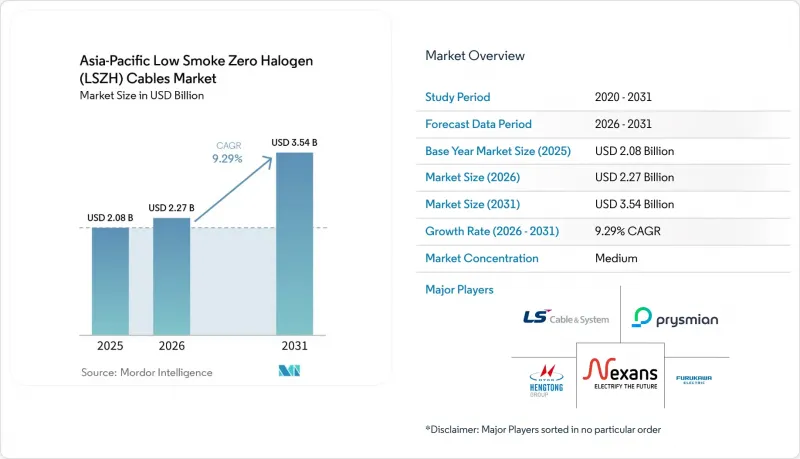
本報告按電纜類型(電力電纜、控制和儀器電纜等)、額定電壓(低於1 kV、1–35 kV、36–65 kV、高於65 kV)、絕緣材料(PVC(聚氯乙烯)等)、終端用戶行業(商業建築、工業製造等)和國家/地區進行細分。市場預測以美元計價。
亞太地區低菸無鹵(LSZH)電纜市場的趨勢與見解。
超大規模資料中心和人工智慧基礎設施的開發
2026年1月,Digital Edge宣布投資45億美元,在印尼勿加泗興建一座500兆瓦的人工智慧賦能型超大規模資料中心園區。該項目圍繞著大規模的電力、光纖和配套基礎設施系統而建。 2026年3月,該公司為該計畫的第一階段獲得了6.65億美元的綠色貸款。人工智慧最佳化的機架每個可能需要50-120千瓦的電力,這增加了封閉式托盤系統內的電纜密度,並進一步凸顯了火災發生時設備保護的重要性。低煙無鹵(LSZH)電纜在這種環境下至關重要,因為聚氯乙烯(PVC)燃燒時釋放的氯化氫(HCl)會在疏散變得困難之前腐蝕運作中設備,並可能影響伺服器、訊號設備和電網保護系統。 2026年7月,SK Telecom宣布其目標是在韓國建造高達15吉瓦的人工智慧資料中心容量。作為第一步,該公司將在韓國東南部地區啟動一個超過2吉瓦的初始叢集建設。這些發展正在擴大亞太地區低煙無鹵 (LSZH) 電纜市場的機遇,使其不再局限於傳統的建築佈線,而是擴展到高密度電力、光纖和控制系統等領域。
在高密度封閉空間採用消防安全標準
中國GB/T 31247標準要求商用和公共部門電纜達到B1級性能標準,這在區域內最大的電纜採購市場設定了很高的最低要求。該標準超越了IEC 60332-3的阻燃標準,從熱輸出、火焰飛濺和腐蝕性氣體等方面評估電纜性能。印度《2016年國家建築標準》第四部分強制規定,在醫院、地鐵站、機場以及地上15層以上(G+15)的住宅大樓等對疏散和資產保護至關重要的場所,必須使用符合IS 17048:2018標準的無鹵阻燃電纜。印度標準局 (BIS) 將 IS 17048:2018 定義為額定電壓不超過 1100 V 的無鹵阻燃電纜標準。在新加坡,生命安全和交通運輸系統強制使用低煙無鹵 (LSZH) 電纜已超過十年,類似的專案實踐也透過公共資金支持的基礎設施建設和資金籌措要求影響了馬來西亞、泰國和越南的採購。在韓國,KS C IEC 60754-2 和 KS C IEC 61034-2 標準適用;而在日本,JIS C 3665 和 JIS C 3666 標準則採用於封閉迴路境。因此,亞太地區低菸無鹵 (LSZH) 電纜市場受到多個國家法規結構的影響。
與PVC電纜系統相比,初始成本較高。
在電纜層面,低菸無鹵(LSZH)化合物電纜的價格比標準PVC鞘套高出15%至30%。這種價格差異在印尼、越南和菲律賓尤為顯著,因為這些國家的私人建築客戶通常不要求符合IEC 61034標準。亞洲開發銀行(ADB)和日本國際協力機構(JICA)的專案融資合約有時會要求使用LSZH電纜,這有助於在各國建築規範變更之前彌合這一價格差距。在資料中心和醫療設施中,火災後的腐蝕可能需要進行大規模的淨化處理,其成本可能超過電纜本身的溢價。中國和印度不斷提高化合物的產量和製造能力正在緩解這項限制。然而,承包商對PVC的熟悉程度以及某些LSZH化合物對彎曲半徑的嚴格要求,仍然阻礙亞太地區對成本高度敏感的低煙無鹵(LSZH)電纜市場的轉型。
細分市場分析
2025年,低菸無鹵(LSZH)電力電纜在電纜類型細分市場中佔比34.55%,主要得益於商業建築、工業設施、配電系統以及資料中心低壓配電盤的持續採購。預計2026年至2031年,LSZH光纖電纜的複合年成長率將達到11.78%,主要受超大規模資料中心互連需求以及政府支持的光纖部署計畫的推動。古河電氣於2026年3月在其三重縣第二工廠開始量產13,824芯光纖電纜。據該公司稱,與2023年相比,該新工廠的產能加倍以上,旨在滿足對高密度光纖電纜的需求。 LSZH資料和通訊電纜以及控制和儀器電纜將繼續應用於建築管理、流程自動化、監控和資料收集(SCADA)系統以及工業網路設備。
在印度、中國和澳大利亞,低煙無鹵(LSZH)建築電纜與住宅和商業建築密切相關,這些國家修訂後的建築規範正在推動低菸電纜系統的應用。用於核能、海洋和氫氣運輸的專用電纜雖然規模較小,但由於其對環境和安全的要求更為嚴格,因此代表著高附加價值應用領域。在亞太地區的低菸無鹵(LSZH)電纜市場,電力電纜預計在2025年將佔據34.55%的市場佔有率。 IEC 60332和IEC 61034為日本、韓國和中國生產的光纖電纜提供了通用技術標準,從而能夠在跨境基礎設施專案中指定相容的產品。氫氣運輸、日本和韓國核能發電廠的運作以及船舶電氣化預計將推動對LSZH性能和耐鹽霧護套的專用應用的需求成長。
2025年,亞太地區低菸無鹵(LSZH)電纜市場中,1千伏以下細分市場佔了61.12%的市佔率。此細分市場廣泛應用於商業和工廠建築佈線、資料中心配電、交通樞紐電路、輕工業自動化以及低壓配電盤等領域。由於應用範圍廣泛,該細分市場的需求與城市建設和分散式能源使用密切相關,銷售量下滑的風險相對較低。預計2026年至2031年,1-35千伏中壓電纜市場將以10.56%的複合年成長率成長。中國、印度和東南亞的工業園區、可再生能源變電站併網、電網擴建以及新興開發區等因素將推動這項需求的成長。
寮國、泰國、馬來西亞和新加坡之間的互聯計畫規定,在潮濕環境和鹽鹼土壤條件下,中壓佈線必須使用交聯聚乙烯(XLPE)低煙無鹵(LSZH)電纜。此要求可作為區域電網專案的採購指南,確保電纜的防潮性和防火性。 IEC 60502-1 和 IEC 60332-3 是廣泛採用的束狀電纜敷設技術規範標準。 36–65 kV 和 65 kV 以上類別的電纜用於升級超高壓輸電網路以及變電站和變電站的室內部分。東京電力公司(TEPCO)正在推動架空配電線路地下化,計劃於 2024 年至 2027 年實施,這將推動對低煙無鹵包覆超高壓地下電纜的需求。共擠出製程可以在一個生產過程中同時生產 XLPE 絕緣層和 LSZH 覆層,從而縮小與 PVC 結構之間的成本差距,並促進向中壓和工業應用規範的過渡。
其他好處:
- Excel格式的市場預測(ME)表
- 3個月的分析師支持
目錄
第1章:引言
- 研究假設和市場定義
- 調查範圍
第2章:調查方法
第3章執行摘要
第4章 市場狀況
- 市場概覽
- 市場促進因素
- 超大規模資料中心和人工智慧基礎設施的開發
- 在多人使用的封閉空間中採用消防安全標準
- 鐵路、地鐵、港口和商務傳輸的電氣化
- 可再生能源、電網現代化和電池儲能的廣泛應用
- 用於工業自動化和高密度製造的電纜
- 出口導向型採購,需要國際防火認證。
- 市場限制因素
- 與PVC電纜系統相比,初始成本較高。
- 銅價波動以及原物料成本轉嫁的風險
- 國內標準和核准要求各不相同
- 權衡排煙性能、柔軟性和安裝便利性。
- 產業價值鏈分析
- 波特五力分析
第5章 市場規模與成長預測
- 按電纜類型
- 低煙無鹵電源線
- 低菸無鹵控制和測量電纜
- 低菸無鹵數據通訊電纜
- 低菸無鹵光纖電纜
- 低菸無鹵建築用電線
- 特殊低菸無鹵電纜
- 額定電壓
- 小於1千伏
- 1~35 kV
- 36~65 kV
- 65千伏或以上
- 按類型分類的絕緣材料
- PVC(聚氯乙烯)
- 交聯聚乙烯(XLPE)
- PE(聚乙烯)
- 其他特殊隔熱材料
- 按最終用戶行業分類
- 商業建築
- 工業製造
- 資料中心
- 能源公用事業
- 交通基礎設施
- 電訊
- 可再生能源
- 其他終端用戶產業
- 國家
- 中國
- 印度
- 日本
- 韓國
- 其他亞太國家
第6章 競爭情勢
- 市場集中度
- 策略趨勢
- 市佔率分析
- 公司簡介
- Prysmian SpA
- Nexans SA
- LS Cable & System Ltd.
- Sumitomo Electric Industries, Ltd.
- Furukawa Electric Co., Ltd.
- Hengtong Group Co., Ltd.
- Jiangsu Zhongtian Technology Co., Ltd.
- Fujikura Ltd.
- Polycab India Limited
- Finolex Cables Limited
- KEI Industries Limited
- Havells India Limited
- Belden Inc.
- TE Connectivity Ltd.
- Leoni AG
- Yazaki Corporation
- Amphenol Corporation
- HELUKABEL GmbH
- Jiangnan Group Limited
- Sterlite Technologies Ltd.
- Yangtze Optical Fibre and Cable Joint Stock Limited Company(YOFC)
- Eland Cables Ltd.
- Relemac Technologies Pvt. Ltd.
- Borealis AG
- Avient Corporation
第7章 市場機會與未來展望
According to Mordor Intelligence, the Asia-Pacific low smoke zero halogen (LSZH) cables market size is projected to expand from USD 2.08 billion in 2025 to USD 2.27 billion in 2026, and to USD 3.54 billion by 2031, registering a CAGR of 9.29% from 2026 to 2031.
This report is Segmented by Cable Type (Power Cables, Control and Instrumentation Cables, and More), Voltage Rating (Less Than 1 KV, 1-35 KV, 36-65 KV, and Above 65 KV), Insulation Material (PVC (Polyvinyl Chloride), and More), End-User Industry (Commercial Buildings, Industrial Manufacturing, and More), and Country. The Market Forecasts are Provided in Terms of Value (USD).
Asia-Pacific Low Smoke Zero Halogen (LSZH) Cables Market Trends and Insights
Hyperscale Data Center and AI Infrastructure Buildout
Digital Edge announced a USD 4.5 billion investment in January 2026 for a 500 MW AI-ready hyperscale campus in Bekasi, Indonesia, a project built around large-scale power, fiber, and supporting facility systems. The company secured a USD 665 million green loan for the project's first phase in March 2026. AI-optimized racks can require 50-120 kW per rack, increasing cable density in enclosed tray systems and underscoring the importance of equipment protection during a fire. LSZH cable is important in these settings because hydrogen chloride (HCl) from burning PVC can corrode active equipment before conditions become unsafe for evacuation, affecting servers, signaling equipment, and grid protection systems. SK Telecom announced in July 2026 that it was pursuing up to 15 GW of AI data center capacity in South Korea, starting with an initial cluster above 2 GW in the southeast. These developments extend the Asia-Pacific low smoke zero halogen (LSZH) cables market opportunity beyond conventional building wiring into high-density power, fiber, and control systems.
Fire-Safety Code Adoption in High-Occupancy and Enclosed Spaces
China's GB/T 31247 standard requires B1-class performance for commercial and public-sector cables, establishing a high minimum requirement in the region's largest cable procurement base. The standard assesses heat release, flaming droplets, and corrosive gas performance beyond the IEC 60332-3 flame-propagation baseline. India's National Building Code 2016, Part 4, requires IS 17048:2018 halogen-free, flame-retardant cables in hospitals, underground metro stations, airports, and residential buildings above G+15 floors, where both evacuation and asset protection are important. The Bureau of Indian Standards identifies IS 17048:2018 as the standard for halogen-free flame-retardant cables rated up to 1,100 V. Singapore has required LSZH cables in life-safety and transport systems for more than a decade, and similar project practices influence procurement in Malaysia, Thailand, and Vietnam through publicly funded infrastructure and financing requirements. South Korea applies KS C IEC 60754-2 and KS C IEC 61034-2, while Japan uses JIS C 3665 and JIS C 3666 for enclosed applications, leaving the Asia-Pacific low smoke zero halogen (LSZH) cables market shaped by multiple national compliance frameworks.
Higher Upfront Cost Versus PVC Cable Systems
LSZH compounds cost 15-30% more than standard PVC sheaths at the cable level. This difference is especially significant in Indonesia, Vietnam, and the Philippines, where private construction buyers often do not require IEC 61034 compliance. ADB and Japan International Cooperation Agency project-finance agreements may require LSZH cable, which helps bridge the gap until domestic building codes change. In data centers and health care facilities, post-fire corrosion can require extensive decontamination and may cost more than the initial cable premium. Greater regional compounding output and manufacturing capacity in China and India are reducing this constraint. Installer familiarity with PVC and the tighter bending-radius requirements of some LSZH compounds still slow switching in cost-sensitive parts of the Asia-Pacific low smoke zero halogen (LSZH) cables market.
Other drivers and restraints analyzed in the detailed report include:
- Electrification of Rail, Metro, Ports, and Commercial Transport
- Renewable Power, Grid Modernization, and Battery Storage Expansion
- Copper Price Volatility and Material-Cost Pass-Through Risk
For complete list of drivers and restraints, kindly check the Table Of Contents.
Segment Analysis
LSZH power cables accounted for 34.55% of the cable-type segment in 2025, supported by recurring procurement for commercial buildings, industrial sites, utility distribution systems, and data center low-voltage panels. LSZH fiber-optic cables are projected to grow at an 11.78% CAGR from 2026 to 2031, supported by hyperscale data center interconnect requirements and government-backed fiber rollout programs. Furukawa Electric began mass production of 13,824-count optical fiber cable at Mie Works No. 2 in March 2026. The company stated that the new facility more than doubled capacity compared with 2023 and was designed to serve dense optical cable requirements. LSZH data and communication cables, plus control and instrumentation cables, continue to serve building management, process automation, supervisory control and data acquisition systems, and industrial network installations.
LSZH building wires remain linked to residential and commercial construction in India, China, and Australia, where code revisions are expanding the use of lower-smoke-cable systems. Specialty cables for nuclear, marine, and hydrogen-transit uses occupy smaller but higher-value application areas because their environmental and safety requirements are more demanding. The Asia-Pacific low smoke zero halogen (LSZH) cables market size for power cables was supported by their 34.55% share in 2025. IEC 60332 and IEC 61034 provide a common technical baseline for fiber-optic cables produced in Japan, South Korea, and China, enabling compatible products to be specified for cross-border infrastructure projects. Hydrogen transit, nuclear recommissioning in Japan and South Korea, and marine electrification are expected to support specialty applications that require both LSZH performance and salt-spray-resistant jacket performance.
The less-than-1-kV segment accounted for 61.12% of the Asia-Pacific low smoke zero halogen (LSZH) cables market share in 2025. It serves building wiring, data center power distribution, transit-station circuits, light industrial automation, and low-voltage panels in commercial and factory facilities. This broad base of applications makes the segment less exposed to volume displacement, as its demand is tied to urban construction and distributed electricity use. The 1-35 kV medium-voltage category is projected to expand at a 10.56% CAGR from 2026 to 2031. Industrial parks, renewable energy substation connections, grid distribution extensions, and new development zones across China, India, and Southeast Asia support this demand.
The Lao-Thailand-Malaysia-Singapore connection specifies XLPE LSZH cable for medium-voltage runs in humid and saline-soil conditions. This requirement provides a procurement reference point for regional grid programs where moisture resistance and fire performance must be addressed together. IEC 60502-1 and IEC 60332-3 are widely used engineering submission frameworks for the installation of grouped cables. The 36-65 kV and above-65 kV categories serve extra-high-voltage grid upgrades and the enclosed portions of substations and converter stations. Tokyo Electric Power Company is undergrounding overhead distribution lines through a program running from 2024 to 2027, which supports demand for LSZH-sheathed underground extra-high-voltage cable. Co-extrusion can produce XLPE insulation and an LSZH sheath in a single pass, narrowing the cost gap with PVC constructions and facilitating specification migration for medium-voltage and industrial applications.
Complete Report Scope:
- By Cable Type
- LSZH Power Cables
- LSZH Control and Instrumentation Cables
- LSZH Data and Communication Cables
- LSZH Fiber Optic Cables
- LSZH Building Wires
- Specialty LSZH Cables
- By Voltage Rating
- Less Than 1 kV
- 1-35 kV
- 36-65 kV
- Above 65 kV
- By Insulation Material
- PVC (Polyvinyl Chloride)
- XLPE (Cross-linked Polyethylene)
- PE (Polyethylene)
- Other Specialty Insulation Materials
- By End-User Industry
- Commercial Buildings
- Industrial Manufacturing
- Data Centers
- Energy and Utilities
- Transportation Infrastructure
- Telecommunications
- Renewable Energy
- Other End-User Industries
- By Country
- China
- India
- Japan
- South Korea
- Rest of Asia-Pacific
List of Companies Covered in this Report:
- Prysmian S.p.A.
- Nexans S.A.
- LS Cable & System Ltd.
- Sumitomo Electric Industries, Ltd.
- Furukawa Electric Co., Ltd.
- Hengtong Group Co., Ltd.
- Jiangsu Zhongtian Technology Co., Ltd.
- Fujikura Ltd.
- Polycab India Limited
- Finolex Cables Limited
- KEI Industries Limited
- Havells India Limited
- Belden Inc.
- TE Connectivity Ltd.
- Leoni AG
- Yazaki Corporation
- Amphenol Corporation
- HELUKABEL GmbH
- Jiangnan Group Limited
- Sterlite Technologies Ltd.
- Yangtze Optical Fibre and Cable Joint Stock Limited Company (YOFC)
- Eland Cables Ltd.
- Relemac Technologies Pvt. Ltd.
- Borealis AG
- Avient Corporation
Additional Benefits:
- The market estimate (ME) sheet in Excel format
- 3 months of analyst support
TABLE OF CONTENTS
1 INTRODUCTION
- 1.1 Study Assumptions and Market Definition
- 1.2 Scope of the Study
2 RESEARCH METHODOLOGY
3 EXECUTIVE SUMMARY
4 MARKET LANDSCAPE
- 4.1 Market Overview
- 4.2 Market Drivers
- 4.2.1 Hyperscale Data Center and AI Infrastructure Buildout
- 4.2.2 Fire-Safety Code Adoption in High-Occupancy and Enclosed Spaces
- 4.2.3 Electrification of Rail, Metro, Ports, and Commercial Transport
- 4.2.4 Renewable Power, Grid Modernization, and Battery Storage Expansion
- 4.2.5 Industrial Automation and High-Density Manufacturing Cabling
- 4.2.6 Export-Oriented Procurement Requiring International Fire-Performance Certification
- 4.3 Market Restraints
- 4.3.1 Higher Upfront Cost Versus PVC Cable Systems
- 4.3.2 Copper Price Volatility and Material-Cost Pass-Through Risk
- 4.3.3 Fragmented National Standards and Approval Requirements
- 4.3.4 Processing Trade-Offs Between Smoke Performance, Flexibility, and Installability
- 4.4 Industry Value Chain Analysis
- 4.5 Porter's Five Forces Analysis
- 4.5.1 Threat of New Entrants
- 4.5.2 Bargaining Power of Suppliers
- 4.5.3 Bargaining Power of Buyers
- 4.5.4 Threat of Substitutes
- 4.5.5 Rivalry Among Existing Competitors
5 MARKET SIZE AND GROWTH FORECASTS (VALUE)
- 5.1 By Cable Type
- 5.1.1 LSZH Power Cables
- 5.1.2 LSZH Control and Instrumentation Cables
- 5.1.3 LSZH Data and Communication Cables
- 5.1.4 LSZH Fiber Optic Cables
- 5.1.5 LSZH Building Wires
- 5.1.6 Specialty LSZH Cables
- 5.2 By Voltage Rating
- 5.2.1 Less Than 1 kV
- 5.2.2 1-35 kV
- 5.2.3 36-65 kV
- 5.2.4 Above 65 kV
- 5.3 By Insulation Material
- 5.3.1 PVC (Polyvinyl Chloride)
- 5.3.2 XLPE (Cross-linked Polyethylene)
- 5.3.3 PE (Polyethylene)
- 5.3.4 Other Specialty Insulation Materials
- 5.4 By End-User Industry
- 5.4.1 Commercial Buildings
- 5.4.2 Industrial Manufacturing
- 5.4.3 Data Centers
- 5.4.4 Energy and Utilities
- 5.4.5 Transportation Infrastructure
- 5.4.6 Telecommunications
- 5.4.7 Renewable Energy
- 5.4.8 Other End-User Industries
- 5.5 By Country
- 5.5.1 China
- 5.5.2 India
- 5.5.3 Japan
- 5.5.4 South Korea
- 5.5.5 Rest of Asia-Pacific
6 COMPETITIVE LANDSCAPE
- 6.1 Market Concentration
- 6.2 Strategic Moves
- 6.3 Market Share Analysis
- 6.4 Company Profiles (includes Global Level Overview, Market Level Overview, Core Segments, Financials as available, Strategic Information, Market Rank/Share, Products and Services, Recent Developments)
- 6.4.1 Prysmian S.p.A.
- 6.4.2 Nexans S.A.
- 6.4.3 LS Cable & System Ltd.
- 6.4.4 Sumitomo Electric Industries, Ltd.
- 6.4.5 Furukawa Electric Co., Ltd.
- 6.4.6 Hengtong Group Co., Ltd.
- 6.4.7 Jiangsu Zhongtian Technology Co., Ltd.
- 6.4.8 Fujikura Ltd.
- 6.4.9 Polycab India Limited
- 6.4.10 Finolex Cables Limited
- 6.4.11 KEI Industries Limited
- 6.4.12 Havells India Limited
- 6.4.13 Belden Inc.
- 6.4.14 TE Connectivity Ltd.
- 6.4.15 Leoni AG
- 6.4.16 Yazaki Corporation
- 6.4.17 Amphenol Corporation
- 6.4.18 HELUKABEL GmbH
- 6.4.19 Jiangnan Group Limited
- 6.4.20 Sterlite Technologies Ltd.
- 6.4.21 Yangtze Optical Fibre and Cable Joint Stock Limited Company (YOFC)
- 6.4.22 Eland Cables Ltd.
- 6.4.23 Relemac Technologies Pvt. Ltd.
- 6.4.24 Borealis AG
- 6.4.25 Avient Corporation
7 MARKET OPPORTUNITIES AND FUTURE OUTLOOK
- 7.1 White-Space and Unmet-Need Assessment

 亞太地區電線電纜市場:市場佔有率分析、產業趨勢與統計、成長預測(2026-2031)北美電線電纜:市場佔有率分析、產業趨勢與統計及成長預測(2026-2031 年)歐洲低菸無鹵 (LSZH) 電纜:市場佔有率分析、產業趨勢和統計數據以及成長預測 (2026-2031)越南電線電纜市場:市場佔有率分析、產業趨勢與統計及成長預測(2026-2031)中東和非洲低菸無鹵 (LSZH) 電纜:市場佔有率分析、行業趨勢和統計數據以及成長預測 (2026-2031)中東電線電纜市場:市場佔有率分析、產業趨勢與統計、成長預測(2026-2031年)非洲電線電纜市場:市場佔有率分析、產業趨勢與統計、成長預測(2026-2031 年)北美低菸無鹵(LSZH)電纜:市場佔有率分析、產業趨勢和統計數據以及成長預測(2026-2031 年)德國電線電纜市場:市場佔有率分析、產業趨勢與統計、成長預測(2026-2031)東南亞電線電纜市場:市場佔有率分析、產業趨勢與統計、成長預測(2026-2031)