


 |
市場調查報告書
商品編碼
2119159
越南電線電纜市場:市場佔有率分析、產業趨勢與統計及成長預測(2026-2031)Vietnam Wire and Cable - Market Share Analysis, Industry Trends & Statistics, Growth Forecasts (2026 - 2031) |
||||||

※ 本網頁內容可能與最新版本有所差異。詳細情況請與我們聯繫。
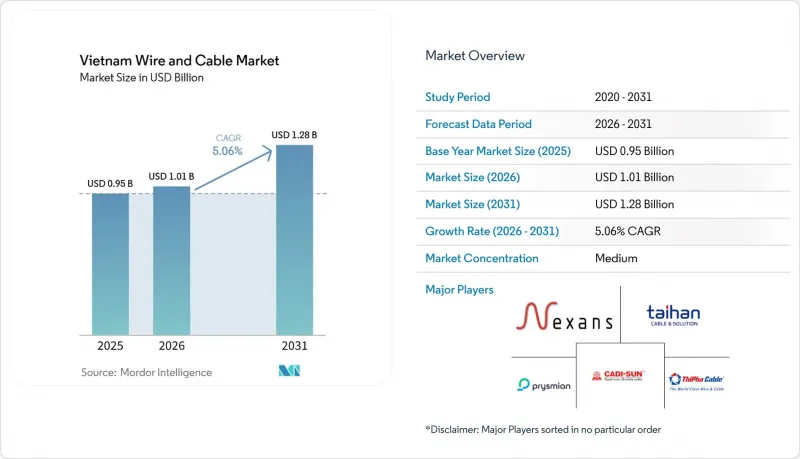
根據 Mordor Intelligence 預測,越南電線電纜市場規模將從 2025 年的 9.5 億美元和 2026 年的 10.1 億美元成長到 2031 年的 12.8 億美元,2026 年至 2031 年的年複合成長率(CAGR)為 5.06%。
本報告按電壓(例如,特高壓和高壓)、電纜類型(例如,電力電纜、光纖電纜)、導體材料(例如,銅)、安裝方式(例如,架空)、終端用戶行業(例如,電信/資料中心、汽車/出行)以及絕緣方式(絕緣、非絕緣)進行細分。市場預測以美元計價。
越南電線電纜市場趨勢與洞察
電網現代化和可再生能源併網正在推動電纜需求成長。
越南電網現代化計劃持續推動該國電線電纜市場長期需求。 2026年4月發布的第768/QD-TTg號決議批准了修訂後的第八個電力發展規劃,該規劃明確了建設能夠整合大規模可再生能源發電基礎設施的電網的方向。與同等規模的分散式發電工程相比,該規劃中設想的輸電走廊將需要更多的高壓連接。 2025年1月,500千伏特的孟山-清美輸電線路投入運營,使越南得以從寮國進口600兆瓦電力。投資長距離輸電對於確保北部需求地區(當地發電能力不足)的電力供應穩定至關重要。此外,第253/2025/QH15號決議設立了一項到2030年的特殊能源發展機制,其中包括加快對符合條件的國有電網計畫進行決策的條款。
工業製造業和電子業的擴張增加了對基礎設施級電纜的需求。
製造業投資正推動新建工業設施對纜線和數據線的需求。在越南,預計到2025年,註冊的外國直接投資(FDI)將達到384.2億美元,其中276.2億美元為實際投資。此外,根據草案,預計2026年前五個月的註冊FDI將達到248.1億美元,其中150.1億美元將投資於製造業。這將在設施投入運作前產生建造需求,並在產能擴張後產生替換需求。與傳統的簡單組裝作業相比,半導體、精密製造和電動車零件製造設施對電源控制、屏蔽和資料連接的要求更為嚴格。這些設施的電纜需求可能包括中壓配電電纜、屏蔽訊號電纜以及低菸無鹵控制產品。
銅鋁價格的波動給製造商的利潤率帶來了壓力。
金屬價格飆升正為電纜製造商帶來迫在眉睫的成本挑戰。 2026年1月29日,倫敦金屬交易所(LME)銅價創下每噸14,527.50美元的歷史新高,截至2026年6月底,銅鋁比價維持在4.2左右。銅成本可佔電纜製造總成本的70%至85%,如果合約價格無法迅速調整,製造商將面臨風險。由於原料價格在交貨前可能會波動,越南電線電纜市場在固定價格合約方面面臨更大的壓力。製造商正在採用與市場價格掛鉤並按月或按季度調整的公式來應對這一挑戰。然而,這可能會使基於多年固定價格的政府競標變得複雜。
細分市場分析
在越南電線電纜市場,超高壓和高壓電纜預計將成為電壓等級細分市場中成長最快的產品,2026年至2031年的複合年成長率將達到7.12%。這項預測反映了500千伏輸電線路的擴建、跨國互聯以及可再生能源輸電需求的成長。預計到2030年,越南北部將需要5,000至8,000兆瓦的電力進口,這將推動長距離輸電線路的需求。與區域配電專案相比,每個大型連網專案都需要更長距離、更專業化的電纜系統,從而形成對高規格產品的持續採購週期。這一趨勢也提升了擁有成熟技術能力的供應商的重要性。
預計到2025年,低壓電纜將佔越南電線電纜市場41.11%的佔有率,主要需求來自住宅佈線、商業建築和輕工業活動。這一巨大的需求反映了大量建築物和小規模設施需要基本的電力連接。中壓產品則供應給工業園區、都市區變電站、離岸風力發電發電系統及大規模生產設施。半導體和電動車零件工廠對耐熱性和電磁屏蔽性能更高的產品需求日益成長。 LS-VINA的230kV超高壓電纜預計將於2026年1月獲得KEMA認證,使其位於海防的工廠能夠參與美國電網計畫。這項進展凸顯了越南高壓產品和出口型產品國內產能的擴張。
預計到2025年,電力電纜將佔越南電線電纜市場佔有率的39.76%,成為電纜品類中最大的細分市場。電網和工業配電是該細分市場的主要需求來源。電力基礎設施升級、可再生能源併網以及工廠建設都需要不同電壓等級的電力電纜。其廣泛的應用範圍支撐著公共、私人和工業項目的需求。都市區電網維修和機場建設也受惠於此品類。因此,電力電纜的需求與基礎建設項目的進展密切相關。
在越南的線纜市場,光纖電纜預計在2026年至2031年間將以6.98%的複合年成長率成長。這項成長主要得益於5G回程傳輸、資料中心、企業網路和智慧城市的部署。預計到2026年2月,越南將安裝約4萬個5G基地台,並在2026年全年規劃再安裝2萬個,回程傳輸的需求預計將進一步擴大。訊號和控制電纜為半導體、汽車和精密製造工廠的自動化提供支援。同軸電纜和數據電纜也受惠於分散式天線系統、電纜網路升級和企業連接需求的成長。在中壓電力電纜領域,從聚氯乙烯(PVC)絕緣到交聯聚乙烯絕緣的轉變,進一步反映了工業和資料中心環境對耐熱性日益成長的需求。
其他好處:
- Excel格式的市場預測(ME)表
- 3個月的分析師支持
目錄
第1章:引言
- 研究假設和市場定義
- 調查範圍
第2章:調查方法
第3章執行摘要
第4章 市場狀況
- 市場概覽
- 市場促進因素
- 電網現代化及可再生能源併網
- 工業製造和電子生態系的擴張
- 城市建設、交通運輸和機場基礎設施
- 光纖、資料中心和 5G 連接基礎設施的建設。
- 出口導引型電纜製造和區域供應鏈整合
- 對高規格、低煙電纜產品的需求日益成長
- 市場限制因素
- 銅鋁價格波動
- 工程核准、競標及併網均出現延誤。
- 依賴進口優質樹脂和特殊零件
- 與海底電纜可靠性、暴露於天氣條件和線路冗餘相關的風險。
- 產業供應鏈分析
- 監理情勢
- 技術展望
- 宏觀經濟因素對市場的影響
- 投資分析
- 波特五力分析
第5章 市場規模與成長預測
- 透過電壓
- 超高壓和高壓(超過35千伏特)
- 中壓(1-35千伏特)
- 低電壓(低於1千伏特)
- 按電纜類型
- 電源線
- 光纖電纜
- 訊號和控制電纜
- 同軸電纜和資料電纜
- 按導體材質
- 銅
- 鋁
- 光學玻璃/聚合物
- 按安裝類型
- 開賣
- 地下
- 海底
- 按最終用戶行業分類
- 住宅
- 商業建築
- 電力基礎設施(公共產業和可再生能源)
- 通訊和資料中心
- 石油、天然氣和石化產品
- 汽車與出行
- 工業製造
- 按類型分類的隔熱材料
- 帶隔熱材料
- 非隔熱材料
第6章 競爭情勢
- 市場集中度
- 策略趨勢
- Vendor Positioning Analysis
- 公司簡介
- LS-VINA Cable and System Joint Stock Company
- ThiPha Cable Joint Stock Company
- CADISUN Vietnam Joint Stock Company
- Taihan Cable Vina Co., Ltd.
- Daphaco Cable Joint Stock Company
- Thịnh Phat Cable Joint Stock Company
- 陳富電氣機械股份公司
- Taya(Vietnam)Electric Wire and Cable Joint Stock Company
- Vietnam-Okaya Electric Wire and Cable Co., Ltd.
- LIOA Manufacturing and Trading Joint Stock Company
- VELCO Vietnam Electric Cable Joint Stock Company
- Cap Dien Vinh Khanh Joint Stock Company
- 吉文利製造貿易股份公司
- Dong Tam Cable Joint Stock Company
- Ha Noi Cable Joint Stock Company
- 富美電纜股份公司
- Prysmian SpA
- Nexans SA
第7章 市場機會與未來展望
According to Mordor Intelligence, the Vietnam wire and cable market size is projected to expand from USD 0.95 billion in 2025 and USD 1.01 billion in 2026 to USD 1.28 billion by 2031, registering a CAGR of 5.06% between 2026 to 2031.
This report is Segmented by Voltage (Extra-And High-Voltage, and More), Cable Type (Power Cable, Fiber-Optic Cable, and More), Conductor Material (Copper, and More), Installation (Overhead, and More), End-User Vertical (Telecommunications and Data Centers, Automotive and Mobility, and More), and Insulation (Insulated, and Non-Insulated). The Market Forecasts are Provided in Terms of Value (USD).
Vietnam Wire and Cable Market Trends and Insights
Grid Modernization and Renewable Energy Interconnection Support Cable Demand
Vietnam's grid upgrade program remains the leading source of long-cycle demand for the Vietnam wire and cable market. Decision 768/QD-TTg confirmed the revised Power Development Plan VIII in April 2026 and set a direction for a grid capable of integrating a larger renewable generation base. The plan's transmission corridors require more high-voltage connections than comparable distributed generation projects. The 500kV Monsoon-Thanh My line was energized in January 2025, enabling 600MW of electricity imports from Laos. Northern demand centers have a local generation deficit, making long-distance transmission investment important for supply security. Resolution 253/2025/QH15 also established special energy development mechanisms through 2030, including faster decision-making for qualifying state-owned grid projects.
Industrial Manufacturing and Electronics Expansion Increases Facility-Scale Cabling
Manufacturing investment supports demand for electrical and data cabling within new industrial facilities. Vietnam recorded USD 38.42 billion in registered foreign direct investment in 2025, including USD 27.62 billion in disbursed investment. The draft also reported USD 24.81 billion in registered foreign direct investment during the first 5 months of 2026, with manufacturing receiving USD 15.01 billion. This creates construction demand before facilities begin operating and replacement demand as production capacity expands. Semiconductor, precision manufacturing, and electric-vehicle component facilities need more controlled power, shielding, and data connections than earlier light-assembly operations. Their cable requirements may include medium-voltage distribution, shielded signal cables, and low-smoke, halogen-free control products.
Copper and Aluminum Price Volatility Pressures Manufacturer Margins
Elevated metal prices have created an immediate cost challenge for cable producers. LME copper reached an intraday record of USD 14,527.50 per tonne on January 29, 2026, while the copper-to-aluminum price ratio remained near 4.2 at the end of June 2026. Copper can account for 70%-85% of total cable manufacturing cost, leaving producers exposed when contract prices do not adjust quickly. The Vietnam wire and cable market faces more pressure in fixed-price contracts because raw material prices can change before delivery. Producers have responded by using formulas linked to market prices with monthly or quarterly adjustments. This can complicate government tenders designed around multi-year fixed pricing.
Other drivers and restraints analyzed in the detailed report include:
- Urban Construction, Transport, and Airport Infrastructure Broadens Cable Use
- Fiber-Optic, Data Center, and 5G Connectivity Buildout Opens New Demand
- Project Approval, Tendering, and Grid Connection Delays Postpone Orders
For complete list of drivers and restraints, kindly check the Table Of Contents.
Segment Analysis
Extra-and high-voltage cables are projected to register the highest growth among voltage categories, with a CAGR of 7.12% between 2026 and 2031 in the Vietnam wire and cable market. This forecast reflects the expansion of 500 kV corridors, cross-border interconnections, and the need to evacuate renewable power. Northern Vietnam is projected to require 5,000-8,000 MW of electricity imports by 2030, supporting demand for long-distance transmission links. Each major interconnection requires longer and more specialized cable systems than local distribution projects, creating a sustained procurement cycle for high-specification products. This trend also increases the importance of suppliers with proven technical compliance.
Low-voltage cables are expected to account for 41.11% of the Vietnam wire and cable market in 2025, supported by residential wiring, commercial construction, and light industrial activity. Their large volume base reflects the broad number of buildings and small facilities that require basic power connections. Medium-voltage products serve industrial parks, urban substations, offshore wind array systems, and larger production facilities. Semiconductor and electric-vehicle component plants are increasing demand for products with higher temperature ratings and stronger electromagnetic shielding. LS-VINA is expected to receive KEMA certification for its 230-kV ultra-high-voltage cable in January 2026, enabling the Hai Phong plant to pursue U.S. power grid projects. This development highlights the expansion of domestic capability into higher-voltage and export-grade products.
Power cables are expected to account for 39.76% of the Vietnam wire and cable market share in 2025, making them the leading cable category. Grid transmission and industrial power distribution provide the largest spending base for this segment. Utility upgrades, renewable interconnections, and factory construction require power cables across different voltage levels. Their broad application supports demand across state, private, and industrial projects. The category also benefits from upgrades to urban distribution and airport construction. As a result, demand for power cables remains closely linked to the pace of capital projects.
Fiber-optic cables are projected to record a CAGR of 6.98% between 2026 and 2031 in the Vietnam wire and cable market. Growth is supported by 5G backhaul, data centers, enterprise networks, and smart-city deployments. Nearly 40,000 5G base stations are expected to be installed by February 2026, and the planned addition of 20,000 more stations during 2026 is expected to create further backhaul demand. Signal and control cables support automation in semiconductor, automotive, and precision manufacturing plants. Coaxial and data cables also benefit from distributed antenna systems, cable-network upgrades, and enterprise connectivity. The shift from PVC to cross-linked polyethylene insulation in medium-voltage power cables further reflects rising demand for thermal performance in industrial and data-center settings.
Complete Report Scope:
- By Voltage
- Extra- and High-Voltage (Greater Than 35 kV)
- Medium-Voltage (1-35 kV)
- Low-Voltage (Less Than 1 kV)
- By Cable Type
- Power Cable
- Fiber-Optic Cable
- Signal and Control Cable
- Coaxial and Data Cable
- By Conductor Material
- Copper
- Aluminum
- Optical Glass / Polymer
- By Installation
- Overhead
- Underground
- Submarine
- By End-User Vertical
- Residential Construction
- Commercial Construction
- Power Infrastructure (Utilities and Renewables)
- Telecommunications and Data Centers
- Oil and Gas and Petrochemicals
- Automotive and Mobility
- Industrial Manufacturing
- By Insulation
- Insulated
- Non-Insulated
List of Companies Covered in this Report:
- LS-VINA Cable and System Joint Stock Company
- ThiPha Cable Joint Stock Company
- CADISUN Vietnam Joint Stock Company
- Taihan Cable Vina Co., Ltd.
- Daphaco Cable Joint Stock Company
- Thịnh Phat Cable Joint Stock Company
- Trần Phu Electric Mechanical Joint Stock Company
- Taya (Vietnam) Electric Wire and Cable Joint Stock Company
- Vietnam-Okaya Electric Wire and Cable Co., Ltd.
- LIOA Manufacturing and Trading Joint Stock Company
- VELCO Vietnam Electric Cable Joint Stock Company
- Cap Dien Vĩnh Khanh Joint Stock Company
- Cat Vạn Lợi Manufacturing and Trading Joint Stock Company
- Dong Tam Cable Joint Stock Company
- Ha Noi Cable Joint Stock Company
- Phu Mỹ Cable Joint Stock Company
- Prysmian S.p.A.
- Nexans S.A.
Additional Benefits:
- The market estimate (ME) sheet in Excel format
- 3 months of analyst support
TABLE OF CONTENTS
1 INTRODUCTION
- 1.1 Study Assumptions and Market Definition
- 1.2 Scope of the Study
2 RESEARCH METHODOLOGY
3 EXECUTIVE SUMMARY
4 MARKET LANDSCAPE
- 4.1 Market Overview
- 4.2 Market Drivers
- 4.2.1 Grid Modernization and Renewable-Energy Interconnection
- 4.2.2 Industrial Manufacturing and Electronics-Ecosystem Expansion
- 4.2.3 Urban Construction, Transport, and Airport Infrastructure
- 4.2.4 Fiber-Optic, Data-Center, and 5G Connectivity Buildout
- 4.2.5 Export-Oriented Cable Manufacturing and Regional Supply-Chain Integration
- 4.2.6 Rising Demand for High-Specification and Low-Smoke Cable Products
- 4.3 Market Restraints
- 4.3.1 Copper and Aluminum Price Volatility
- 4.3.2 Project Approval, Tendering, and Grid-Connection Delays
- 4.3.3 Dependence on Imported High-Grade Resins and Specialized Components
- 4.3.4 Subsea-Cable Reliability, Weather Exposure, and Route-Redundancy Risk
- 4.4 Industry Supply Chain Analysis
- 4.5 Regulatory Landscape
- 4.6 Technological Outlook
- 4.7 The Impact of Macroeconomic Factors on the Market
- 4.8 Investment Analysis
- 4.9 Porter's Five Forces Analysis
- 4.9.1 Bargaining Power of Suppliers
- 4.9.2 Bargaining Power of Buyers
- 4.9.3 Threat of New Entrants
- 4.9.4 Threat of Substitutes
- 4.9.5 Intensity of Competitive Rivalry
5 MARKET SIZE AND GROWTH FORECASTS (VALUE)
- 5.1 By Voltage
- 5.1.1 Extra- and High-Voltage (Greater Than 35 kV)
- 5.1.2 Medium-Voltage (1-35 kV)
- 5.1.3 Low-Voltage (Less Than 1 kV)
- 5.2 By Cable Type
- 5.2.1 Power Cable
- 5.2.2 Fiber-Optic Cable
- 5.2.3 Signal and Control Cable
- 5.2.4 Coaxial and Data Cable
- 5.3 By Conductor Material
- 5.3.1 Copper
- 5.3.2 Aluminum
- 5.3.3 Optical Glass / Polymer
- 5.4 By Installation
- 5.4.1 Overhead
- 5.4.2 Underground
- 5.4.3 Submarine
- 5.5 By End-User Vertical
- 5.5.1 Residential Construction
- 5.5.2 Commercial Construction
- 5.5.3 Power Infrastructure (Utilities and Renewables)
- 5.5.4 Telecommunications and Data Centers
- 5.5.5 Oil and Gas and Petrochemicals
- 5.5.6 Automotive and Mobility
- 5.5.7 Industrial Manufacturing
- 5.6 By Insulation
- 5.6.1 Insulated
- 5.6.2 Non-Insulated
6 COMPETITIVE LANDSCAPE
- 6.1 Market Concentration
- 6.2 Strategic Moves
- 6.3 Vendor Positioning Analysis
- 6.4 Company Profiles (Includes Global Level Overview, Market Level Overview, Core Segments, Financials as Available, Strategic Information, Market Rank/Share for Key Companies, Products and Services, and Recent Developments)
- 6.4.1 LS-VINA Cable and System Joint Stock Company
- 6.4.2 ThiPha Cable Joint Stock Company
- 6.4.3 CADISUN Vietnam Joint Stock Company
- 6.4.4 Taihan Cable Vina Co., Ltd.
- 6.4.5 Daphaco Cable Joint Stock Company
- 6.4.6 Thịnh Phat Cable Joint Stock Company
- 6.4.7 Trần Phu Electric Mechanical Joint Stock Company
- 6.4.8 Taya (Vietnam) Electric Wire and Cable Joint Stock Company
- 6.4.9 Vietnam-Okaya Electric Wire and Cable Co., Ltd.
- 6.4.10 LIOA Manufacturing and Trading Joint Stock Company
- 6.4.11 VELCO Vietnam Electric Cable Joint Stock Company
- 6.4.12 Cap Dien Vĩnh Khanh Joint Stock Company
- 6.4.13 Cat Vạn Lợi Manufacturing and Trading Joint Stock Company
- 6.4.14 Dong Tam Cable Joint Stock Company
- 6.4.15 Ha Noi Cable Joint Stock Company
- 6.4.16 Phu Mỹ Cable Joint Stock Company
- 6.4.17 Prysmian S.p.A.
- 6.4.18 Nexans S.A.
7 MARKET OPPORTUNITIES AND FUTURE OUTLOOK
- 7.1 White-Space and Unmet-Need Assessment

 亞太地區電線電纜市場:市場佔有率分析、產業趨勢與統計、成長預測(2026-2031)北美電線電纜:市場佔有率分析、產業趨勢與統計及成長預測(2026-2031 年)亞太地區低菸無鹵(LSZH)電纜:市場佔有率分析、產業趨勢與統計及成長預測(2026-2031 年)歐洲低菸無鹵 (LSZH) 電纜:市場佔有率分析、產業趨勢和統計數據以及成長預測 (2026-2031)中東和非洲低菸無鹵 (LSZH) 電纜:市場佔有率分析、行業趨勢和統計數據以及成長預測 (2026-2031)中東電線電纜市場:市場佔有率分析、產業趨勢與統計、成長預測(2026-2031年)非洲電線電纜市場:市場佔有率分析、產業趨勢與統計、成長預測(2026-2031 年)北美低菸無鹵(LSZH)電纜:市場佔有率分析、產業趨勢和統計數據以及成長預測(2026-2031 年)德國電線電纜市場:市場佔有率分析、產業趨勢與統計、成長預測(2026-2031)東南亞電線電纜市場:市場佔有率分析、產業趨勢與統計、成長預測(2026-2031)