


 |
市場調查報告書
商品編碼
2119117
中東和非洲低菸無鹵 (LSZH) 電纜:市場佔有率分析、行業趨勢和統計數據以及成長預測 (2026-2031)Middle East and Africa Low Smoke Zero Halogen (LSZH) Cables - Market Share Analysis, Industry Trends & Statistics, Growth Forecasts (2026 - 2031) |
||||||

※ 本網頁內容可能與最新版本有所差異。詳細情況請與我們聯繫。
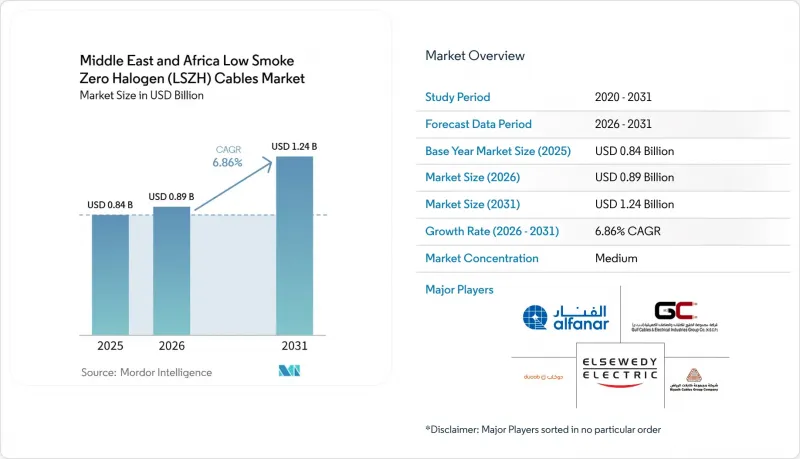
據 Mordor Intelligence 稱,中東和非洲低煙無鹵 (LSZH) 電纜的市場規模預計將從 2025 年的 8.4 億美元成長到 2026 年的 8.9 億美元,到 2031 年達到 12.4 億美元,預計 2026 年至 2031 年的複合年成長率為 2031.86%。
本報告按電纜類型(電力電纜、控制和儀器電纜等)、額定電壓(低於1 kV、1–35 kV、36–65 kV、高於65 kV)、絕緣材料(PVC(聚氯乙烯)等)、終端用戶產業(商業建築、資料中心等)和地區進行細分。市場預測以美元(USD)為單位。
中東和非洲低煙無鹵 (LSZH) 電纜市場趨勢與洞察
高密度封閉基礎設施中的生命安全需求
海灣合作理事會(GCC)各國的建築規範均強制規定在封閉空間內使用低煙無鹵(LSZH)電纜,並且隨著法規的不斷修訂,其應用範圍也持續擴大。阿拉伯聯合大公國《消防與生命安全實施規範》(包括其2025年修訂版)強制要求在高層建築的封閉空間內使用LSZH電纜,並要求杜拜民防局進行認證以確認其符合相關規定。該規範對電路完整性提出了要求,並參考了測量鹵代酸氣體排放量和煙霧密度的測試方法。沙烏地阿拉伯的採購要求也參考了IEC 60332耐火測試標準,適用於超過指定入住人數限制的建築物。保險公司擴大將使用LSZH電纜作為大規模商業開發項目火災風險保險的必要條件,這即使在監管力度不足的地區也推動了市場需求。這項商業性需求進一步加強了中東和非洲低煙無鹵(LSZH)電纜市場中符合標準的產品的監管基礎。
海灣合作理事會正在擴大資料中心和數位基礎設施
資料中心的建置正在推動對低菸無鹵(LSZH)光纖電纜的需求。這是因為封閉的伺服器機房、豎井和相關電氣設備空間都需要經過認證的耐火產品。高密度運算設備比傳統IT設施對熱環境的要求更高,從而提高了每兆瓦裝置容量的電纜系統價值。 2026年,NEOM和DataVolt在沙烏地阿拉伯啟動了一個價值50億美元的人工智慧資料中心綜合體的建設。第一期工程的目標是在2027年第四季實現200兆瓦的裝置容量,並在2030年達到1.5吉瓦的總裝置容量。 2026年7月,普睿司曼宣布與莫仕(Molex)簽訂了一份價值55億歐元(61.6億美元)的長期光纖電纜供應契約,同時光纖和光纜產能增加了12.5億歐元(14億美元)。該合約表明,隨著區域項目的推進,全球供應商正在確保超大規模部署所需的產能。因此,中東和非洲的低煙無鹵化 (LSZH) 電纜市場正受益於既需要連接性又需要嚴格防火保護的數位專案。
低菸無鹵電纜與PVC電纜替代方案的價格溢價比較
無鹵電纜材料的價格溢價仍然是成本敏感型專案中採用無鹵電纜的最大障礙。對於控制和儀表電纜而言,此價格溢價尤為顯著,因為與大直徑電力電纜相比,控制和儀表電纜在整體材料成本中所佔比例更高。如果開發商的資金籌措條件沒有要求符合國際防火安全標準,則可能面臨整個電纜材料清單的材料成本預算壓力。這種情況在非洲的商業和輕工業建築領域最為突出,因為這些領域的採購決策仍然以成本為導向。在建築規範嚴格執行的地區,這種限制並不明顯,因為專案業主必須承擔合規產品的成本。另一方面,在中東和非洲的低煙無鹵 (LSZH) 電纜市場,由於合規性驗證不足,除高階應用之外的其他應用類別中,這一問題仍然是一個重大挑戰。
細分市場分析
到2025年,電力電纜將佔中東和非洲低煙無鹵(LSZH)電纜市場36.29%的佔有率,這反映了其在商業建築、電網基礎設施和工業設施中的核心作用。 IEC 60502-2:2014/AMD1:2024標準引進了ST8和ST12無鹵護套選項,提高了中壓電力電纜的耐火要求。受資料中心對用於封閉式伺服器機房的LSZH光纖產品的需求推動,預計2026年至2031年光纖電纜市場將以8.11%的複合年成長率成長。中東和非洲地區光纖系統LSZH電纜市場規模的成長也得益於高密度運算設施日益嚴格的防火安全等級要求。
數據通訊電纜和建築電纜廣泛應用於商業、酒店和住宅項目,在這些項目中,遵守建築規範至關重要。特殊產品包括採用雲母帶的耐火電纜、經輻射交聯處理的海上電纜以及符合鐵路標準的電纜。這些電纜適用於除符合IEC 60331電路完整性要求外,還需具備無鹵化和低煙特性的應用場合。在2025年中東能源展上,Ducab公司發布了海灣合作理事會(GCC)地區首款高壓光纖電纜,這顯示該地區對高規格產品的投資正在持續成長。
至2025年,受建築電纜和低壓配電系統需求的推動,1千伏特以下電壓等級的電纜市場將佔全部區域市場價值的61.11%。該市場的大部分需求來自商業建築、酒店項目、醫療機構和資料中心。預計到2031年,1-35千伏電壓等級的電纜市場將以7.41%的複合年成長率成長,這主要得益於電力公司和市政當局推動地下電纜鋪設、可再生能源併網以及提高電網密度。在中東和非洲地區,低煙無鹵(LSZH)電纜在該電壓等級的市場規模成長,主要受採購標準中日益增多的無鹵中壓電纜規範的驅動。
36–65 kV 和 65 kV 以上電壓等級的頻寬主要用於輸電、海上互聯和特定電力應用。雖然這些頻寬的電纜供應有限,但每公里價值高,且規格要求嚴格。低煙無鹵 (LSZH) 電纜在這些電壓等級的應用主要集中在變電站、隧道段和海上平台。 2026 年 2 月,Ducab 完成了中東首個 400 kV 超高壓電纜系統的長期預認證測試,該系統符合 IEEE、IEC 和 AEIC 標準。
其他好處:
- Excel格式的市場預測(ME)表
- 3個月的分析師支持
目錄
第1章:引言
- 研究假設和市場定義
- 調查範圍
第2章:調查方法
第3章執行摘要
第4章 市場狀況
- 市場概覽
- 市場促進因素
- 對基礎設施(一個多人使用的封閉空間)的生命和安全要求。
- 海灣合作理事會正在擴大資料中心和數位基礎設施
- 鐵路、地鐵、機場和隧道的發展
- 石油和天然氣行業的電氣化和海上設施的現代化
- 專案規範和製造合格的本地化。
- 支援國際消防安全標準的多邊組織進行採購。
- 市場限制因素
- 低菸無鹵電纜比PVC電纜價格高出不少
- 非洲市場執法缺乏一致性
- 特種聚合物和阻燃化合物的供應風險
- 安裝人員和顧問對 LSZH 性能等級的了解有限。
- 產業價值鏈分析
- 波特五力分析
第5章 市場規模與成長預測
- 按電纜類型
- 低煙無鹵電源線
- 低菸無鹵控制和儀表電纜
- 低菸無鹵數據通訊電纜
- 低菸無鹵光纖電纜
- 低菸無鹵建築用電線
- 特殊低菸無鹵電纜
- 額定電壓
- 小於1千伏
- 1~35 kV
- 36~65 kV
- 65千伏或以上
- 按類型分類的絕緣材料
- PVC(聚氯乙烯)
- 交聯聚乙烯(XLPE)
- PE(聚乙烯)
- 其他特殊隔熱材料
- 按最終用戶行業分類
- 商業建築
- 工業製造
- 資料中心
- 能源公用事業
- 交通基礎設施
- 電訊
- 可再生能源
- 其他終端用戶產業
- 按地區
- 中東
- 沙烏地阿拉伯
- 阿拉伯聯合大公國
- 卡達
- 其他中東國家
- 非洲
- 南非
- 埃及
- 奈及利亞
- 其他非洲國家
- 中東
第6章 競爭情勢
- 市場集中度
- 策略趨勢
- 市佔率分析
- 公司簡介
- Ducab Group
- Riyadh Cables Group
- Elsewedy Electric SAE
- Gulf Cable and Electrical Industries Co. KSCP
- Alfanar Group
- Middle East Specialized Cables Company
- Prysmian SpA
- Nexans SA
- Southwire Company, LLC
- HELUKABEL GmbH
- Eland Cables Ltd.
- Belden Inc.
- CommScope Holding Company, Inc.
- TE Connectivity Ltd.
- Sumitomo Electric Industries, Ltd.
- Furukawa Electric Co., Ltd.
- Leoni AG
- Bahra Cables Company
- Top Cable, SA
- Fahad Cables Industry FZE
- Gulf Cables and Electrical Industries Company
第7章 市場機會與未來展望
According to Mordor Intelligence, the Middle East and Africa low smoke zero halogen (LSZH) cables market size is expected to increase from USD 0.84 billion in 2025 to USD 0.89 billion in 2026 and reach USD 1.24 billion by 2031, growing at a CAGR of 6.86% over 2026-2031.
This report is Segmented by Cable Type (Power Cables, Control and Instrumentation Cables, and More), Voltage Rating (Less Than 1 KV, 1-35 KV, 36-65 KV, and Above 65 KV), Insulation Material (PVC (Polyvinyl Chloride), and More), End-User Industry (Commercial Buildings, Data Centers, and More), and Geography. The Market Forecasts are Provided in Terms of Value (USD).
Middle East and Africa Low Smoke Zero Halogen (LSZH) Cables Market Trends and Insights
Life-Safety Requirements in High-Occupancy and Enclosed Infrastructure
Mandatory LSZH specifications in enclosed spaces are embedded in building requirements across the GCC, and their use continues to widen through code revision cycles. The UAE Fire and Life Safety Code of Practice, including its 2025 amendments, requires LSZH cables in enclosed spaces within high-rise buildings and links compliance to Dubai Civil Defense certification. The code sets requirements for circuit integrity and references tests measuring halogen-acid gas emissions and smoke density. Saudi procurement requirements also refer to IEC 60332 fire-testing criteria for buildings above defined occupancy thresholds. Insurance underwriters increasingly make the use of LSZH a condition of fire-risk coverage for large commercial developments, thereby strengthening demand where enforcement is less consistent. This commercial requirement reinforces the regulatory case for compliant products in the Middle East and Africa low smoke zero halogen (LSZH) cables market.
GCC Data Center and Digital Infrastructure Expansion
Data center construction supports demand for LSZH fiber optic cables because enclosed server halls, risers, and associated electrical spaces require certified fire-performance products. High-density computing equipment creates more demanding thermal conditions than conventional IT installations, increasing the value of cable systems per MW of installed capacity. NEOM and DataVolt began work on a USD 5 billion AI data center complex in Saudi Arabia in 2026, with a first phase targeting 200 MW by Q4 2027 and full capacity targeting 1.5 GW by 2030. Prysmian announced a EUR 5.5 billion (USD 6.16 billion) long-term optical cable supply agreement with Molex in July 2026, alongside a EUR 1.25 billion (USD 1.40 billion) increase in fiber and optical cable capacity. The agreement shows how global suppliers are securing capacity for hyperscale deployments as regional projects move forward. The Middle East and Africa low smoke zero halogen (LSZH) cables market, therefore, gains from digital projects that require both connectivity and stringent fire performance.
LSZH Price Premium Versus PVC Cable Alternatives
The price premium for halogen-free cable materials remains the most persistent barrier to adoption in cost-sensitive projects. The premium is particularly important for control and instrumentation cables, where the compound represents a larger share of the total material cost than for large-conductor power cables. Developers without financing conditions that require international fire-safety standards can face material budget pressure across the entire cable bill of materials. This is most evident in commercial and light-industrial construction categories in Africa, where procurement decisions remain highly cost-led. The restraint is less pronounced where building codes are consistently enforced because projects must absorb the cost of compliant products. It remains significant for the Middle East and Africa low smoke zero halogen (LSZH) cables market in non-prestige categories, where compliance checks are less consistent.
Other drivers and restraints analyzed in the detailed report include:
- Railway, Metro, Airport, and Tunnel Development
- Oil and Gas Electrification and Offshore Modernization
- Limited Enforcement Consistency Across African Markets
For complete list of drivers and restraints, kindly check the Table Of Contents.
Segment Analysis
Power cables accounted for 36.29% of the Middle East and Africa low smoke zero halogen (LSZH) cables market share in 2025, reflecting their central role in commercial construction, grid infrastructure, and industrial facilities. IEC 60502-2:2014/AMD1:2024 introduced ST8 and ST12 halogen-free sheath options and expanded fire-performance requirements for medium-voltage power cables. Fiber optic cables are projected to grow at an 8.11% CAGR from 2026 to 2031, driven by data centers requiring LSZH-jacketed optical products for enclosed server halls. The Middle East and Africa LSZH cables market size for fiber systems is supported by stricter fire classifications around high-density computing facilities.
Data and communication cables, as well as building wires, serve commercial, hospitality, and residential projects where code compliance is a requirement. Specialty products include mica-tape fire-resistant variants, radiation cross-linked offshore products, and rail-compliant constructions. These categories are used in applications where IEC 60331 circuit-integrity requirements are accompanied by halogen-free and low-smoke attributes. Ducab launched the GCC's first high-voltage fiber-optic cable at Middle East Energy 2025, underscoring regional investment in higher-specification products.
The less-than-1-kV segment accounted for 61.11% of the regional value in 2025, supported by building wires and low-voltage distribution systems. Commercial construction, hospitality projects, health-care facilities, and data centers account for much of this demand. The 1-35 kV tier is expected to expand at a 7.41% CAGR through 2031 as utilities and municipalities develop underground cabling, renewable-energy connections, and denser grids. The Middle East and Africa low smoke zero halogen (LSZH) cables market size for this tier is driven by procurement standards that increasingly include halogen-free medium-voltage cable specifications.
The 36-65 kV and above 65 kV tiers serve transmission, offshore interconnection, and selected utility applications. Their volumes are lower, but their value per kilometer and specification intensity are higher. LSZH use in these tiers is concentrated in substations, tunneled corridors, and offshore platforms. Ducab completed the Middle East's first extended pre-qualification test for a 400 kV extra-high-voltage cable system in February 2026, aligned with IEEE, IEC, and AEIC standards.
Complete Report Scope:
- By Cable Type
- LSZH Power Cables
- LSZH Control and Instrumentation Cables
- LSZH Data and Communication Cables
- LSZH Fiber Optic Cables
- LSZH Building Wires
- Specialty LSZH Cables
- By Voltage Rating
- Less Than 1 kV
- 1-35 kV
- 36-65 kV
- Above 65 kV
- By Insulation Material
- PVC (Polyvinyl Chloride)
- XLPE (Cross-linked Polyethylene)
- PE (Polyethylene)
- Other Specialty Insulation Materials
- By End-User Industry
- Commercial Buildings
- Industrial Manufacturing
- Data Centers
- Energy and Utilities
- Transportation Infrastructure
- Telecommunications
- Renewable Energy
- Other End-User Industries
- By Geography
- Middle East
- Saudi Arabia
- United Arab Emirates
- Qatar
- Rest of Middle East
- Africa
- South Africa
- Egypt
- Nigeria
- Rest of Africa
- Middle East
List of Companies Covered in this Report:
- Ducab Group
- Riyadh Cables Group
- Elsewedy Electric S.A.E.
- Gulf Cable and Electrical Industries Co. K.S.C.P.
- Alfanar Group
- Middle East Specialized Cables Company
- Prysmian S.p.A.
- Nexans S.A.
- Southwire Company, LLC
- HELUKABEL GmbH
- Eland Cables Ltd.
- Belden Inc.
- CommScope Holding Company, Inc.
- TE Connectivity Ltd.
- Sumitomo Electric Industries, Ltd.
- Furukawa Electric Co., Ltd.
- Leoni AG
- Bahra Cables Company
- Top Cable, S.A.
- Fahad Cables Industry FZE
- Gulf Cables and Electrical Industries Company
Additional Benefits:
- The market estimate (ME) sheet in Excel format
- 3 months of analyst support
TABLE OF CONTENTS
1 INTRODUCTION
- 1.1 Study Assumptions and Market Definition
- 1.2 Scope of the Study
2 RESEARCH METHODOLOGY
3 EXECUTIVE SUMMARY
4 MARKET LANDSCAPE
- 4.1 Market Overview
- 4.2 Market Drivers
- 4.2.1 Life-Safety Requirements in High-Occupancy and Enclosed Infrastructure
- 4.2.2 GCC Data Center and Digital Infrastructure Expansion
- 4.2.3 Railway, Metro, Airport, and Tunnel Development
- 4.2.4 Oil and Gas Electrification and Offshore Modernization
- 4.2.5 Project-Specification Localization and Regional Manufacturing Qualification
- 4.2.6 Multilateral-Institution Procurement Favoring International Fire-Safety Standards
- 4.3 Market Restraints
- 4.3.1 LSZH Price Premium Versus PVC Cable Alternatives
- 4.3.2 Limited Enforcement Consistency Across African Markets
- 4.3.3 Specialized Polymer and Flame-Retardant Compound Supply Exposure
- 4.3.4 Limited Installer and Consultant Familiarity With LSZH Performance Classes
- 4.4 Industry Value Chain Analysis
- 4.5 Porter's Five Forces Analysis
- 4.5.1 Threat of New Entrants
- 4.5.2 Bargaining Power of Suppliers
- 4.5.3 Bargaining Power of Buyers
- 4.5.4 Threat of Substitutes
- 4.5.5 Rivalry Among Existing Competitors
5 MARKET SIZE AND GROWTH FORECASTS (VALUE)
- 5.1 By Cable Type
- 5.1.1 LSZH Power Cables
- 5.1.2 LSZH Control and Instrumentation Cables
- 5.1.3 LSZH Data and Communication Cables
- 5.1.4 LSZH Fiber Optic Cables
- 5.1.5 LSZH Building Wires
- 5.1.6 Specialty LSZH Cables
- 5.2 By Voltage Rating
- 5.2.1 Less Than 1 kV
- 5.2.2 1-35 kV
- 5.2.3 36-65 kV
- 5.2.4 Above 65 kV
- 5.3 By Insulation Material
- 5.3.1 PVC (Polyvinyl Chloride)
- 5.3.2 XLPE (Cross-linked Polyethylene)
- 5.3.3 PE (Polyethylene)
- 5.3.4 Other Specialty Insulation Materials
- 5.4 By End-User Industry
- 5.4.1 Commercial Buildings
- 5.4.2 Industrial Manufacturing
- 5.4.3 Data Centers
- 5.4.4 Energy and Utilities
- 5.4.5 Transportation Infrastructure
- 5.4.6 Telecommunications
- 5.4.7 Renewable Energy
- 5.4.8 Other End-User Industries
- 5.5 By Geography
- 5.5.1 Middle East
- 5.5.1.1 Saudi Arabia
- 5.5.1.2 United Arab Emirates
- 5.5.1.3 Qatar
- 5.5.1.4 Rest of Middle East
- 5.5.2 Africa
- 5.5.2.1 South Africa
- 5.5.2.2 Egypt
- 5.5.2.3 Nigeria
- 5.5.2.4 Rest of Africa
- 5.5.1 Middle East
6 COMPETITIVE LANDSCAPE
- 6.1 Market Concentration
- 6.2 Strategic Moves
- 6.3 Market Share Analysis
- 6.4 Company Profiles (includes Global Level Overview, Market Level Overview, Core Segments, Financials as available, Strategic Information, Market Rank/Share, Products and Services, Recent Developments)
- 6.4.1 Ducab Group
- 6.4.2 Riyadh Cables Group
- 6.4.3 Elsewedy Electric S.A.E.
- 6.4.4 Gulf Cable and Electrical Industries Co. K.S.C.P.
- 6.4.5 Alfanar Group
- 6.4.6 Middle East Specialized Cables Company
- 6.4.7 Prysmian S.p.A.
- 6.4.8 Nexans S.A.
- 6.4.9 Southwire Company, LLC
- 6.4.10 HELUKABEL GmbH
- 6.4.11 Eland Cables Ltd.
- 6.4.12 Belden Inc.
- 6.4.13 CommScope Holding Company, Inc.
- 6.4.14 TE Connectivity Ltd.
- 6.4.15 Sumitomo Electric Industries, Ltd.
- 6.4.16 Furukawa Electric Co., Ltd.
- 6.4.17 Leoni AG
- 6.4.18 Bahra Cables Company
- 6.4.19 Top Cable, S.A.
- 6.4.20 Fahad Cables Industry FZE
- 6.4.21 Gulf Cables and Electrical Industries Company
7 MARKET OPPORTUNITIES AND FUTURE OUTLOOK
- 7.1 White-Space and Unmet-Need Assessment

 亞太地區電線電纜市場:市場佔有率分析、產業趨勢與統計、成長預測(2026-2031)北美電線電纜:市場佔有率分析、產業趨勢與統計及成長預測(2026-2031 年)亞太地區低菸無鹵(LSZH)電纜:市場佔有率分析、產業趨勢與統計及成長預測(2026-2031 年)歐洲低菸無鹵 (LSZH) 電纜:市場佔有率分析、產業趨勢和統計數據以及成長預測 (2026-2031)越南電線電纜市場:市場佔有率分析、產業趨勢與統計及成長預測(2026-2031)中東電線電纜市場:市場佔有率分析、產業趨勢與統計、成長預測(2026-2031年)非洲電線電纜市場:市場佔有率分析、產業趨勢與統計、成長預測(2026-2031 年)北美低菸無鹵(LSZH)電纜:市場佔有率分析、產業趨勢和統計數據以及成長預測(2026-2031 年)德國電線電纜市場:市場佔有率分析、產業趨勢與統計、成長預測(2026-2031)東南亞電線電纜市場:市場佔有率分析、產業趨勢與統計、成長預測(2026-2031)