


 |
市場調查報告書
商品編碼
2119022
德國電線電纜市場:市場佔有率分析、產業趨勢與統計、成長預測(2026-2031)Germany Wire and Cable - Market Share Analysis, Industry Trends & Statistics, Growth Forecasts (2026 - 2031) |
||||||

※ 本網頁內容可能與最新版本有所差異。詳細情況請與我們聯繫。
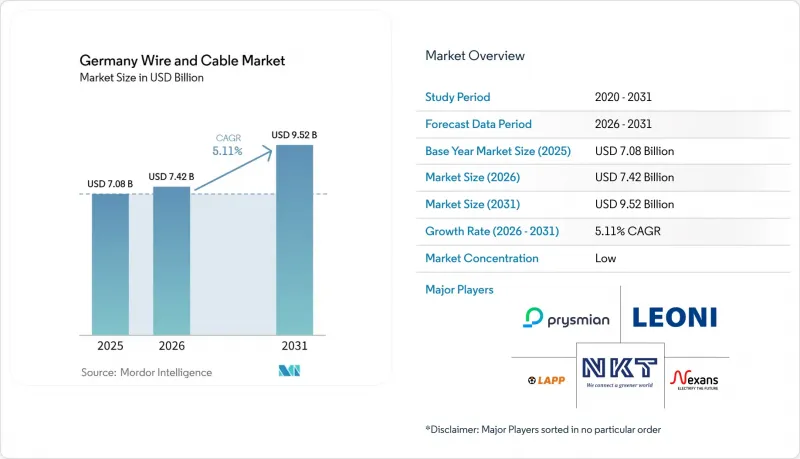
根據 Mordor Intelligence 預測,德國電線電纜市場規模將在 2025 年達到 70.8 億美元,2026 年達到 74.2 億美元,2031 年達到 95.2 億美元,2026 年至 2031 年的複合年成長率為 5.11%。
本報告按電壓(例如,超高壓、高壓(35千伏以上))、電纜類型(例如,電力電纜)、導體(例如,銅、鋁)、安裝方式(例如,架空、地下)、最終用戶行業(例如,建築(住宅、商業))和絕緣方式(帶絕緣、無絕緣)進行分類。市場預測以美元計價。
德國電線電纜市場趨勢與洞察
利用可再生能源擴建電網將從大幅改變電纜需求。
德國計劃在2030年安裝30吉瓦離岸風力發電裝置容量,到2035年達到50吉瓦,這將滿足對高壓和超高壓系統的需求。 《2025年海上電網發展規劃》規定了到2034年海上區域的互聯互通要求。 2025年7月,聯邦網路管理局(Bundesnetzagentur)批准了525千伏、2吉瓦的「東南連接線」(SuedOstLink)的最後一段工程。據德國電力和能源部(BDEW)和德國電氣電子工業協會(ZVEI)稱,到2045年,德國將需要超過50萬公里的電力電纜,用於替換老化設備,並連接可再生能源發電、熱泵和充電基礎設施。如此巨大的需求將推動長期供應合約的簽訂,因為輸電項目需要在電纜鋪設前幾年確保合格的生產能力。因此,德國電線電纜市場將受到電網主導的持續採購週期的影響,而不是短期建設週期的影響。
對工業自動化和工業4.0的投資正在推動對專用電纜的需求。
工業自動化持續推動德國工廠對柔軟性、耐油和電磁屏蔽電纜的需求。工廠升級需要為機械、機器人和生產設備提供可靠的訊號、控制和電源連接。由於電纜系統需要定期更新,因此這項工作涵蓋了電纜的更換和新安裝。單對乙太網路和資料通訊(PoD) 電纜設計即使在安裝長度較短的情況下,也能提升電纜在單一機器中的附加價值。隨著製造商採用滿足更高可靠性和移動性要求的電纜規格,德國電線電纜市場也從中受益。這些需求在巴伐利亞州、巴登-符騰堡州和北萊茵-威斯特法倫州的製造業集群中尤為突出。
銅和鋁的價格波動給整個價值鏈的利潤率帶來了壓力。
2026年1月29日,倫敦金屬交易所(LME)銅價創下每噸14,527.50美元的歷史新高。 2026年1月銅鋁比價達到4.3,超過了3.5-4.0的區間,在該區間內,材料替代率預計將會增加。這種情況可能導致在主饋送電纜和輸電應用中,在專案規範允許的情況下,鋁的使用量增加。在固定價格的設計、採購和施工(EPC)合約下,如果金屬價格在競標和交付之間波動,供應商將面臨風險。與大宗商品基準掛鉤的正式定價可以降低這種風險,但需要專案業主批准。德國電線電纜市場仍然對供應商透過合約對沖原料採購和收回成本的能力非常敏感。
細分市場分析
2025年,低壓電纜佔德國電線電纜市場的49.68%。這些電纜廣泛應用於建築佈線、充電電路、工業機械以及末端配電連接,因此替換需求十分旺盛。新建住宅仍低迷,2025年12月ifo住宅商業景氣指數為-20.6點。這導致同期建築佈線訂單下降。然而,工業設施維修和充電設備安裝專案支撐了其他低壓應用領域的需求。
中壓電纜用於加強配電網路、可再生能源收集網路、工業變電站連接以及用地下系統取代舊架空基礎設施。這些項目滿足了都市區、農村和工業區持續成長的電力需求。預計到2031年,特高壓和高壓電纜的複合年成長率將達到6.48%。諸如SuedLink、SuedOstLink、A-Nord、Ultranet和Korridor B等專案需要大量的地下電纜。技術測試和電力公司合格要求限制了能夠滿足這些專案需求的供應商範圍。
2025年,電力電纜佔德國電線電纜市場59.84%的佔有率。電力電纜利用銅和鋁系統,將可再生能源從發電廠輸送到工業和都市區電網,並進行電力分配。訊號和控制電纜為流程工業中的自動化設備和儀器提供支援。同軸電纜和資料電纜在廣播系統和現有基礎設施中繼續發揮至關重要的作用。這些應用確保了電力電纜在德國電線電纜市場中保持核心地位。
預計到2031年,光纖電纜市場將以5.89%的複合年成長率成長。光纖到戶(FTTH)的部署、5G回程傳輸的需求以及資料中心之間的互聯互通,都推動了這一領域的成長。此外,修訂後的VDE指南也促進了建築內互聯互通。資料中心園區需要高密度光纖佈線,以滿足未來網路升級的需求。光纖的需求還包括接入連接、骨幹線路以及商業設施內部的連接。儘管光纖電纜的應用範圍廣泛,使其成為一個重要的成長領域,但電力電纜仍佔據最大的市場佔有率。
其他好處:
- Excel格式的市場預測(ME)表
- 3個月的分析師支持
目錄
第1章:引言
- 市場分析與定義的前提條件
- 分析範圍
第2章 分析方法
第3章執行摘要
第4章 市場狀況
- 市場概覽
- 市場促進因素
- 可再生能源和電網擴張
- 對工業自動化和工業4.0的投資
- 光纖和資料中心基礎設施的擴展
- 電動車和充電基礎設施的電氣化
- 南北輸電走廊對高壓電纜的需求
- 實施電纜防盜措施和智慧電纜監控。
- 市場限制因素
- 銅鋁價格波動
- 安裝地下和海底電纜成本高昂
- 技術純熟勞工短缺和核准延誤
- 互聯電纜系統的網路安全和實體安全要求
- 產業供應鏈分析
- 監理情勢
- 技術展望
- 宏觀經濟因素對市場的影響
- 投資分析
- 波特五力分析
第5章:預測市場規模與成長率
- 透過電壓
- 超高壓/高壓(超過35千伏特)
- 中壓(1-35千伏特)
- 低電壓(低於1千伏特)
- 按電纜類型
- 電源線
- 光纖電纜
- 訊號和控制電纜
- 同軸電纜和資料電纜
- 按導體材料
- 銅
- 鋁
- 光學玻璃/聚合物
- 透過安裝方法
- 虛構的
- 地下
- 海底
- 按最終用戶行業分類
- 建造
- 住宅
- 商業的
- 電力基礎設施(公用事業和可再生能源)
- 通訊和資料中心
- 石油、天然氣和石化產品
- 汽車與出行
- 工業製造
- 建造
- 絕緣類型
- 帶隔熱材料
- 無隔熱材料
第6章 競爭情勢
- 市場集中度
- 策略趨勢
- 供應商定位分析
- 公司簡介
- Prysmian SpA
- Nexans SA
- NKT A/S
- LEONI AG
- LAPP GmbH
- HELUKABEL GmbH
- PHOENIX CONTACT GmbH and Co. KG
- igus GmbH
- Murrelektronik GmbH
- Weidmuller Interface GmbH and Co. KG
- Hans Turck GmbH and Co. KG
- TKD Kabel GmbH
- Kabelwerk Eupen AG
- SAB Brockskes GmbH and Co. KG
- Faber Kabel GmbH
- Sudkabel GmbH
- Waskonig+Walter Kabel-Werk GmbH and Co. KG
- Gebauer and Griller Kabelwerke GmbH
- METZ CONNECT GmbH
- Sumitomo Electric Industries, Ltd.
- TE Connectivity Ltd.
第7章 市場機會與未來展望
According to Mordor Intelligence, the Germany wire and Cable Market size is projected to be USD 7.08 billion in 2025, USD 7.42 billion in 2026, and reach USD 9.52 billion by 2031, growing at a CAGR of 5.11% from 2026 to 2031.
This report is Segmented by Voltage (Extra- and High-Voltage (Greater Than 35 KV), and More), Cable Type (Power Cable, and More), Conductor (Copper, Aluminum, and More), Installation (Overhead, Underground, and More), End-User Vertical (Construction (Residential and Commercial), and More), and Insulation (Insulated, and Non-Insulated). The Market Forecasts are Provided in Terms of Value (USD).
Germany Wire and Cable Market Trends and Insights
Renewable-Power Grid Expansion Reshapes Cable Demand At Scale
Germany's target is 30 GW of installed offshore wind capacity by 2030 and 50 GW by 2035, supporting demand for high-voltage and extra-high-voltage systems. The Offshore Network Development Plan 2025 set out connection requirements for offshore areas through 2034. The Bundesnetzagentur approved the final section of the 543 km SuedOstLink at 525 kV and 2 GW in July 2025. BDEW and ZVEI said more than 500,000 km of power cables will be needed by 2045 to replace aging assets and connect renewable generation, heat pumps, and charging infrastructure. This volume encourages long-term supply arrangements, because transmission projects require qualified production capacity years before cable installation. The Germany wire and cable market is consequently exposed to a durable grid-led procurement cycle rather than a short construction cycle.
Industrial Automation and Industry 4.0 Investment Supports Specialty Cable Demand
Industrial automation continues to support demand for flexible, oil-resistant, and electromagnetically shielded cables in German factories. Factory upgrades require dependable signal, control, and power connections for machinery, robotics, and production equipment. This work supports both replacement demand and new installations, as moving cable systems require periodic renewal. Single-pair Ethernet and power-over-data cable designs can increase the value of cable content in individual machines, even when installed lengths are shorter. The Germany wire and cable market also benefits when manufacturers adopt cable specifications that meet higher reliability and motion requirements. These needs are most visible in manufacturing corridors in Bavaria, Baden-Wurttemberg, and North Rhine-Westphalia.
Copper and Aluminum Price Volatility Pressures Margins Across the Value Chain
Copper reached an intraday high of USD 14,527.50 per tonne on the London Metal Exchange on January 29, 2026. The copper-to-aluminum price ratio reached 4.3 in January 2026, above the 3.5-4.0 range cited for increased material substitution. This situation can increase aluminum use in main feeders and transmission applications where project specifications permit it. Fixed-price engineering, procurement, and construction contracts leave suppliers exposed when metal prices change between bid submission and delivery. Formula pricing tied to commodity benchmarks can reduce this risk, though it requires the project owners' acceptance. The Germany wire and cable market remains sensitive to suppliers' ability to hedge material purchases and recover costs through contracts.
Other drivers and restraints analyzed in the detailed report include:
- Fiber-Optic and Data-Center Infrastructure Expansion Creates a Parallel Demand Cycle
- Electric-Vehicle and Charging-Infrastructure Electrification Increases Cable Requirements
- High Installation Costs For Underground and Submarine Cables Strain Project Economics
For complete list of drivers and restraints, kindly check the Table Of Contents.
Segment Analysis
Low-voltage cable accounted for 49.68% of the German wire and cable market share in 2025. It is used in building wiring, charging circuits, industrial machinery, and last-mile distribution connections, creating a broad replacement base. New residential construction remained weak, with the ifo Business Climate Index for residential construction at -20.6 points in December 2025. This reduced some building-wire orders during the period. Industrial retrofits and charging installation programs provided demand in other low-voltage uses.
Medium-voltage cable supports distribution-grid reinforcement, renewable collector networks, industrial substation connections, and the replacement of aging overhead assets with underground systems. This work supports recurring demand across urban, rural, and industrial locations. Extra- and high-voltage cable is projected to record a 6.48% CAGR through 2031. SuedLink, SuedOstLink, A-Nord, Ultranet, and Korridor B require large volumes of land cable. Technical testing and utility qualification requirements limit the field of suppliers able to serve these projects.
Power cable accounted for 59.84% of the Germany wire and cable market in 2025. It transmits renewable electricity from generation sites and distributes power through industrial and urban networks using copper and aluminum systems. Signal and control cable supports automation equipment and process-industry instrumentation. Coaxial and data cables continue to play a role in broadcast systems and existing infrastructure. These applications keep the power cable at the center of the Germany wire and cable market.
Fiber-optic cable is expected to expand at a 5.89% CAGR through 2031. The category benefits from fiber-to-the-home deployment, 5G backhaul requirements, and data-center interconnection, while the VDE's updated guideline supports in-building connections. Data-center campuses require dense fiber routing that can accommodate later network upgrades. Fiber demand also includes access connections, backbone links, and connections inside commercial properties. This broad role makes fiber cable an important growth area, while power cable retains the largest share.
Complete Report Scope:
- By Voltage
- Extra- and High-Voltage (Greater Than 35 kV)
- Medium-Voltage (1-35 kV)
- Low-Voltage (Less Than 1 kV)
- By Cable Type
- Power Cable
- Fiber-Optic Cable
- Signal and Control Cable
- Coaxial and Data Cable
- By Conductor Material
- Copper
- Aluminum
- Optical Glass/Polymer
- By Installation
- Overhead
- Underground
- Submarine
- By End-User Vertical
- Construction
- Residential
- Commercial
- Power Infrastructure (Utilities and Renewables)
- Telecommunications and Data Centers
- Oil and Gas and Petrochemicals
- Automotive and Mobility
- Industrial Manufacturing
- Construction
- By Insulation
- Insulated
- Non-Insulated
List of Companies Covered in this Report:
- Prysmian S.p.A.
- Nexans S.A.
- NKT A/S
- LEONI AG
- LAPP GmbH
- HELUKABEL GmbH
- PHOENIX CONTACT GmbH and Co. KG
- igus GmbH
- Murrelektronik GmbH
- Weidmuller Interface GmbH and Co. KG
- Hans Turck GmbH and Co. KG
- TKD Kabel GmbH
- Kabelwerk Eupen AG
- SAB Brockskes GmbH and Co. KG
- Faber Kabel GmbH
- Sudkabel GmbH
- Waskonig + Walter Kabel-Werk GmbH and Co. KG
- Gebauer and Griller Kabelwerke GmbH
- METZ CONNECT GmbH
- Sumitomo Electric Industries, Ltd.
- TE Connectivity Ltd.
Additional Benefits:
- The market estimate (ME) sheet in Excel format
- 3 months of analyst support
TABLE OF CONTENTS
1 INTRODUCTION
- 1.1 Study Assumptions and Market Definition
- 1.2 Scope of the Study
2 RESEARCH METHODOLOGY
3 EXECUTIVE SUMMARY
4 MARKET LANDSCAPE
- 4.1 Market Overview
- 4.2 Market Drivers
- 4.2.1 Renewable-Power Grid Expansion
- 4.2.2 Industrial Automation and Industry 4.0 Investment
- 4.2.3 Fiber-Optic and Data-Center Infrastructure Expansion
- 4.2.4 Electric-Vehicle and Charging-Infrastructure Electrification
- 4.2.5 High-Voltage Cable Demand from North-South Transmission Corridors
- 4.2.6 Cable-Theft Prevention and Smart Cable Monitoring Adoption
- 4.3 Market Restraints
- 4.3.1 Copper and Aluminum Price Volatility
- 4.3.2 High Installation Costs for Underground and Submarine Cables
- 4.3.3 Skilled-Labor Shortages and Approval Delays
- 4.3.4 Cybersecurity and Physical-Security Requirements for Connected Cable Systems
- 4.4 Industry Supply Chain Analysis
- 4.5 Regulatory Landscape
- 4.6 Technological Outlook
- 4.7 Impact of Macroeconomic Factors on the Market
- 4.8 Investment Analysis
- 4.9 Porter's Five Forces Analysis
- 4.9.1 Bargaining Power of Suppliers
- 4.9.2 Bargaining Power of Buyers
- 4.9.3 Threat of New Entrants
- 4.9.4 Threat of Substitutes
- 4.9.5 Intensity of Competitive Rivalry
5 MARKET SIZE AND GROWTH FORECASTS (VALUE)
- 5.1 By Voltage
- 5.1.1 Extra- and High-Voltage (Greater Than 35 kV)
- 5.1.2 Medium-Voltage (1-35 kV)
- 5.1.3 Low-Voltage (Less Than 1 kV)
- 5.2 By Cable Type
- 5.2.1 Power Cable
- 5.2.2 Fiber-Optic Cable
- 5.2.3 Signal and Control Cable
- 5.2.4 Coaxial and Data Cable
- 5.3 By Conductor Material
- 5.3.1 Copper
- 5.3.2 Aluminum
- 5.3.3 Optical Glass/Polymer
- 5.4 By Installation
- 5.4.1 Overhead
- 5.4.2 Underground
- 5.4.3 Submarine
- 5.5 By End-User Vertical
- 5.5.1 Construction
- 5.5.1.1 Residential
- 5.5.1.2 Commercial
- 5.5.2 Power Infrastructure (Utilities and Renewables)
- 5.5.3 Telecommunications and Data Centers
- 5.5.4 Oil and Gas and Petrochemicals
- 5.5.5 Automotive and Mobility
- 5.5.6 Industrial Manufacturing
- 5.5.1 Construction
- 5.6 By Insulation
- 5.6.1 Insulated
- 5.6.2 Non-Insulated
6 COMPETITIVE LANDSCAPE
- 6.1 Market Concentration
- 6.2 Strategic Moves
- 6.3 Vendor Positioning Analysis
- 6.4 Company Profiles (includes Global Level Overview, Market Level Overview, Core Segments, Financials as available, Strategic Information, Market Rank/Share, Products and Services, Recent Developments)
- 6.4.1 Prysmian S.p.A.
- 6.4.2 Nexans S.A.
- 6.4.3 NKT A/S
- 6.4.4 LEONI AG
- 6.4.5 LAPP GmbH
- 6.4.6 HELUKABEL GmbH
- 6.4.7 PHOENIX CONTACT GmbH and Co. KG
- 6.4.8 igus GmbH
- 6.4.9 Murrelektronik GmbH
- 6.4.10 Weidmuller Interface GmbH and Co. KG
- 6.4.11 Hans Turck GmbH and Co. KG
- 6.4.12 TKD Kabel GmbH
- 6.4.13 Kabelwerk Eupen AG
- 6.4.14 SAB Brockskes GmbH and Co. KG
- 6.4.15 Faber Kabel GmbH
- 6.4.16 Sudkabel GmbH
- 6.4.17 Waskonig + Walter Kabel-Werk GmbH and Co. KG
- 6.4.18 Gebauer and Griller Kabelwerke GmbH
- 6.4.19 METZ CONNECT GmbH
- 6.4.20 Sumitomo Electric Industries, Ltd.
- 6.4.21 TE Connectivity Ltd.
7 MARKET OPPORTUNITIES AND FUTURE OUTLOOK
- 7.1 White-Space and Unmet-Need Assessment

 亞太地區電線電纜市場:市場佔有率分析、產業趨勢與統計、成長預測(2026-2031)北美電線電纜:市場佔有率分析、產業趨勢與統計及成長預測(2026-2031 年)亞太地區低菸無鹵(LSZH)電纜:市場佔有率分析、產業趨勢與統計及成長預測(2026-2031 年)歐洲低菸無鹵 (LSZH) 電纜:市場佔有率分析、產業趨勢和統計數據以及成長預測 (2026-2031)越南電線電纜市場:市場佔有率分析、產業趨勢與統計及成長預測(2026-2031)中東和非洲低菸無鹵 (LSZH) 電纜:市場佔有率分析、行業趨勢和統計數據以及成長預測 (2026-2031)中東電線電纜市場:市場佔有率分析、產業趨勢與統計、成長預測(2026-2031年)非洲電線電纜市場:市場佔有率分析、產業趨勢與統計、成長預測(2026-2031 年)北美低菸無鹵(LSZH)電纜:市場佔有率分析、產業趨勢和統計數據以及成長預測(2026-2031 年)東南亞電線電纜市場:市場佔有率分析、產業趨勢與統計、成長預測(2026-2031)