


 |
市場調查報告書
商品編碼
2119064
亞太地區電線電纜市場:市場佔有率分析、產業趨勢與統計、成長預測(2026-2031)Asia-Pacific Wire and Cable - Market Share Analysis, Industry Trends & Statistics, Growth Forecasts (2026 - 2031) |
||||||

※ 本網頁內容可能與最新版本有所差異。詳細情況請與我們聯繫。
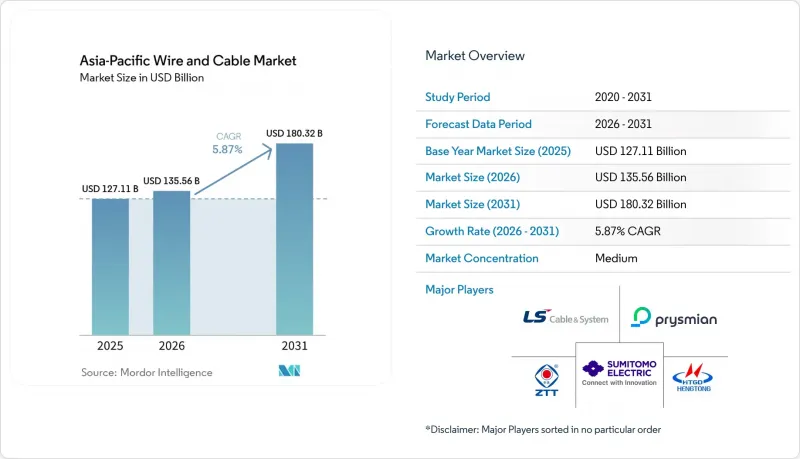
據 Mordor Intelligence 稱,亞太地區電線電纜市場在 2025 年的價值為 1271.1 億美元,預計到 2031 年將達到 1803.2 億美元,而 2026 年為 1355.6 億美元,預測期(2026-2031 年)的複合年成長率為 5.7%。
本報告按電壓等級(低壓、中壓、特高壓/高壓)、電纜類型(電力電纜、光纖電纜等)、導體材質(銅等)、安裝方式(架空、地下、水下)、最終用戶(建築(住宅)、其他)、絕緣類型(絕緣、非絕緣)以及地區(中國、印度、其他)進行細分。市場預測以美元計價。
亞太地區電線電纜市場趨勢及洞察。
擴大可再生能源規模和電網現代化
中國國家電網公司計劃在2026年至2030年間新建15條特高壓輸電線路。該計畫預計將省際輸電能力提升35%,並每年將200吉瓦時的可再生能源發電容量併入電網。陝安徽±800千伏高壓直流輸電工程已於2026年6月30日投入運作。該專案投資205億元人民幣(約30.3億美元),輸電距離1,055公里,額定容量800萬千瓦。此類項目需要大量專用高壓電纜,導致延長至認證供應商供貨週期。隨著印度可再生能源發電的成長,也需要增加從電廠到電網的輸電容量。 2026 年 6 月,印度電網公司與日本國際協力銀行簽署了一項綠色貸款協議,金額為 800 億日圓(4.9 億美元),用於卡夫達-那格浦爾高壓直流輸電項目。
對城市基礎設施、電氣化和智慧城市的投資
在亞太地區的電線電纜市場,由於城市發展,對低壓佈線和地下配電系統的需求日益成長。專案規格越來越傾向於選擇防火、低煙、無鹵電纜產品,而非普通的建築電纜。印度的「BharatNet」計畫旨在2030年將27萬個村莊連接到光纖網路。一項提案的1000億盧比(約10.4億美元)的地下電力電纜製造可行性缺口資金籌措計劃,預計將幫助滿足國內對高容量電纜的需求。由於印度標準局(BIS)的合規要求和與生產連結獎勵計畫計劃,官方採購僅限於經過認證的國內供應商。這為現有生產商提供了一定程度的保護,使其免受不受監管的進口產品的衝擊。
銅鋁價格波動
銅和鋁的價格波動劇烈,為電纜製造商帶來不確定性。在價格上漲前簽訂的固定價格合約可能導致材料成本超出預期。雖然在低壓應用中用鋁取代銅可以維持電纜產量,但單位利潤可能會下降。因此,當合約價格固定時,管理長期金屬價格風險就變得十分困難。製造商正在探索將原物料成本與基準金屬價格掛鉤的價格調整機制。在這種環境下,能夠有效管理金屬價格風險並將成本波動轉嫁到產品價格上的製造商將更具優勢。
細分市場分析
2025年,低壓電纜佔總銷售量的52.84%(依電壓等級分類)。這反映了中國、印度和東南亞地區建築和住宅配電的需求。中壓產品支援可再生能源併網和都市區電網升級。基於中國GB/T標準和印度BIS標準的要求,交聯聚乙烯(XLPE)電纜的應用日益廣泛。預計2026年至2031年,特高壓和高壓電纜的複合年成長率將達到6.48%。這些電纜單位成本較高,且通常用於大規模電網專案。
陝北至安徽±800千伏特高壓直流輸電專案於2026年6月投入運作,是中國「十五」規劃下首條特高壓直流輸電線路。該線路全長1055公里,額定容量800萬千瓦。西藏至廣東特高壓輸電線路於2026年4月動工建設,全長2,681公里。在印度,2027年至2032年間計畫投資50萬至60千萬公升(約520億至620億美元)用於輸電建設。該計畫的目標是每年新增2萬條電路公里輸電線路。這些項目將帶動對合格高壓電纜製造商的需求。
2025年,以電纜類型分類,電力電纜佔亞太地區電線電纜市場總銷售額的60.92%。公用事業、可再生能源、建築和工業項目支撐著這個龐大的市場基礎。訊號和控制產品應用於工業自動化和製程控制設施。同軸電纜和數據產品繼續為廣播和傳統末端網路提供支援。預計2026年至2031年,光纖電纜將以6.83%的複合年成長率成長。這項成長主要受5G網路、資料中心建置以及各國寬頻規劃的推動。
古河電工旗下子公司Lightera於2026年3月開始量產1,3824芯光纖電纜。該產品提高了固定電纜截面內的光纖密度。 Sterlite Technologies於2026年5月獲得一份價值11.1億美元的多年期契約,為其人工智慧資料中心提供光連接解決方案。該公司的「Neuralis」產品組合旨在滿足人工智慧資料中心的特定需求。因此,亞太地區的線纜市場正在分化為兩個細分市場:基礎寬頻光纖和用於計算叢集的高密度連接。擁有先進光纖製造技術的供應商將在後者領域獲得競爭優勢。
其他好處:
- Excel格式的市場預測(ME)表
- 3個月的分析師支持
目錄
第1章:引言
- 市場分析與定義的前提條件
- 分析範圍
第2章 分析方法
第3章執行摘要
第4章 市場狀況
- 市場概覽
- 市場促進因素
- 擴大可再生能源規模和電網現代化
- 對城市基礎設施、電氣化和智慧城市的投資
- 5G、雲端和資料中心網路的擴展
- 電動車和充電基礎設施的電氣化
- 人工智慧資料中心的功率密度和水冷式電纜需求
- 島際連接和海底電纜的定位
- 市場限制因素
- 銅鋁價格波動
- 資本密集度高,實施複雜。
- 標準不一致以及非標準電纜造成的競爭加劇。
- 船舶和港口的授權、土地徵用以及瓶頸問題
- 產業供應鏈分析
- 監理情勢
- 技術展望
- 宏觀經濟因素對市場的影響
- 投資分析
- 波特五力分析
第5章:預測市場規模與成長率
- 透過電壓
- 超高壓/高壓(超過35千伏特)
- 中壓(1-35千伏特)
- 低電壓(低於1千伏特)
- 按電纜類型
- 電源線
- 光纖電纜
- 訊號和控制電纜
- 同軸電纜和資料電纜
- 按導體材料
- 銅
- 鋁
- 光學玻璃/聚合物
- 透過安裝方法
- 虛構的
- 地下
- 海底
- 按最終用戶行業分類
- 建築(住宅)
- 建築(商業設施)
- 電力基礎設施(公用事業、可再生能源)
- 通訊和資料中心
- 石油和天然氣、石油化學產品
- 汽車與出行
- 工業/製造業
- 絕緣類型
- 帶隔熱材料
- 無隔熱材料
- 國家
- 中國
- 印度
- 日本
- 韓國
- 澳洲和紐西蘭
- 其他亞太國家
第6章 競爭情勢
- 市場集中度
- 策略趨勢
- 供應商定位分析
- 公司簡介
- Prysmian SpA
- HENGTONG GROUP CO.,LTD.
- Jiangsu Zhongtian Technology Co., Ltd.
- Sumitomo Electric Industries, Ltd.
- LS Cable & System
- Furukawa Electric Co., Ltd.
- Fujikura Ltd.
- Nexans
- Taihan Cable & Solution Co., Ltd.
- KEI Industries Limited
- Polycab India Limited
- Finolex Cables Limited
- RR Kabel Limited
- Sterlite Technologies Limited
- APAR Industries Limited
- NKT A/S
- Belden Inc.
- LEONI AG
- Amphenol Corporation
- TE Connectivity Ltd.
第7章 市場機會與未來展望
According to Mordor Intelligence, the Asia-Pacific wire and cable market size was valued at USD 127.11 billion in 2025 and estimated to grow from USD 135.56 billion in 2026 to reach USD 180.32 billion by 2031, at a CAGR of 5.87% during the forecast period (2026-2031).
This report is Segmented by Voltage (Low, Medium, and Extra- and High-Voltage), Cable Type (Power, Fiber-Optic, and More), Conductor (Copper, and More), Installation (Overhead, Underground, and Submarine), End-User (Construction - Residential, and More), Insulation (Insulated, and Non-Insulated), and Geography (China, India, and More). The Market Forecasts are Provided in Terms of Value (USD).
Asia-Pacific Wire and Cable Market Trends and Insights
Renewable Energy Expansion and Grid Modernization
China's State Grid Corporation plans to build 15 additional ultra-high-voltage transmission lines between 2026 and 2030. The program is expected to raise cross-provincial transmission capacity by 35% and connect 200 GWh of renewable capacity each year. The Shaanbei-Anhui +-800 kV UHVDC project entered service on June 30, 2026, with a CNY 20.50 billion (USD 3.03 billion) investment, a route of 1,055 km, and a rated capacity of 8 million kW. Such projects require large volumes of specialty high-voltage cable and have extended delivery schedules for qualified suppliers. India's rising renewable output also requires new generation-to-transmission capacity. Power Grid Corporation of India signed a JPY 80 billion (USD 490 million) green loan agreement with JBIC in June 2026 for the Khavda-Nagpur HVDC project.
Urban Infrastructure, Electrification, and Smart-City Investment
Urban development is increasing demand for low-voltage wiring and underground distribution systems in the Asia-Pacific wire and cable market. Project specifications increasingly favor fire-resistant, low-smoke, zero-halogen cable products over basic building wire. India's BharatNet program aims to connect 270,000 villages with fiber infrastructure by 2030. A proposed INR 10,000 crore (USD 1.04 billion) viability gap funding scheme for underground power cable manufacturing could help meet domestic demand for high-capacity cables. BIS compliance requirements and the production-linked incentive program direct formal procurement toward certified domestic suppliers. This provides established producers with some protection against unregulated imports.
Copper and Aluminum Price Volatility
Copper and aluminum prices can change rapidly, creating uncertainty for cable manufacturers. Fixed-price contracts signed before a price increase can place material costs above planned levels. Aluminum substitution may preserve cable volumes in lower-voltage applications, but it can reduce revenue per unit. Long-term metal exposure is, therefore, difficult to manage when contract pricing is fixed. Producers are seeking price-adjustment mechanisms that link material costs to metal reference prices. This environment rewards manufacturers that can manage metal exposure and pass through cost changes.
Other drivers and restraints analyzed in the detailed report include:
- 5G, Cloud, and Data-Center Network Expansion
- Electric Vehicle and Charging-Infrastructure Electrification
- High Capital Intensity and Installation Complexity
For complete list of drivers and restraints, kindly check the Table Of Contents.
Segment Analysis
Low-voltage cables held 52.84% of revenue by voltage in 2025. Their scale reflects demand from construction and residential distribution across China, India, and Southeast Asia. Medium-voltage products support renewable connections and urban distribution upgrades. XLPE adoption is increasing under China's GB/T standards and India's BIS requirements. Extra- and high-voltage cables are projected to expand at a 6.48% CAGR from 2026 to 2031. These cables have higher unit values and are linked to large grid projects.
The Shaanbei-Anhui +-800 kV UHVDC project was commissioned in June 2026 as the first UHVDC line under China's 15th Five-Year Plan. It spans 1,055 km and has a rated capacity of 8 million kW. Construction of the Xizang-Guangdong UHV line began in April 2026, and the route will span 2,681 km. India's planned transmission investment is INR 5-6 lakh crore (USD 52-62 billion) over FY27-FY32. The plan targets annual additions of 20,000 circuit km of transmission lines. These programs support demand for qualified high-voltage cable producers.
Power cable held 60.92% of the Asia-Pacific wire and cable market revenue by cable type in 2025. Utilities, renewables, construction, and industrial projects support this large base. Signal and control products serve industrial automation and process facilities. Coaxial and data products continue to support broadcast and legacy last-mile networks. Fiber-optic cable is projected to expand at a 6.83% CAGR from 2026 to 2031. The growth reflects 5G networks, data center construction, and national broadband programs.
Furukawa Electric's Lightera subsidiary began mass production of a 13,824-count optical fiber cable in March 2026. The product raises fiber density within a fixed cable cross-section. Sterlite Technologies secured a USD 1.11 billion multi-year product award in May 2026 for AI data center optical connectivity. Its Neuralis portfolio addresses specialized AI data center requirements. The Asia-Pacific wire and cable market is therefore separating into basic broadband fiber and high-density connectivity for computing clusters. Suppliers with advanced fiber manufacturing can compete in the latter category.
Complete Report Scope:
- By Voltage
- Extra- and High-Voltage (Greater Than 35 kV)
- Medium-Voltage (1-35 kV)
- Low-Voltage (Less Than 1 kV)
- By Cable Type
- Power Cable
- Fiber-Optic Cable
- Signal and Control Cable
- Coaxial and Data Cable
- By Conductor Material
- Copper
- Aluminum
- Optical Glass/Polymer
- By Installation
- Overhead
- Underground
- Submarine
- By End-User Vertical
- Construction - Residential
- Construction - Commercial
- Power Infrastructure (Utilities and Renewables)
- Telecommunications and Data Centers
- Oil and Gas and Petrochemicals
- Automotive and Mobility
- Industrial Manufacturing
- By Insulation
- Insulated
- Non-Insulated
- By Country
- China
- India
- Japan
- South Korea
- Australia and New Zealand
- Rest of Asia-Pacific
List of Companies Covered in this Report:
- Prysmian S.p.A.
- HENGTONG GROUP CO.,LTD.
- Jiangsu Zhongtian Technology Co., Ltd.
- Sumitomo Electric Industries, Ltd.
- LS Cable & System
- Furukawa Electric Co., Ltd.
- Fujikura Ltd.
- Nexans
- Taihan Cable & Solution Co., Ltd.
- KEI Industries Limited
- Polycab India Limited
- Finolex Cables Limited
- R R Kabel Limited
- Sterlite Technologies Limited
- APAR Industries Limited
- NKT A/S
- Belden Inc.
- LEONI AG
- Amphenol Corporation
- TE Connectivity Ltd.
Additional Benefits:
- The market estimate (ME) sheet in Excel format
- 3 months of analyst support
TABLE OF CONTENTS
1 INTRODUCTION
- 1.1 Study Assumptions and Market Definition
- 1.2 Scope of the Study
2 RESEARCH METHODOLOGY
3 EXECUTIVE SUMMARY
4 MARKET LANDSCAPE
- 4.1 Market Overview
- 4.2 Market Drivers
- 4.2.1 Renewable Energy Expansion and Grid Modernization
- 4.2.2 Urban Infrastructure, Electrification, and Smart-City Investment
- 4.2.3 5G, Cloud, and Data-Center Network Expansion
- 4.2.4 Electric Vehicle and Charging-Infrastructure Electrification
- 4.2.5 AI Data-Center Power-Density and Liquid-Cooling Cable Requirements
- 4.2.6 Inter-Island Interconnection and Subsea Cable Localization
- 4.3 Market Restraints
- 4.3.1 Copper and Aluminum Price Volatility
- 4.3.2 High Capital Intensity and Installation Complexity
- 4.3.3 Inconsistent Standards and Substandard Cable Competition
- 4.3.4 Permitting, Right-of-Way, Vessel, and Port Bottlenecks
- 4.4 Industry Supply Chain Analysis
- 4.5 Regulatory Landscape
- 4.6 Technological Outlook
- 4.7 Impact of Macroeconomic Factors on the Market
- 4.8 Investment Analysis
- 4.9 Porter's Five Forces Analysis
- 4.9.1 Bargaining Power of Suppliers
- 4.9.2 Bargaining Power of Buyers
- 4.9.3 Threat of New Entrants
- 4.9.4 Threat of Substitutes
- 4.9.5 Intensity of Competitive Rivalry
5 MARKET SIZE AND GROWTH FORECASTS (VALUE)
- 5.1 By Voltage
- 5.1.1 Extra- and High-Voltage (Greater Than 35 kV)
- 5.1.2 Medium-Voltage (1-35 kV)
- 5.1.3 Low-Voltage (Less Than 1 kV)
- 5.2 By Cable Type
- 5.2.1 Power Cable
- 5.2.2 Fiber-Optic Cable
- 5.2.3 Signal and Control Cable
- 5.2.4 Coaxial and Data Cable
- 5.3 By Conductor Material
- 5.3.1 Copper
- 5.3.2 Aluminum
- 5.3.3 Optical Glass/Polymer
- 5.4 By Installation
- 5.4.1 Overhead
- 5.4.2 Underground
- 5.4.3 Submarine
- 5.5 By End-User Vertical
- 5.5.1 Construction - Residential
- 5.5.2 Construction - Commercial
- 5.5.3 Power Infrastructure (Utilities and Renewables)
- 5.5.4 Telecommunications and Data Centers
- 5.5.5 Oil and Gas and Petrochemicals
- 5.5.6 Automotive and Mobility
- 5.5.7 Industrial Manufacturing
- 5.6 By Insulation
- 5.6.1 Insulated
- 5.6.2 Non-Insulated
- 5.7 By Country
- 5.7.1 China
- 5.7.2 India
- 5.7.3 Japan
- 5.7.4 South Korea
- 5.7.5 Australia and New Zealand
- 5.7.6 Rest of Asia-Pacific
6 COMPETITIVE LANDSCAPE
- 6.1 Market Concentration
- 6.2 Strategic Moves
- 6.3 Vendor Positioning Analysis
- 6.4 Company Profiles (includes Global Level Overview, Market Level Overview, Core Segments, Financials as available, Strategic Information, Market Rank/Share, Products and Services, Recent Developments)
- 6.4.1 Prysmian S.p.A.
- 6.4.2 HENGTONG GROUP CO.,LTD.
- 6.4.3 Jiangsu Zhongtian Technology Co., Ltd.
- 6.4.4 Sumitomo Electric Industries, Ltd.
- 6.4.5 LS Cable & System
- 6.4.6 Furukawa Electric Co., Ltd.
- 6.4.7 Fujikura Ltd.
- 6.4.8 Nexans
- 6.4.9 Taihan Cable & Solution Co., Ltd.
- 6.4.10 KEI Industries Limited
- 6.4.11 Polycab India Limited
- 6.4.12 Finolex Cables Limited
- 6.4.13 R R Kabel Limited
- 6.4.14 Sterlite Technologies Limited
- 6.4.15 APAR Industries Limited
- 6.4.16 NKT A/S
- 6.4.17 Belden Inc.
- 6.4.18 LEONI AG
- 6.4.19 Amphenol Corporation
- 6.4.20 TE Connectivity Ltd.
7 MARKET OPPORTUNITIES AND FUTURE OUTLOOK
- 7.1 White-Space and Unmet-Need Assessment

 北美電線電纜:市場佔有率分析、產業趨勢與統計及成長預測(2026-2031 年)亞太地區低菸無鹵(LSZH)電纜:市場佔有率分析、產業趨勢與統計及成長預測(2026-2031 年)歐洲低菸無鹵 (LSZH) 電纜:市場佔有率分析、產業趨勢和統計數據以及成長預測 (2026-2031)越南電線電纜市場:市場佔有率分析、產業趨勢與統計及成長預測(2026-2031)中東和非洲低菸無鹵 (LSZH) 電纜:市場佔有率分析、行業趨勢和統計數據以及成長預測 (2026-2031)中東電線電纜市場:市場佔有率分析、產業趨勢與統計、成長預測(2026-2031年)非洲電線電纜市場:市場佔有率分析、產業趨勢與統計、成長預測(2026-2031 年)北美低菸無鹵(LSZH)電纜:市場佔有率分析、產業趨勢和統計數據以及成長預測(2026-2031 年)德國電線電纜市場:市場佔有率分析、產業趨勢與統計、成長預測(2026-2031)東南亞電線電纜市場:市場佔有率分析、產業趨勢與統計、成長預測(2026-2031)