


 |
市場調查報告書
商品編碼
2119062
中東電線電纜市場:市場佔有率分析、產業趨勢與統計、成長預測(2026-2031年)Middle East Wire and Cable - Market Share Analysis, Industry Trends & Statistics, Growth Forecasts (2026 - 2031) |
||||||

※ 本網頁內容可能與最新版本有所差異。詳細情況請與我們聯繫。
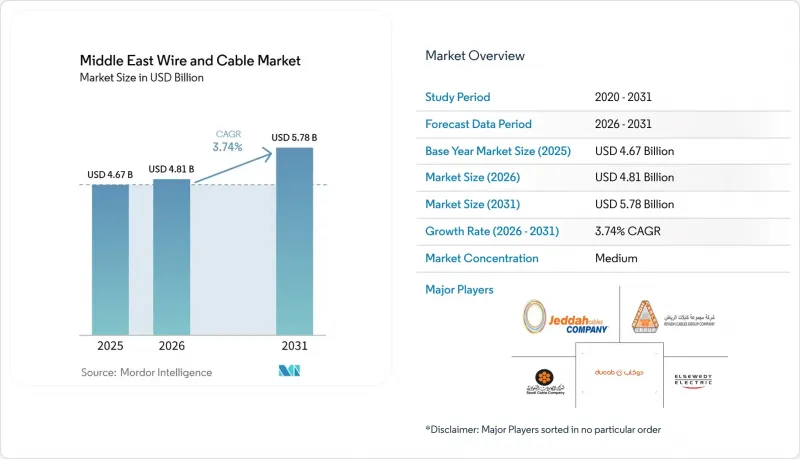
據 Mordor Intelligence 稱,2025 年中東電線電纜市場價值 46.7 億美元,預計到 2031 年將從 2026 年的 48.1 億美元成長至 57.8 億美元,預測期(2026-2031 年)的複合年成長率預計為 3.74%。
本報告按電壓(低壓、中壓、超高壓)、電纜類型(電力電纜、光纖電纜等)、導體(銅等)、安裝方式(架空、地下、水下)、最終用戶(建築(住宅)等)、絕緣方式(隔熱材料、隔熱材料)和地區(沙烏地阿拉伯、卡達等)進行細分。市場預測以美元計價。
中東電線電纜市場趨勢與洞察
各國電網的擴建與現代化
中東地區電線電纜市場需求的主要推動要素仍是各國電網現代化。沙烏地阿拉伯電力公司 (SEC) 的採購活動正在為新建負載中心和住宅擴建項目採購中高壓系統。大型工程的建造也增加了對輸電線路和電力設備的需求。高壓直流 (HVDC) 專案不僅需要大型輸電系統,還需要相關的供電電纜和變電站電纜。這種組合需求涵蓋了比單一採購項目更廣泛的電纜類別。擁有成熟測試記錄的供應商更有能力滿足這些需求。
公用事業規模的可再生能源和併網項目
可再生能源專案正在催生對直流電纜(用於太陽能發電)、集電電纜和長距離輸電導線的需求。沙烏地阿拉伯已設定目標,到2030年實現58.7吉瓦的可再生能源發電裝置容量,這將為未來幾年新建發電設施和電網連接提供電纜支援。偏遠地區的太陽能和風力發電廠需要能夠承受高溫和紫外線輻射的隔熱材料。這些要求使得符合規範對於參與大規模電力專案的供應商至關重要。中東電線電纜市場也受惠於離岸能源系統與當地電網的併網。這項工作需要專用海底電纜、陸上連接設施以及與廣域電網的連接。
銅、鋁和聚合物的價格波動
原物料價格波動是區域電纜製造商利潤率面臨的最緊迫風險。銅價在2026年5月飆升至近每噸13,500美元,推高了含銅量高的產品的成本。在固定價格的基礎設施合約中,如果合約簽訂後金屬價格出現波動,供應商將面臨風險。生產商正在透過在合約中加入與金屬價格掛鉤的調整條款以及增加價格審查頻率來應對這一風險。銅價上漲也可能促使工程師在技術標準允許的情況下考慮採用鋁或複合導體。如果大型供應商能夠確保上游原料供應並消化短期成本波動,它們可能會佔優勢。
細分市場分析
到2025年,低電壓電纜將佔中東電線電纜市場銷售額的50.94%,成為該市場最大的電壓等級類別。這部分需求主要來自住宅和商業建築。在NEOM、Dilya Gate和Roshn等城市,由於分階段的建設項目,建築電纜的需求量很大。低壓產品也用於商業設施和公共建築的內部配電。其需求取決於施工進度、建築許可和承包商的採購週期。預計到2031年,特高壓和高壓電纜的年複合成長率將達到3.85%。這反映了對高壓直流輸電(HVDC)和特高壓交流輸電走廊的投資。這些系統將新的負載中心連接到國家電網和遠端發電設施。中壓電纜在都市區配電、地鐵擴建、變電站和工業園區中繼續發揮至關重要的作用。
利雅德電纜集團於2026年5月完成了TAQA 1 x 2500 mm 2400 kV超高壓(EHV)電纜系統的型式試驗。該試驗在公司獲得ISO 17025認證的測試實驗室進行。這項成就證明了公司具備在國內生產先前主要由海外製造商供應的電壓等級電纜的能力。獲得技術資格將擴大參與高品質電力公司競標的機會。 IEC 60840和IEC 62067在超高壓電纜採購要求中的重要性日益凸顯。這些標準提高了缺乏相關測試經驗的供應商的進入門檻。預先獲得認證的供應商可以從這些有限的認證標準中受益。新進者則需要投資測試、設計檢驗和專案經驗。由於建設和電網發展計畫的同步推進,中東電線電纜市場對所有電壓等級的需求依然強勁。這為建築、電力分配和電力傳輸領域創造了均衡的商業機會。
到2025年,電力電纜仍將是最大的電纜類型,佔銷售額的61.86%。能源基礎設施在該地區資本投資中仍佔據重要地位。所有新的可再生能源項目都需要發電、配電和輸電系統。沙烏地阿拉伯的可再生能源計畫將在整個預測期內保障電力電纜的永續供應。訊號和控制產品用於工廠、工業設施和能源設施的儀器。同軸電纜和數據電纜支援監控和通訊功能。這些應用推動了對擁有多元化產品系列的製造商的持續需求。都市區電網升級和新建變電站也促進了對電力電纜的需求。由於電力系統是該地區大多數項目的基礎,因此電力電纜仍然是中東電線電纜市場的核心。其市場規模反映了對可靠電力基礎設施的持續重視。
預計到2031年,光纖電纜的複合年成長率將達到3.98%。陸地光纖到府(FTTH)網路、5G回程傳輸和海底光纜系統是推動這一成長的主要動力。海底光纜計畫需要沿著線路鋪設陸地光纜,連接至登陸站和內陸資料中心,這催生了海底光纜產業以外的需求。 Ooredoo的FIG計畫清楚展現了區域間互聯基礎設施的規劃投資規模。光纖產品也被用於資料中心互連和結構化佈線。混合光纜設計實現了高壓電力傳輸和光感測的結合。此類產品有助於電力營運商監測共用線路沿線的溫度和應力。因此,儘管電力電纜仍然是主要類別,但數位基礎設施正在推動光纜類型的多樣化,並逐步轉向高價值的特種產品。
其他好處:
- Excel格式的市場預測(ME)表
- 3個月的分析師支持
目錄
第1章:引言
- 市場分析與定義的前提條件
- 分析範圍
第2章 分析方法
第3章執行摘要
第4章 市場狀況
- 市場概覽
- 市場促進因素
- 各國電網的擴建與現代化
- 大型可再生能源和併網項目
- 大型企劃、交通網、智慧城市建設
- 資料中心、5G、FTTH(光纖到府)以及海底通訊網路的擴展
- 基於國家願景計畫的能源多元化和產業區域化
- 用於沙漠和沿海基礎設施的抗氣候變遷電纜的技術規範
- 市場限制因素
- 銅、鋁和聚合物的價格波動
- 每個國家的標準、測試和認證要求都不同。
- 極端高溫、紫外線照射、沙塵暴和海岸腐蝕
- 進口假冒仿冒品、不合格和不合規的電纜。
- 產業供應鏈分析
- 監理情勢
- 技術展望
- 宏觀經濟因素對市場的影響
- 投資分析
- 波特五力分析
第5章 市場規模與成長預測
- 透過電壓
- 超高壓/高壓(超過35千伏特)
- 中壓(1-35千伏特)
- 低電壓(低於1千伏特)
- 按電纜類型
- 電源線
- 光纖電纜
- 訊號和控制電纜
- 同軸電纜和資料電纜
- 按導體材料
- 銅
- 鋁
- 光學玻璃/聚合物
- 透過安裝方法
- 架空電線
- 地下
- 海底
- 按最終用戶行業分類
- 建築(住宅)
- 建築(商業設施)
- 電力基礎設施(公用事業和可再生能源)
- 通訊和資料中心
- 石油和天然氣、石油化學產品
- 汽車與出行
- 工業/製造業
- 絕緣類型
- 帶隔熱材料
- 無隔熱材料
- 國家
- 沙烏地阿拉伯
- 阿拉伯聯合大公國
- 卡達
- 以色列
- 土耳其
- 科威特
- 阿曼
- 巴林
- 其他中東國家
第6章 競爭情勢
- 市場集中度
- 策略趨勢
- 供應商定位分析
- 公司簡介
- Riyadh Cables Group
- Jeddah Cables Company
- Ducab Group
- Elsewedy Electric
- Saudi Cable Company
- Bahra Advanced Cable Manufacture Co.
- Oman Cables Industry SAOG
- National Cable Industry
- Arabian Cables Company
- Doha Cables
- Qatar International Cables Company
- Prysmian SpA
- Nexans SA
- NKT A/S
- LS Cable and System Ltd.
- Sumitomo Electric Industries, Ltd.
- Furukawa Electric Co., Ltd.
- Fujikura Ltd.
- ABB Ltd.
- Hitachi Energy Ltd.
第7章 市場機會與未來展望
According to Mordor Intelligence, the Middle East wire and cable market size was valued at USD 4.67 billion in 2025 and estimated to grow from USD 4.81 billion in 2026 to reach USD 5.78 billion by 2031, at a CAGR of 3.74% during the forecast period (2026-2031).
This report is Segmented by Voltage (Low, Medium, and Extra- and High-Voltage), Cable Type (Power, Fiber-Optic, and More), Conductor (Copper, and More), Installation (Overhead, Underground, and Submarine), End-User (Construction - Residential, and More), Insulation (Insulated and Non-Insulated) and Geography (Saudi Arabia, Qatar, and More). The Market Forecasts are Provided in Terms of Value (USD).
Middle East Wire and Cable Market Trends and Insights
Expansion and Modernization of National Electricity Grids
National grid modernization remains the strongest demand driver for the Middle East wire and cable market. Saudi Electricity Company procurement supports the procurement of medium- and high-voltage systems for new load centers and residential expansion. Giga-project construction adds to the need for transmission connections and utility equipment. HVDC projects require associated feeder and substation cables in addition to their main transmission systems. This combination supports demand across more cable categories than a single procurement award may show. Suppliers with established testing credentials are well placed to respond to these requirements.
Utility-Scale Renewable Energy and Grid-Integration Projects
Renewable projects create demand for solar DC cables, collector cables, and long-distance transmission conductors. Saudi Arabia has a 58.7 GW renewable capacity target for 2030, which supports multi-year cable needs for new generation and grid connections. Remote solar and wind sites require insulation that can tolerate heat and ultraviolet exposure. These requirements make compliance with specifications important for suppliers serving premium utility projects. The Middle East wire and cable market also benefits when offshore energy systems connect to mainland grids. This work requires specialized marine cables, landfall equipment, and links to the wider grid.
Copper, Aluminum, and Polymer Price Volatility
Raw-material volatility is the most immediate margin risk for regional cable manufacturers. Copper prices near USD 13,500 per tonne in May 2026 raised costs for products that use copper intensively. Fixed-price infrastructure contracts expose suppliers when metal prices change after contract award. Producers are responding through metal-linked adjustment clauses and more frequent price resets. Higher copper costs can also encourage engineers to consider aluminum or composite conductors where technical rules allow. Larger suppliers may gain an advantage when they can secure upstream materials or absorb short-term cost movements.
Other drivers and restraints analyzed in the detailed report include:
- Mega-Project, Transport Network, and Smart-City Construction
- Data Center, 5G, FTTH, and Submarine Connectivity Expansion
- Fragmented National Standards, Testing, and Certification Requirements
For complete list of drivers and restraints, kindly check the Table Of Contents.
Segment Analysis
Low-voltage cables accounted for 50.94% of revenue in 2025, making them the largest voltage category in the Middle East wire and cable market. Residential and commercial construction account for much of this demand. NEOM, Diriyah Gate, and ROSHN require large volumes of building wire through phased construction programs. Low-voltage products also support internal distribution within commercial sites and public buildings. Their demand depends on construction schedules, building approvals, and contractor purchasing cycles. Extra- and high-voltage cables are forecast to grow at a 3.85% CAGR through 2031. This reflects investment in HVDC and extra-high-voltage alternating-current corridors. These systems link new load centers with national grids and remote generation assets. Medium-voltage cables remain essential for urban distribution, metro extensions, substations, and industrial parks.
Riyadh Cables Group completed type testing for a TAQA 1X2500 mm2 400 kV EHV cable system in May 2026. The testing took place at the company's ISO 17025-accredited laboratory. The event indicates a domestic capability for a voltage class previously supplied mainly by foreign producers. Technical qualification can improve access to premium utility tenders. IEC 60840 and IEC 62067 are increasingly important in EHV procurement requirements. These standards raise the entry threshold for suppliers without documented testing credentials. Pre-approved suppliers can benefit from this restricted qualification base. New suppliers must invest in testing, design validation, and project references. The Middle East wire and cable market retains a broad need for all voltage classes because construction and grid programs advance together. This creates a balanced opportunity across building, distribution, and transmission applications.
Power cables commanded 61.86% of revenue in 2025 and remained the largest cable type. Energy infrastructure continues to receive a significant share of regional capital spending. Every new renewable project needs collection, distribution, and transmission systems. Saudi Arabia's renewable energy program supports sustained power cable procurement over the forecast period. Signal and control products serve instrumentation in plants, industrial facilities, and energy sites. Coaxial and data cables support monitoring and communications functions. These applications provide recurring demand for producers with varied product portfolios. Power cable demand also benefits from urban grid upgrades and new substations. The category remains central to the Middle East wire and cable market because electricity systems underpin most regional projects. Its scale reflects the continuing priority placed on reliable power infrastructure.
Fiber-optic cable is expected to grow at a 3.98% CAGR through 2031. Terrestrial FTTH networks, 5G backhaul, and submarine systems support that expansion. Submarine projects require land-based cables at landing stations and along routes to inland data centers. This creates demand beyond the marine cable section itself. Ooredoo's FIG project shows the scale of planned regional connectivity investment. Fiber products are also used in data-center interconnects and structured cabling. Hybrid cable designs can combine high-voltage transmission with optical sensing. Such products can help utilities monitor temperature and strain on a shared route. Digital infrastructure therefore broadens the cable type mix while power cable remains the dominant category. This supports a gradual shift toward higher-value specialty products.
Complete Report Scope:
- By Voltage
- Extra- and High-Voltage (Greater Than 35 kV)
- Medium-Voltage (1-35 kV)
- Low-Voltage (Less Than 1 kV)
- By Cable Type
- Power Cable
- Fiber-Optic Cable
- Signal and Control Cable
- Coaxial and Data Cable
- By Conductor Material
- Copper
- Aluminum
- Optical Glass/Polymer
- By Installation
- Overhead
- Underground
- Submarine
- By End-User Vertical
- Construction - Residential
- Construction - Commercial
- Power Infrastructure (Utilities and Renewables)
- Telecommunications and Data Centers
- Oil and Gas and Petrochemicals
- Automotive and Mobility
- Industrial Manufacturing
- By Insulation
- Insulated
- Non-Insulated
- By Country
- Saudi Arabia
- United Arab Emirates
- Qatar
- Israel
- Turkey
- Kuwait
- Oman
- Bahrain
- Rest of Middle East
List of Companies Covered in this Report:
- Riyadh Cables Group
- Jeddah Cables Company
- Ducab Group
- Elsewedy Electric
- Saudi Cable Company
- Bahra Advanced Cable Manufacture Co.
- Oman Cables Industry SAOG
- National Cable Industry
- Arabian Cables Company
- Doha Cables
- Qatar International Cables Company
- Prysmian S.p.A.
- Nexans S.A.
- NKT A/S
- LS Cable and System Ltd.
- Sumitomo Electric Industries, Ltd.
- Furukawa Electric Co., Ltd.
- Fujikura Ltd.
- ABB Ltd.
- Hitachi Energy Ltd.
Additional Benefits:
- The market estimate (ME) sheet in Excel format
- 3 months of analyst support
TABLE OF CONTENTS
1 INTRODUCTION
- 1.1 Study Assumptions and Market Definition
- 1.2 Scope of the Study
2 RESEARCH METHODOLOGY
3 EXECUTIVE SUMMARY
4 MARKET LANDSCAPE
- 4.1 Market Overview
- 4.2 Market Drivers
- 4.2.1 Expansion and Modernization of National Electricity Grids
- 4.2.2 Utility-Scale Renewable Energy and Grid-Integration Projects
- 4.2.3 Construction of Mega-Projects, Transport Networks, and Smart Cities
- 4.2.4 Data Center, 5G, Fiber-to-the-Home, and Submarine Connectivity Expansion
- 4.2.5 Energy Diversification and Industrial Localization Under National Vision Programs
- 4.2.6 Climate-Resilient Cable Specifications for Desert and Coastal Infrastructure
- 4.3 Market Restraints
- 4.3.1 Copper, Aluminum, and Polymer Price Volatility
- 4.3.2 Fragmented National Standards, Testing, and Certification Requirements
- 4.3.3 Extreme Heat, Ultraviolet Exposure, Sandstorms, and Coastal Corrosion
- 4.3.4 Counterfeit, Substandard, and Non-Compliant Cable Imports
- 4.4 Industry Supply Chain Analysis
- 4.5 Regulatory Landscape
- 4.6 Technological Outlook
- 4.7 Impact of Macroeconomic Factors on the Market
- 4.8 Investment Analysis
- 4.9 Porter's Five Forces Analysis
- 4.9.1 Bargaining Power of Suppliers
- 4.9.2 Bargaining Power of Buyers
- 4.9.3 Threat of New Entrants
- 4.9.4 Threat of Substitutes
- 4.9.5 Intensity of Competitive Rivalry
5 MARKET SIZE AND GROWTH FORECASTS (VALUE)
- 5.1 By Voltage
- 5.1.1 Extra- and High-Voltage (Greater Than 35 kV)
- 5.1.2 Medium-Voltage (1-35 kV)
- 5.1.3 Low-Voltage (Less Than 1 kV)
- 5.2 By Cable Type
- 5.2.1 Power Cable
- 5.2.2 Fiber-Optic Cable
- 5.2.3 Signal and Control Cable
- 5.2.4 Coaxial and Data Cable
- 5.3 By Conductor Material
- 5.3.1 Copper
- 5.3.2 Aluminum
- 5.3.3 Optical Glass/Polymer
- 5.4 By Installation
- 5.4.1 Overhead
- 5.4.2 Underground
- 5.4.3 Submarine
- 5.5 By End-User Vertical
- 5.5.1 Construction - Residential
- 5.5.2 Construction - Commercial
- 5.5.3 Power Infrastructure (Utilities and Renewables)
- 5.5.4 Telecommunications and Data Centers
- 5.5.5 Oil and Gas and Petrochemicals
- 5.5.6 Automotive and Mobility
- 5.5.7 Industrial Manufacturing
- 5.6 By Insulation
- 5.6.1 Insulated
- 5.6.2 Non-Insulated
- 5.7 By Country
- 5.7.1 Saudi Arabia
- 5.7.2 United Arab Emirates
- 5.7.3 Qatar
- 5.7.4 Israel
- 5.7.5 Turkey
- 5.7.6 Kuwait
- 5.7.7 Oman
- 5.7.8 Bahrain
- 5.7.9 Rest of Middle East
6 COMPETITIVE LANDSCAPE
- 6.1 Market Concentration
- 6.2 Strategic Moves
- 6.3 Vendor Positioning Analysis
- 6.4 Company Profiles (includes Global Level Overview, Market Level Overview, Core Segments, Financials as available, Strategic Information, Market Rank/Share, Products and Services, Recent Developments)
- 6.4.1 Riyadh Cables Group
- 6.4.2 Jeddah Cables Company
- 6.4.3 Ducab Group
- 6.4.4 Elsewedy Electric
- 6.4.5 Saudi Cable Company
- 6.4.6 Bahra Advanced Cable Manufacture Co.
- 6.4.7 Oman Cables Industry SAOG
- 6.4.8 National Cable Industry
- 6.4.9 Arabian Cables Company
- 6.4.10 Doha Cables
- 6.4.11 Qatar International Cables Company
- 6.4.12 Prysmian S.p.A.
- 6.4.13 Nexans S.A.
- 6.4.14 NKT A/S
- 6.4.15 LS Cable and System Ltd.
- 6.4.16 Sumitomo Electric Industries, Ltd.
- 6.4.17 Furukawa Electric Co., Ltd.
- 6.4.18 Fujikura Ltd.
- 6.4.19 ABB Ltd.
- 6.4.20 Hitachi Energy Ltd.
7 MARKET OPPORTUNITIES AND FUTURE OUTLOOK
- 7.1 White-Space and Unmet-Need Assessment

 亞太地區電線電纜市場:市場佔有率分析、產業趨勢與統計、成長預測(2026-2031)北美電線電纜:市場佔有率分析、產業趨勢與統計及成長預測(2026-2031 年)亞太地區低菸無鹵(LSZH)電纜:市場佔有率分析、產業趨勢與統計及成長預測(2026-2031 年)歐洲低菸無鹵 (LSZH) 電纜:市場佔有率分析、產業趨勢和統計數據以及成長預測 (2026-2031)越南電線電纜市場:市場佔有率分析、產業趨勢與統計及成長預測(2026-2031)中東和非洲低菸無鹵 (LSZH) 電纜:市場佔有率分析、行業趨勢和統計數據以及成長預測 (2026-2031)非洲電線電纜市場:市場佔有率分析、產業趨勢與統計、成長預測(2026-2031 年)北美低菸無鹵(LSZH)電纜:市場佔有率分析、產業趨勢和統計數據以及成長預測(2026-2031 年)德國電線電纜市場:市場佔有率分析、產業趨勢與統計、成長預測(2026-2031)東南亞電線電纜市場:市場佔有率分析、產業趨勢與統計、成長預測(2026-2031)