


 |
市場調查報告書
商品編碼
2119016
北美低菸無鹵(LSZH)電纜:市場佔有率分析、產業趨勢和統計數據以及成長預測(2026-2031 年)North America Low Smoke Zero Halogen (LSZH) Cables - Market Share Analysis, Industry Trends & Statistics, Growth Forecasts (2026 - 2031) |
||||||

※ 本網頁內容可能與最新版本有所差異。詳細情況請與我們聯繫。
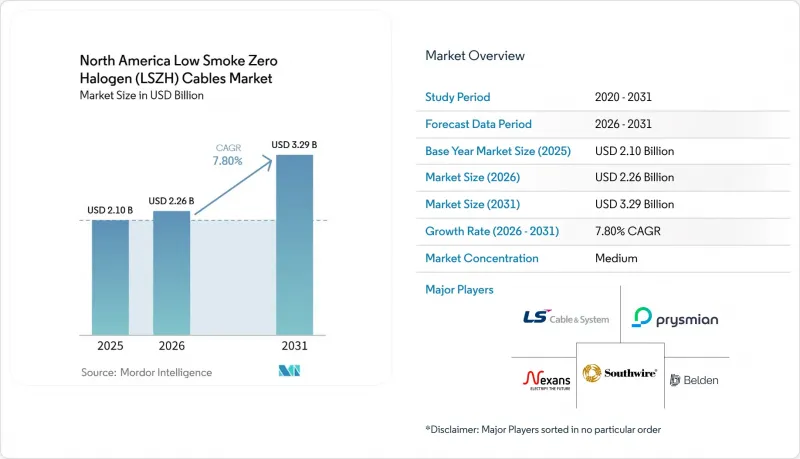
據 Mordor Intelligence 稱,2025 年北美 LSZH(低菸無鹵)電纜市場價值為 21 億美元,預計到 2031 年將從 2026 年的 22.6 億美元成長至 32.9 億美元,預測期(2026-2031 年)複合年成長率為 7.80%。
本報告按電纜類型(電力電纜、控制和儀器電纜等)、額定電壓(低於1 kV、1–35 kV、36–65 kV、高於65 kV)、絕緣材料(PVC(聚氯乙烯)等)、終端用戶行業(商業建築、工業和製造業等)以及國家/地區進行細分。市場預測以美元計價。
北美低菸無鹵(LSZH)電纜市場趨勢及洞察
超大規模和人工智慧資料中心建設的擴展
預計到2026年,全球人工智慧資料中心投資將達到4,500億美元,北美地區的計畫主要集中在維吉尼亞北部、德克薩斯州、亞利桑那州和喬治亞。與傳統伺服器機房相比,這些專案對封閉技術空間內的電力和數據佈線需求更大。 NFPA 75 第6章要求IT設備安裝空間內的電纜必須最大限度地減少煙霧和有毒氣體的危害,而ANSI/BICSI 002建議在資料中心建築內使用低煙無鹵(LSZH)產品進行電力和數據佈線。因此,北美LSZH電纜市場受益於將防火安全納入新設施基本設計的規格。這種需求有利於能夠為大型專案提供認證產品、可靠交貨和文件的製造商。此外,由於園區營運商需要在配電設施、設備機房、骨幹網路、水平連接和維護團隊等封閉空間中使用相容的電纜,電纜供應商可以銷售電力、光纖和結構化佈線系統的整合解決方案,而不是單獨的產品。這種綜合方法還可以簡化複雜設施的技術審查和採購程序。
封閉式基礎設施中更嚴格的消防和生命安全要求
在2026版《美國國家電氣規範》(NEC)中,通訊電路從第8章移至第7章,使其更接近第1至4章中所述的一般佈線要求。這項變更加強了低壓通訊工作與更廣泛的電氣標準之間的連結。 NFPA 130強制要求在鐵路客運車輛、車站和隧道中使用低煙材料,而NFPA 502對公路隧道和橋樑中的生命安全系統也提出了類似的要求。 NEC第770節和NFPA 262也影響通風管道空間和垂直佈線路徑中的電纜選擇,尤其是在大規模商業和資料中心專案中。北美低菸無鹵電纜市場受益於客戶在其採購文件中納入低菸無鹵要求,即使沒有單一標準明確規定。另一方面,維護認證記錄的需求可能會延緩改良配方的推出,尤其是在製造商必須證明產品在所有方面(包括阻燃性、煙霧排放、鹵素含量、電氣要求和安裝要求)均表現穩定的情況下。由此產生的審核流程也會在施工和檢驗規範變更期間影響產品的供應。
與PVC電纜相比的價格差異
低菸無鹵(LSZH)電纜的價格比同類PVC電纜高出20-30%。這是因為這種特殊的無鹵聚烯化合物比標準PVC化合物更昂貴。在住宅建築和小規模商業維修項目中,由於買家優先考慮初始材料成本,這種價格差異尤其顯著。擁有自有化合物生產部門的電纜製造商可以降低採購化合物價格波動所帶來的風險,從而更有效地參與競爭。如果專案從一開始就按照更嚴格的建築規範進行設計,成本計算方式則會有所不同。在施工期間安裝符合規範的產品比在設施完工後更換電纜對專案的干擾更小。因此,當建築電纜的買家直接比較LSZH產品與標準THHN或THWN-2電纜時,這些限制最為突出,尤其是在設計對電纜用量要求相對較低、火災風險評估有限且專案預算內幾乎沒有空間彌補初始材料成本差異的情況下。
細分市場分析
至2025年,電力電纜將佔北美低菸無鹵(LSZH)電纜市場31.40%的佔有率。這主要得益於商業建築、公用設施設備升級以及可再生能源電力收集系統的發展。大規模建築和變電站專案需要大量電纜,而日益嚴格的煙霧控制要求正在推動設計中採用LSZH規範。控制和儀器產品為自動化工業系統提供支持,而數據和通訊電纜則受益於企業IT升級和5G回程傳輸專案。建築佈線仍與商業建築活動密切相關,專用的耐火電路產品和交通運輸產品能夠滿足性能要求高於標準LSZH等級的應用需求。這些需求支撐著建築、公用設施、交通運輸和數位基礎設施等領域的多種電纜類型。
預計到2031年,光纖電纜的年複合成長率將達到9.60%,成為成長最快的電纜類型。超大規模資料中心的不斷湧現推動了對高密度、防火資料基礎設施以及配備全面技術文件的產品的需求。擁有符合低菸無鹵(LSZH)標準的光纖國內生產能力的供應商能夠快速回應專案進度和認證要求。預端接和結構化光纖系統也有助於安裝人員在大規模資料中心中管理高密度連接。因此,隨著營運商擴展其數位基礎設施,光纖在區域需求中的重要性日益凸顯。
2025年,低壓產品(1千伏以下)佔北美低菸無鹵(LSZH)電纜市場的68.40%。這項銷售量主要由商業建築佈線、IT配電和結構化佈線推動。 NEC、NFPA和BICSI的要求推動了人們對低煙結構的日益青睞。 65千伏以上的產品用於封閉式輸電工程,而36-65千伏範圍的產品在支援大規模資料中心園區的變電站中日益重要。這兩種高壓產品都用於對防火性能要求極高的環境,例如電纜路徑有限的密閉空間和封閉式開關室。
預計到2031年,1-35 kV中壓市場將以8.70%的複合年成長率成長。可再生能源發電、電池儲能以及大型資料中心的供電需求正在推動中壓產品需求的成長。在需要高電流下卓越散熱性能的應用中,採用交聯聚乙烯(XLPE)絕緣的低煙無鹵(LSZH)設計是首選。 2025年6月,普睿司曼(Prysmian)在其位於德克薩斯州麥金尼的Encor Wire園區投資5億美元,興建一座佔地65萬平方英尺的中壓生產設施,預計於2027年投入運作。 UL認證的XLPE和LSZH結構正逐漸成為領先公用事業公司和資料中心專案的合約標準。
其他好處:
- Excel格式的市場預測(ME)表
- 3個月的分析師支持
目錄
第1章:引言
- 市場分析與定義的前提條件
- 分析範圍
第2章 分析方法
第3章執行摘要
第4章 市場狀況
- 市場概覽
- 市場促進因素
- 超大規模和人工智慧資料中心擴展
- 對封閉式基礎設施的防火和生命安全提出了更嚴格的要求。
- 可再生能源和電池儲能的擴展
- 工業自動化與先進製造業回流
- 計算熱密度的增加推動了高性能低煙無鹵化合物的應用。
- 優先選擇低碳、國產且可追溯的產品。
- 市場限制因素
- 高價電纜與PVC電纜的比較
- 複雜的認證、測試和認可要求
- 無鹵化合物和添加劑供應的波動性
- 與維修傳統基礎設施相關的中斷和相容性限制
- 產業價值鏈分析
- 波特五力分析
第5章:預測市場規模與成長率
- 按電纜類型
- 低煙無鹵電源線
- 低菸無鹵控制和儀器電纜
- 低菸無鹵數據通訊電纜
- 低菸無鹵光纖電纜
- 低菸無鹵施工電纜
- 特殊低菸無鹵電纜
- 額定電壓
- 小於1千伏
- 1~35 kV
- 36~65 kV
- 65千伏或以上
- 按類型分類的絕緣材料
- PVC(聚氯乙烯)
- 交聯聚乙烯(XLPE)
- PE(聚乙烯)
- 其他特殊絕緣材料
- 按最終用戶行業分類
- 商業建築
- 工業/製造業
- 資料中心
- 能源公用事業
- 交通基礎設施
- 溝通
- 可再生能源
- 其他終端用戶產業
- 國家
- 美國
- 加拿大
- 墨西哥
第6章 競爭情勢
- 市場集中度
- 策略趨勢
- 市佔率分析
- 公司簡介
- Prysmian Group
- Nexans SA
- Southwire Company, LLC
- Belden Inc.
- CommScope Holding Company, Inc.(Amphenol Corporation)
- TE Connectivity Ltd.
- Corning Incorporated
- LS Cable & System USA, Inc.
- Furukawa Electric Co., Ltd.
- Leoni Cable Inc.
- Encore Wire Corporation
- Superior Essex Inc.
- AFL Telecommunications LLC
- Alpha Wire Company
- HELUKABEL USA, Inc.
- SAB Associated Wire Products, LLC
- RSCC Wire & Cable LLC
- Sumitomo Electric USA Inc.
第7章 市場機會與未來展望
According to Mordor Intelligence, the North America low smoke zero halogen (LSZH) cables market size was valued at USD 2.10 billion in 2025 and is estimated to grow from USD 2.26 billion in 2026 to reach USD 3.29 billion by 2031, at a CAGR of 7.80% during the forecast period (2026-2031).
This report is Segmented by Cable Type (Power Cables, Control and Instrumentation Cables, and More), Voltage Rating (Less Than 1 KV, 1-35 KV, 36-65 KV, and Above 65 KV), Insulation Material (PVC (Polyvinyl Chloride), and More), End-User Industry (Commercial Buildings, Industrial Manufacturing, and More), and Country. The Market Forecasts are Provided in Terms of Value (USD).
North America Low Smoke Zero Halogen (LSZH) Cables Market Trends and Insights
Hyperscale and AI Data Center Buildouts
Global AI data center capital expenditure is projected at USD 450 billion in 2026, with North American projects concentrated in Northern Virginia, Texas, Arizona, and Georgia. These projects require more power and data cabling in enclosed technical spaces than conventional server facilities. NFPA 75 Chapter 6 requires cables in IT equipment spaces to limit smoke and toxic gas hazards, while ANSI/BICSI 002 recommends LSZH products for intra-building power and data cabling in data centers. The North America LSZH cables market, therefore, gains from specifications that make fire performance part of the base design for new facilities. This demand favors manufacturers that can provide certified products, reliable deliveries, and documentation for large projects. It also allows cable suppliers to sell coordinated power, fiber, and structured cabling systems rather than isolated products, because campus operators need compatible cables across electrical distribution, equipment rooms, backbone networks, horizontal connections, and enclosed spaces where maintenance teams work. This coordinated approach also simplifies technical review and procurement for complex facilities.
Tightening Fire and Life-Safety Requirements in Enclosed Infrastructure
The 2026 National Electrical Code moved communications circuits from Chapter 8 into Chapter 7, placing them closer to the general wiring requirements in Chapters 1 through 4. This change strengthens the relationship between low-voltage communications work and broader electrical compliance. NFPA 130 requires low-smoke, halogen-free materials in passenger rail coaches, stations, and tunnels, while NFPA 502 applies similar requirements to life-safety systems in road tunnels and bridges. NEC Article 770 and NFPA 262 also influence cable selection in plenum spaces and vertical runs, particularly in large commercial and data center projects. The North America LSZH cables market benefits as owners include LSZH requirements in procurement documents, even when a single code does not explicitly require them. At the same time, the need to maintain qualification records can slow the introduction of revised compound formulations, particularly when a manufacturer must demonstrate consistent performance across flame, smoke, halogen, electrical, and installation requirements. The resulting review process also affects product availability during periods of changing construction and inspection practices.
Premium Pricing Versus PVC-Based Cables
LSZH cables carry a 20-30% price premium over comparable PVC-based products because specialty halogen-free polyolefin compounds cost more than standard PVC compounds. This difference is most significant in residential construction and light commercial retrofit work, where buyers focus on initial material cost. Cable makers with captive compounding operations can reduce their exposure to purchased compound prices and compete more effectively. The cost calculation changes when a project is designed for a stricter code environment from the beginning. Installing compliant products during construction is less disruptive than replacing cables after a facility is complete. The restraint is therefore strongest where building-wire buyers compare LSZH products directly with standard THHN and THWN-2 alternatives, particularly when designs involve modest cable volumes, limited fire-risk assessment, and little scope to recover the initial material premium through a wider project budget.
Other drivers and restraints analyzed in the detailed report include:
- Renewable Power and Battery Storage Expansion
- Industrial Automation and Reshoring of Advanced Manufacturing
- Complex Qualification, Testing, and Certification Requirements
For complete list of drivers and restraints, kindly check the Table Of Contents.
Segment Analysis
Power cables accounted for 31.40% of the North America low-smoke zero-halogen (LSZH) cables market share in 2025, supported by commercial construction, utility upgrades, and renewable power collection systems. Larger building and substation projects use substantial amounts of cable, and tighter smoke-control requirements are encouraging LSZH specifications in their designs. Control and instrumentation products support automated industrial systems, while data and communication cables benefit from enterprise IT upgrades and 5G backhaul work. Building wire remains linked to commercial construction activity, and specialty fire-circuit and transit products serve uses that require performance beyond standard LSZH grades. These demand sources provide the cable-type mix with a broad base across construction, utilities, transport, and digital infrastructure.
Fiber-optic cables are projected to grow at a 9.60% CAGR through 2031, making them the fastest-growing cable type. Hyperscale facilities are increasing the need for dense, fire-safe data infrastructure and for products supported by complete technical documentation. Suppliers with domestic LSZH-rated fiber capacity can respond more quickly to project schedules and qualification requirements. Pre-terminated and structured fiber systems also help installers manage dense connections in large facilities. Fiber, therefore, becomes a more important part of regional demand as operators expand digital infrastructure.
Less-than-1-kV low-voltage products accounted for 68.40% of the North America low-smoke zero-halogen (LSZH) cables market in 2025. Commercial building wiring, IT power distribution, and structured cabling account for much of this volume. NEC, NFPA, and BICSI requirements increasingly shape selection toward low-smoke constructions. Above-65-kV products serve enclosed transmission projects, while the 36-65 kV range is gaining relevance at substations supporting large data center campuses. Both higher-voltage categories serve settings where confined cable corridors and enclosed switch rooms make fire performance especially important.
The 1-35 kV medium-voltage segment is projected to grow at an 8.70% CAGR through 2031. Renewable generation, battery storage, and large data center utility feeds are driving increased demand for medium-voltage products. XLPE-insulated LSZH designs are preferred where high-current operation requires sound thermal performance. Prysmian began a USD 500 million investment in a 650,000-square-foot medium-voltage production facility at its Encore Wire campus in McKinney, Texas, in June 2025, and the facility is expected to come online in 2027. UL-listed XLPE and LSZH constructions are becoming a contractual baseline for major utility and data center projects.
Complete Report Scope:
- By Cable Type
- LSZH Power Cables
- LSZH Control and Instrumentation Cables
- LSZH Data and Communication Cables
- LSZH Fiber Optic Cables
- LSZH Building Wires
- Specialty LSZH Cables
- By Voltage Rating
- Less Than 1 kV
- 1-35 kV
- 36-65 kV
- Above 65 kV
- By Insulation Material
- PVC (Polyvinyl Chloride)
- XLPE (Cross-linked Polyethylene)
- PE (Polyethylene)
- Other Specialty Insulation Materials
- By End-User Industry
- Commercial Buildings
- Industrial Manufacturing
- Data Centers
- Energy and Utilities
- Transportation Infrastructure
- Telecommunications
- Renewable Energy
- Other End-User Industries
- By Country
- United States
- Canada
- Mexico
List of Companies Covered in this Report:
- Prysmian Group
- Nexans S.A.
- Southwire Company, LLC
- Belden Inc.
- CommScope Holding Company, Inc. (Amphenol Corporation)
- TE Connectivity Ltd.
- Corning Incorporated
- LS Cable & System U.S.A., Inc.
- Furukawa Electric Co., Ltd.
- Leoni Cable Inc.
- Encore Wire Corporation
- Superior Essex Inc.
- AFL Telecommunications LLC
- Alpha Wire Company
- HELUKABEL USA, Inc.
- SAB Associated Wire Products, LLC
- RSCC Wire & Cable LLC
- Sumitomo Electric USA Inc.
Additional Benefits:
- The market estimate (ME) sheet in Excel format
- 3 months of analyst support
TABLE OF CONTENTS
1 INTRODUCTION
- 1.1 Study Assumptions and Market Definition
- 1.2 Scope of the Study
2 RESEARCH METHODOLOGY
3 EXECUTIVE SUMMARY
4 MARKET LANDSCAPE
- 4.1 Market Overview
- 4.2 Market Drivers
- 4.2.1 Hyperscale and AI Data Center Buildouts
- 4.2.2 Tightening Fire and Life-Safety Requirements in Enclosed Infrastructure
- 4.2.3 Renewable Power and Battery Storage Expansion
- 4.2.4 Industrial Automation and Reshoring of Advanced Manufacturing
- 4.2.5 Higher Compute Heat Density Driving High-Performance LSZH Compound Adoption
- 4.2.6 Traceable Low-Carbon and Domestic-Content Procurement Preferences
- 4.3 Market Restraints
- 4.3.1 Premium Pricing Versus PVC-Based Cables
- 4.3.2 Complex Qualification, Testing, and Certification Requirements
- 4.3.3 Volatility in Halogen-Free Compound and Additive Supply
- 4.3.4 Retrofit Disruption and Compatibility Constraints in Legacy Infrastructure
- 4.4 Industry Value Chain Analysis
- 4.5 Porter's Five Forces Analysis
- 4.5.1 Threat of New Entrants
- 4.5.2 Bargaining Power of Suppliers
- 4.5.3 Bargaining Power of Buyers
- 4.5.4 Threat of Substitutes
- 4.5.5 Rivalry Among Existing Competitors
5 MARKET SIZE AND GROWTH FORECASTS (VALUE)
- 5.1 By Cable Type
- 5.1.1 LSZH Power Cables
- 5.1.2 LSZH Control and Instrumentation Cables
- 5.1.3 LSZH Data and Communication Cables
- 5.1.4 LSZH Fiber Optic Cables
- 5.1.5 LSZH Building Wires
- 5.1.6 Specialty LSZH Cables
- 5.2 By Voltage Rating
- 5.2.1 Less Than 1 kV
- 5.2.2 1-35 kV
- 5.2.3 36-65 kV
- 5.2.4 Above 65 kV
- 5.3 By Insulation Material
- 5.3.1 PVC (Polyvinyl Chloride)
- 5.3.2 XLPE (Cross-linked Polyethylene)
- 5.3.3 PE (Polyethylene)
- 5.3.4 Other Specialty Insulation Materials
- 5.4 By End-User Industry
- 5.4.1 Commercial Buildings
- 5.4.2 Industrial Manufacturing
- 5.4.3 Data Centers
- 5.4.4 Energy and Utilities
- 5.4.5 Transportation Infrastructure
- 5.4.6 Telecommunications
- 5.4.7 Renewable Energy
- 5.4.8 Other End-User Industries
- 5.5 By Country
- 5.5.1 United States
- 5.5.2 Canada
- 5.5.3 Mexico
6 COMPETITIVE LANDSCAPE
- 6.1 Market Concentration
- 6.2 Strategic Moves
- 6.3 Market Share Analysis
- 6.4 Company Profiles (includes Global Level Overview, Market Level Overview, Core Segments, Financials as available, Strategic Information, Market Rank/Share, Products and Services, Recent Developments)
- 6.4.1 Prysmian Group
- 6.4.2 Nexans S.A.
- 6.4.3 Southwire Company, LLC
- 6.4.4 Belden Inc.
- 6.4.5 CommScope Holding Company, Inc. (Amphenol Corporation)
- 6.4.6 TE Connectivity Ltd.
- 6.4.7 Corning Incorporated
- 6.4.8 LS Cable & System U.S.A., Inc.
- 6.4.9 Furukawa Electric Co., Ltd.
- 6.4.10 Leoni Cable Inc.
- 6.4.11 Encore Wire Corporation
- 6.4.12 Superior Essex Inc.
- 6.4.13 AFL Telecommunications LLC
- 6.4.14 Alpha Wire Company
- 6.4.15 HELUKABEL USA, Inc.
- 6.4.16 SAB Associated Wire Products, LLC
- 6.4.17 RSCC Wire & Cable LLC
- 6.4.18 Sumitomo Electric USA Inc.
7 MARKET OPPORTUNITIES AND FUTURE OUTLOOK
- 7.1 White-Space and Unmet-Need Assessment

 亞太地區電線電纜市場:市場佔有率分析、產業趨勢與統計、成長預測(2026-2031)北美電線電纜:市場佔有率分析、產業趨勢與統計及成長預測(2026-2031 年)亞太地區低菸無鹵(LSZH)電纜:市場佔有率分析、產業趨勢與統計及成長預測(2026-2031 年)歐洲低菸無鹵 (LSZH) 電纜:市場佔有率分析、產業趨勢和統計數據以及成長預測 (2026-2031)越南電線電纜市場:市場佔有率分析、產業趨勢與統計及成長預測(2026-2031)中東和非洲低菸無鹵 (LSZH) 電纜:市場佔有率分析、行業趨勢和統計數據以及成長預測 (2026-2031)中東電線電纜市場:市場佔有率分析、產業趨勢與統計、成長預測(2026-2031年)非洲電線電纜市場:市場佔有率分析、產業趨勢與統計、成長預測(2026-2031 年)德國電線電纜市場:市場佔有率分析、產業趨勢與統計、成長預測(2026-2031)東南亞電線電纜市場:市場佔有率分析、產業趨勢與統計、成長預測(2026-2031)