


 |
市場調查報告書
商品編碼
2119114
中國OTT市場:市場佔有率分析、產業趨勢與統計及成長預測(2026-2031年)China OTT - Market Share Analysis, Industry Trends & Statistics, Growth Forecasts (2026 - 2031) |
||||||

※ 本網頁內容可能與最新版本有所差異。詳細情況請與我們聯繫。
根據 Mordor Intelligence 預測,中國 OTT 市場規模預計到 2025 年將達到 279.6 億美元,到 2026 年將達到 318.1 億美元,到 2031 年將達到 562.8 億美元,2026 年至 2031 年的複合成長率為 12.09%。
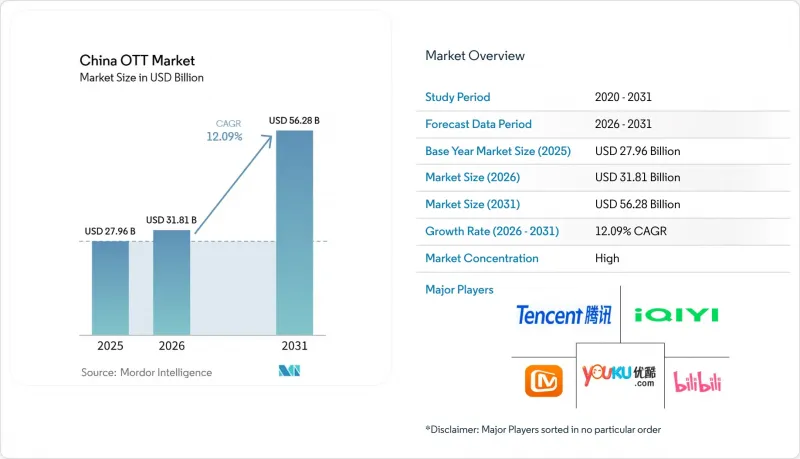
本報告按收入模式(SVOD、AVOD、TVOD 和混合模式(訂閱加廣告))、設備類型(智慧型手機和平板電腦、智慧型電視、筆記型電腦和桌上型電腦以及其他設備類型)和內容類型(電影、電視節目和劇集、紀錄片以及其他內容類型)進行分類。市場預測以美元計價。
中國OTT市場的趨勢與洞察
透過高品質的本地內容增加訂閱提升銷售
在中國OTT市場,高品質的國產內容仍然是用戶訂閱和續訂服務的主要原因。如果平台能夠獲得獨家發行權,新劇和綜藝節目就能帶來持續的續訂。愛奇藝2025年的會員業務收益達到168.1億元人民幣(約24億美元),即使在整體收入下滑的情況下,會員服務收入仍是其最大的收入來源。這項結果表明,即使平台的新片上線速度放緩,豐富的片庫也能留住付費用戶。 2026年,愛奇藝推出了“納豆Pro”,透過“集智”模式和第三方製作工具,支援專業影視製作。透過降低製作成本,各大平台將能夠投入更多資金製作原創節目,同時保護支撐其高價訂閱服務的獨家內容,從而減輕將高成本新片數量限制在少數的壓力。
透過混合影片捆綁包加速廣告變現
在中國OTT市場,訂閱和廣告的融合日益緊密。愛奇藝的廣告收入預計將在2025年下降9%至51.9億元人民幣(約7億美元),凸顯了僅依靠廣告收入來支撐長影片內容的困境。根據該公司公佈的營收數據顯示,嗶哩嗶哩2025年的廣告收入預計將超過100億元人民幣(約14億美元),較去年同期成長22.8%。另有報導稱,人工智慧相關的廣告收入成長了180%,顯示市場對能夠根據受眾興趣最佳化廣告訊息的工具的需求日益成長。混合型服務既能為平台帶來訂閱用戶,又能從願意使用低價服務的用戶那裡獲得廣告收入,從而在不斷變化的廣告格局中降低對特定收入來源的依賴。這種模式對於那些希望滿足不同消費習慣用戶需求,同時又不犧牲加值內容或使服務套餐選項過於複雜的平台來說尤其有效。
優質原創作品和體育內容的授權費用不斷上漲。
內容成本仍是限制中國OTT市場發展的一大瓶頸。愛奇藝公佈的數據顯示,其2025年的內容成本預計為154.5億元人民幣(約22億美元),而總收入預計將下降7%至272.9億元人民幣(約38億美元)。巨額內容投入與收入成長放緩之間的差距正給利潤率帶來壓力,尤其是在平台必須持續投入資金製作未來內容以維持現有用戶群的情況下。體育賽事轉播權可能會進一步加劇這種壓力,因為在確定有多少觀眾會轉化為付費用戶之前,就必須支付授權費用。大型平台可以將這些成本分攤到會員費、廣告和相關業務中。而小規模的服務提供者則難以承擔賽季期間的高昂成本,這可能會進一步拉大大型服務商與獨立運營商之間的差距,並減少可靠的長篇內容競爭對手的數量。
細分市場分析
到2025年,SVOD(訂閱視訊點播)將佔據中國OTT(串流媒體)市場54.73%的佔有率。這主要得益於觀眾可以連續觀看數週甚至整季的新劇和綜藝節目。 SVOD在中國OTT市場的規模得益於獨家發行管道,這為訂閱用戶提供了持續付費的理由。 AVOD(廣告支援型視訊點播)預計到2031年將以13.20%的複合年成長率成長,高於成熟的訂閱模式。廣告支援的存取方式可以觸及那些不願意定期付費的觀眾。它也為品牌提供了一種無需直接轉換訂閱用戶即可觸及影片觀眾的途徑。 TVOD(付費視訊點播)繼續提供精選電影,用戶只需一次性付費即可享受優質內容的價值。混合訂閱和廣告模式將最低保證的定期付費金額與額外的廣告收入結合。這種模式為平台提供了在訂閱成長放緩時保障收入的途徑。因此,儘管中國OTT市場存在多種獲利模式的空間,但SVOD仍是主要的收入來源。每個服務商都需要確定哪些內容值得作為付費串流服務的一部分提供,哪些內容可以支援更廣泛的廣告投放。
2025年,芒果TV展現了聚焦型雙收入模式的價值,尤其是在將清晰的節目定位與訂閱收入和廣告收入相結合的服務領域。芒果優良傳媒公佈的數據顯示,其訂閱收入達46.46億元人民幣(約7億美元),廣告收入達38.31億元人民幣(約5億美元),活躍用戶達7,560萬。透過專注於綜藝節目和生活風格內容,芒果TV成功拓展了用戶群,而無需與各大平台購買的大量優質劇集直接競爭。 2026年頒布的CAC規則將適用於平台與創作者網路合作的所有收入模式。隨著平台拓展廣告、訂閱或銷售相關內容,它們需要建立內容管理流程和明確的創作者協議。這些要求可能會使現有服務成為廣告商和創作者更值得信賴的合作夥伴,但同時也增加大規模建立新收入模式的成本。在中國OTT產業,能夠在同一作業系統內管理內容、廣告和合規的平台可能更具優勢。這種結構使得企業能夠更快地應對廣告需求、受眾偏好或監管義務的變化。
其他好處:
- Excel格式的市場預測(ME)表
- 3個月的分析師支持
目錄
第1章:引言
- 研究假設和市場定義
- 調查範圍
第2章:調查方法
第3章執行摘要
第4章 市場狀況
- 市場概覽
- 市場促進因素
- 透過優質本地內容增加訂閱提升銷售
- 透過混合影片捆綁包加速廣告變現
- 各大平台體育賽事轉播權的差異
- 拓展智慧電視和連網螢幕的觀賞體驗
- 透過人工智慧驅動的個人化功能提高用戶留存率和觀看時長
- 短篇內容髮現管道正在擴大付費長篇內容的轉換率。
- 市場限制因素
- 優質原創作品和體育內容的授權費用不斷上漲。
- 平台對內容、建議和獲利模式進行嚴格監管。
- 多平台用戶的訂閱疲勞
- 巨大的頻寬和雲端交付成本正在給利潤率帶來壓力。
- 產業價值鏈分析
- 宏觀經濟因素對市場的影響
- 監理情勢
- 技術展望
- 波特五力分析
第5章 市場規模與成長預測
- 按收入模式
- SVOD
- AVOD
- TVOD
- 混合模式(訂閱與廣告結合)
- 依設備類型
- 智慧型手機和平板電腦
- 智慧電視
- 筆記型電腦和桌上型電腦
- 其他設備類型
- 按內容類型
- 電影和影像作品
- 電視節目和劇集內容
- 記錄
- 其他內容類型
第6章 競爭情勢
- 市場集中度
- 策略趨勢
- 市佔率分析
- 公司簡介
- Tencent Holdings Limited
- iQIYI, Inc.
- Alibaba Group Holding Limited
- Mango Excellent Media Co., Ltd.
- Bilibili Inc.
- ByteDance Ltd.
- Kuaishou Technology
- China Mobile Limited
- China Telecom Corporation Limited
- China Unicom(Hong Kong)Limited
- Oriental Pearl Group Co., Ltd.
- China Media Group
- Wasu Media Holding Co., Ltd.
- Guangdong South New Media Co., Ltd.
- CIBN Oriental Network(Beijing)Co., Ltd.
- Sohu.com Limited
- DouYu International Holdings Limited
- HUYA Inc.
- Migu Video
第7章 市場機會與未來展望
According to Mordor Intelligence, the China OTT market size is projected to be USD 27.96 billion in 2025, USD 31.81 billion in 2026, and reach USD 56.28 billion by 2031, growing at a CAGR of 12.09% from 2026 to 2031.
This report is Segmented by Revenue Model (SVOD, AVOD, TVOD, and Hybrid Subscription and Ads), Device Type (Smartphones and Tablets, Smart TVs, Laptops and Desktops, and Other Device Types), and Content Genre (Movies and Films, TV Shows and Episodic Content, Documentaries, and Other Content Genres). The Market Forecasts are Provided in Terms of Value (USD).
China OTT Market Trends and Insights
Rising Subscription Upsell From Premium Local Content
Premium local programming remains a key reason viewers join and renew subscriptions in the China OTT market. First-run dramas and variety programs can create recurring renewal periods when platforms secure exclusive rights. iQIYI reported membership-service revenue of CNY 16.81 billion (USD 2.4 billion) in 2025, making it the company's largest revenue line despite weaker overall revenue. The result indicates that established content libraries can retain paying users when a service faces a weaker release schedule. iQIYI introduced Nadou Pro in 2026 to support professional film and television production through its Qizhi model and third-party generation tools. Lower production costs could allow major platforms to fund more original programming while protecting the exclusive titles that support higher subscription tiers, thereby reducing the pressure to choose only a few costly releases.
Accelerating Ad Monetization From Hybrid Video Bundles
Subscription and advertising are becoming increasingly intertwined across the China OTT market. iQIYI's advertising revenue declined 9% to CNY 5.19 billion (USD 0.7 billion) in 2025, which shows the difficulty of relying only on advertising revenue in long-form video. The supplied company results showed that Bilibili's advertising revenue exceeded CNY 10 billion (USD 1.4 billion) in 2025, up 22.8% from the prior year. They also reported 180% growth in AI-related advertising revenue, suggesting demand for advertising tools that match messages to audience interests. Hybrid offers can give platforms a subscription base while retaining advertising income from viewers who accept lower-priced access, thereby reducing reliance on any one source of revenue amid changing advertising conditions. This approach may be especially useful as platforms seek to serve audiences with different spending preferences without sacrificing access to premium content or creating confusing choices among service tiers.
Content Licensing Cost Inflation for Premium Originals and Sports
Content costs remain a persistent constraint for the China OTT market. iQIYI reported content costs of CNY 15.45 billion (USD 2.2 billion) for 2025, while total revenue declined 7% to CNY 27.29 billion (USD 3.8 billion). The difference between large content investments and slower revenue growth puts pressure on margins, especially when platforms must continue funding future releases to retain their existing subscriber base. Sports rights can add to this pressure because services must pay for licenses before they know how many viewers will convert to paid users. Large platforms can spread these costs across memberships, advertising, and related businesses. Smaller services have less room to absorb a costly season, which can widen the gap between leading services and independent operators and reduce the number of credible long-form competitors.
Other drivers and restraints analyzed in the detailed report include:
- Sports Rights Differentiation Across Major Platforms
- AI-Driven Personalization Improving Retention and Watch Time
- Tight Platform Oversight on Content, Recommendation, and Monetization Practices
For complete list of drivers and restraints, kindly check the Table Of Contents.
Segment Analysis
SVOD held 54.73% of the China OTT market share in 2025, supported by the renewal value of first-run dramas and variety programs that viewers can follow over several weeks or an entire season. The China OTT market size for SVOD benefits when exclusive releases give members a reason to maintain paid access. AVOD is projected to grow at a 13.20% CAGR through 2031, which is faster than the mature subscription model. Advertising-supported access can reach viewers who do not want another recurring payment. It can also give brands access to video audiences without requiring a direct subscription conversion. TVOD continues to serve selected film releases where a one-time payment can preserve the value of a premium title. Hybrid subscription and advertising plans combine a recurring payment floor with additional advertising income. This model gives platforms another way to protect revenue when subscription growth slows. The China OTT market, therefore, has room for several revenue models, although SVOD remains the main source of revenue. Services will need to decide which titles justify a paid window and which titles can support broader advertising reach.
Mango TV showed the value of a focused dual-revenue model in 2025, particularly for a service that connects a recognizable programming identity with membership and advertising income. Mango Excellent Media reported membership revenue of CNY 4.646 billion (USD 0.7 billion), advertising revenue of CNY 3.831 billion (USD 0.5 billion), and an effective membership base of 75.6 million. Its variety and lifestyle focus helped it build memberships without directly matching every premium drama acquisition by the largest services. The CAC rules issued in 2026 apply across revenue models when platforms work with creator networks. Platforms need content-management processes and clear creator agreements as they expand advertising, subscriptions, or sales-linked content. These requirements may make established services more reliable partners for advertisers and creators. They also raise the cost of building a new revenue model at scale. The China OTT industry is likely to favor platforms that can manage content, advertising, and compliance within the same operating system. This structure can make it easier to respond when advertising demand, viewer preferences, or regulatory duties change.
Complete Report Scope:
- By Revenue Model
- SVOD
- AVOD
- TVOD
- Hybrid Subscription and Ads
- By Device Type
- Smartphones and Tablets
- Smart TVs
- Laptops and Desktops
- Other Device Types
- By Content Genre
- Movies and Films
- TV Shows and Episodic Content
- Documentaries
- Other Content Genres
List of Companies Covered in this Report:
- Tencent Holdings Limited
- iQIYI, Inc.
- Alibaba Group Holding Limited
- Mango Excellent Media Co., Ltd.
- Bilibili Inc.
- ByteDance Ltd.
- Kuaishou Technology
- China Mobile Limited
- China Telecom Corporation Limited
- China Unicom (Hong Kong) Limited
- Oriental Pearl Group Co., Ltd.
- China Media Group
- Wasu Media Holding Co., Ltd.
- Guangdong South New Media Co., Ltd.
- CIBN Oriental Network (Beijing) Co., Ltd.
- Sohu.com Limited
- DouYu International Holdings Limited
- HUYA Inc.
- Migu Video
Additional Benefits:
- The market estimate (ME) sheet in Excel format
- 3 months of analyst support
TABLE OF CONTENTS
1 INTRODUCTION
- 1.1 Study Assumptions and Market Definition
- 1.2 Scope of the Study
2 RESEARCH METHODOLOGY
3 EXECUTIVE SUMMARY
4 MARKET LANDSCAPE
- 4.1 Market Overview
- 4.2 Market Drivers
- 4.2.1 Rising Subscription Upsell From Premium Local Content
- 4.2.2 Accelerating Ad Monetization From Hybrid Video Bundles
- 4.2.3 Sports Rights Differentiation Across Major Platforms
- 4.2.4 Smart TV and Connected Screen Viewing Expansion
- 4.2.5 AI-Driven Personalization Improving Retention and Watch Time
- 4.2.6 Short-Form Discovery Funnel Expanding Paid Long-Form Conversion
- 4.3 Market Restraints
- 4.3.1 Content Licensing Cost Inflation for Premium Originals and Sports
- 4.3.2 Tight Platform Oversight on Content, Recommendation, and Monetization Practices
- 4.3.3 Subscription Fatigue Among Multi-Platform Users
- 4.3.4 Margin Pressure From Heavy Bandwidth and Cloud Delivery Costs
- 4.4 Industry Value Chain Analysis
- 4.5 Impact of Macroeconomic Factors on the Market
- 4.6 Regulatory Landscape
- 4.7 Technological Outlook
- 4.8 Porter's Five Forces Analysis
- 4.8.1 Bargaining Power of Buyers
- 4.8.2 Bargaining Power of Suppliers
- 4.8.3 Threat of New Entrants
- 4.8.4 Threat of Substitutes
- 4.8.5 Intensity of Competitive Rivalry
5 MARKET SIZE AND GROWTH FORECASTS (VALUE)
- 5.1 By Revenue Model
- 5.1.1 SVOD
- 5.1.2 AVOD
- 5.1.3 TVOD
- 5.1.4 Hybrid Subscription and Ads
- 5.2 By Device Type
- 5.2.1 Smartphones and Tablets
- 5.2.2 Smart TVs
- 5.2.3 Laptops and Desktops
- 5.2.4 Other Device Types
- 5.3 By Content Genre
- 5.3.1 Movies and Films
- 5.3.2 TV Shows and Episodic Content
- 5.3.3 Documentaries
- 5.3.4 Other Content Genres
6 COMPETITIVE LANDSCAPE
- 6.1 Market Concentration
- 6.2 Strategic Moves
- 6.3 Market Share Analysis
- 6.4 Company Profiles (includes Global Level Overview, Market Level Overview, Core Segments, Financials as available, Strategic Information, Market Rank/Share, Products and Services, Recent Developments)
- 6.4.1 Tencent Holdings Limited
- 6.4.2 iQIYI, Inc.
- 6.4.3 Alibaba Group Holding Limited
- 6.4.4 Mango Excellent Media Co., Ltd.
- 6.4.5 Bilibili Inc.
- 6.4.6 ByteDance Ltd.
- 6.4.7 Kuaishou Technology
- 6.4.8 China Mobile Limited
- 6.4.9 China Telecom Corporation Limited
- 6.4.10 China Unicom (Hong Kong) Limited
- 6.4.11 Oriental Pearl Group Co., Ltd.
- 6.4.12 China Media Group
- 6.4.13 Wasu Media Holding Co., Ltd.
- 6.4.14 Guangdong South New Media Co., Ltd.
- 6.4.15 CIBN Oriental Network (Beijing) Co., Ltd.
- 6.4.16 Sohu.com Limited
- 6.4.17 DouYu International Holdings Limited
- 6.4.18 HUYA Inc.
- 6.4.19 Migu Video
7 MARKET OPPORTUNITIES AND FUTURE OUTLOOK
- 7.1 White-Space and Unmet-Need Assessment

 全球Over-The-Top服務市場規模、佔有率、趨勢和成長分析報告(2026-2034年)
 商業媒體服務:市場佔有率分析、產業趨勢與統計、成長預測(2026-2031 年)英國OTT:市場佔有率分析、產業趨勢與統計、成長預測(2026-2031年)美國OTT:市場佔有率分析、行業趨勢和統計數據、成長預測(2026-2031年)雲端OTT:市場佔有率分析、產業趨勢與統計、成長預測(2026-2031年)印度OTT市場:市場佔有率分析、產業趨勢與統計及成長預測(2026-2031年)德國OTT:市場佔有率分析、產業趨勢與統計及成長預測(2026-2031年)OTT(Over The Top):市場佔有率分析、產業趨勢與統計數據、成長預測(2026-2031)北美OTT:市佔率分析、產業趨勢與統計及成長預測(2026-2031年)OTT機上盒:市場佔有率分析、產業趨勢與統計及成長預測(2026-2031年)