


 |
市場調查報告書
商品編碼
2119086
北美OTT:市佔率分析、產業趨勢與統計及成長預測(2026-2031年)North America OTT - Market Share Analysis, Industry Trends & Statistics, Growth Forecasts (2026 - 2031) |
||||||

※ 本網頁內容可能與最新版本有所差異。詳細情況請與我們聯繫。
根據 Mordor Intelligence 預測,北美 OTT 市場規模將從 2025 年的 1,748.8 億美元和 2026 年的 1912.9 億美元成長到 2031 年的 2,788 億美元,2026 年至 2031 年的複合年成長率為 7.83%。
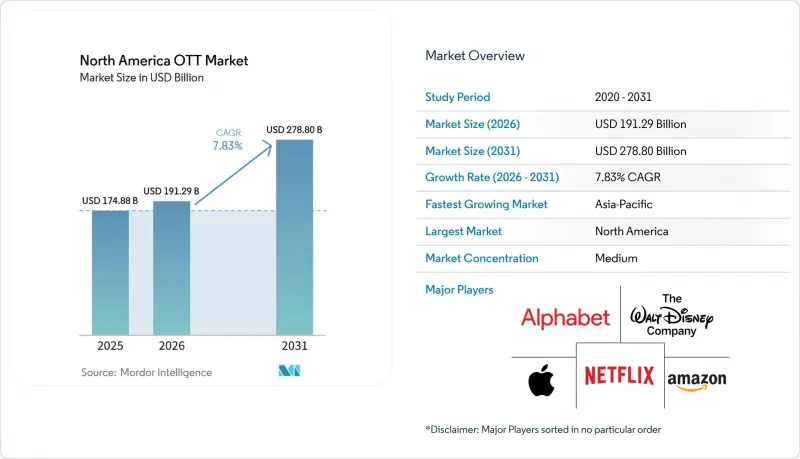
本報告按收入模式(定期訂閱收費(SVOD)、按次收費(TVOD/PPV)、廣告支援式收費(AVOD/FAST)和混合獲利模式)、裝置類型(智慧型手機/平板電腦、智慧電視等)、內容類型(電影、電視劇/劇集、紀錄片)和國家分類。市場預測以美元計價。
北美OTT市場趨勢與洞察
廣告支援型串流媒體套餐日益普及
在北美OTT市場,廣告支援型套餐正成為用戶成長的核心手段。這些套餐降低了價格敏感型家庭的進入門檻,同時也為平台提供了透過每月收費和廣告雙管齊下的收入來源。這種模式使廣告主能夠觸及那些不再觀看傳統電視節目的受眾,尤其是那些偏好免費廣告頻道的用戶。捆綁套餐減少了消費者在多個獨立服務中進行選擇的需要,從而簡化了每月娛樂支出的管理。這改變了消費者選擇服務的標準,因為價值、價格和便利性與單一的內容庫或限時獨家內容同等重要。對於平台而言,這也提供了一種滿足那些可能無法接受訂閱費用不斷上漲的家庭用戶需求的方式。
體育賽事直播權的商業化進程正在加速。
體育賽事直播仍然至關重要,因為觀眾通常選擇即時觀看而非觀看錄影。轉播權有助於服務商獲取新用戶,留住現有用戶,並讓廣告主觸達龐大的即時觀眾群。 2025-26賽季NBA轉播權交易(迪士尼、亞馬遜和NBC環球的套裝保險契約)凸顯了串流媒體對各大聯盟日益成長的重要性。 2026年7月,亞馬遜將其雲端遊戲服務Luna整合到Fire TV上的Prime Video中,使其影片體驗不再局限於被動觀看。體育賽事轉播權通常涉及大規模的多年期契約,這會影響平台的內容支出計劃。這不僅有助於提升用戶參與度和廣告需求,也增加了謹慎定價、拓展用戶群和保障廣告收入的必要性。
高昂的內容取得和製作成本
內容製作和獲取成本仍然是北美OTT市場面臨的一項持續挑戰,因為觀眾期望獲得源源不斷的高品質節目。平台需要劇集、電影、體育賽事和本地內容來維持用戶黏性並支撐廣告收入。 Netflix預計將繼續投入大量資金用於內容製作,而迪士尼則預計在娛樂和體育領域也將投入大量資金。體育賽事轉播權可能帶來進一步的壓力,因為合約通常跨越多個賽季,且不會根據季度用戶表現進行調整。如果用戶成長放緩或廣告收入需要時間才能穩定成長,公司將難以縮減其巨額投入。因此,公司需要透過廣告、定價策略、捆綁銷售以及嚴格的節目製作決策來涵蓋加值內容的成本。
細分市場分析
到2025年,訂閱收費將佔總收入的57.50%,成為最大的收入來源,也是各大平台的核心付費服務。訂閱方案仍然重要,因為它們提供了可預測的收費,能夠幫助平台與客戶建立直接聯繫,並為投資建立龐大的娛樂內容庫提供支援。 Netflix在2026年第二季財報中指出,受用戶數量成長和價格上漲的推動,其年度營收成長了13%至15%。這表明,即使家庭用戶正在重新評估其經常性支出,付費計畫在該地區成熟的市場中仍然有價值。同時,訂閱成長與包含廣告的計劃以及提供更低月費的計劃之間的聯繫也越來越緊密。
混合獲利模式預計將在2026年至2031年間以8.55%的複合年成長率成長,成為成長最快的營收模式。這類服務將訂閱存取和廣告收入整合到單一產品結構中,使平台能夠靈活適應每個家庭的付費意願。免費觀看的商業性重要性日益凸顯,廣告支援的收費模式將在2025年進一步擴張,Tubi的收入也將超過10億美元。對於付費電影、重大活動和按次付費(PPV)購買而言,交易收費模式仍然適用,因為即使暫停訂閱,用戶仍可能繼續為特定影片付費。北美OTT產業正在利用訂閱、廣告和交易選項的組合,而不是將單一模式視為所有其他模式的替代品。
區域分析
2025年,美國佔區域收入的72.50%。美國擁有成熟的聯網電視廣告環境和龐大的付費串流家庭用戶群。美國在北美OTT市場的佔有率反映了其在廣告、訂閱和內容支出方面的規模。在廣告收入預計成長的支撐下,Netflix預計其2026年的年收入將進一步成長。美國仍然是廣告支援型套餐、捆綁定價、體育賽事直播和主螢幕廣告的重要試驗場。美國大規模的用戶群使該平台能夠調整價格,但內容和體育相關的成本可能會限制其營運槓桿。
預計加拿大OTT訂閱營收將穩定成長。此外,OTT訂閱收入預計將首次超過傳統電視訂閱收入。 《線上串流媒體法案》的實施為平台產業計畫引入了監管要素。加拿大廣播通訊委員會(CRTC)已為國際串流媒體服務設定了收入貢獻要求,以支持加拿大的內容基金。這些要求可能會影響內容投資決策,並使本地內容的資金投入成為競爭格局的一部分。
預計2026年至2031年間,墨西哥的複合年成長率將達到9.21%,是該地區最高的國家成長率。這一成長與行動優先的觀看習慣、寬頻存取的普及以及西班牙語內容的擴張密切相關。 SVOD(訂閱視訊點播)在墨西哥的滲透率預計將持續成長。 Netflix預計仍將保持領先地位,其次是Disney+和HBO Max。墨西哥大多數能夠存取SVOD的網路用戶預計將選擇中低檔位的費率方案。 ViX FAST頻道預計將在墨西哥創造可觀的收入。這種情況凸顯了彈性價格設定和廣告支援模式在北美OTT市場的重要性。這也解釋了為什麼客戶維繫和獲利能力以及用戶成長變得越來越重要。
其他好處:
- Excel格式的市場預測(ME)表
- 3個月的分析師支持
目錄
第1章:引言
- 研究假設和市場定義
- 調查範圍
第2章:調查方法
第3章執行摘要
第4章 市場狀況
- 市場概覽
- 市場促進因素
- 包含廣告的串流媒體套餐越來越受歡迎。
- 擴大體育賽事直播權的商業化範圍
- 擴大聯網電視上的廣告空間
- 人工智慧驅動的個人化和客戶流失率降低
- 加強打擊密碼共用行為,以及家庭搬遷數量增加。
- 通訊和付費電視的綜合夥伴關係
- 市場限制因素
- 高昂的內容取得和製作成本
- 訂閱疲勞和解約率趨勢
- 高階客戶對廣告負擔的抗拒情緒
- 發現跨生態系統的碎片化設備和應用程式
- 產業價值鏈分析
- 宏觀經濟因素對市場的影響
- 監理情勢
- 技術展望
- 波特五力分析
第5章 市場規模與成長預測
- 按收入模式
- 收費式計費(SVOD)
- 交易收費(TVOD/PPV)
- 廣告支援收費(AVOD/FAST)
- 混合貨幣化和收費
- 依設備類型
- 智慧型手機和平板電腦
- 智慧電視
- 筆記型電腦和桌上型電腦
- 其他設備類型
- 按內容類型
- 電影和影像作品
- 電視節目和劇集內容
- 記錄
- 其他內容類型
- 國家
- 美國
- 加拿大
- 墨西哥
第6章 競爭情勢
- 市場集中度
- 策略趨勢
- Vendor Positioning Analysis
- 公司簡介
- Netflix Inc.
- The Walt Disney Company
- Amazon.com, Inc.
- Alphabet Inc.
- Apple Inc.
- Paramount, a Skydance Corporation
- Warner Bros. Discovery, Inc.
- Comcast Corporation
- Roku, Inc.
- DAZN Group Ltd.
- Fox Corporation
- EchoStar Corporation
- TelevisaUnivision, Inc.
- Sony Group Corporation
- Starz Entertainment Corp.
- Samsung Electronics Co., Ltd.
- LG Electronics Inc.
- Cineverse Corp.
- Plex, Inc.
第7章 市場機會與未來展望
According to Mordor Intelligence, the North America OTT market size is projected to expand from USD 174.88 billion in 2025 and USD 191.29 billion in 2026 to USD 278.80 billion by 2031, registering a CAGR of 7.83% between 2026 to 2031.
This report is Segmented by Revenue Model (Recurring Subscription Billing (SVOD), Transactional Billing (TVOD/PPV), Advertising-Supported Billing (AVOD/FAST), and Hybrid Monetization Billing), Device Types (Smartphones and Tablets, Smart TVs, and More), Content Genre (Movies and Films, TV Shows and Episodic Content, and Documentaries), and Country. The Market Forecasts are Provided in Terms of Value (USD).
Global North America OTT Market Trends and Insights
Rising Adoption of Ad-Supported Streaming Bundles
Ad-supported plans are becoming a central route to subscriber growth in the North America OTT market. These plans give price-sensitive households a lower entry point while allowing platforms to earn from both monthly billing and advertising. The model gives advertisers access to audiences that have moved away from scheduled television, particularly viewers who prefer free ad-supported channels. Bundled offers can reduce the need for consumers to choose between several separate services, which can make monthly entertainment spending easier to manage. This changes service selection because value, price, and convenience can matter as much as a single catalog or a temporary exclusive title. It also gives platforms a way to serve households that may not accept repeated subscription price increases.
Escalating Live Sports Rights Monetization
Live sports remain important because audiences often watch events when they happen rather than at a later time. Rights can help a service attract new subscribers, give current subscribers a reason to remain, and offer advertisers access to large live audiences. The 2025-26 NBA rights structure placed packages with Disney, Amazon, and NBCUniversal, increasing the importance of streaming distribution for major leagues. Amazon integrated Luna cloud gaming into Prime Video on Fire TVs in July 2026, extending its video environment beyond passive viewing. Sports rights also create large commitments that continue for several years and can shape how platforms plan content spending. This can support engagement and advertising demand, but it increases the need for careful pricing, audience growth, and advertising returns.
High Content Acquisition and Production Costs
Content production and acquisition costs remain a persistent challenge for the North America OTT market, as viewers expect a steady supply of recognizable programming. Platforms require series, films, sports, and local content to sustain subscriber engagement and support advertising sales. Netflix expected its content spending to remain substantial, while Disney projected significant spending across entertainment and sports. Sports rights can create additional pressure, as agreements often span multiple seasons and do not adjust based on quarterly subscriber performance. Companies find it difficult to scale back large commitments if subscriber growth slows or advertising revenue takes longer to mature. Therefore, companies need advertising, pricing strategies, bundles, and disciplined programming decisions to support the cost of premium content.
Other drivers and restraints analyzed in the detailed report include:
- Connected-TV Ad Inventory Expansion
- AI-Driven Personalization and Churn Reduction
- Subscription Fatigue and Churn Intensity
For complete list of drivers and restraints, kindly check the Table Of Contents.
Segment Analysis
Recurring subscription billing held 57.50% of revenue in 2025, making it the largest revenue model and the core paid offer for major platforms. Subscription plans remain important because they provide predictable billing, direct customer relationships, and a way to support investment in broad entertainment libraries. Netflix reported 13-15% annual revenue growth in its Q2 2026 filing, supported by membership growth and price increases. This shows that paid plans still retain value in mature parts of the region, even as households review their recurring bills. At the same time, subscription growth is increasingly tied to plans that include advertising and give customers a lower monthly price.
Hybrid monetization billing is projected to grow at an 8.55% CAGR between 2026 and 2031, making it the fastest-growing revenue model. These offers combine subscription access with advertising income in one product structure and let platforms respond to different levels of household willingness to pay. Advertising-supported billing expanded during 2025, and Tubi passed USD 1 billion in revenue, showing the growing commercial importance of free viewing. Transactional billing remains useful for premium films, major events, and pay-per-view purchases because households may still spend on selected titles after pausing subscriptions. The North America OTT industry is using subscription, advertising, and transaction options together, rather than treating one model as a replacement for all others.
Complete Report Scope:
- By Revenue Model
- Recurring Subscription Billing (SVOD)
- Transactional Billing (TVOD/PPV)
- Advertising-Supported Billing (AVOD/FAST)
- Hybrid Monetization Billing
- By Device Types
- Smartphones and Tablets
- Smart TVs
- Laptops and Desktops
- Other Device Types
- By Content Genre
- Movies and Films
- TV Shows and Episodic Content
- Documentaries
- Other Content Genres
- By Country
- United States
- Canada
- Mexico
Geography Analysis
The United States held 72.50% of regional revenue in 2025. It has a mature connected TV advertising environment and a large base of paid streaming households. The North America OTT market share held by the United States reflects its scale in advertising, subscriptions, and content spending. Netflix is expected to achieve higher annual revenue in 2026, supported by expected growth in advertising revenue. The country remains the primary testing ground for advertising tiers, bundle pricing, sports distribution, and home-screen advertising. Its large subscription base allows platforms to adjust pricing, although content and sports costs may limit operating leverage.
Canada's OTT subscription revenue is projected to grow steadily. The country is also expected to see OTT subscription revenue exceed traditional television subscription revenue for the first time. The Online Streaming Act has introduced a regulatory factor into platform planning. The Canadian Radio-television and Telecommunications Commission has established a revenue contribution requirement for international streaming services to support Canadian content funds. This requirement can influence content investment decisions and make local content funding part of the competitive setting.
Mexico is projected to record a 9.21% CAGR from 2026 to 2031, the fastest national rate in the region. Its growth is linked to mobile-first viewing, broader broadband access, and Spanish-language catalog expansion. Mexico is expected to see continued SVOD adoption. Netflix is projected to remain the leading platform, followed by Disney+ and HBO Max. A significant share of Mexico's internet users with SVOD access is expected to remain in the lower-to-mid pricing tiers. ViX FAST channels are projected to generate substantial revenue in Mexico. These conditions make flexible pricing and advertising-supported access important for the North America OTT market. They also show why retention and monetization are becoming as important as subscriber additions.
List of Companies Covered in this Report:
- Netflix Inc.
- The Walt Disney Company
- Amazon.com, Inc.
- Alphabet Inc.
- Apple Inc.
- Paramount, a Skydance Corporation
- Warner Bros. Discovery, Inc.
- Comcast Corporation
- Roku, Inc.
- DAZN Group Ltd.
- Fox Corporation
- EchoStar Corporation
- TelevisaUnivision, Inc.
- Sony Group Corporation
- Starz Entertainment Corp.
- Samsung Electronics Co., Ltd.
- LG Electronics Inc.
- Cineverse Corp.
- Plex, Inc.
Additional Benefits:
- The market estimate (ME) sheet in Excel format
- 3 months of analyst support
TABLE OF CONTENTS
1 INTRODUCTION
- 1.1 Study Assumptions and Market Definition
- 1.2 Scope of the Study
2 RESEARCH METHODOLOGY
3 EXECUTIVE SUMMARY
4 MARKET LANDSCAPE
- 4.1 Market Overview
- 4.2 Market Drivers
- 4.2.1 Rising Adoption of Ad-Supported Streaming Bundles
- 4.2.2 Escalating Live Sports Rights Monetization
- 4.2.3 Connected-TV Ad Inventory Expansion
- 4.2.4 AI-Driven Personalization and Churn Reduction
- 4.2.5 Rising Password Sharing Enforcement and Household Conversion
- 4.2.6 Telecom and Pay-TV Aggregation Partnerships
- 4.3 Market Restraints
- 4.3.1 High Content Acquisition and Production Costs
- 4.3.2 Subscription Fatigue and Churn Intensity
- 4.3.3 Advertising Load Resistance in Premium Tiers
- 4.3.4 Fragmented Device and App Discovery Across Ecosystems
- 4.4 Industry Value Chain Analysis
- 4.5 Impact of Macroeconomic Factors on the Market
- 4.6 Regulatory Landscape
- 4.7 Technological Outlook
- 4.8 Porter's Five Forces Analysis
- 4.8.1 Threat of New Entrants
- 4.8.2 Bargaining Power of Buyers
- 4.8.3 Bargaining Power of Suppliers
- 4.8.4 Threat of Substitutes
- 4.8.5 Intensity of Competitive Rivalry
5 MARKET SIZE AND GROWTH FORECASTS (VALUE)
- 5.1 By Revenue Model
- 5.1.1 Recurring Subscription Billing (SVOD)
- 5.1.2 Transactional Billing (TVOD/PPV)
- 5.1.3 Advertising-Supported Billing (AVOD/FAST)
- 5.1.4 Hybrid Monetization Billing
- 5.2 By Device Types
- 5.2.1 Smartphones and Tablets
- 5.2.2 Smart TVs
- 5.2.3 Laptops and Desktops
- 5.2.4 Other Device Types
- 5.3 By Content Genre
- 5.3.1 Movies and Films
- 5.3.2 TV Shows and Episodic Content
- 5.3.3 Documentaries
- 5.3.4 Other Content Genres
- 5.4 By Country
- 5.4.1 United States
- 5.4.2 Canada
- 5.4.3 Mexico
6 COMPETITIVE LANDSCAPE
- 6.1 Market Concentration
- 6.2 Strategic Moves
- 6.3 Vendor Positioning Analysis
- 6.4 Company Profiles (includes Global Level Overview, Market Level Overview, Core Segments, Financials as available, Strategic Information, Market Rank/Share, Products and Services, Recent Developments)
- 6.4.1 Netflix Inc.
- 6.4.2 The Walt Disney Company
- 6.4.3 Amazon.com, Inc.
- 6.4.4 Alphabet Inc.
- 6.4.5 Apple Inc.
- 6.4.6 Paramount, a Skydance Corporation
- 6.4.7 Warner Bros. Discovery, Inc.
- 6.4.8 Comcast Corporation
- 6.4.9 Roku, Inc.
- 6.4.10 DAZN Group Ltd.
- 6.4.11 Fox Corporation
- 6.4.12 EchoStar Corporation
- 6.4.13 TelevisaUnivision, Inc.
- 6.4.14 Sony Group Corporation
- 6.4.15 Starz Entertainment Corp.
- 6.4.16 Samsung Electronics Co., Ltd.
- 6.4.17 LG Electronics Inc.
- 6.4.18 Cineverse Corp.
- 6.4.19 Plex, Inc.
7 MARKET OPPORTUNITIES AND FUTURE OUTLOOK
- 7.1 White-Space and Unmet-Need Assessment

 全球Over-The-Top服務市場規模、佔有率、趨勢和成長分析報告(2026-2034年)
 商業媒體服務:市場佔有率分析、產業趨勢與統計、成長預測(2026-2031 年)英國OTT:市場佔有率分析、產業趨勢與統計、成長預測(2026-2031年)美國OTT:市場佔有率分析、行業趨勢和統計數據、成長預測(2026-2031年)雲端OTT:市場佔有率分析、產業趨勢與統計、成長預測(2026-2031年)中國OTT市場:市場佔有率分析、產業趨勢與統計及成長預測(2026-2031年)印度OTT市場:市場佔有率分析、產業趨勢與統計及成長預測(2026-2031年)德國OTT:市場佔有率分析、產業趨勢與統計及成長預測(2026-2031年)OTT(Over The Top):市場佔有率分析、產業趨勢與統計數據、成長預測(2026-2031)OTT機上盒:市場佔有率分析、產業趨勢與統計及成長預測(2026-2031年)