


 |
市場調查報告書
商品編碼
2116410
非洲汽車潤滑油:市場佔有率分析、產業趨勢與統計及成長預測(2026-2031 年)Africa Automotive Lubricants - Market Share Analysis, Industry Trends & Statistics, Growth Forecasts (2026 - 2031) |
||||||

※ 本網頁內容可能與最新版本有所差異。詳細情況請與我們聯繫。
據 Mordor Intelligence 稱,非洲汽車潤滑油市場預計到 2026 年將達到 15.8 億公升,高於 2025 年的 15.4 億公升,預計到 2031 年將達到 18.1 億公升。
預計從 2026 年到 2031 年,其複合年成長率將達到 2.74%。
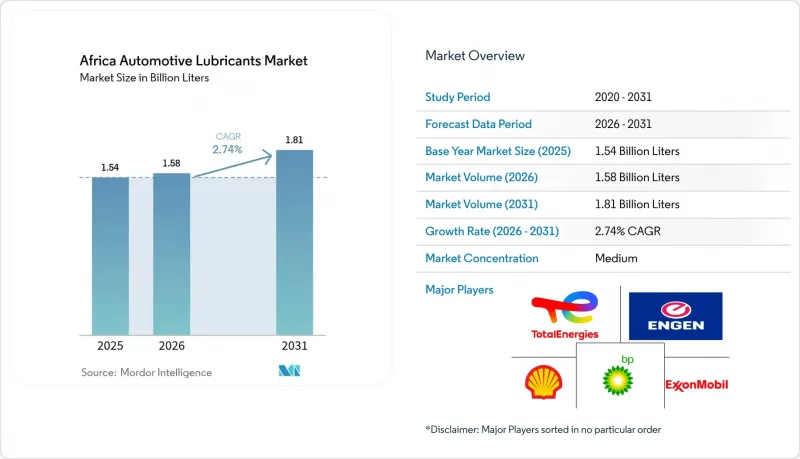
本報告按產品類型(汽車引擎油、手排變速箱油、自動變速箱油、煞車油、汽車潤滑脂及其他產品類型)、車輛類型(乘用車、商用車、摩托車)和地區(埃及、摩洛哥、奈及利亞、南非及非洲其他地區)進行細分。市場預測以銷售量(公升)為單位。
非洲汽車潤滑油市場趨勢與洞察
汽車保有量的增加和二手車進口量的增加正在推動持續的需求。
車輛數量的持續成長支撐著非洲汽車潤滑油市場的穩定消費。許多非洲國家仍然依賴二手車進口,這使得車輛平均車齡維持在12年以上,並確保了定期換油週期的建立。肯亞對進口車輛設定了8年的車齡限制,並引入了漸進式消費稅制度,這正在逐步加速向使用低黏度合成油的新型車輛過渡,從而提高了對優質產品的需求。坦尚尼亞和加納正在採取類似的政策方針,在逐步獎勵電動車的同時,也意識到內燃機在2030年之前仍將佔據主導地位。盧安達的註冊車輛數量將在2024年超過27萬輛,其中摩托車佔40%,顯示二輪車仍是重要的銷售來源。摩洛哥的汽車製造業佔其GDP的22%,其工廠的潤滑油供應需求正逐步成長,同時也提高了對潤滑油品質的期望。
商務傳輸和物流活動的擴展
非洲大陸自由貿易區(AfCFTA)下的貿易自由化預計將使非洲內部貨物貿易量在2024年同比成長7.7%,這主要得益於卡車、公共汽車和施工機械使用量的增加。目前,南非的跨境運輸走廊平均每天有超過6000輛重型卡車通行,推動了對高清潔度機油和長效變速箱油的需求。奈及利亞拉各斯-卡諾鐵路的現代化改造以及耗資250億美元的奈及利亞-摩洛哥天然氣管道項目,在其建設階段也帶動了對工業潤滑脂和液壓油的需求。加納耗資120億美元的石油樞紐自2024年開始建設,預計將成為未來石油儲存和調配設施的核心,填補西非的供應缺口。
假潤滑油的氾濫阻礙了市場成長。
在一些西非和東非國家,仿冒品估計佔總供應量的20%以上,侵蝕了合法品牌的收入,並損害了終端用戶的信任。肯亞仿冒品機構估計,每年直接稅收損失高達21億肯亞先令。針對標籤、QR碼和防篡改封條的複雜造假技術,使得零售層面的真偽驗證,尤其是在非正式市場,變得異常困難。為了應對這個問題,品牌所有者正在部署基於區塊鏈的追蹤溯源系統、限量編號的瓶蓋,並在全國範圍內開展「清潔貿易」宣傳活動。監管機構正在加強實地打擊力度,但緩慢的司法程序和低定罪率持續削弱著威懾作用。
細分市場分析
到2025年,汽車機油將繼續保持其主導地位,佔據非洲汽車潤滑油市場46.96%的佔有率。這凸顯了機油在老舊車輛日常維護中的關鍵作用。自動變速箱油(ATF)預計將以3.44%的複合年成長率成長,是所有產品系列中成長率最高的。這反映了輕型進口轎車和豪華商用卡車中自動變速箱佔有率的不斷成長。雖然手排變速箱油和車橋油的需求將保持穩定,但預計其市場佔有率將逐漸被ATF蠶食。煞車油和潤滑脂的成長率較低,個位數,這主要得益於安全檢查的增加和重型設備的維修。轉向使用5W-30和0W-20等多級機油,以及福特WSS-M2C952-A1等OEM特定認證,標誌著人們正朝著使用低粘度合成油以提高燃油效率的方向發展。
儘管單級 SAE 40 潤滑油仍有需求,尤其是在大都會圈以外的固定引擎車輛和老舊小型巴士領域,但其市場佔有率預計將會下降。摩洛哥快速發展的電動車供應鏈及其工廠產能提升,正在催生溫度控管液和電驅動橋潤滑脂等專業細分市場。雖然目前的銷售量較低,但隨著當地汽車製造商擴大組裝規模,這些市場正以兩位數的速度成長。
其他好處:
- Excel格式的市場預測(ME)表
- 3個月的分析師支持
目錄
第1章:引言
- 研究假設和市場定義
- 調查範圍
第2章:調查方法
第3章執行摘要
第4章 市場狀況
- 市場概覽
- 市場促進因素
- 汽車保有量增加和二手車進口量增加
- 商業運輸和物流活動的擴展
- 隨著排放氣體法規日益嚴格,人們越來越傾向於使用更高等級和合成的機油。
- 非洲大陸自由貿易區正在加速最佳化非洲內部的潤滑油貿易和供應鏈。
- 擴大本地混合能力和銷售代理網路
- 市場限制因素
- 假冒仿冒品潤滑油的市場滲透率
- 原油價格波動正在影響原物料成本。
- 廢油收集和提煉的生態系尚不發達
- 價值鍊和通路分析
- 波特五力模型
- 法律規範
- 汽車產業的發展趨勢
第5章 市場規模與成長預測
- 依產品類型
- 汽車引擎油
- 0W-XX
- 5W-XX
- 10W-XX
- 15W-XX
- 單級
- 其他年級
- 手排變速箱油(MTF)
- 自排變速箱油(ATF)
- 煞車油
- 汽車潤滑脂
- 其他產品類型(例如動力方向盤機油)
- 汽車引擎油
- 車輛類型
- 搭乘用車
- 商用車輛
- 摩托車
- 按地區
- 埃及
- 摩洛哥
- 奈及利亞
- 南非
- 其他非洲國家
第6章 競爭情勢
- 市場集中度
- 策略趨勢
- 市佔率(%)** / 排名分析
- 公司簡介
- Afriquia
- Astron Energy Pty Ltd
- BP plc
- Chevron Corporation
- Coperative Soceite des Petroleum
- Engen Petroleum Ltd
- Exxon Mobil Corporation
- FUCHS
- Kenol & Kobil
- Misr Petroleum
- Oando PLC
- OLA Energy
- Petromin Corporation
- Puma Energy
- Sasol Ltd
- Saudi Arabian Co. Ltd
- Shell plc
- TotalEnergies
第7章 市場機會與未來展望
第8章:執行長面臨的關鍵策略挑戰
According to Mordor Intelligence, Africa automotive lubricants market size in 2026 is estimated at 1.58 Billion Liters, growing from 2025 value of 1.54 Billion Liters with 2031 projections showing 1.81 Billion Liters, growing at 2.74% CAGR over 2026-2031.
This report is Segmented by Product Type (Automotive Engine Oil, Manual Transmission Fluids, Automatic Transmission Fluids, Brake Fluids, Automotive Greases, and Other Product Types), Vehicle Type (Passenger Vehicles, Commercial Vehicles, and Two-Wheelers), and Geography (Egypt, Morocco, Nigeria, South Africa, and Rest of Africa). The Market Forecasts are Provided in Terms of Volume (Litres).
Africa Automotive Lubricants Market Trends and Insights
Rising Vehicle Parc and Used-Vehicle Imports Drive Sustained Demand
Ongoing fleet expansion underpins stable lubricant off-take across the Africa Automotive Lubricants market. Most African countries continue to rely on second-hand imports, keeping the median vehicle age above 12 years and cementing regular oil-change cycles. Kenya's eight-year import age ceiling, coupled with differentiated excise tiers, is encouraging a gradual shift toward newer models that specify low-viscosity synthetics, thereby broadening the demand for premium-grade products. Tanzania and Ghana are following similar policy paths, balancing incremental electric-vehicle incentives with the recognition that internal-combustion engines will continue to dominate through 2030. Rwanda's registered vehicle stock surpassed 270,000 units in 2024, 40% of which are motorcycles, demonstrating that two-wheelers remain a material volume contributor. Morocco's automotive manufacturing ecosystem, which accounts for 22% of GDP, generates incremental factory-fill requirements and heightens lubricant quality expectations.
Commercial Transport & Logistics Activity Expansion
Trade liberalization under AfCFTA has lifted intra-African merchandise trade volumes by 7.7% year-on-year in 2024, driving heavier utilization of trucks, buses, and construction machinery. South Africa's cross-border corridors now support average daily heavy-truck flows exceeding 6,000 units, intensifying the need for high-detergency engine oils and long-drain transmission fluids. Nigeria's Lagos-Kano rail modernization and the USD 25 billion Nigeria-Morocco Gas Pipeline are driving demand for industrial greases and hydraulic fluids during the construction phases. Ghana's USD 12 billion Petroleum Hub, under development since 2024, is set to anchor future storage and blending facilities, bridging supply gaps in West Africa.
Counterfeit Lubricant Penetration Undermines Market Growth
Counterfeit volumes are estimated to be more than 20% of the total supply in several West and East African countries, eroding legitimate brand revenues and tarnishing end-user trust. Kenya's Anti-Counterfeit Authority pegs direct annual tax losses at KES 2.1 billion. Sophisticated falsification of labels, QR codes, and tamper-evident seals blurs authenticity checks at the retail level, particularly in informal markets. Brand owners are responding with blockchain-enabled track-and-trace programs, serialized closures, and nationwide "clean trade" campaigns. Regulatory bodies are stepping up field raids, but judicial backlogs and low conviction rates continue to dilute deterrence.
Other drivers and restraints analyzed in the detailed report include:
- Shift Toward Higher-Grade & Synthetic Oils Under Emission Standards Evolution
- AfCFTA Trade Facilitation & Supply-Chain Optimization
- Crude-Oil Price Volatility Disrupts Supply-Chain Economics
For complete list of drivers and restraints, kindly check the Table Of Contents.
Segment Analysis
Automotive engine oil retained dominance at 46.96% of the Africa Automotive Lubricants market in 2025, underscoring its indispensable role in routine maintenance for an aging fleet. Automatic transmission fluid is projected to expand at a 3.44% CAGR, the fastest among all product groups, reflecting the rising share of automatic gearboxes in light-duty imports and premium commercial trucks. Manual transmission and axle oil demand will remain stable but cede an incremental share to ATF. Brake fluids and greases posted low-single-digit growth, driven by increased safety inspections and the refurbishment of heavy equipment. The transition to 5W-30 and 0W-20 multigrades, alongside OEM-specific approvals such as Ford WSS-M2C952-A1, exemplifies the shift toward low-viscosity synthetics for improved fuel efficiency.
Monograde SAE 40 remains relevant in stationary engines and older minibuses, particularly outside major urban centers, but its proportional contribution is expected to decline. Factory-fill opportunities in Morocco's burgeoning EV supply chain are opening specialty niches for thermal-management fluids and e-axle greases, with volumes small today yet growing at double-digit rates as local OEM assembly scales.
Complete Report Scope:
- By Product Type
- Automotive Engine Oil
- 0W-XX
- 5W-XX
- 10W-XX
- 15W-XX
- Monogrades
- Other Grades
- Manual Transmission Fluids (MTF)
- Automatic Transmission Fluids (ATF)
- Brake Fluids
- Automotive Greases
- Other Product Types (Power Steering Fluid etc.)
- Automotive Engine Oil
- By Vehicle Type
- Passenger Vehicles
- Commercial Vehicles
- Two-Wheelers
- By Geography
- Egypt
- Morocco
- Nigeria
- South Africa
- Rest of Africa
List of Companies Covered in this Report:
- Afriquia
- Astron Energy Pty Ltd
- BP p.l.c.
- Chevron Corporation
- Coperative Soceite des Petroleum
- Engen Petroleum Ltd
- Exxon Mobil Corporation
- FUCHS
- Kenol & Kobil
- Misr Petroleum
- Oando PLC
- OLA Energy
- Petromin Corporation
- Puma Energy
- Sasol Ltd
- Saudi Arabian Co. Ltd
- Shell plc
- TotalEnergies
Additional Benefits:
- The market estimate (ME) sheet in Excel format
- 3 months of analyst support
TABLE OF CONTENTS
1 Introduction
- 1.1 Study Assumptions and Market Definition
- 1.2 Scope of the Study
2 Research Methodology
3 Executive Summary
4 Market Landscape
- 4.1 Market Overview
- 4.2 Market Drivers
- 4.2.1 Rising vehicle parc and used-vehicle imports
- 4.2.2 Growth in commercial transport and logistics activity
- 4.2.3 Shift toward higher-grade and synthetic oils under tightening emission norms
- 4.2.4 AfCFTA accelerating intra-Africa lubricant trade and supply-chain optimisation
- 4.2.5 Expansion of local blending capacity and distributor networks
- 4.3 Market Restraints
- 4.3.1 Counterfeit and low-quality lubricant penetration
- 4.3.2 Crude-oil price volatility impacting feedstock costs
- 4.3.3 Under-developed used-oil collection & rerefining ecosystem
- 4.4 Value Chain and Distribution Channel Analysis
- 4.5 Porter's Five Forces
- 4.5.1 Threat of New Entrants
- 4.5.2 Bargaining Power of Suppliers
- 4.5.3 Bargaining Power of Buyers
- 4.5.4 Threat of Substitutes
- 4.5.5 Industry Rivalry
- 4.6 Regulatory Framework
- 4.7 Automotive Industry Trends
5 Market Size and Growth Forecasts (Volume)
- 5.1 By Product Type
- 5.1.1 Automotive Engine Oil
- 5.1.1.1 0W-XX
- 5.1.1.2 5W-XX
- 5.1.1.3 10W-XX
- 5.1.1.4 15W-XX
- 5.1.1.5 Monogrades
- 5.1.1.6 Other Grades
- 5.1.2 Manual Transmission Fluids (MTF)
- 5.1.3 Automatic Transmission Fluids (ATF)
- 5.1.4 Brake Fluids
- 5.1.5 Automotive Greases
- 5.1.6 Other Product Types (Power Steering Fluid etc.)
- 5.1.1 Automotive Engine Oil
- 5.2 By Vehicle Type
- 5.2.1 Passenger Vehicles
- 5.2.2 Commercial Vehicles
- 5.2.3 Two-Wheelers
- 5.3 By Geography
- 5.3.1 Egypt
- 5.3.2 Morocco
- 5.3.3 Nigeria
- 5.3.4 South Africa
- 5.3.5 Rest of Africa
6 Competitive Landscape
- 6.1 Market Concentration
- 6.2 Strategic Moves
- 6.3 Market Share (%)**/Ranking Analysis
- 6.4 Company Profiles (includes Global level Overview, Market level overview, Core Segments, Financials as available, Production Capacity, Strategic Information, Market Rank/Share for key companies, Products and Services, and Recent Developments)
- 6.4.1 Afriquia
- 6.4.2 Astron Energy Pty Ltd
- 6.4.3 BP p.l.c.
- 6.4.4 Chevron Corporation
- 6.4.5 Coperative Soceite des Petroleum
- 6.4.6 Engen Petroleum Ltd
- 6.4.7 Exxon Mobil Corporation
- 6.4.8 FUCHS
- 6.4.9 Kenol & Kobil
- 6.4.10 Misr Petroleum
- 6.4.11 Oando PLC
- 6.4.12 OLA Energy
- 6.4.13 Petromin Corporation
- 6.4.14 Puma Energy
- 6.4.15 Sasol Ltd
- 6.4.16 Saudi Arabian Co. Ltd
- 6.4.17 Shell plc
- 6.4.18 TotalEnergies
7 Market Opportunities and Future Outlook
- 7.1 White-space and Unmet-need Assessment
8 Key Strategic Questions for CEOs

 日本汽車潤滑油市場:市場佔有率分析、產業趨勢與統計及成長預測(2026-2031)泰國汽車潤滑油市場:市場佔有率分析、產業趨勢與統計及成長預測(2026-2031)越南汽車潤滑油市場:市場佔有率分析、產業趨勢與統計及成長預測(2026-2031)馬來西亞汽車潤滑油:市場佔有率分析、產業趨勢與統計及成長預測(2026-2031)中國汽車潤滑油市場:市場佔有率分析、產業趨勢與統計及成長預測(2026-2031年)北美汽車潤滑油:市場佔有率分析、產業趨勢與統計及成長預測(2026-2031 年)德國汽車潤滑油市場:市場佔有率分析、產業趨勢與統計及成長預測(2026-2031)法國汽車潤滑油市場:市場佔有率分析、產業趨勢與統計及成長預測(2026-2031)
 2026-2034年全球汽車潤滑油市場規模、佔有率、趨勢及成長分析報告印度汽車潤滑油:市場佔有率分析、產業趨勢與統計及成長預測(2026-2031)