

 |
市場調查報告書
商品編碼
2116380
日本汽車潤滑油市場:市場佔有率分析、產業趨勢與統計及成長預測(2026-2031)Japan Automotive Lubricants - Market Share Analysis, Industry Trends & Statistics, Growth Forecasts (2026 - 2031) |
||||||

※ 本網頁內容可能與最新版本有所差異。詳細情況請與我們聯繫。
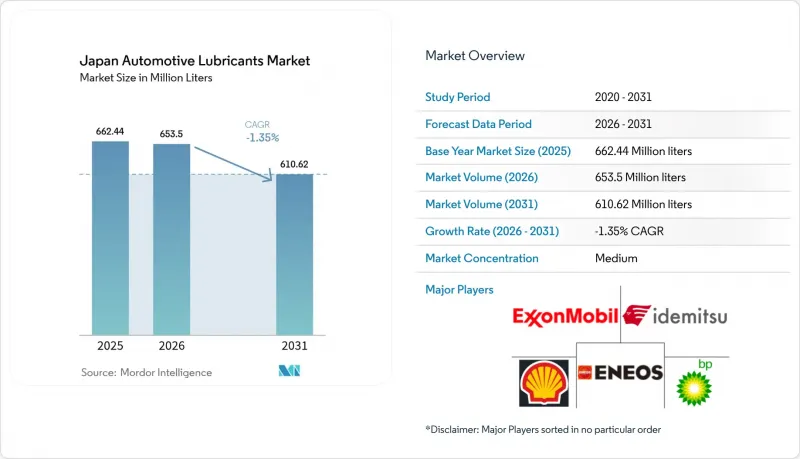
根據Mordor Intelligence預測,2026年日本汽車潤滑油市場規模預計為6.535億公升,低於2025年的6.6244億公升。 2031年的預測值為6.1062億公升,預計2026年至2031年該市場將以-1.35%的複合年成長率成長。
本報告依產品類型(汽車引擎機油[0W-XX、5W-XX、10W-XX、15W-XX、單級油及其他等級]、手排變速箱油、自排變速箱油、煞車油、汽車潤滑脂及其他產品類型)和車輛類型(乘用車、商用車和摩托車)進行分類。市場預測以銷售量(公升)為單位。
日本汽車潤滑油市場趨勢與洞察
原廠正品潤滑油的高滲透率支撐了市場對優質潤滑油的需求。
原廠配套(OEM)潤滑油在全球市場佔有率超過45%,使得汽車製造商和煉油廠即使在內燃機汽車數量下降的情況下也能維持高價位。經銷商管理的保養計畫確保定期更換潤滑油,鞏固了原廠配套品牌在消費者心中的習慣。豐田、本田和日產利用其專屬的經銷網路,強制使用比礦物油利潤更高的先進合成潤滑油。法律規定的車輛年檢迫使車主選擇經認證的維修店,進一步強化了原廠配套經銷通路的優勢。因此,對高階潤滑油的需求下降速度低於總銷售量的下降速度,儘管銷售量下滑,日本汽車潤滑油市場仍保持穩定的利潤基礎。同時,獨立維修店則儲備成本績效實惠的合成潤滑油品牌,以留住那些因保固期到期而轉向其他品牌的客戶。
法規轉向使用低黏度、節能型潤滑油。
為了實現日本2030年25.4公里/公升的CAFE(企業平均燃油經濟性)目標,煉油商面臨供應低黏度潤滑油的壓力,例如0W-8,這種潤滑油相比5W-30能降低動態阻力。日本國內製造商正利用其一體化的供應鏈,廣泛客製化並供應符合JASO GLV-1和GLV-2標準的III+類和IV類基礎油。另一方面,進口商則承擔配方重新設計的相關成本。儘管生產成本不斷增加,但由於燃油效率的提升有助於實現車輛平均燃油經濟性目標,整車製造商(OEM)願意將這些增加的成本轉嫁給消費者。因此,日本汽車潤滑油市場向合成油和超低黏度產品傾斜,加劇了老牌企業與新興供應商之間的技術差距。在預測期內,由於黏度降低,總需求預計將會下降,但由於平均售價將同步上漲,預計銷量下滑的幅度將有所緩解。
電動車和混合動力汽車的快速普及正在抑制內燃機潤滑油的銷售量。
到2024年,電動車將在新車銷量中佔據相當大的佔有率,從而減少引擎運作和每輛車的潤滑油消耗。電池式電動車(BEV)平台無需使用引擎油。隨著政府宣布將在2035年前禁止銷售新的「僅內燃機(ICE)」乘用車,這一趨勢正在加速。 ENEOS預測,到2040年汽油需求將下降50%,顯示汽油需求下降與機油需求下降直接相關。混合動力汽車的變速箱仍需要專用液壓油,但其總消耗量的下降速度超過了車輛保有量的下降速度。供應商正在將資金重新配置到工業和船舶潤滑油領域,以對沖風險。在日本汽車潤滑油市場,電氣化仍然是最大的阻力,其影響超過了所有其他成長要素的綜合作用。
細分市場分析
預計到2025年,汽車機油將維持在日本汽車潤滑油市場61.62%的佔有率,凸顯其在內燃機(ICE)維護的核心作用。然而,該細分市場的負複合年成長率反映了電動動力系統的結構性轉變。在該類別中,0W-8和0W-12機油的成長速度最快,因為這些等級的機油被OEM廠商指定用於滿足燃油效率測試要求。在日本汽車潤滑油市場,自排變速箱油(ATF)的市場規模預計將以-1.23%的適度複合年成長率萎縮。這是因為混合動力傳動系統和無段變速箱(CVT)需要專用的ATF來潤滑和溫度控管馬達。隨著CVT和電動輔助轉向系統的普及,手排變速箱油和動力方向盤機油的市場萎縮速度更快。另一方面,煞車油市場保持穩定,因為即使在電動車中,液壓煞車系統仍然被廣泛使用。
超低黏度配方的高技術難度使得擁有III類+升級煉油廠的煉油廠更具優勢,這使得像ENEOS和出光興產這樣的公司能夠供應大量經OEM認證的0W-8機油。隨著換油週期的延長,供應商透過捆綁油液分析服務和延長保固來增加產品價值。潤滑脂在內燃機和電動車平台的輪轂軸承和底盤部件中仍然保持著重要的地位,從而緩解了整體需求的下滑。更嚴格的檢驗標準確保了徹底的更換週期,即使在電氣化的壓力下,也維持了日本汽車潤滑油市場所有潤滑油類別的穩定需求。
其他好處:
- Excel格式的市場預測(ME)表
- 3個月的分析師支持
目錄
第1章:引言
- 研究假設和市場定義
- 調查範圍
第2章:調查方法
第3章執行摘要
第4章 市場狀況
- 市場概覽
- 市場促進因素
- 原廠正品潤滑油的高市場滲透率支撐了市場對優質潤滑油的需求。
- 法規轉向使用低黏度、節能型潤滑油。
- 成熟且老化的車輛擁有群體為售後市場銷售提供了支撐。
- 合成材料和生物基材料混合物的成長有助於減少碳排放
- 車輛車隊遠距油液狀態監測的實施現狀
- 市場限制因素
- 電動車和混合動力汽車的快速普及抑制了對內燃機所用潤滑油的需求。
- 基礎油價格波動對利潤率帶來壓力。
- 假潤滑劑在電商網站氾濫成災。
- 價值鍊和通路分析
- 波特五力模型
- 法律規範
- 汽車產業的發展趨勢
第5章 市場規模與成長預測
- 依產品類型
- 汽車引擎油
- 0W-XX
- 5W-XX
- 10W-XX
- 15W-XX
- 單級
- 其他年級
- 手排變速箱油(MTF)
- 自排變速箱油(ATF)
- 煞車油
- 汽車潤滑脂
- 其他產品類型(例如動力方向盤機油)
- 汽車引擎油
- 按車輛類型
- 搭乘用車
- 商用車輛
- 摩托車
第6章 競爭情勢
- 市場集中度
- 策略趨勢
- 市佔率和排名分析
- 公司簡介
- AKT Japan Co. Ltd(TAKUMI Motor Oil)
- BP plc
- Chevron Corporation
- Cosmo Energy Holdings Co. Ltd
- ENEOS Corporation
- Exxon Mobil Corporation
- FUCHS
- Gazpromneft-Lubricants Ltd.
- Idemitsu Kosan Co. Ltd
- Japan Sun Oil Co. Ltd(SUNOCO Inc.)
- Motul
- PETRONAS Lubricants International
- Saudi Arabian Oil Co.
- Shell plc
- TotalEnergies
- Wako Chemical Co. Ltd
第7章 市場機會與未來展望
第8章:執行長應考慮的關鍵策略問題
According to Mordor Intelligence, Japan automotive lubricants market size in 2026 is estimated at 653.5 million liters, growing from 2025 value of 662.44 million liters with 2031 projections showing 610.62 million liters, growing at -1.35% CAGR over 2026-2031.
This report is Segmented by Product Type (Automotive Engine Oil [0W-XX, 5W-XX, 10W-XX, 15W-XX, Monogrades, and Other Grades], Manual Transmission Fluids, Automatic Transmission Fluids, Brake Fluids, Automotive Greases, and Other Product Types) and Vehicle Type (Passenger Vehicles, Commercial Vehicles, and Two-Wheelers). The Market Forecasts are Provided in Terms of Volume (Litres).
Japan Automotive Lubricants Market Trends and Insights
High OEM-Genuine Oil Penetration Sustains Premium-Grade Demand
OEM-genuine oil penetration surpasses the global average of 45%, enabling automakers and refiners to maintain premium pricing power despite the shrinking base of internal-combustion vehicles. Dealer-controlled maintenance schedules ensure routine lubricant replacement and keep genuine labels embedded in consumer habits. Toyota, Honda, and Nissan exploit this captive channel to mandate advanced synthetics that command higher margins than mineral oils. The legally mandated Shaken inspection obliges drivers to use certified workshops, reinforcing OEM channel dominance. As a result, premium-grade demand softens more slowly than total volume, helping the Japanese automotive lubricants market maintain a stable profit pool even as liters decline. Independent workshops respond by stocking value-branded synthetics to retain customers migrating out of warranty.
Regulatory Shift to Low-Viscosity, Fuel-Efficient Oils
Japan's 2030 CAFE target of 25.4 km/L pushes refiners to deliver oils as thin as 0W-8, a grade that lowers hydrodynamic drag compared with 5W-30. Domestic players leverage integrated supply chains to customize Group III+ and Group IV base-oil blends that meet JASO GLV-1 and GLV-2 benchmarks at scale, whereas importers incur costs associated with formula redesign. Production expenses increase, yet OEMs willingly pass these premiums on to consumers because validated fuel-efficiency gains help them meet their fleet-average targets. The Japan automotive lubricants market, therefore, skews toward synthetics and ultra-low viscosities, widening the technology gap between incumbents and late-entry suppliers. Over the forecast horizon, viscosity downgrading is expected to reduce aggregate demand but simultaneously raise average selling prices, thereby tempering revenue erosion.
Rapid EV/Hybrid Uptake Curbs ICE-Oil Volumes
Electrified vehicles captured a significant share of new sales in 2024, cutting engine running time and lubricant consumption per unit. Battery electric platforms eliminate the need for engine oil. The government's 2035 ban on new ICE-only passenger cars accelerates the downward trajectory. ENEOS projects gasoline demand to fall by 50% by 2040, implying a direct correlation with engine oil erosion. While hybrid transmissions still require specialized fluids, the overall decline in liters is faster than the contraction of the vehicle stock. Suppliers respond by reallocating capital toward industrial and marine lubricants to hedge exposure. For the Japan automotive lubricants market, electrification remains the single largest headwind, outweighing all incremental drivers combined.
Other drivers and restraints analyzed in the detailed report include:
- Mature but Aging Vehicle Parc Maintains Aftermarket Volumes
- Growth of Synthetic and Bio-Based Blends for Carbon Reduction
- Volatile Base-Oil Feedstock Costs Pressure Margins
For complete list of drivers and restraints, kindly check the Table Of Contents.
Segment Analysis
Automotive engine oil retained 61.62% of Japan's automotive lubricants market share in 2025, underscoring its centrality to ICE maintenance. Yet the segment's negative CAGR mirrors the systemic shift toward electrified drivetrains. Within the category, 0W-8 and 0W-12 account for the fastest growth as OEM manuals specify these grades to satisfy fuel-economy tests. Japan's automotive lubricants market size for automatic transmission fluids is forecast to decline at a modest -1.23% CAGR, as hybrid powertrains and continuously variable transmissions require specialized ATFs for electric-motor lubrication and thermal management. Manual transmission fluids and power-steering fluids shrink more quickly due to the rise of CVTs and electric steering systems. Brake fluids remain steady because EVs still employ hydraulic braking circuits.
Elevated technical barriers in ultra-low viscosity formulations favor refiners with Group III+ upgrading units, enabling ENEOS and Idemitsu to supply OEM-approved 0W-8 at volume. As drain intervals extend, suppliers embed value by bundling oil-analysis services and warranty extensions. Greases hold niche relevance in wheel bearings and chassis components for both ICE and EV platforms, moderating the overall decline. The shaken inspection protocol enforces replacement cycles, ensuring that the Japanese automotive lubricants market maintains calibrated demand for every fluid family, even under pressure from electrification.
Complete Report Scope:
- By Product Type
- Automotive Engine Oil
- 0W-XX
- 5W-XX
- 10W-XX
- 15W-XX
- Monogrades
- Other Grades
- Manual Transmission Fluids (MTF)
- Automatic Transmission Fluids (ATF)
- Brake Fluids
- Automotive Greases
- Other Product Types (Power Steering Fluid etc.)
- Automotive Engine Oil
- By Vehicle Type
- Passenger Vehicles
- Commercial Vehicles
- Two-Wheelers
List of Companies Covered in this Report:
- AKT Japan Co. Ltd (TAKUMI Motor Oil)
- BP p.l.c.
- Chevron Corporation
- Cosmo Energy Holdings Co. Ltd
- ENEOS Corporation
- Exxon Mobil Corporation
- FUCHS
- Gazpromneft - Lubricants Ltd.
- Idemitsu Kosan Co. Ltd
- Japan Sun Oil Co. Ltd (SUNOCO Inc.)
- Motul
- PETRONAS Lubricants International
- Saudi Arabian Oil Co.
- Shell plc
- TotalEnergies
- Wako Chemical Co. Ltd
Additional Benefits:
- The market estimate (ME) sheet in Excel format
- 3 months of analyst support
TABLE OF CONTENTS
1 Introduction
- 1.1 Study Assumptions and Market Definition
- 1.2 Scope of the Study
2 Research Methodology
3 Executive Summary
4 Market Landscape
- 4.1 Market Overview
- 4.2 Market Drivers
- 4.2.1 High OEM-genuine oil penetration sustains premium-grade demand
- 4.2.2 Regulatory shift to low-viscosity, fuel-efficient oils
- 4.2.3 Mature but aging vehicle parc maintains aftermarket volumes
- 4.2.4 Growth of synthetic and bio-based blends for carbon reduction
- 4.2.5 Remote oil-condition monitoring adoption among fleets
- 4.3 Market Restraints
- 4.3.1 Rapid EV/hybrid uptake curbs ICE-oil volumes
- 4.3.2 Volatile base-oil feedstock costs pressure margins
- 4.3.3 Counterfeit lubricants proliferating on e-commerce
- 4.4 Value Chain and Distribution Channel Analysis
- 4.5 Porter's Five Forces
- 4.5.1 Threat of New Entrants
- 4.5.2 Bargaining Power of Suppliers
- 4.5.3 Bargaining Power of Buyers
- 4.5.4 Threat of Substitutes
- 4.5.5 Industry Rivalry
- 4.6 Regulatory Framework
- 4.7 Automotive Industry Trends
5 Market Size and Growth Forecasts (Volume)
- 5.1 By Product Type
- 5.1.1 Automotive Engine Oil
- 5.1.1.1 0W-XX
- 5.1.1.2 5W-XX
- 5.1.1.3 10W-XX
- 5.1.1.4 15W-XX
- 5.1.1.5 Monogrades
- 5.1.1.6 Other Grades
- 5.1.2 Manual Transmission Fluids (MTF)
- 5.1.3 Automatic Transmission Fluids (ATF)
- 5.1.4 Brake Fluids
- 5.1.5 Automotive Greases
- 5.1.6 Other Product Types (Power Steering Fluid etc.)
- 5.1.1 Automotive Engine Oil
- 5.2 By Vehicle Type
- 5.2.1 Passenger Vehicles
- 5.2.2 Commercial Vehicles
- 5.2.3 Two-Wheelers
6 Competitive Landscape
- 6.1 Market Concentration
- 6.2 Strategic Moves
- 6.3 Market Share (%)/Ranking Analysis
- 6.4 Company Profiles (includes Global level Overview, Market level overview, Core Segments, Financials as available, Production Capacity, Strategic Information, Market Rank/Share for key companies, Products and Services, and Recent Developments)
- 6.4.1 AKT Japan Co. Ltd (TAKUMI Motor Oil)
- 6.4.2 BP p.l.c.
- 6.4.3 Chevron Corporation
- 6.4.4 Cosmo Energy Holdings Co. Ltd
- 6.4.5 ENEOS Corporation
- 6.4.6 Exxon Mobil Corporation
- 6.4.7 FUCHS
- 6.4.8 Gazpromneft - Lubricants Ltd.
- 6.4.9 Idemitsu Kosan Co. Ltd
- 6.4.10 Japan Sun Oil Co. Ltd (SUNOCO Inc.)
- 6.4.11 Motul
- 6.4.12 PETRONAS Lubricants International
- 6.4.13 Saudi Arabian Oil Co.
- 6.4.14 Shell plc
- 6.4.15 TotalEnergies
- 6.4.16 Wako Chemical Co. Ltd
7 Market Opportunities and Future Outlook
- 7.1 White-space and Unmet-need Assessment
8 Key Strategic Questions for CEOs

 泰國汽車潤滑油市場:市場佔有率分析、產業趨勢與統計及成長預測(2026-2031)越南汽車潤滑油市場:市場佔有率分析、產業趨勢與統計及成長預測(2026-2031)非洲汽車潤滑油:市場佔有率分析、產業趨勢與統計及成長預測(2026-2031 年)馬來西亞汽車潤滑油:市場佔有率分析、產業趨勢與統計及成長預測(2026-2031)中國汽車潤滑油市場:市場佔有率分析、產業趨勢與統計及成長預測(2026-2031年)北美汽車潤滑油:市場佔有率分析、產業趨勢與統計及成長預測(2026-2031 年)德國汽車潤滑油市場:市場佔有率分析、產業趨勢與統計及成長預測(2026-2031)法國汽車潤滑油市場:市場佔有率分析、產業趨勢與統計及成長預測(2026-2031)
 2026-2034年全球汽車潤滑油市場規模、佔有率、趨勢及成長分析報告印度汽車潤滑油:市場佔有率分析、產業趨勢與統計及成長預測(2026-2031)