


 |
市場調查報告書
商品編碼
2116367
法國汽車潤滑油市場:市場佔有率分析、產業趨勢與統計及成長預測(2026-2031)France Automotive Lubricants - Market Share Analysis, Industry Trends & Statistics, Growth Forecasts (2026 - 2031) |
||||||

※ 本網頁內容可能與最新版本有所差異。詳細情況請與我們聯繫。
據 Mordor Intelligence 稱,2025 年法國汽車潤滑油市值為 2.8915 億公升,預計將從 2026 年的 2.8606 億公升萎縮到 2031 年的 2.7104 億升,預測期(2026-2031 年)的複合年成長率為 -1.07%。
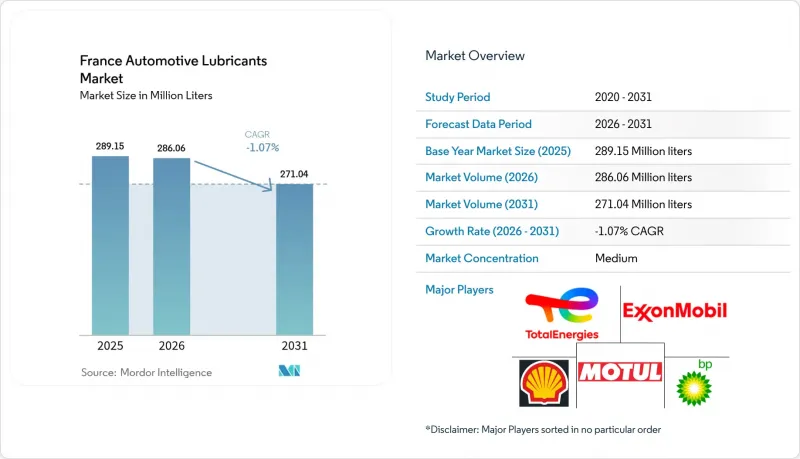
本報告按產品類型(汽車引擎油、手排變速箱油、自動變速箱油、煞車油、汽車潤滑脂及其他產品類型)和車輛類型(乘用車、商用車和摩托車)進行細分。市場預測以銷售量(公升)為單位。
法國汽車潤滑油市場趨勢與洞察
新冠疫情後新車登記量的恢復情形
2024年商用車註冊量有所增加。物流卡車和貨車的成長主要得益於電子商務的擴張和供應鏈回流法國。因此,重型潤滑油的重要性仍然突出,因為車隊營運商優先考慮的是車輛的運作和可靠性。較長的更換週期(通常為5至7年)有助於穩定潤滑油的需求,即使輕型車輛的電氣化進程正在迅速推進。供應商正集中資源研發專為高負載應用設計的高級柴油機油、長效冷卻液和車橋油。隨著乘用車銷售下滑,商用車車隊已成為法國汽車潤滑油市場的主要客戶群。
更嚴格的歐7排放標準正在推動低黏度配方的發展。
將於2026年11月生效的歐盟7排放標準將顆粒物濃度閾值降低至10奈米,並強制要求提高排放氣體的長期耐久性。為此,法國汽車製造商正在認證0W-20和0W-16黏度等級的機油,這些機油可降低摩擦並提高燃油效率高達2%。這些低黏度機油還含有低SAPS添加劑,以保護後處理系統。目前,具有高氧化穩定性的合成基礎油正逐漸成為新車認證的主流,促使潤滑油調配商調整其產品線。這項新規提升了優質合成潤滑油在法國汽車潤滑油市場的提案。
原廠設備製造商強制要求延長換油週期。
歐洲高階品牌目前已批准3萬公里的保養週期,降低了年度機油需求。這些新規範對潤滑油的抗氧化性和總鹼值(TBN)保持能力提出了更高的要求,推動了中硫磷灰石(SAPS)和全硫磷灰石(Full SAPS)合成潤滑油成長。法國汽車製造商(OEM)也順應這一趨勢,以降低保固成本。因此,車輛維修次數有所減少,但透過提升銷售更高等級的機油和配套服務彌補了這一損失。儘管每公升機油的利潤率有所提高,但這一趨勢仍然是法國汽車潤滑油市場銷售量的最大阻力。
細分市場分析
在法國汽車潤滑油市場,機油佔總銷售量的58.25%。大規模平均車車齡為9.2年的內燃機汽車支撐著機油的基本需求。歐盟7排放標準推動了0W-20和0W-16黏度等級的機油普及,從而提高了合成油的滲透率。隨著電動輔助轉向系統(EPS)的日益普及,動力方向盤油的銷量有所下降,但由於強制更換週期,煞車油的銷量保持穩定。自動變速箱油的銷量降幅最大,達-0.91%,這主要是由於密封雙離合器變速箱的廣泛應用。
合成機油透過滿足低硫磷灰石(SAPS)和低揮發性要求,有效保護顆粒物過濾器,從而不斷擴大市場佔有率。調配商採用III+類基礎油及聚α烯烴基礎油,確保在2萬至3萬公里的換油週期內維持抗氧化穩定。配方延長了使用壽命,使得維修店能夠透過收取更高的費用來彌補換油頻率的降低。在循環經濟的獎勵下,再生油的比例也不斷增加。潤滑脂在車輪軸承、底盤零件和電動車馬達軸承方面的需求穩定,抵消了法國汽車潤滑油市場其他領域需求的下降。
其他好處:
- Excel格式的市場預測(ME)表
- 3個月的分析師支持
目錄
第1章:引言
- 研究假設和市場定義
- 調查範圍
第2章:調查方法
第3章執行摘要
第4章 市場狀況
- 市場概覽
- 市場促進因素
- 法國在新冠疫情後的新車註冊量復甦
- 更嚴格的歐7排放標準正在推動低黏度配方的應用。
- 最後一公里配送車輛激增
- 汽車共享和訂閱式車輛的擴張
- 《循環經濟法》正在加速精煉基油的採用。
- 市場限制因素
- 原廠設備製造商強制要求延長換油週期。
- 密封式無油電驅動橋的興起
- 利用遠端資訊處理技術進行預測性維護,減少換油頻率。
- 價值鍊和通路分析
- 波特五力模型
- 法律規範
- 汽車產業的發展趨勢
第5章 市場規模與成長預測
- 依產品類型
- 汽車引擎油
- 0W-XX
- 5W-XX
- 10W-XX
- 15W-XX
- 單級
- 其他年級
- 手排變速箱油(MTF)
- 自排變速箱油(ATF)
- 煞車油
- 汽車潤滑脂
- 其他產品類型(例如動力方向盤機油)
- 汽車引擎油
- 按車輛類型
- 搭乘用車
- 商用車輛
- 摩托車
第6章 競爭情勢
- 市場集中度
- 策略趨勢
- 市佔率和排名分析
- 公司簡介
- AMSOIL INC
- BP plc
- Chevron Corporation
- Eni SpA
- Exxon Mobil Corporation
- FUCHS
- Gulf Oil International
- IGOL
- LIQUI MOLY
- Millers Oils
- MOTOREX
- Motul
- PETRONAS Lubricants International
- Saudi Arabian Oil Co.
- Shell plc
- TotalEnergies
- Wolf Oil Corporation
第7章 市場機會與未來展望
第8章:執行長面臨的關鍵策略挑戰
According to Mordor Intelligence, the France automotive lubricants market size was valued at 289.15 million liters in 2025 and estimated to grow from 286.06 million liters in 2026 to reach 271.04 million liters by 2031, at a CAGR of -1.07% during the forecast period (2026-2031).
This report is Segmented by Product Type (Automotive Engine Oil, Manual Transmission Fluids, Automatic Transmission Fluids, Brake Fluids, Automotive Greases, and Other Product Types) and Vehicle Type (Passenger Vehicles, Commercial Vehicles, and Two-Wheelers). The Market Forecasts are Provided in Terms of Volume (Litres).
France Automotive Lubricants Market Trends and Insights
Post-COVID rebound in new-vehicle registrations
Commercial vehicle registrations in 2024 grew. The uptick in logistics trucks and vans is driven by the expansion of e-commerce and the reshoring of supply chains. Heavy-duty lubricants, therefore, maintain relevance as fleet operators prioritize uptime and reliability. Longer replacement cycles, typically five to seven years, help stabilize lubricant demand even as the total light-duty fleet electrifies more rapidly. Suppliers are channeling resources toward premium diesel engine oils, long-life coolants, and axle fluids specifically designed for high-load applications. As passenger car volumes dip, commercial fleets become the focal customer group across the France automotive lubricants market.
Stricter Euro-7 limits driving low-viscosity formulations
Euro-7 standards, effective in November 2026, introduce particle-number thresholds down to 10 nm and mandate emissions durability over extended lifespans. To comply, French OEMs are homologating 0W-20 and 0W-16 grades that cut friction and improve fuel economy by up to 2%. These light viscosities also carry low-SAPS additive packages to protect after-treatment systems. Synthetic base oils with high oxidative stability now dominate new-fill factory approvals, prompting blenders to reformulate portfolios. The regulation thereby elevates the value proposition of premium synthetics within the France automotive lubricants market.
OEM-mandated extended drain intervals
Premium European brands now approve 30,000-kilometer service intervals, cutting annual oil demand. The specifications require robust oxidative resistance and TBN retention, spurring a shift toward mid-SAPS and full-SAPS synthetics. French OEMs follow the pattern to lower warranty expenses. Workshops consequently see fewer visits and compensate by upselling higher-grade oils and ancillary services. While per-liter margins improve, the restraint remains the largest drag on volumes in the France automotive lubricants market.
Other drivers and restraints analyzed in the detailed report include:
- Boom in last-mile delivery fleets
- Expansion of car-sharing and subscription fleets
- Rise of sealed, oil-free e-axles
For complete list of drivers and restraints, kindly check the Table Of Contents.
Segment Analysis
The French automotive lubricants market size for engine oils accounts for 58.25% of the total volume. A large ICE parc with an average age of 9.2 years supports baseline demand. Euro-7 promotes the mix toward 0W-20 and 0W-16 grades, thereby increasing synthetic oil penetration. Power steering fluids decline as EPS becomes universal, while brake fluids remain stable due to mandatory change intervals. Automatic transmission fluids post the steepest fall at -0.91% as sealed dual-clutch units proliferate.
Synthetic engine oils capture a growing share by meeting low-SAPS and volatility limits that safeguard particulate filters. Blenders deploy Group III+ and poly-alpha-olefin base stocks to ensure oxidation stability over 20,000- to 30,000-kilometer intervals. Long-life formulations enable workshops to compensate for fewer oil changes by charging premium rates. Re-refined content also rises, driven by incentives from the circular economy. Greases enjoy steady demand for wheel bearings, chassis points, and EV motor bearings, balancing reductions elsewhere within the France automotive lubricants market.
Complete Report Scope:
- By Product Type
- Automotive Engine Oil
- 0W-XX
- 5W-XX
- 10W-XX
- 15W-XX
- Monogrades
- Other Grades
- Manual Transmission Fluids (MTF)
- Automatic Transmission Fluids (ATF)
- Brake Fluids
- Automotive Greases
- Other Product Types (Power Steering Fluid etc.)
- Automotive Engine Oil
- By Vehicle Type
- Passenger Vehicles
- Commercial Vehicles
- Two-Wheelers
List of Companies Covered in this Report:
- AMSOIL INC
- BP p.l.c.
- Chevron Corporation
- Eni SpA
- Exxon Mobil Corporation
- FUCHS
- Gulf Oil International
- IGOL
- LIQUI MOLY
- Millers Oils
- MOTOREX
- Motul
- PETRONAS Lubricants International
- Saudi Arabian Oil Co.
- Shell plc
- TotalEnergies
- Wolf Oil Corporation
Additional Benefits:
- The market estimate (ME) sheet in Excel format
- 3 months of analyst support
TABLE OF CONTENTS
1 Introduction
- 1.1 Study Assumptions and Market Definition
- 1.2 Scope of the Study
2 Research Methodology
3 Executive Summary
4 Market Landscape
- 4.1 Market Overview
- 4.2 Market Drivers
- 4.2.1 Post-COVID rebound in French new-vehicle registrations
- 4.2.2 Stricter Euro-7 limits driving low-viscosity formulations
- 4.2.3 Boom in last-mile delivery fleets
- 4.2.4 Expansion of car-sharing and subscription fleets
- 4.2.5 Circular-economy law accelerating re-refined base-oil adoption
- 4.3 Market Restraints
- 4.3.1 OEM-mandated extended drain intervals
- 4.3.2 Rise of sealed, oil-free e-axles
- 4.3.3 Telematics-based predictive maintenance reducing oil changes
- 4.4 Value Chain and Distribution Channel Analysis
- 4.5 Porter's Five Forces
- 4.5.1 Threat of New Entrants
- 4.5.2 Bargaining Power of Suppliers
- 4.5.3 Bargaining Power of Buyers
- 4.5.4 Threat of Substitutes
- 4.5.5 Industry Rivalry
- 4.6 Regulatory Framework
- 4.7 Automotive Industry Trends
5 Market Size and Growth Forecasts (Volume)
- 5.1 By Product Type
- 5.1.1 Automotive Engine Oil
- 5.1.1.1 0W-XX
- 5.1.1.2 5W-XX
- 5.1.1.3 10W-XX
- 5.1.1.4 15W-XX
- 5.1.1.5 Monogrades
- 5.1.1.6 Other Grades
- 5.1.2 Manual Transmission Fluids (MTF)
- 5.1.3 Automatic Transmission Fluids (ATF)
- 5.1.4 Brake Fluids
- 5.1.5 Automotive Greases
- 5.1.6 Other Product Types (Power Steering Fluid etc.)
- 5.1.1 Automotive Engine Oil
- 5.2 By Vehicle Type
- 5.2.1 Passenger Vehicles
- 5.2.2 Commercial Vehicles
- 5.2.3 Two-Wheelers
6 Competitive Landscape
- 6.1 Market Concentration
- 6.2 Strategic Moves
- 6.3 Market Share (%)/Ranking Analysis
- 6.4 Company Profiles (includes Global level Overview, Market level overview, Core Segments, Financials as available, Production Capacity, Strategic Information, Market Rank/Share for key companies, Products and Services, and Recent Developments)
- 6.4.1 AMSOIL INC
- 6.4.2 BP p.l.c.
- 6.4.3 Chevron Corporation
- 6.4.4 Eni SpA
- 6.4.5 Exxon Mobil Corporation
- 6.4.6 FUCHS
- 6.4.7 Gulf Oil International
- 6.4.8 IGOL
- 6.4.9 LIQUI MOLY
- 6.4.10 Millers Oils
- 6.4.11 MOTOREX
- 6.4.12 Motul
- 6.4.13 PETRONAS Lubricants International
- 6.4.14 Saudi Arabian Oil Co.
- 6.4.15 Shell plc
- 6.4.16 TotalEnergies
- 6.4.17 Wolf Oil Corporation
7 Market Opportunities and Future Outlook
- 7.1 White-space and Unmet-need Assessment
8 Key Strategic Questions for CEOs

 日本汽車潤滑油市場:市場佔有率分析、產業趨勢與統計及成長預測(2026-2031)泰國汽車潤滑油市場:市場佔有率分析、產業趨勢與統計及成長預測(2026-2031)越南汽車潤滑油市場:市場佔有率分析、產業趨勢與統計及成長預測(2026-2031)非洲汽車潤滑油:市場佔有率分析、產業趨勢與統計及成長預測(2026-2031 年)馬來西亞汽車潤滑油:市場佔有率分析、產業趨勢與統計及成長預測(2026-2031)中國汽車潤滑油市場:市場佔有率分析、產業趨勢與統計及成長預測(2026-2031年)北美汽車潤滑油:市場佔有率分析、產業趨勢與統計及成長預測(2026-2031 年)德國汽車潤滑油市場:市場佔有率分析、產業趨勢與統計及成長預測(2026-2031)
 2026-2034年全球汽車潤滑油市場規模、佔有率、趨勢及成長分析報告印度汽車潤滑油:市場佔有率分析、產業趨勢與統計及成長預測(2026-2031)