


 |
市場調查報告書
商品編碼
2116372
德國汽車潤滑油市場:市場佔有率分析、產業趨勢與統計及成長預測(2026-2031)Germany Automotive Lubricants - Market Share Analysis, Industry Trends & Statistics, Growth Forecasts (2026 - 2031) |
||||||

※ 本網頁內容可能與最新版本有所差異。詳細情況請與我們聯繫。
根據Mordor Intelligence預測,2026年德國汽車潤滑油市場規模預計將為2.7121億公升,低於2025年的2.7426億公升。 2031年的預測值為2.5647億公升,這意味著2026年至2031年的複合年成長率為-1.11%。
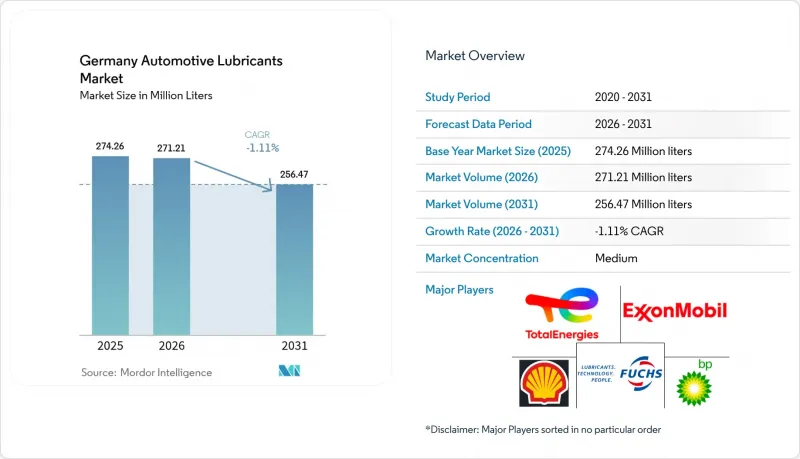
本報告按產品類型(汽車引擎油、手排變速箱油、自動變速箱油、煞車油、汽車潤滑脂及其他產品類型)和車輛類型(乘用車、商用車和摩托車)進行分類。市場預測以銷售量(公升)為單位。
德軍汽車潤滑油市場趨勢與洞察
德國微型車產量將於2024年起逐步恢復
2025年9月,德國國內乘用車產量開始復甦,原廠加註潤滑油及初始保養的需求趨於穩定。儘管產量仍低於2019年的水平,但預計製造業活動將持續維持,2025年至2029年間已確認投資3,200億歐元。電動車型在總產量中的比例已經提升,雖然單車潤滑油消耗量下降,但電動車冷卻液領域正在湧現新的機會。引擎工廠的運轉率仍然低於歷史平均水平,但零件供應的改善和供應鏈的重組預計將在短期內提升組裝廠對工業潤滑油的需求。因此,此次復甦將在一定程度上緩解德國汽車潤滑油市場的整體下滑。
合成低黏度機油的廣泛應用
隨著汽車製造商追求更高的燃油效率和更長的換油週期,0W-XX 和 5W-XX 等級的 OEM 規範在全國加速推廣。合成油具有更優異的揮發性控制和抗油泥性能,尤其是在渦輪增壓車輛和高熱負荷工況下。基於 ATIEL 行為準則的 ACEA 認證要求進行嚴格的台架和引擎測試,這限制了市場競爭,因為小規模調配商能夠滿足這些要求。殼牌轉向 III 類基礎油產品加劇了 I 類基礎油供應緊張和原料溢價上漲,但也改善了合成油所需高性能基礎油的獲取途徑。因此,高階供應商正利用品牌價值和經認證的測試實驗室來獲取市場佔有率,德國汽車潤滑油市場也越來越注重「品質而非數量」。
電動車數量的增加將降低對引擎油的需求。
隨著純電動車註冊量的成長,引擎油的年需求量正在下降。在充電站密度高的都市區,快速換油服務(快速換油)的使用量已經出現了兩位數的下降。汽車製造商的投資策略主要集中在電池組件和電力驅動系統上,引擎產量勢必會持續萎縮。因此,潤滑油經銷商需要調整產品系列,納入電驅動油、導熱間隙填充潤滑脂以及與無矽材料相容的冷卻液混合物。如果不能適應這項變化,德國汽車潤滑油市場的銷售量將會長期下滑。
細分市場分析
汽車機油佔德國汽車潤滑油市場的62.68%。這個細分市場仍然受益於內燃機汽車的普及,而內燃機汽車仍佔據主導地位,而老舊車輛較短的換油週期也進一步支撐了這個市場。由於汽車製造商(OEM)的燃油效率指南以及III類基礎油的供應,合成0W-20和0W-30配方在高階產品類別中佔據了一定的市場佔有率。然而,乘用車引擎產量的下降以及電池式電動車(BEV)中自動變速箱被單速變速箱取代,正在拖累其長期銷售量。手排變速箱油和煞車油的需求佔比較小,其需求趨勢相對穩定,與定期保養計畫密切相關。汽車潤滑脂用於車輪軸承和底盤的各個部件,受電氣化的影響較小,但隨著電子控制煞車和轉向系統的普及,液壓油和轉向液等細分產品的市場需求正在下降。整體而言,產品組合的變化並沒有阻止德國汽車潤滑油市場銷售量的下滑,而只是減緩了下滑的速度。
自動變速箱油預計將出現最大幅度的萎縮,複合年成長率 (CAGR) 為 -0.94%,這反映了多級變速箱系統使用量的快速下降。其他產品類型的趨勢各不相同。煞車油的銷售量與道路上的車輛數量相關,而潤滑脂的銷售量則與重型車輛行業的零件數量相關。此外,電動車冷卻液的銷售量正在逐步成長,部分抵消了先前的下滑。在整個預測期內,合成潤滑油的市場佔有率預計將以高於總銷量下降速度的速度成長,從而即使德國汽車潤滑油市場的絕對規模縮小,也能維持其市場價值。
其他好處:
- Excel格式的市場預測(ME)表
- 3個月的分析師支持
目錄
第1章:引言
- 研究假設和市場定義
- 調查範圍
第2章:調查方法
第3章執行摘要
第4章 市場狀況
- 市場概覽
- 市場促進因素
- 德國微型車產量將於2024年起逐步恢復
- 合成低黏度機油的普及程度越來越高。
- 車齡老化(10 年或以上)推高了售後市場的需求。
- 馬達和變速箱對液壓油的需求
- OEM 的範圍 3 目標正在推動二氧化碳中性潤滑油的採用。
- 市場限制因素
- 電動車數量的增加導致引擎機油消耗量下降。
- 基礎油價格波動
- 德國加強包裝廢棄物監管
- 價值鍊和通路分析
- 波特五力模型
- 法律規範
- 汽車產業的發展趨勢
第5章 市場規模與成長預測
- 依產品類型
- 汽車引擎油
- 0W-XX
- 5W-XX
- 10W-XX
- 15W-XX
- 單級
- 其他年級
- 手排變速箱油(MTF)
- 自排變速箱油(ATF)
- 煞車油
- 汽車潤滑脂
- 其他產品類型(例如動力方向盤機油)
- 汽車引擎油
- 車輛類型
- 搭乘用車
- 商用車輛
- 摩托車
第6章 競爭情勢
- 市場集中度
- 策略趨勢
- 市佔率和排名分析
- 公司簡介
- ADDINOL
- AVISTA OIL
- BP Plc
- Chevron Corporation
- Exxon Mobil Corporation
- Finke Mineralolwerk
- FUCHS
- LIQUI MOLY
- Motul
- PETRONAS Lubricants International
- Ravensberger Schmierstoffvertrieb GmbH
- ROWE MINERALOLWERK GMBH
- Saudi Arbian Oil Co.
- SCT Lubricants
- Shell plc
- TotalEnergies
第7章 市場機會與未來展望
第8章:執行長面臨的關鍵策略挑戰
According to Mordor Intelligence, Germany automotive lubricants market size in 2026 is estimated at 271.21 million liters, growing from 2025 value of 274.26 million liters with 2031 projections showing 256.47 million liters, growing at -1.11% CAGR over 2026-2031.
This report is Segmented by Product Type (Automotive Engine Oil, Manual Transmission Fluids, Automatic Transmission Fluids, Brake Fluids, Automotive Greases, and Other Product Types) and Vehicle Type (Passenger Vehicles, Commercial Vehicles, and Two-Wheelers). The Market Forecasts are Provided in Terms of Volume (Litres).
Germany Automotive Lubricants Market Trends and Insights
Revival of German Light-Vehicle Production Post-2024
Domestic passenger-car output rebounded in September 2025, stabilizing factory fill and early-service demand. Although volumes remain below 2019 levels, committed investments of EUR 320 billion between 2025 and 2029 indicate sustained manufacturing activity. Electrified models already command a growing share of this output, trimming lubricant litres per vehicle yet opening new opportunities in e-drive coolants. Engine-plant utilization remains below historical norms; however, improved parts availability and reorganized supply chains are expected to support a near-term increase in industrial lubricants used within assembly facilities. The revival, therefore, offers a modest buffer that slows the overall decline of the German automotive lubricants market.
Rising Penetration of Synthetic Low-Viscosity Engine Oils
OEM specifications for 0W-XX and 5W-XX grades accelerate nationwide as automakers chase fuel economy and extended-drain benefits. Synthetics provide better volatility control and sludge resistance under turbocharged, high-thermal-load conditions. ACEA approvals governed by the ATIEL Code of Practice set rigorous bench and engine tests that few small blenders can meet, limiting competitive entry. Shell's shift to Group III output tightens Group I availability, raising feedstock premiums yet improving access to high-performance base oils required for synthetics. Premium suppliers consequently leverage brand equity and accredited labs to capture wallet share, cementing the German automotive lubricants market as a value-over-volume play.
Growing BEV Fleet Reducing Engine-Oil Volume
BEV registrations increased, resulting in a reduction in annual engine oil demand. Urban areas with dense charging hubs already show double-digit declines in quick-lube traffic. OEM spending commitments favor battery assembly and electric drivetrains, ensuring that engine manufacturing will continue to shrink. Lubricant marketers must therefore retool portfolios toward e-drive fluids, greases for thermal gap fillers, and coolant blends compatible with silicone-free materials. Failing to adapt will expose them to lasting volume loss in the German automotive lubricants market.
Other drivers and restraints analyzed in the detailed report include:
- Aging Car Parc Boosting After-Market Demand
- Demand for E-Motor and Reduction-Gearbox Fluids
- Base-Oil Price Volatility
For complete list of drivers and restraints, kindly check the Table Of Contents.
Segment Analysis
Automotive engine oil accounted for 62.68% of Germany's automotive lubricants market. The segment benefits from the still-dominant internal-combustion fleet and gains further support from older vehicles that require shorter drain intervals. Synthetic 0W-20 and 0W-30 formulations capture premium shelf space due to OEM fuel-economy directives and the availability of Group III base oils. Yet the decline in passenger-car engine builds and the replacement of automatic transmissions with single-speed gearboxes in BEVs undercut long-term volume. Manual transmission fluids and brake fluids account for a modest slice of demand, showing relatively stable trends tied to routine service schedules. Automotive greases serve wheel bearings and chassis points, with a limited impact on electrification, while niche products, such as hydraulic and steering fluids, decline in tandem with the adoption of electronic braking and steering systems. Altogether, the mix shift merely slows rather than stops the decline in volume in the German automotive lubricants market.
Automatic transmission fluids are expected to represent the steepest contraction, -0.94% CAGR, mirroring the rapid decline in the use of multi-gear boxes. Other product categories see uneven trajectories: brake fluids track the size of the rolling fleet, greases follow component counts in heavy-duty sectors, and emergent e-drive coolants acquire incremental litres that partially offset traditional losses. Over the forecast horizon, synthetic share rises faster than total litres decline, allowing value retention even as Germany's automotive lubricants market size contracts in absolute terms.
Complete Report Scope:
- By Product Type
- Automotive Engine Oil
- 0W-XX
- 5W-XX
- 10W-XX
- 15W-XX
- Monogrades
- Other Grades
- Manual Transmission Fluids (MTF)
- Automatic Transmission Fluids (ATF)
- Brake Fluids
- Automotive Greases
- Other Product Types (Power Steering Fluid etc.)
- Automotive Engine Oil
- By Vehicle Type
- Passenger Vehicles
- Commercial Vehicles
- Two-Wheelers
List of Companies Covered in this Report:
- ADDINOL
- AVISTA OIL
- BP Plc
- Chevron Corporation
- Exxon Mobil Corporation
- Finke Mineralolwerk
- FUCHS
- LIQUI MOLY
- Motul
- PETRONAS Lubricants International
- Ravensberger Schmierstoffvertrieb GmbH
- ROWE MINERALOLWERK GMBH
- Saudi Arbian Oil Co.
- SCT Lubricants
- Shell plc
- TotalEnergies
Additional Benefits:
- The market estimate (ME) sheet in Excel format
- 3 months of analyst support
TABLE OF CONTENTS
1 Introduction
- 1.1 Study Assumptions and Market Definition
- 1.2 Scope of the Study
2 Research Methodology
3 Executive Summary
4 Market Landscape
- 4.1 Market Overview
- 4.2 Market Drivers
- 4.2.1 Revival of German light-vehicle production post-2024
- 4.2.2 Rising penetration of synthetic low-viscosity engine oils
- 4.2.3 Aging car parc (more than 10 yrs) boosting after-market demand
- 4.2.4 Demand for e-motor and reduction-gearbox fluids
- 4.2.5 OEM Scope-3 targets driving CO2-neutral lubricants
- 4.3 Market Restraints
- 4.3.1 Growing BEV fleet reducing engine-oil volume
- 4.3.2 Base-oil price volatility
- 4.3.3 Stricter German packaging-waste rules
- 4.4 Value Chain and Distribution Channel Analysis
- 4.5 Porter's Five Forces
- 4.5.1 Threat of New Entrants
- 4.5.2 Bargaining Power of Suppliers
- 4.5.3 Bargaining Power of Buyers
- 4.5.4 Threat of Substitutes
- 4.5.5 Industry Rivalry
- 4.6 Regulatory Framework
- 4.7 Automotive Industry Trends
5 Market Size and Growth Forecasts (Volume)
- 5.1 By Product Type
- 5.1.1 Automotive Engine Oil
- 5.1.1.1 0W-XX
- 5.1.1.2 5W-XX
- 5.1.1.3 10W-XX
- 5.1.1.4 15W-XX
- 5.1.1.5 Monogrades
- 5.1.1.6 Other Grades
- 5.1.2 Manual Transmission Fluids (MTF)
- 5.1.3 Automatic Transmission Fluids (ATF)
- 5.1.4 Brake Fluids
- 5.1.5 Automotive Greases
- 5.1.6 Other Product Types (Power Steering Fluid etc.)
- 5.1.1 Automotive Engine Oil
- 5.2 By Vehicle Type
- 5.2.1 Passenger Vehicles
- 5.2.2 Commercial Vehicles
- 5.2.3 Two-Wheelers
6 Competitive Landscape
- 6.1 Market Concentration
- 6.2 Strategic Moves
- 6.3 Market Share (%)/Ranking Analysis
- 6.4 Company Profiles (includes Global level Overview, Market level overview, Core Segments, Financials as available, Production Capacity, Strategic Information, Market Rank/Share for key companies, Products and Services, and Recent Developments)
- 6.4.1 ADDINOL
- 6.4.2 AVISTA OIL
- 6.4.3 BP Plc
- 6.4.4 Chevron Corporation
- 6.4.5 Exxon Mobil Corporation
- 6.4.6 Finke Mineralolwerk
- 6.4.7 FUCHS
- 6.4.8 LIQUI MOLY
- 6.4.9 Motul
- 6.4.10 PETRONAS Lubricants International
- 6.4.11 Ravensberger Schmierstoffvertrieb GmbH
- 6.4.12 ROWE MINERALOLWERK GMBH
- 6.4.13 Saudi Arbian Oil Co.
- 6.4.14 SCT Lubricants
- 6.4.15 Shell plc
- 6.4.16 TotalEnergies
7 Market Opportunities and Future Outlook
- 7.1 White-space and Unmet-need Assessment
8 Key Strategic Questions for CEOs

 日本汽車潤滑油市場:市場佔有率分析、產業趨勢與統計及成長預測(2026-2031)泰國汽車潤滑油市場:市場佔有率分析、產業趨勢與統計及成長預測(2026-2031)越南汽車潤滑油市場:市場佔有率分析、產業趨勢與統計及成長預測(2026-2031)非洲汽車潤滑油:市場佔有率分析、產業趨勢與統計及成長預測(2026-2031 年)馬來西亞汽車潤滑油:市場佔有率分析、產業趨勢與統計及成長預測(2026-2031)中國汽車潤滑油市場:市場佔有率分析、產業趨勢與統計及成長預測(2026-2031年)北美汽車潤滑油:市場佔有率分析、產業趨勢與統計及成長預測(2026-2031 年)法國汽車潤滑油市場:市場佔有率分析、產業趨勢與統計及成長預測(2026-2031)
 2026-2034年全球汽車潤滑油市場規模、佔有率、趨勢及成長分析報告印度汽車潤滑油:市場佔有率分析、產業趨勢與統計及成長預測(2026-2031)