


 |
市場調查報告書
商品編碼
2116387
馬來西亞汽車潤滑油:市場佔有率分析、產業趨勢與統計及成長預測(2026-2031)Malaysia Automotive Lubricants - Market Share Analysis, Industry Trends & Statistics, Growth Forecasts (2026 - 2031) |
||||||

※ 本網頁內容可能與最新版本有所差異。詳細情況請與我們聯繫。
根據 Mordor Intelligence 預測,馬來西亞汽車潤滑油市場預計將從 2025 年的 2.9967 億公升成長到 2026 年的 3.0449 億公升,到 2031 年達到 3.2978 億公升,2026 年至 2031 年的複合成長率為 1.61%。
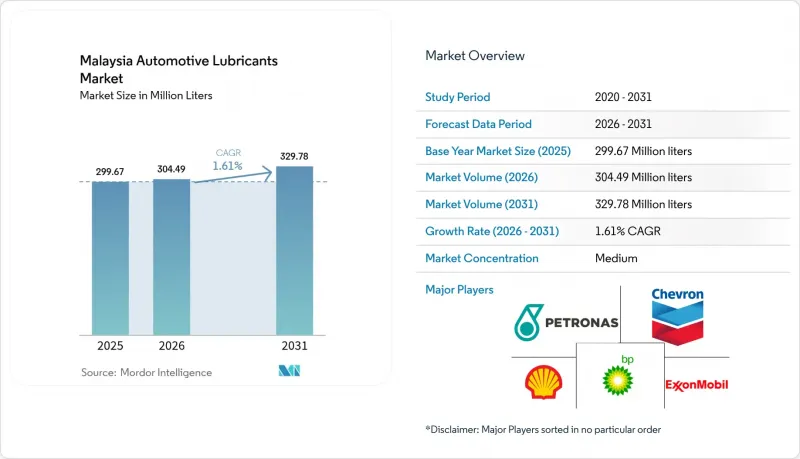
本報告按產品類型(汽車引擎油、手排變速箱油、自動變速箱油、煞車油、汽車潤滑脂及其他產品類型)和車輛類型(乘用車、商用車、摩托車)進行細分。市場預測以銷售量(公升)為單位。
馬來西亞汽車潤滑油市場趨勢與洞察
車輛擁有數量增加和汽車擁有率高
2024年1月至3月,車輛登記量達202,245輛,較去年同期成長5%。這證實了車輛營運數量與潤滑油消耗量之間存在密切關聯。隨著新車進入需要使用優質合成潤滑油的保養週期,老舊車輛的更換需求也不斷增加。柔佛新山和檳城等區域性城市人口密度的增加,為推廣認證產品的正規服務模式創造了新的市場機會。同期,國內組裝量(210,431輛)進一步推動了整車廠商的工廠銷售和售後市場銷售。隨著車輛平均使用壽命的延長,定期保養變得愈發重要,從而持續推高潤滑油消耗量。
Quicklube鏈條和OEM服務中心的擴張
馬來西亞國家石油公司旗下的AutoExpert宣佈在全國開設100家門市,提供標準化服務,以確保潤滑油品質並增強品牌忠誠度。與線上零售商的合作能夠實現快速市場拓展,並觸及現有基本客群。諸如森那美汽車(Sime Darby Motors)的「Drivecare」等由汽車製造商主導的舉措,凸顯了汽車製造商自主管理整個保養流程並確保高利潤潤滑油銷售的決心。連鎖店利用集中採購和技師培訓,在性價比方面超越了獨立維修店。這一趨勢正在推動優質化,因為為了滿足保固要求,潤滑油的規格必須與普通礦物油相符,而必須符合精確的規格。
混合動力汽車/純電動汽車的日益普及給引擎油銷售量帶來了壓力。
儘管電動車 (EV) 和混合動力汽車(HEV) 在 2024 年約佔汽車總銷量的 2-3%,但到 2030 年達到 15% 的政策目標預計將會降低對內燃機潤滑油的需求。聯邦政府已撥款 24 億馬來西亞馬幣用於發展充電基礎設施和鼓勵國內組裝。為此,供應商正在推出電動車溫度控管液,例如 UMW Grantt 於 2024 年 7 月宣布推出的煞車油和冷卻液產品線。這些新產品的單價較高,無法完全抵消機油需求下降的影響,因為機油的消耗量龐大。車輛的電氣化,尤其是在最後一公里物流領域,進一步加劇了需求壓力,因為行駛距離越長,需求下降的趨勢就越明顯。
細分市場分析
2025年,機油在馬來西亞汽車潤滑油市場仍佔55.26%的佔有率。這主要歸因於內燃機在該國汽車保有量中的持續主導地位。 2025年實施的認證法規提高了平行輸入的門檻,有助於現有供應商維持銷售量。然而,隨著該品類日趨成熟,成長速度正在放緩,製造商正轉向生產高附加價值的合成油。相較之下,隨著多速變速箱在搭乘用和皮卡車中日益普及,自動變速箱油(ATF)預計將以1.82%的複合年成長率成長。 Pentas Flora公司在馬來西亞本地進行的II類煉油工藝能夠降低成本並回收原料,從而以具有競爭力的價格生產優質ATF。
國內調配商正利用F1賽車技術轉移,生產具有卓越剪切穩定性的合成油,以適應走走停停的都市區駕駛循環。儘管手排變速箱油和煞車油的替換需求仍然強勁,但由於手排變速箱本身的長期衰退,銷售成長受到限制。動力方向盤油、潤滑脂和液壓油等特殊油品領域,在車輛電氣化進程的推動下,正從小規模的基數成長,而車輛電氣化需要專用冷卻液和絕緣材料。在預測期內,優質化將推動平均銷售量以高於銷售成長的速度上漲,因此產品組合的精細化將成為營收成長的主要驅動力。
其他好處:
- Excel格式的市場預測(ME)表
- 3個月的分析師支持
目錄
第1章:引言
- 研究假設和市場定義
- 調查範圍
第2章:調查方法
第3章執行摘要
第4章 市場狀況
- 市場概覽
- 市場促進因素
- 汽車擁有量增加和汽車擁有率高
- Quicklube鏈條和OEM服務中心的擴張
- 柴油燃料補貼制度改革後,過渡到低黏度合成油。
- 該命令強制要求對機油進行認證,以遏制仿冒品。
- 棕櫚油衍生生物潤滑劑的研究與開發;保障國內原料供應。
- 市場限制因素
- 混合動力車/純電動車的日益普及導致了機油銷售量的下降。
- 由於成本因素,燃油補貼的減少導致換油週期延長。
- 比品牌產品更便宜的灰色/非法石油產品。
- 價值鍊和通路分析
- 波特五力模型
- 法律規範
- 汽車產業的發展趨勢
第5章 市場規模與成長預測
- 依產品類型
- 汽車引擎油
- 0W-XX
- 5W-XX
- 10W-XX
- 15W-XX
- 單級
- 其他年級
- 手排變速箱油(MTF)
- 自排變速箱油(ATF)
- 煞車油
- 汽車潤滑脂
- 其他產品類型(例如動力方向盤機油)
- 汽車引擎油
- 車輛類型
- 搭乘用車
- 商用車輛
- 摩托車
第6章 競爭情勢
- 市場集中度
- 策略趨勢
- 市佔率(%)** / 排名分析
- 公司簡介
- Add Oil.(M)SDN BHD
- Advance Lube Enterprise Sdn Bhd
- AMSOIL INC.
- BP plc
- Chevron Corporation
- ENEOS Corporation
- ENOC Company
- Exxon Mobil Corporation
- Feoso Oil(Malaysia)Sdn.Bhd.
- FUCHS
- Idemitsu Kosan Co Ltd
- LIQUI MOLY
- Motul
- PENTAS FLORA
- Petromin Corporation
- Petron
- PETRONAS Lubricants International
- PTT LUBRICANTS
- Saudi Arabian Oil Co.
- Shell plc
- TotalEnergies
第7章 市場機會與未來展望
第8章:執行長面臨的關鍵策略挑戰
According to Mordor Intelligence, the Malaysia automotive lubricants market size is expected to grow from 299.67 million liters in 2025 to 304.49 million liters in 2026 and is forecast to reach 329.78 million liters by 2031 at 1.61% CAGR over 2026-2031.
This report is Segmented by Product Type (Automotive Engine Oil, Manual Transmission Fluids, Automatic Transmission Fluids, Brake Fluids, Automotive Greases, and Other Product Types) and Vehicle Type (Passenger Vehicles, Commercial Vehicles, and Two-Wheelers). The Market Forecasts are Provided in Terms of Volume (liters).
Malaysia Automotive Lubricants Market Trends and Insights
Rising vehicle-parc growth and high motorization
Vehicle registrations reached 202,245 units between January and March 2024, up 5% year-over-year, reinforcing a robust link between parc size and lubricant consumption. Newer cars enter the maintenance cycle requiring premium synthetic oils, while aging vehicles increase replacement demand. Secondary urban centers, such as Johor Bahru and Penang, witness an increasing density, opening up white space for organized service formats that push certified products. Domestic assembly volumes-210,431 units in the same period-further support OEM factory-fill as well as aftermarket sales. As average vehicle age rises, adherence to scheduled maintenance becomes more critical, driving sustained lubricant turnover.
Acceleration of quick-lube chains and OEM service centers
PETRONAS AutoExpert has announced 100 outlets nationwide, using standardized servicing to assure lubricant quality and strengthen brand loyalty. Partnerships with digital retailers enable rapid market roll-out and access to established customer pools. OEM initiatives such as Sime Darby Motors' Drivecare highlight automakers' intent to own the maintenance journey and capture high-margin fluid sales. Chain formats utilize centralized procurement and technician training to outperform independent workshops in terms of price-to-service value. The trend supports premiumization because warranty compliance favors exact-spec lubricants over generic mineral grades.
Rising HEV/BEV penetration compressing engine-oil volumes
Electric and hybrid vehicles accounted for roughly 2-3% of 2024 sales, but policy targets of 15% by 2030 will reduce internal-combustion lubricant demand. Federal allocations totaling MYR 2.4 billion back charging corridors and local assembly incentives. Suppliers respond by introducing EV thermal-management fluids, as seen in UMW Grantt's brake fluid and coolant line released in July 2024. Although these new products carry a higher unit value, they cannot fully offset the displacement of high-volume engine oil. Fleet electrification, especially in last-mile logistics, adds downward pressure because high mileage amplifies the lost demand.
Other drivers and restraints analyzed in the detailed report include:
- Shift to low-viscosity synthetics after diesel subsidy reform
- Mandatory engine-oil certification order curbing counterfeits
- Cost-driven drain-interval stretching after fuel-subsidy cuts
For complete list of drivers and restraints, kindly check the Table Of Contents.
Segment Analysis
Engine oil retained a 55.26% share of the Malaysian automotive lubricants market in 2025, as internal-combustion engines still dominate the national vehicle parc. Certification rules effective in 2025 raise barriers for parallel imports, helping established suppliers defend volumes. Nevertheless, growth tapers as the category matures, prompting producers to shift toward value-added synthetics. Automatic-transmission fluids, in contrast, are expected to expand at a 1.82% CAGR as multi-speed gearboxes become more prevalent across both passenger sedans and pickups. Local Group II refines from Pentas Flora, trimming costs and closing the feedstock loop, enabling competitively priced premium ATF formulations.
Domestic blenders utilize Formula 1 transfer technology to produce shear-stable synthetics, suitable for stop-and-go urban duty cycles. Manual-transmission and brake fluids hold steady replacement demand but lack volume lift because manual transmissions are in secular decline. Specialty segments-power steering fluids, greases, and hydraulic oils-grow from a smaller base, driven by vehicle electrification that requires dedicated coolant and dielectric fluids. Over the forecast period, premiumization lifts average selling price faster than liters, so product-mix upgrades become the principal driver of revenue.
Complete Report Scope:
- By Product Type
- Automotive Engine Oil
- 0W-XX
- 5W-XX
- 10W-XX
- 15W-XX
- Monogrades
- Other Grades
- Manual Transmission Fluids (MTF)
- Automatic Transmission Fluids (ATF)
- Brake Fluids
- Automotive Greases
- Other Product Types (Power Steering Fluid etc.)
- Automotive Engine Oil
- By Vehicle Type
- Passenger Vehicles
- Commercial Vehicles
- Two-Wheelers
List of Companies Covered in this Report:
- Add Oil. (M) SDN BHD
- Advance Lube Enterprise Sdn Bhd
- AMSOIL INC.
- BP p.l.c.
- Chevron Corporation
- ENEOS Corporation
- ENOC Company
- Exxon Mobil Corporation
- Feoso Oil (Malaysia) Sdn.Bhd.
- FUCHS
- Idemitsu Kosan Co Ltd
- LIQUI MOLY
- Motul
- PENTAS FLORA
- Petromin Corporation
- Petron
- PETRONAS Lubricants International
- PTT LUBRICANTS
- Saudi Arabian Oil Co.
- Shell plc
- TotalEnergies
Additional Benefits:
- The market estimate (ME) sheet in Excel format
- 3 months of analyst support
TABLE OF CONTENTS
1 Introduction
- 1.1 Study Assumptions and Market Definition
- 1.2 Scope of the Study
2 Research Methodology
3 Executive Summary
4 Market Landscape
- 4.1 Market Overview
- 4.2 Market Drivers
- 4.2.1 Rising vehicle-parc growth and high motorisation
- 4.2.2 Acceleration of quick-lube chains and OEM service centres
- 4.2.3 Shift to low-viscosity synthetics post-diesel subsidy reform
- 4.2.4 Mandatory Engine-Oil Certification Order curbing counterfeits
- 4.2.5 Palm-oil bio-lubricant R&D bolstering domestic feedstock
- 4.3 Market Restraints
- 4.3.1 Rising HEV/BEV penetration compressing engine-oil volumes
- 4.3.2 Cost-driven drain-interval stretching after fuel-subsidy cuts
- 4.3.3 Grey-/illicit oils undercutting branded players
- 4.4 Value Chain and Distribution Channel Analysis
- 4.5 Porter's Five Forces
- 4.5.1 Threat of New Entrants
- 4.5.2 Bargaining Power of Suppliers
- 4.5.3 Bargaining Power of Buyers
- 4.5.4 Threat of Substitutes
- 4.5.5 Industry Rivalry
- 4.6 Regulatory Framework
- 4.7 Automotive Industry Trends
5 Market Size and Growth Forecasts (Volume)
- 5.1 By Product Type
- 5.1.1 Automotive Engine Oil
- 5.1.1.1 0W-XX
- 5.1.1.2 5W-XX
- 5.1.1.3 10W-XX
- 5.1.1.4 15W-XX
- 5.1.1.5 Monogrades
- 5.1.1.6 Other Grades
- 5.1.2 Manual Transmission Fluids (MTF)
- 5.1.3 Automatic Transmission Fluids (ATF)
- 5.1.4 Brake Fluids
- 5.1.5 Automotive Greases
- 5.1.6 Other Product Types (Power Steering Fluid etc.)
- 5.1.1 Automotive Engine Oil
- 5.2 By Vehicle Type
- 5.2.1 Passenger Vehicles
- 5.2.2 Commercial Vehicles
- 5.2.3 Two-Wheelers
6 Competitive Landscape
- 6.1 Market Concentration
- 6.2 Strategic Moves
- 6.3 Market Share (%)**/Ranking Analysis
- 6.4 Company Profiles (includes Global level Overview, Market level overview, Core Segments, Financials as available, Production Capacity, Strategic Information, Market Rank/Share for key companies, Products and Services, and Recent Developments)
- 6.4.1 Add Oil. (M) SDN BHD
- 6.4.2 Advance Lube Enterprise Sdn Bhd
- 6.4.3 AMSOIL INC.
- 6.4.4 BP p.l.c.
- 6.4.5 Chevron Corporation
- 6.4.6 ENEOS Corporation
- 6.4.7 ENOC Company
- 6.4.8 Exxon Mobil Corporation
- 6.4.9 Feoso Oil (Malaysia) Sdn.Bhd.
- 6.4.10 FUCHS
- 6.4.11 Idemitsu Kosan Co Ltd
- 6.4.12 LIQUI MOLY
- 6.4.13 Motul
- 6.4.14 PENTAS FLORA
- 6.4.15 Petromin Corporation
- 6.4.16 Petron
- 6.4.17 PETRONAS Lubricants International
- 6.4.18 PTT LUBRICANTS
- 6.4.19 Saudi Arabian Oil Co.
- 6.4.20 Shell plc
- 6.4.21 TotalEnergies
7 Market Opportunities and Future Outlook
- 7.1 White-space and Unmet-need Assessment
8 Key Strategic Questions for CEOs

 日本汽車潤滑油市場:市場佔有率分析、產業趨勢與統計及成長預測(2026-2031)泰國汽車潤滑油市場:市場佔有率分析、產業趨勢與統計及成長預測(2026-2031)越南汽車潤滑油市場:市場佔有率分析、產業趨勢與統計及成長預測(2026-2031)非洲汽車潤滑油:市場佔有率分析、產業趨勢與統計及成長預測(2026-2031 年)中國汽車潤滑油市場:市場佔有率分析、產業趨勢與統計及成長預測(2026-2031年)北美汽車潤滑油:市場佔有率分析、產業趨勢與統計及成長預測(2026-2031 年)德國汽車潤滑油市場:市場佔有率分析、產業趨勢與統計及成長預測(2026-2031)法國汽車潤滑油市場:市場佔有率分析、產業趨勢與統計及成長預測(2026-2031)
 2026-2034年全球汽車潤滑油市場規模、佔有率、趨勢及成長分析報告印度汽車潤滑油:市場佔有率分析、產業趨勢與統計及成長預測(2026-2031)