


 |
市場調查報告書
商品編碼
2114386
印度汽車潤滑油:市場佔有率分析、產業趨勢與統計及成長預測(2026-2031)India Automotive Lubricants - Market Share Analysis, Industry Trends & Statistics, Growth Forecasts (2026 - 2031) |
||||||

※ 本網頁內容可能與最新版本有所差異。詳細情況請與我們聯繫。
據 Mordor Intelligence 稱,2025 年印度汽車潤滑油市值為 25.1 億公升,預計到 2031 年將達到 29.2 億公升,而 2026 年為 25.7 億公升,預測期(2026-2031 年)的複合年成長率為 2.52%。
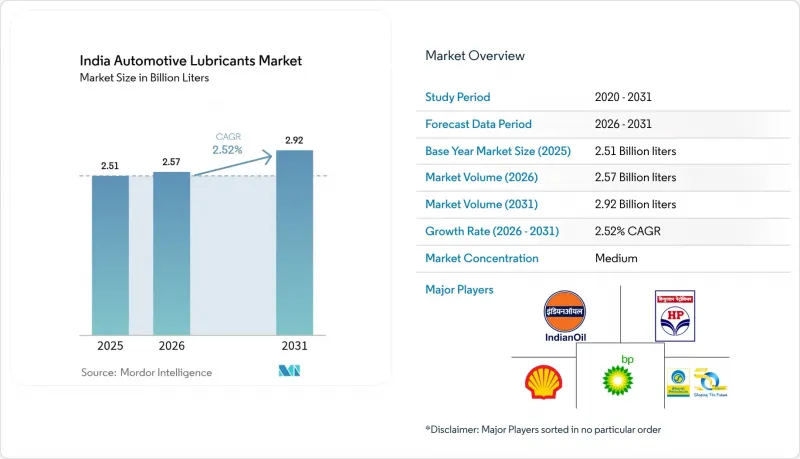
本報告按產品類型(汽車引擎油、手排變速箱油、自動變速箱油、煞車油、汽車潤滑脂及其他產品類型)和車輛類型(乘用車、商用車和摩托車)進行分類。市場預測以銷售量(公升)為單位。
印度汽車潤滑油市場趨勢與洞察
汽車保有量和乘用車銷量增加
2024會計年度,受8.2%的GDP成長和消費者信心的提升推動,乘用車產量恢復了9.9%。新車型的推出,尤其是緊湊型SUV,刺激了對符合API SP標準的合成機油的初始補充需求,而不斷提高的功率重量比也催生了對具有卓越熱穩定性的優質潤滑油的需求。儘管印度輕型車輛的換油週期已延長,但由於其平均年行駛里程為12,000公里,因此仍需每年更換2-3次機油,從而保證了售後市場的持續需求。經銷商的服務計畫通常包含品牌潤滑油,以促進客戶遵守原廠建議的潤滑油等級。因此,印度汽車潤滑油市場受惠於原廠補充裝和維修店持續的需求週期。
印度農村地區二輪車普及率的快速成長
受農村收入成長和「總理鄉村道路計畫」(Pradhan Mantri Gram Sadak Yojana)帶來的道路網路改善的推動,摩托車保有量持續上升,摩托車和踏板車仍然是主要的交通工具。頻繁的換油週期(3000-4000公里)也帶來了對潤滑油的持續需求。 100-125cc排氣量的車型仍然最受歡迎,儘管都市區消費者轉向電動車型,但由於許多人仍然使用礦物油或半合成油,摩托車的保有量仍然保持穩定。市場領導者Hero MotoCorp和Honda繼續透過村級維修技師進行分銷,這使得品牌潤滑油製造商能夠拓展其在農村地區的銷售網路。因此,摩托車市場構成了支撐印度低收入地區汽車潤滑油市場強勁成長的基礎。
兩輪和三輪車輛的快速電氣化
FAME-II獎勵和各邦政府的補貼正在加速電動滑板車和三輪車在最後一公里配送領域的普及。電動動力傳動系統無需使用引擎油,並減少了變速箱油的使用,從而降低了傳統潤滑油的消耗。然而,電動車的出現也催生了一些新的細分市場,例如用於電池溫度控管的介電冷卻劑和用於單速減速齒輪的低黏度齒輪油。 Savita Oil Technologies公司近期已將用於這些應用的合成酯基潤滑油商業化。雖然到2030年,這些因素對整體市場規模的影響仍然較小,但這項限制正在減緩印度汽車潤滑油市場傳統潤滑油領域的成長。
細分市場分析
預計到2025年,印度汽車潤滑油市場中,機油將佔總銷售量的58.12%。符合API SP和ILSAC GF-6標準的潤滑油產品在BS-VI引擎中越來越受歡迎,因為這些引擎需要具備抗氧化性和活塞清潔性能。儘管全合成潤滑油的價格上漲了30%,但由於銷量相對平穩,其市佔率仍在持續成長。車隊試驗表明,使用低黏度0W-20潤滑油可提高2%的燃油效率,這推動了其在大都會圈共乘車隊的應用。與歷史數據相比,由於特種潤滑油的擴張,機油的市場佔有率略有下降,但該細分市場仍然是印度汽車潤滑油市場的基石。
自動變速箱油 (ATF) 是規模最小但成長最快的細分市場,預計到 2031 年將以 2.63% 的年複合成長率(CAGR)成長。這一成長主要得益於緊湊型轎車和 SUV 中 CVT 和 AMT 變速箱的日益普及。此外,汽車製造商正在將城市公車的變速箱升級為 6 速自動變速箱,這推動了對符合 TES-295 標準、能夠滿足 12 萬公里換油週期的變速箱油的需求。為了滿足液力變矩器氧化測試標準,調配商正在投資研發高品質的 III 類和 PAO 基 ATF。因此,ATF產品系列日益多元化,推高了印度汽車潤滑油市場規模計算中的平均售價。
其他好處
- Excel格式的市場預測(ME)表
- 3個月的分析師支持
目錄
第1章:引言
- 研究假設和市場定義
- 調查範圍
第2章:調查方法
第3章執行摘要
第4章 市場狀況
- 市場概覽
- 市場促進因素
- 汽車保有量和乘用車銷量增加
- 印度農村地區二輪車普及率的快速成長
- BS-VI排放標準實施後,過渡到高性能合成油。
- 由於原始設備製造商 (OEM) 與工廠填充商之間的合作,潤滑油用量增加。
- 由於共乘車輛數量不斷增加,換油頻率也隨之增加。
- 市場限制因素
- 兩輪和三輪車輛的快速電氣化
- 基礎油價格波動
- 向精煉基礎油的轉變導致對初榨油的需求下降。
- 價值鍊和通路分析
- 波特五力模型
- 法律規範
- 汽車產業的發展趨勢
第5章 市場規模與成長預測
- 依產品類型
- 汽車引擎油
- 0W-XX
- 5W-XX
- 10W-XX
- 15W-XX
- 單級
- 其他
- 手排變速箱油(MTF)
- 自排變速箱油(ATF)
- 煞車油
- 汽車潤滑脂
- 其他產品類型(動力方向盤機油等)
- 汽車引擎油
- 按車輛類型
- 搭乘用車
- 商用車輛
- 摩托車
第6章 競爭情勢
- 市場集中度
- 策略趨勢
- 市佔率(%)和排名分析
- 公司簡介
- Bharat Petroleum Corporation Limited
- BP plc
- Chevron Alkhalij
- ENEOS Corporation
- Exxon Mobil Corporation
- FUCHS
- GP Petroleums
- Gulf Oil International
- Hindustan Petroleum Corporation Limited
- Idemitsu Lubricants India Pvt Ltd
- Indian Oil Corporation Limited
- KLUBER LUBRICATION INDIA Pvt. Ltd.
- Morris Lubricants India
- Motul
- Saudi Arabian Oil Co.
- Savita Oil Technologies Limited
- Shell Plc
- TotalEnergies
- Veedol Corporation Limited
第7章 市場機會與未來展望
第8章:執行長面臨的關鍵策略挑戰
According to Mordor Intelligence, the India automotive lubricants market size was valued at 2.51 billion liters in 2025 and estimated to grow from 2.57 billion liters in 2026 to reach 2.92 billion liters by 2031, at a CAGR of 2.52% during the forecast period (2026-2031).
This report is Segmented by Product Type (Automotive Engine Oil, Manual Transmission Fluids, Automatic Transmission Fluids, Brake Fluids, Automotive Greases, and Other Product Types) and Vehicle Type (Passenger Vehicles, Commercial Vehicles, and Two-Wheelers). The Market Forecasts are Provided in Terms of Volume (liters).
India Automotive Lubricants Market Trends and Insights
Rising Vehicle Parc and Passenger-Car Sales
Passenger-car production rebounded 9.9% in FY 2024 as GDP grew 8.2% and consumer sentiment recovered. New models, especially compact SUVs, stimulate first-fill demand for API SP synthetics, and higher power-to-weight ratios necessitate premium lubricants for thermal stability. Recurring aftermarket volumes follow because the average Indian light vehicle clocks 12,000 km annually, still requiring two to three oil changes a year despite extended drain intervals. Dealer service programs bundle branded lubricants, improving compliance with OEM-recommended grades. Consequently, India automotive lubricants market benefits from both initial factory fills and sustained workshop demand cycles.
Two-Wheeler Penetration Surge in Rural India
Rising rural incomes and improved road connectivity, facilitated by the Pradhan Mantri Gram Sadak Yojana, continue to boost two-wheeler ownership, with motorcycles and scooters serving as the primary means of mobility. Frequent oil-change intervals of 3,000-4,000 km generate recurring lubricant demand. Penetration remains highest for 100-125 cc models, many of which still use mineral or semi-synthetic oils, preserving volume even as urban consumers shift to electric variants. Market leaders Hero MotoCorp and Honda sustain outreach programs through village-level mechanics, enabling branded lubricant companies to deepen rural distribution. The two-wheeler segment, therefore, anchors volume resilience for the India automotive lubricants market in lower-income geographies.
Rapid Electrification of 2- & 3-Wheelers
FAME-II incentives and state-level subsidies have accelerated the adoption of electric scooters and three-wheelers for last-mile deliveries. Electric powertrains eliminate engine oil requirements and reduce transmission fluid volumes, thereby reducing traditional lubricant consumption. Still, EVs introduce new niches-dielectric coolants for battery thermal management and low-viscosity gear oils for single-speed reducers. Savita Oil Technologies recently commercialized synthetic ester fluids targeting these applications. While overall volume impact remains modest to 2030, the restraint trims growth of conventional segments within India automotive lubricants market.
Other drivers and restraints analyzed in the detailed report include:
- Shift to High-Performance Synthetics Post-BS-VI
- OEM Factory-Fill Tie-Ups Expanding Lubricant Volume
- Base-Oil Price Volatility
For complete list of drivers and restraints, kindly check the Table Of Contents.
Segment Analysis
India automotive lubricants market size for engine oils totaled 58.12% share of total volumes in 2025. API SP and ILSAC GF-6 formulations are gaining traction because BS-VI engines require improved oxidation resistance and piston cleanliness. Fully synthetic variants fetch 30% higher prices, lifting segment value despite flat volumes. Fleet trials show a 2 % fuel-economy gain using low-viscosity 0W-20 oils, encouraging adoption across ride-hailing fleets in metropolitan areas. Historical comparisons reveal that the share of engine oil is declining marginally as specialty fluids expand, yet the segment remains the anchor of India's automotive lubricants market.
Automatic transmission fluids constitute a smaller but fastest-growing pocket, with projected volumes rising at a 2.63% CAGR through 2031. Growth stems from the rising penetration of CVT and AMT gearboxes in compact cars and SUVs. OEMs also shift city-bus fleets to six-speed automatics, spurring demand for TES-295-grade fluids capable of 120,000 km service intervals. Blenders invest in premium Group III and PAO-based ATFs to meet torque-converter oxidation tests. As a result, ATFs increasingly diversify product portfolios and improve average realizations within India automotive lubricants market size calculations.
Complete Report Scope:
- By Product Type
- Automotive Engine Oil
- 0W-XX
- 5W-XX
- 10W-XX
- 15W-XX
- Monogrades
- Other Grades
- Manual Transmission Fluids (MTF)
- Automatic Transmission Fluids (ATF)
- Brake Fluids
- Automotive Greases
- Other Product Types (Power Steering Fluid etc.)
- Automotive Engine Oil
- By Vehicle Type
- Passenger Vehicles
- Commercial Vehicles
- Two-Wheelers
List of Companies Covered in this Report:
- Bharat Petroleum Corporation Limited
- BP p.l.c.
- Chevron Alkhalij
- ENEOS Corporation
- Exxon Mobil Corporation
- FUCHS
- GP Petroleums
- Gulf Oil International
- Hindustan Petroleum Corporation Limited
- Idemitsu Lubricants India Pvt Ltd
- Indian Oil Corporation Limited
- KLUBER LUBRICATION INDIA Pvt. Ltd.
- Morris Lubricants India
- Motul
- Saudi Arabian Oil Co.
- Savita Oil Technologies Limited
- Shell Plc
- TotalEnergies
- Veedol Corporation Limited
Additional Benefits:
- The market estimate (ME) sheet in Excel format
- 3 months of analyst support
TABLE OF CONTENTS
1 Introduction
- 1.1 Study Assumptions and Market Definition
- 1.2 Scope of the Study
2 Research Methodology
3 Executive Summary
4 Market Landscape
- 4.1 Market Overview
- 4.2 Market Drivers
- 4.2.1 Rising vehicle parc and passenger-car sales
- 4.2.2 Two-wheeler penetration surge in rural India
- 4.2.3 Shift to high-performance synthetics post-BS-VI
- 4.2.4 OEM factory-fill tie-ups expanding lubricant volume
- 4.2.5 Growth of shared-mobility fleets driving higher churn
- 4.3 Market Restraints
- 4.3.1 Rapid electrification of 2- & 3-wheelers
- 4.3.2 Base-oil price volatility
- 4.3.3 Push toward re-refined base oils reducing virgin demand
- 4.4 Value Chain and Distribution Channel Analysis
- 4.5 Porter's Five Forces
- 4.5.1 Threat of New Entrants
- 4.5.2 Bargaining Power of Suppliers
- 4.5.3 Bargaining Power of Buyers
- 4.5.4 Threat of Substitutes
- 4.5.5 Industry Rivalry
- 4.6 Regulatory Framework
- 4.7 Automotive Industry Trends
5 Market Size and Growth Forecasts (Volume)
- 5.1 By Product Type
- 5.1.1 Automotive Engine Oil
- 5.1.1.1 0W-XX
- 5.1.1.2 5W-XX
- 5.1.1.3 10W-XX
- 5.1.1.4 15W-XX
- 5.1.1.5 Monogrades
- 5.1.1.6 Other Grades
- 5.1.2 Manual Transmission Fluids (MTF)
- 5.1.3 Automatic Transmission Fluids (ATF)
- 5.1.4 Brake Fluids
- 5.1.5 Automotive Greases
- 5.1.6 Other Product Types (Power Steering Fluid etc.)
- 5.1.1 Automotive Engine Oil
- 5.2 By Vehicle Type
- 5.2.1 Passenger Vehicles
- 5.2.2 Commercial Vehicles
- 5.2.3 Two-Wheelers
6 Competitive Landscape
- 6.1 Market Concentration
- 6.2 Strategic Moves
- 6.3 Market Share (%)**/Ranking Analysis
- 6.4 Company Profiles (includes Global level Overview, Market level overview, Core Segments, Financials as available, Production Capacity, Strategic Information, Market Rank/Share for key companies, Products and Services, and Recent Developments)
- 6.4.1 Bharat Petroleum Corporation Limited
- 6.4.2 BP p.l.c.
- 6.4.3 Chevron Alkhalij
- 6.4.4 ENEOS Corporation
- 6.4.5 Exxon Mobil Corporation
- 6.4.6 FUCHS
- 6.4.7 GP Petroleums
- 6.4.8 Gulf Oil International
- 6.4.9 Hindustan Petroleum Corporation Limited
- 6.4.10 Idemitsu Lubricants India Pvt Ltd
- 6.4.11 Indian Oil Corporation Limited
- 6.4.12 KLUBER LUBRICATION INDIA Pvt. Ltd.
- 6.4.13 Morris Lubricants India
- 6.4.14 Motul
- 6.4.15 Saudi Arabian Oil Co.
- 6.4.16 Savita Oil Technologies Limited
- 6.4.17 Shell Plc
- 6.4.18 TotalEnergies
- 6.4.19 Veedol Corporation Limited
7 Market Opportunities and Future Outlook
- 7.1 White-space and Unmet-need Assessment
8 Key Strategic Questions for CEOs

 日本汽車潤滑油市場:市場佔有率分析、產業趨勢與統計及成長預測(2026-2031)泰國汽車潤滑油市場:市場佔有率分析、產業趨勢與統計及成長預測(2026-2031)越南汽車潤滑油市場:市場佔有率分析、產業趨勢與統計及成長預測(2026-2031)非洲汽車潤滑油:市場佔有率分析、產業趨勢與統計及成長預測(2026-2031 年)馬來西亞汽車潤滑油:市場佔有率分析、產業趨勢與統計及成長預測(2026-2031)中國汽車潤滑油市場:市場佔有率分析、產業趨勢與統計及成長預測(2026-2031年)北美汽車潤滑油:市場佔有率分析、產業趨勢與統計及成長預測(2026-2031 年)德國汽車潤滑油市場:市場佔有率分析、產業趨勢與統計及成長預測(2026-2031)法國汽車潤滑油市場:市場佔有率分析、產業趨勢與統計及成長預測(2026-2031)
 2026-2034年全球汽車潤滑油市場規模、佔有率、趨勢及成長分析報告