


 |
市場調查報告書
商品編碼
2116383
中國汽車潤滑油市場:市場佔有率分析、產業趨勢與統計及成長預測(2026-2031年)China Automotive Lubricants - Market Share Analysis, Industry Trends & Statistics, Growth Forecasts (2026 - 2031) |
||||||

※ 本網頁內容可能與最新版本有所差異。詳細情況請與我們聯繫。
根據 Mordor Intelligence 預測,中國汽車潤滑油市場規模預計將從 2025 年的 34.8 億公升成長到 2026 年的 34.9 億公升,然後從 2026 年到 2031 年以 0.17% 的複合年成長率成長,到 2031 億年達到 35.2 年。
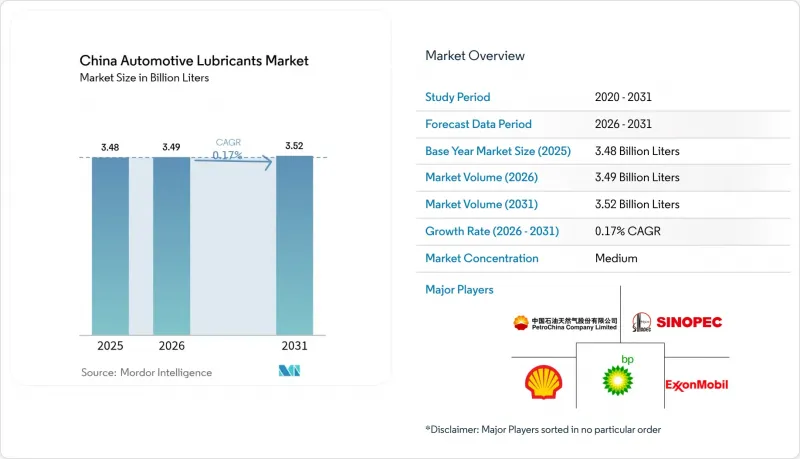
本報告按產品類型(汽車引擎油、手排變速箱油、自動變速箱油、煞車油、汽車潤滑脂及其他產品類型)和車輛類型(乘用車、商用車和摩托車)進行分類。市場預測以銷售量(公升)為單位。
中國汽車潤滑油市場趨勢與洞察
消費者對原廠認證合成油的偏好正在轉變。
汽車製造商現在指定使用低灰分API SP或ILSAC GF-7機油,以保護汽油顆粒過濾器並減少低速行駛時的預燃現象。新的ILSAC標準將於2025年3月生效,該標準要求供應商使用高純度合成基礎油和先進的抗氧化劑配方來重新配製機油。一線城市的消費者重視延長換油週期和提高燃油效率的好處,這推動了0W-20和5W-30機油的快速普及。不斷上漲的認證成本構成了准入壁壘,有利於那些擁有強大研發能力的成熟製造商。隨著符合品質保證要求成為關鍵的購買因素,優質合成機油的價格優勢足以抵銷因電氣化而導致的銷售量下滑。
電動動力傳動系統總成潤滑油配方改進
混合動力和電動車平檯面臨傳統潤滑油無法應對的挑戰,包括間歇性燃燒循環、高熱負荷以及冷卻液污染的風險。供應商正在開發高酯合成油,並改進添加劑的化學成分,以在反覆啟停操作中穩定黏度,並在高壓零件附近保持介電強度。路博潤公司發布的2025年白皮書將黏度剪切控制、銅腐蝕性和多燃料相容性列為關鍵研究重點。滿足這些需求有利於那些能夠投資摩擦學建模和電池-冷卻液相互作用研究的公司,從而使技術主導跨國公司和資金雄厚的國內創新者獲得競爭優勢。
電動車數量的增加正在蠶食內燃機油的需求。
預計到2024年,純電動車的銷售量將佔總銷售量的50%,大都會圈的引擎機油銷售量正呈下降趨勢。電動滑板車目前已佔據兩輪出行市場25%的佔有率,預計到2029年這一佔有率將幾乎加倍,這可能導致小型引擎潤滑油的需求下降。物流公司正在進行無需曲軸箱潤滑油的電池驅動電動貨車試點項目,與此同時,變速箱油和絕緣冷卻液的需求略有上升。各地區充電基礎設施的密度與機油銷量的下降密切相關,這迫使供應商透過推出電動車專用產品和服務組合來規避風險,以在銷售量下降的情況下維持市場佔有率。
細分市場分析
預計到2025年,汽車引擎機油的需求將佔中國汽車潤滑油市場總需求的63.70%,凸顯其核心地位。這一細分市場的成長主要得益於中國VI-B法規的實施,該法規推薦使用低黏度合成油,導致銷售量略有下降,但高級產品佔比提高,價格實現也更佳。雖然一級維修店已基本完成向半合成油的過渡,但三級維修店的滲透率仍然是推動要素。同時,自動變速箱油(ATF)的銷量雖然仍處於個位數中段水平,但預計到2031年將以0.23%的複合年成長率成長,這主要得益於混合動力汽車中CVT和雙離合器技術的日益普及。煞車油和潤滑脂雖然定位小眾,但技術要求很高,電動車馬達軸承潤滑脂和DOT 4以上煞車油市場仍有進一步成長的潛力。儘管由於電動系統的日益普及,動力方向盤液的需求正在下降,但高壓電池組用介電冷卻劑的新需求在一定程度上抵消了這一降幅,而介電冷卻劑並不屬於傳統潤滑油的範疇。那些將機油、自動變速箱油和新興電動車用油等產品組合銷售的供應商,預計在擴大市場佔有率的同時,緩解傳統產品銷售下滑的影響。
在產品競爭中,同時擁有API/ACEA認證和本地OEM推薦的企業具有優勢。採用III類+或GTL基礎油的合成潤滑油憑藉其卓越的抗氧化穩定性和燃油效率,正在中國汽車潤滑油市場不斷擴大市場佔有率。維修店和車隊透過技術服務、廢油分析和換油週期建議等方式提升服務差異化水平,市場正從單純的桶裝商品銷售轉向一體化的售後服務生態系統。這種轉變凸顯了對添加劑科學、台架測試和現場檢驗能力投資的重要性,而這些能力目前主要集中在跨國公司和國內最大的煉油企業手中。
其他好處:
- Excel格式的市場預測(ME)表
- 3個月的分析師支持
目錄
第1章:引言
- 研究假設和市場定義
- 調查範圍
第2章:調查方法
第3章執行摘要
第4章 市場狀況
- 市場概覽
- 市場促進因素
- 消費者對原廠認證合成油的偏好有所轉變
- 電動動力傳動系統。
- 電子商務售後市場拓展至三線城市。
- 中國的VI-B排放氣體法規變得更加嚴格。
- 本地化OEM工廠灌裝夥伴關係
- 市場限制因素
- 電動車的廣泛普及正在蠶食內燃機汽車對石油的需求。
- 假潤滑劑的氾濫
- 利用工業物聯網感測器延長換油週期
- 價值鍊和通路分析
- 波特五力模型
- 法律規範
- 汽車產業的發展趨勢
第5章 市場規模與成長預測
- 依產品類型
- 汽車引擎油
- 0W-XX
- 5W-XX
- 10W-XX
- 15W-XX
- 單級
- 其他年級
- 手排變速箱油(MTF)
- 自排變速箱油(ATF)
- 煞車油
- 汽車潤滑脂
- 其他產品類型(例如動力方向盤機油)
- 汽車引擎油
- 車輛類型
- 搭乘用車
- 商用車輛
- 摩托車
第6章 競爭情勢
- 市場集中度
- 策略趨勢
- 市佔率(%)** / 排名分析
- 公司簡介
- BP plc
- Chevron Corporation
- China National Petroleum Corporation
- China Petrochemical Corporation
- ENEOS Corporation
- Exxon Mobil Corporation
- FUCHS
- Gulf Oil
- Idemitsu Kosan Co., Ltd
- Jiangsu Gaoke Petrochemical Co., Ltd
- Jiangsu Lopal Tech Co., Ltd
- LUKOIL
- PetroChina Company Limited
- Qingdao COPTON Technology Co., Ltd
- Saudi Arabian Oil Co.
- Shell plc
- SK Enmove
- Tongyi Petrochemical Co., Ltd
- TotalEnergies
第7章 市場機會與未來展望
第8章:執行長面臨的關鍵策略挑戰
According to Mordor Intelligence, the China automotive lubricants market size is expected to grow from 3.48 Billion Liters in 2025 to 3.49 Billion Liters in 2026 and is forecast to reach 3.52 Billion Liters by 2031 at 0.17% CAGR over 2026-2031.
This report is Segmented by Product Type (Automotive Engine Oil, Manual Transmission Fluids, Automatic Transmission Fluids, Brake Fluids, Automotive Greases, and Other Product Types) and Vehicle Type (Passenger Vehicles, Commercial Vehicles, and Two-Wheelers). The Market Forecasts are Provided in Terms of Volume (Litres).
China Automotive Lubricants Market Trends and Insights
Preference Shift to OEM-Approved Synthetics
Automakers now specify low-ash API SP or ILSAC GF-7 oils that protect gasoline particulate filters and mitigate low-speed pre-ignition. The new ILSAC standard, effective March 2025, requires suppliers to reformulate with higher-purity synthetic basestocks and advanced antioxidant packages. Consumers in Tier-1 cities value extended drain intervals and fuel-economy benefits, driving rapid penetration of 0W-20 and 5W-30 grades. Higher certification costs raise barriers to entry, favoring incumbents with robust research and development (R&D) capacities. As warranty compliance becomes a key purchase trigger, premium synthetics command pricing power that offsets the volume softness caused by electrification.
Electrified-powertrain lubricant reformulations
Hybrid and electric platforms impose intermittent combustion cycles, elevated thermal loads, and coolant contamination risks that legacy oils cannot manage. Suppliers are developing ester-rich synthetics with modified additive chemistries to stabilize viscosity during repeat start-stop events and maintain dielectric strength near high-voltage components. A 2025 white paper from Lubrizol identifies viscosity shear control, copper corrosion resistance, and multi-fuel compatibility as key research priorities. These demands reward companies that can invest in tribology modeling and battery-coolant interaction studies, tilting the competitive advantage toward technology-led multinationals and well-capitalized domestic innovators.
Rising EV parc cannibalizing ICE oil demand
With fully electric cars expected to reach a 50% sales share in 2024, engine oil volumes in metropolitan centers are declining. E-scooters already hold a 25% share of two-wheel mobility, and forecasts indicate a near doubling by 2029, potentially sidelining small-engine lubricants. Logistics operators are piloting battery-electric vans that eliminate the need for crankcase oil, although they introduce a minor demand for gear-reducer fluids and dielectric coolants. Regional charging-infrastructure density correlates strongly with engine oil declines, forcing suppliers to hedge with EV-specific SKUs and service bundles that preserve wallet share even as liters fall.
Other drivers and restraints analyzed in the detailed report include:
- E-commerce aftermarket reach to Tier-3 cities
- Stricter China VI-B emission limits
- Counterfeit lubricant proliferation
For complete list of drivers and restraints, kindly check the Table Of Contents.
Segment Analysis
Automotive engine oil retained 63.70% of 2025 demand, underscoring its centrality to the China automotive lubricants market. The segment's resilience stems from China VI-B regulations that favor low-viscosity synthetics, lifting premium mix and price realization even as volume inches down. Semi-synthetic conversion is largely complete in Tier 1 workshops, but Tier 3 penetration remains an upside lever. On the other hand, automatic transmission fluids (ATF) claim only mid-single-digit volumes yet lead growth at a 0.23% CAGR through 2031, thanks to the uptake of CVT and dual-clutch technology in hybrids. Brake fluids and greases occupy niche but technology-intensive roles, with EV motor-bearing greases and DOT 4-plus brake fluids showing incremental upside. Power-steering fluids trend lower as electric systems proliferate, partially offset by the nascent demand for dielectric coolants in high-voltage battery packs, which fall outside traditional lubricant categories. Suppliers that package engine oils with ATF and emerging EV fluids stand to deepen wallet share while buffering against volume erosion in legacy lines.
The competitive hierarchy by product favors players with both API / ACEA certifications and local OEM endorsements. Synthetic formulations employing Group III+ or GTL basestocks enjoy an expanding proportion of the China automotive lubricants market share due to better oxidative stability and fuel-economy edge. Technical service, used-oil analysis, and drain-interval advisory increasingly differentiate offers in workshops and fleet depots, steering the market away from commodity barrels toward integrated aftersales ecosystems. This pivot stresses the importance of investment in additive science, bench testing, and field validation-capabilities concentrated among multinationals and the largest domestic refiners.
Complete Report Scope:
- By Product Type
- Automotive Engine Oil
- 0W-XX
- 5W-XX
- 10W-XX
- 15W-XX
- Monogrades
- Other Grades
- Manual Transmission Fluids (MTF)
- Automatic Transmission Fluids (ATF)
- Brake Fluids
- Automotive Greases
- Other Product Types (Power Steering Fluid etc.)
- Automotive Engine Oil
- By Vehicle Type
- Passenger Vehicles
- Commercial Vehicles
- Two-Wheelers
List of Companies Covered in this Report:
- BP p.l.c.
- Chevron Corporation
- China National Petroleum Corporation
- China Petrochemical Corporation
- ENEOS Corporation
- Exxon Mobil Corporation
- FUCHS
- Gulf Oil
- Idemitsu Kosan Co., Ltd
- Jiangsu Gaoke Petrochemical Co., Ltd
- Jiangsu Lopal Tech Co., Ltd
- LUKOIL
- PetroChina Company Limited
- Qingdao COPTON Technology Co., Ltd
- Saudi Arabian Oil Co.
- Shell plc
- SK Enmove
- Tongyi Petrochemical Co., Ltd
- TotalEnergies
Additional Benefits:
- The market estimate (ME) sheet in Excel format
- 3 months of analyst support
TABLE OF CONTENTS
1 Introduction
- 1.1 Study Assumptions and Market Definition
- 1.2 Scope of the Study
2 Research Methodology
3 Executive Summary
4 Market Landscape
- 4.1 Market Overview
- 4.2 Market Drivers
- 4.2.1 Preference shift to OEM-approved synthetics
- 4.2.2 Electrified-powertrain lubricant reformulations
- 4.2.3 E-commerce aftermarket reach to Tier-3 cities
- 4.2.4 Stricter China VI-B emission limits
- 4.2.5 Localized OEM factory-fill partnerships
- 4.3 Market Restraints
- 4.3.1 Rising EV parc cannibalizing ICE oil demand
- 4.3.2 Counterfeit lubricant proliferation
- 4.3.3 Extended oil-change intervals via IIOT sensors
- 4.4 Value Chain and Distribution Channel Analysis
- 4.5 Porter's Five Forces
- 4.5.1 Threat of New Entrants
- 4.5.2 Bargaining Power of Suppliers
- 4.5.3 Bargaining Power of Buyers
- 4.5.4 Threat of Substitutes
- 4.5.5 Industry Rivalry
- 4.6 Regulatory Framework
- 4.7 Automotive Industry Trends
5 Market Size and Growth Forecasts (Volume)
- 5.1 By Product Type
- 5.1.1 Automotive Engine Oil
- 5.1.1.1 0W-XX
- 5.1.1.2 5W-XX
- 5.1.1.3 10W-XX
- 5.1.1.4 15W-XX
- 5.1.1.5 Monogrades
- 5.1.1.6 Other Grades
- 5.1.2 Manual Transmission Fluids (MTF)
- 5.1.3 Automatic Transmission Fluids (ATF)
- 5.1.4 Brake Fluids
- 5.1.5 Automotive Greases
- 5.1.6 Other Product Types (Power Steering Fluid etc.)
- 5.1.1 Automotive Engine Oil
- 5.2 By Vehicle Type
- 5.2.1 Passenger Vehicles
- 5.2.2 Commercial Vehicles
- 5.2.3 Two-Wheelers
6 Competitive Landscape
- 6.1 Market Concentration
- 6.2 Strategic Moves
- 6.3 Market Share (%)**/Ranking Analysis
- 6.4 Company Profiles (includes Global level Overview, Market level overview, Core Segments, Financials as available, Production Capacity, Strategic Information, Market Rank/Share for key companies, Products and Services, and Recent Developments)
- 6.4.1 BP p.l.c.
- 6.4.2 Chevron Corporation
- 6.4.3 China National Petroleum Corporation
- 6.4.4 China Petrochemical Corporation
- 6.4.5 ENEOS Corporation
- 6.4.6 Exxon Mobil Corporation
- 6.4.7 FUCHS
- 6.4.8 Gulf Oil
- 6.4.9 Idemitsu Kosan Co., Ltd
- 6.4.10 Jiangsu Gaoke Petrochemical Co., Ltd
- 6.4.11 Jiangsu Lopal Tech Co., Ltd
- 6.4.12 LUKOIL
- 6.4.13 PetroChina Company Limited
- 6.4.14 Qingdao COPTON Technology Co., Ltd
- 6.4.15 Saudi Arabian Oil Co.
- 6.4.16 Shell plc
- 6.4.17 SK Enmove
- 6.4.18 Tongyi Petrochemical Co., Ltd
- 6.4.19 TotalEnergies
7 Market Opportunities and Future Outlook
- 7.1 White-space and Unmet-need Assessment
8 Key Strategic Questions for CEOs

 日本汽車潤滑油市場:市場佔有率分析、產業趨勢與統計及成長預測(2026-2031)泰國汽車潤滑油市場:市場佔有率分析、產業趨勢與統計及成長預測(2026-2031)越南汽車潤滑油市場:市場佔有率分析、產業趨勢與統計及成長預測(2026-2031)非洲汽車潤滑油:市場佔有率分析、產業趨勢與統計及成長預測(2026-2031 年)馬來西亞汽車潤滑油:市場佔有率分析、產業趨勢與統計及成長預測(2026-2031)北美汽車潤滑油:市場佔有率分析、產業趨勢與統計及成長預測(2026-2031 年)德國汽車潤滑油市場:市場佔有率分析、產業趨勢與統計及成長預測(2026-2031)法國汽車潤滑油市場:市場佔有率分析、產業趨勢與統計及成長預測(2026-2031)
 2026-2034年全球汽車潤滑油市場規模、佔有率、趨勢及成長分析報告印度汽車潤滑油:市場佔有率分析、產業趨勢與統計及成長預測(2026-2031)