


 |
市場調查報告書
商品編碼
2116389
越南汽車引擎油:市場佔有率分析、產業趨勢與統計及成長預測(2026-2031)Vietnam Automotive Engine Oils - Market Share Analysis, Industry Trends & Statistics, Growth Forecasts (2026 - 2031) |
||||||

※ 本網頁內容可能與最新版本有所差異。詳細情況請與我們聯繫。
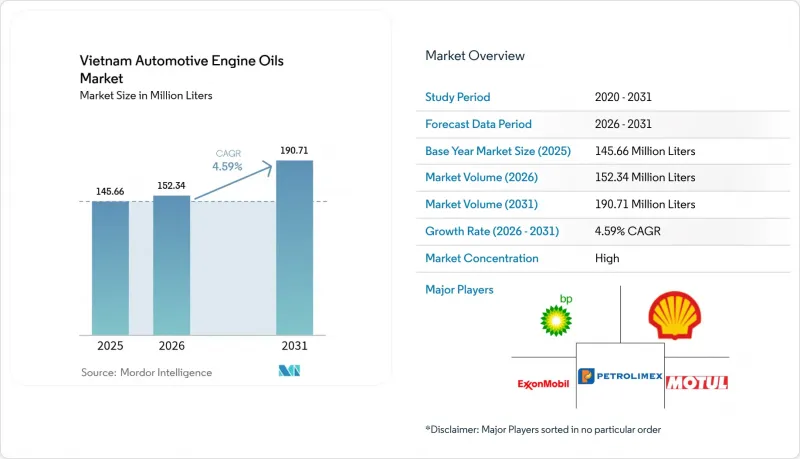
根據 Mordor Intelligence 預測,越南汽車機油市場將從 2025 年的 1.4566 億公升成長到 2026 年的 1.5234 億公升,然後從 2026 年到 2031 年以 4.59% 的複合成長率成長,到 2031 年達到 1.9900 億年成長率。
本報告依產品類型(乘用車引擎油、重型車輛機油、摩托車機油)和基料(礦物油、合成油、半合成油、生物基油)進行分類。市場預測以銷售量(公升)為單位。
越南汽車機油市場趨勢及洞察
摩托車保有量的快速成長以及維修頻率的增加
超過7300萬輛汽油動力摩托車每行駛3000至5000公里就需要更換機油,而汽車的更換週期為10000至15000公里,因此即使新車銷量放緩,潤滑油消耗量依然居高不下。本田在摩托車市場佔據較高佔有率,推動了標準化保養的普及,這也有助於品牌機油銷售量的持續成長。到2024年,摩托車市場將佔據國內潤滑油需求的很大一部分,凸顯其在潤滑油總消耗量中的重要性。道路狀況的改善和可支配收入的增加推動了農村地區摩托車保有量的持續成長,並延長了換油週期。周邊地區老舊摩托車的增加進一步增加了換油頻率,抵消了主要城市逐步轉型為電氣化的趨勢。
政府對國內石油摻混能力的誘因
政府鼓勵國內原油調配,以降低對進口的依賴。例如,福斯公司在巴地-頭頓省投資900萬歐元(約1,020萬美元)興建的工廠,以及耗資12億美元維修的榕桔煉油廠(改造後年產能將達750萬噸)。稅收優惠、簡化的許可程序和土地使用支援降低了調配商的營運成本,使他們能夠以「越南製造」的標籤瞄準主流價格區間。諸如沙烏地阿美和墨西哥石油公司正在進行的合作洽談表明,下游合作將更加深入,從而促進對東協的出口機會。此外,國內經銷商能可以緩衝運費和外匯波動的影響,為獨立零售商帶來結構性優勢。
都市區電動車普及率的提高
政府提出的2030年推廣35萬輛電動車的目標,以及PVOIL公司部署的369個充電站,導致內燃機潤滑油的銷售量下降,尤其是計程車和叫車潤滑油。目前道路上已有200萬輛電動機車,雖然基數較低,但數量正以每年30-35%的速度成長。用於變速箱和溫度控管的電動車潤滑油在一定程度上彌補了內燃機油需求的下降,但銷售量尚未達到內燃機油的水平。除河內和胡志明市以外,其他地區的充電基礎設施有限,加上農村地區的使用情況,在基礎設施完善之前,內燃機汽車可能仍將佔據主導地位。因此,電動車產業面臨的挑戰依然有限,但策略投資者已將這項變更納入其長期生產力計畫。
細分市場分析
預計2025年,隨著乘用車保有量增加至51萬輛,乘用車機油將維持越南汽車引擎機油市場61.45%的佔有率。同時,摩托車機油市場預計將成為成長最快的市場,到2031年,其複合年成長率將達到4.78%,這主要得益於7,300萬輛在運作中摩托車每行駛3000至5000公里就需要更換機油。重型車輛機油則主要供應行駛在連接胡志明市和河內與出口港口主要高速公路上的貨運卡車,支撐了穩定的銷售量。
越南汽車機油市場受惠於摩托車進口量1.6%的成長,預計到2025年2月將達到464,194輛,而乘用車進口量預計到2024年將增加至172,240輛。本田的市場主導地位使供應商更容易確保產品的適用性,而乘用車製造商的多元化發展也拓寬了產品系列。高性能產品系列,例如Motul 300V Road Racing和Yamaha的Yamalube(具備防偽功能),正在推動細分市場的細分化並獲取溢價。
其他好處:
- Excel格式的市場預測(ME)表
- 3個月的分析師支持
目錄
第1章:引言
- 研究假設和市場定義
- 調查範圍
第2章:調查方法
第3章執行摘要
第4章 市場狀況
- 市場概覽
- 市場促進因素
- 摩托車擁有量和保養頻率都在快速增加。
- 政府對國內石油摻混能力的誘因
- 改用低黏度合成油以提高燃油效率
- 潤滑油零售業電子商務的擴張
- 與OEM、工廠填充和本地化相關的夥伴關係
- 市場限制因素
- 都市區電動車滲透率不斷提高
- 仿冒品/灰色市場機油
- 原油價格波動給調配商的利潤率帶來了壓力。
- 價值鏈分析
- 監理情勢
- 波特五力模型
第5章 市場規模與成長預測
- 依產品類型
- 乘用車引擎機油(PCMO)
- 0W-XX
- 5W-XX
- 10W-XX
- 15W-XX
- 單級
- 其他年級
- 重型機油(HDMO)
- 0W-XX
- 5W-XX
- 10W-XX
- 15W-XX
- 單級
- 其他年級
- 摩托車機油(MCO)
- 0W-XX
- 5W-XX
- 10W-XX
- 15W-XX
- 單級
- 其他年級
- 乘用車引擎機油(PCMO)
- 依基料
- 礦物
- 合成
- 半合成
第6章 競爭情勢
- 市場集中度
- 策略趨勢
- 市佔率和排名分析
- 公司簡介
- AP SAIGON PETRO
- BP plc
- Chevron Corporation
- Exxon Mobil Corporation
- FUCHS
- GS Caltex Corporation
- Gulf Oil International Ltd.
- Idemitsu Lubricants Vietnam
- Mekong Petrochemical Jsc
- Motul Vietnam(Vilube)
- Petrolimex(PLX)
- PETRONAS Lubricants International
- PVOIL
- Repsol Vietnam
- Shell Plc
- TotalEnergies
- Wolf Oil Corporation
第7章 市場機會與未來展望
第8章:執行長面臨的關鍵策略挑戰
According to Mordor Intelligence, the Vietnam automotive engine oils market size is expected to grow from 145.66 million liters in 2025 to 152.34 million liters in 2026 and is forecast to reach 190.71 million liters by 2031 at 4.59% CAGR over 2026-2031.
This report is Segmented by Product Type (Passenger Car Motor Oil, Heavy Duty Motor Oil, and Motorcycle Engine Oil), Base Stock (Mineral, Synthetic, Semi-Synthetic, Bio-Based). The Market Forecasts are Provided in Terms of Volume (Liters).
Vietnam Automotive Engine Oils Market Trends and Insights
Surging Motorcycle Parc and Maintenance Frequency
More than 73 million gasoline two-wheelers require oil changes every 3,000-5,000 kilometers, compared with 10,000-15,000 kilometers for cars, so lubricant throughput remains high even as new bike sales soften. Honda's share across motorcycle sales drives standardized servicing, helping branded oils secure repeat volumes. The motorcycle segment generated a significant percent of national lubricant demand in 2024, underscoring its weight in overall consumption. Rural ownership continues to rise thanks to upgraded roads and higher disposable incomes, expanding the replacement cycle. Ageing bikes in peripheral provinces further elevate change frequency, offsetting modest electrification in core cities.
Government Incentives for Domestic Oil Blending Capacity
Authorities encourage local blending to curb import reliance, exemplified by Fuchs' EUR 9 million (USD 10.2 million) plant in Ba Ria-Vung Tau and the USD 1.2 billion Dung Quat refinery upgrade to 7.5 million tons per year. Fiscal perks, streamlined licensing, and land-use support cut operating costs for blenders, letting them target mainstream price points with made-in-Vietnam labels. Partnerships such as ongoing Aramco-Petrolimex talks hint at deeper downstream collaboration that could seed ASEAN export potential. Domestic capacity also helps cushion distributors against freight volatility and foreign-exchange swings, a structural upside for independent retailers.
Growing EV Penetration in Urban Centres
Government targets of 350,000 EVs by 2030 and PVOIL's rollout of 369 charging points begin to erode combustion-engine lubricant volumes, especially among taxi and ride-hail fleets. Two million electric motorcycles already circulate, advancing 30-35% annually, although from a low base. E-fluids for gearboxes and thermal management partially offset the lost engine oil, but lack a comparable volume density. Outside Hanoi and Ho Chi Minh City, limited charging and rural duty cycles preserve internal-combustion dominance until infrastructure matures. Hence, the headwind remains gradual, yet strategic investors already price this shift into long-range capacity plans.
Other drivers and restraints analyzed in the detailed report include:
- Shift Toward Low-Viscosity Synthetic Grades for Fuel Economy
- E-Commerce Expansion in Lubricant Retailing
- Counterfeit / Grey-Market Engine Oils
For complete list of drivers and restraints, kindly check the Table Of Contents.
Segment Analysis
Passenger Car Motor Oil retained a 61.45% slice of the Vietnam automotive engine oils market share in 2025 as the passenger-vehicle fleet rose to 510,000 units. Motorcycle Engine Oil, however, posts the quickest clip at 4.78% CAGR to 2031, propelled by 73 million active bikes requiring changes every 3,000-5,000 kilometres. Heavy-Duty Motor Oil services freight trucks on arterial corridors linking Ho Chi Minh City and Hanoi to export ports, reinforcing steady baseline volume.
The Vietnam automotive engine oils market benefits from 1.6% growth in motorcycle imports to 464,194 units through February 2025, while passenger car imports grew to 172,240 units in 2024. Honda's dominance simplifies compatibility for suppliers, whereas car OEM fragmentation widens product portfolios. High-performance lines such as Motul 300V Road Racing and Yamaha's anti-counterfeit Yamalube enhance segment segmentation and capture price premium.
Complete Report Scope:
- By Product Type
- Passenger Car Motor Oil (PCMO)
- 0W-XX
- 5W-XX
- 10W-XX
- 15W-XX
- Monogrades
- Other Grades
- Heavy Duty Motor Oil (HDMO)
- 0W-XX
- 5W-XX
- 10W-XX
- 15W-XX
- Monogrades
- Other Grades
- Motorcycle Engine Oil (MCO)
- 0W-XX
- 5W-XX
- 10W-XX
- 15W-XX
- Monogrades
- Other Grades
- Passenger Car Motor Oil (PCMO)
- By Base Stock
- Mineral
- Synthetic
- Semi-Synthetic
List of Companies Covered in this Report:
- AP SAIGON PETRO
- BP p.l.c.
- Chevron Corporation
- Exxon Mobil Corporation
- FUCHS
- GS Caltex Corporation
- Gulf Oil International Ltd.
- Idemitsu Lubricants Vietnam
- Mekong Petrochemical Jsc
- Motul Vietnam (Vilube)
- Petrolimex (PLX)
- PETRONAS Lubricants International
- PVOIL
- Repsol Vietnam
- Shell Plc
- TotalEnergies
- Wolf Oil Corporation
Additional Benefits:
- The market estimate (ME) sheet in Excel format
- 3 months of analyst support
TABLE OF CONTENTS
1 Introduction
- 1.1 Study Assumptions and Market Definition
- 1.2 Scope of the Study
2 Research Methodology
3 Executive Summary
4 Market Landscape
- 4.1 Market Overview
- 4.2 Market Drivers
- 4.2.1 Surging Motorcycle Parc and Maintenance Frequency
- 4.2.2 Government Incentives for Domestic Oil Blending Capacity
- 4.2.3 Shift Toward Low-Viscosity Synthetic Grades for Fuel Economy
- 4.2.4 E-Commerce Expansion in Lubricant Retailing
- 4.2.5 OEM Factory-Fill Localisation Partnerships
- 4.3 Market Restraints
- 4.3.1 Growing EV Penetration in Urban Centres
- 4.3.2 Counterfeit / Grey-Market Engine Oils
- 4.3.3 Crude-Price Volatility Squeezing Blender Margins
- 4.4 Value Chain Analysis
- 4.5 Regulatory Landscape
- 4.6 Porter's Five Forces
- 4.6.1 Threat of New Entrants
- 4.6.2 Bargaining Power of Suppliers
- 4.6.3 Bargaining Power of Buyers
- 4.6.4 Threat of Substitutes
- 4.6.5 Competitive Rivalry
5 Market Size and Growth Forecasts (Volume)
- 5.1 By Product Type
- 5.1.1 Passenger Car Motor Oil (PCMO)
- 5.1.1.1 0W-XX
- 5.1.1.2 5W-XX
- 5.1.1.3 10W-XX
- 5.1.1.4 15W-XX
- 5.1.1.5 Monogrades
- 5.1.1.6 Other Grades
- 5.1.2 Heavy Duty Motor Oil (HDMO)
- 5.1.2.1 0W-XX
- 5.1.2.2 5W-XX
- 5.1.2.3 10W-XX
- 5.1.2.4 15W-XX
- 5.1.2.5 Monogrades
- 5.1.2.6 Other Grades
- 5.1.3 Motorcycle Engine Oil (MCO)
- 5.1.3.1 0W-XX
- 5.1.3.2 5W-XX
- 5.1.3.3 10W-XX
- 5.1.3.4 15W-XX
- 5.1.3.5 Monogrades
- 5.1.3.6 Other Grades
- 5.1.1 Passenger Car Motor Oil (PCMO)
- 5.2 By Base Stock
- 5.2.1 Mineral
- 5.2.2 Synthetic
- 5.2.3 Semi-Synthetic
6 Competitive Landscape
- 6.1 Market Concentration
- 6.2 Strategic Moves
- 6.3 Market Share (%)/Ranking Analysis
- 6.4 Company Profiles (includes Global level Overview, Market level overview, Core Segments, Financials as available, Strategic Information, Market Rank/Share, Products and Services, Recent Developments)
- 6.4.1 AP SAIGON PETRO
- 6.4.2 BP p.l.c.
- 6.4.3 Chevron Corporation
- 6.4.4 Exxon Mobil Corporation
- 6.4.5 FUCHS
- 6.4.6 GS Caltex Corporation
- 6.4.7 Gulf Oil International Ltd.
- 6.4.8 Idemitsu Lubricants Vietnam
- 6.4.9 Mekong Petrochemical Jsc
- 6.4.10 Motul Vietnam (Vilube)
- 6.4.11 Petrolimex (PLX)
- 6.4.12 PETRONAS Lubricants International
- 6.4.13 PVOIL
- 6.4.14 Repsol Vietnam
- 6.4.15 Shell Plc
- 6.4.16 TotalEnergies
- 6.4.17 Wolf Oil Corporation
7 Market Opportunities and Future Outlook
- 7.1 White-space and Unmet-Need Assessment
8 Key Strategic Questions for CEOs

 印尼汽車機油市場:市場佔有率分析、產業趨勢與統計及成長預測(2026-2031)馬來西亞汽車機油:市場佔有率分析、產業趨勢與統計及成長預測(2026-2031)中國汽車引擎油市場:市場佔有率分析、產業趨勢與統計及成長預測(2026-2031年)北美汽車引擎機油:市場佔有率分析、產業趨勢與統計及成長預測(2026-2031)印度汽車機油:市場佔有率分析、產業趨勢與統計及成長預測(2026-2031)德國汽車引擎機油:市場佔有率分析、產業趨勢與統計及成長預測(2026-2031)歐洲汽車引擎機油:市場佔有率分析、產業趨勢與統計及成長預測(2026-2031)法國汽車引擎油:市場佔有率分析、產業趨勢與統計及成長預測(2026-2031)
 汽車機油市場:2026-2032年全球市場預測(按產品類型、車輛類型、應用、最終用戶和分銷管道分類)東非汽車機油:市場佔有率分析、產業趨勢與統計及成長預測(2026-2031 年)