


 |
市場調查報告書
商品編碼
2116381
中國汽車引擎油市場:市場佔有率分析、產業趨勢與統計及成長預測(2026-2031年)China Automotive Engine Oils - Market Share Analysis, Industry Trends & Statistics, Growth Forecasts (2026 - 2031) |
||||||

※ 本網頁內容可能與最新版本有所差異。詳細情況請與我們聯繫。
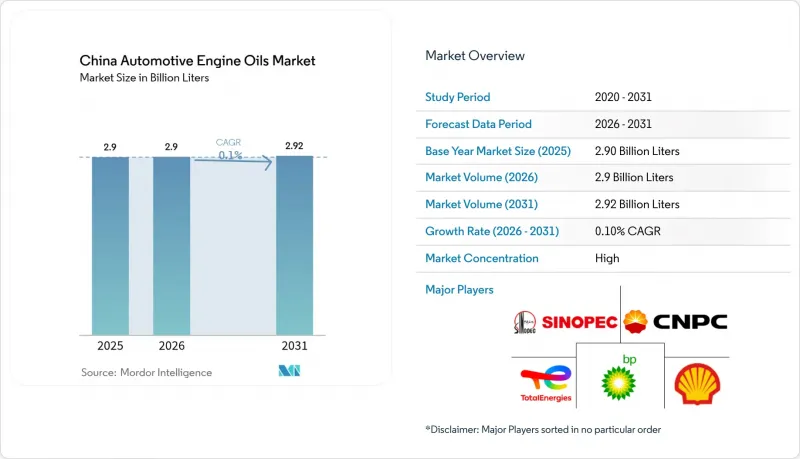
根據 Mordor Intelligence 預測,2026 年中國汽車機油市場規模預計將達到 29 億公升,高於 2025 年的 29 億升,預計到 2031 年將達到 29.2 億公升,2026 年至 2031 年的複合年成長率為 0.10%。
本報告依產品類型(乘用車引擎油、重型車輛機油、摩托車機油)和基礎油(礦物油、合成油、半合成油、生物基油)進行分類。市場預測以銷售量(公升)為單位。
中國汽車機油市場趨勢及洞察。
車輛擁有量增加和車齡老化
2025年,乘用車數量持續成長,儘管電動車的激增成為主要話題,但更換的需求仍保持穩定。在二、三線城市,老舊的內燃機車仍然佔據主導地位,這些地區的家庭推遲了向電動車的更換,導致單車油耗增加,加油頻率也更高。因此,預計內陸省份將在未來幾年起到緩衝作用,緩解全國銷售下滑的趨勢。然而,沿海主要城市推出的報廢補貼政策和更嚴格的車輛檢驗制度徵兆著市場格局將逐漸轉變,這意味著這一因素對中國汽車機油市場的貢獻最終將趨於穩定。
中國嚴格的VI-b排放氣體法規正在推動對高性能潤滑油的需求。
根據中國的VI-b標準,調配商需要在降低硫磷灰石(SAPS)含量、保護後後處理系統的同時,實現0W-20等燃油經濟型黏度。該標準於2025年3月實施後的九個月內,已有超過1,800種產品通過了API SQ/ILSAC GF-7的重新認證。一線城市率先掀起了對全合成和高III類基礎油調配油的需求浪潮,並且這股需求正持續向內陸地區蔓延。合規成本給小規模調配商帶來了壓力,加速了它們與大型基油公司之間的併購和供應協議。這一趨勢進一步加劇了中國汽車機油市場的集中化。
原廠製造的延長換油週期和機油壽命監測。
目前,主要汽車製造商(OEM)對全合成0W-20和5W-30機油的保養週期規定為7,500至8,000公里,許多高階品牌也採用車用演算法,在溫和駕駛條件下延長換油週期。儘管每次換油的機油量有所增加,但與2020年相比,每輛車的年潤滑油消耗量下降了約20%,這使得中國汽車機油市場規模面臨壓力,儘管單價上漲。
細分市場分析
預計到2025年,乘用車機油將佔中國汽車機油市場銷售量的58.10%,鞏固其作為中國汽車機油市場核心地位的歷史地位。該品類產品種類豐富,黏度範圍廣泛,從適用於老式緊湊型轎車的傳統10W-40到適用於渦輪增壓GDI車型的最新0W-20均有涵蓋。中國的共乘車輛仍主要依賴內燃機轎車,支撐著城市地區對乘用車機油的基本需求。然而,隨著電池式電動車轎車和跨界車在新車註冊量中所佔比例的不斷成長,內燃機車的售後市場佔有率正在逐漸萎縮。相較之下,受小包裹遞送和農村交通運輸領域對摩托車強勁需求的推動,預計到2031年,摩托車機油的複合年成長率將達到0.15%。
重型車輛機油市場面臨兩大挑戰:排放氣體要求達到CK-4性能標準,二是都市區配送領域的電動化先導計畫。目前,配備小型柴油發電機的有效距離式卡車仍在支撐著銷量,但珠三角地區純電動卡車(短程配送)的發展預示著未來市場將萎縮。總體而言,乘用車機油仍將是最大的細分市場,但隨著電動化進程的加速以及摩托車配送車輛在內陸Delta獲得新的發展勢頭,其市場佔有率將會下降。
其他好處:
- Excel格式的市場預測(ME)表
- 3個月的分析師支持
目錄
第1章:引言
- 研究假設和市場定義
- 調查範圍
第2章:調查方法
第3章執行摘要
第4章 市場狀況
- 市場概覽
- 市場促進因素
- 汽車保有量增加和車輛老化
- 中國嚴格的VI-b排放氣體法規正在推動對高性能潤滑油的需求。
- 乘用車採用渦輪增壓GDI引擎,正在推動合成機油的需求成長。
- 擴大身分與存取管理 (IAM) 研討會和擴大潤滑油電子商務零售。
- 需要低黏度柴油燃料的混合有效距離式卡車。
- 市場限制因素
- 電動車的快速普及導致內燃機潤滑油的需求下降。
- OEM延長換油週期和機油壽命監測
- 打擊假石油的行動導致灰色管道庫存減少。
- 價值鍊和通路分析
- 波特五力模型
- 法律規範
- 汽車產業的發展趨勢
第5章 市場規模與成長預測
- 依產品類型
- 乘用車引擎機油(PCMO)
- 0W-XX
- 5W-XX
- 10W-XX
- 15W-XX
- 單級
- 其他年級
- 重型機油(HDMO)
- 0W-XX
- 5W-XX
- 10W-XX
- 15W-XX
- 單級
- 其他年級
- 摩托車機油(MCO)
- 0W-XX
- 5W-XX
- 10W-XX
- 15W-XX
- 單級
- 其他年級
- 乘用車引擎機油(PCMO)
- 依基料
- 礦物
- 合成
- 半合成
- 生物基
第6章 競爭情勢
- 市場集中度
- 策略趨勢
- 市佔率(%)** / 排名分析
- 公司簡介
- BP plc
- Chevron Corporation
- China National Petroleum Corporation
- China Petrochemical Corporation
- ExxonMobil Corporation
- FUCHS
- HF Sinclair Corporation
- Idemitsu Kosan Co., Ltd.
- Jiangsu Lopal Tech Co., Ltd.
- JX Nippon Oil & Energy Corp.(ENEOS)
- Lubrizol Corp.(Additive Vendor)
- Qingdao COPTON Technology Co., Ltd.
- Saudi Arabian Oil Co.
- Shell plc
- SK ZIC
- Tongyi Petrochemical Co., Ltd.
- TotalEnergies
第7章 市場機會與未來展望
第8章:執行長應考慮的關鍵策略問題
According to Mordor Intelligence, the China automotive engine oils market size in 2026 is estimated at 2.9 billion liters, growing from 2025 value of 2.90 billion liters with 2031 projections showing 2.92 billion liters, growing at 0.10% CAGR over 2026-2031.
This report is Segmented by Product Type (Passenger Car Motor Oil, Heavy Duty Motor Oil, and Motorcycle Engine Oil), Base Stock (Mineral, Synthetic, Semi-Synthetic, Bio-Based). The Market Forecasts are Provided in Terms of Volume (Liters).
China Automotive Engine Oils Market Trends and Insights
Rising Vehicle Parc & Ageing Fleet
The passenger-car parc continued to expand in 2025, adding a modest but steady flow of replacement demand despite the headline EV surge. Older ICE models dominate Tier 2-3 cities, where households postpone EV upgrades, translating into higher per-vehicle oil consumption and more frequent top-ups. Inland provinces, therefore, offer a multi-year buffer that slows the nationwide volume decline. Scrappage incentives and tighter inspection programs in coastal hubs, however, foreshadow a gradual shift that will ultimately cap this driver's contribution to the China automotive engine oils market.
Stringent China VI-b Emission Norms Driving High-Performance Lubricants
China VI-b standards oblige formulators to cut SAPS levels and deliver fuel-economy-oriented viscosities such as 0W-20 while still protecting after-treatment hardware. Over 1,800 products were relicensed under API SQ/ILSAC GF-7 in the first nine months after the March 2025 start date. Tier 1 cities moved first, triggering a ripple of demand for fully-synthetic and high Group III blends that continues to widen inland. Compliance costs have squeezed small blenders and are accelerating mergers or supply agreements with base-oil majors, a trend reinforcing the concentrated character of the China automotive engine oils market.
Longer OEM Drain Intervals & Oil-Life Monitoring
Mainstream OEMs now quote service intervals at 7,500-8,000 km with fully synthetic 0W-20 and 5W-30 oils, and many premium marques pair that with in-vehicle algorithms that push drains out when operating conditions are mild. Although each sump fill is larger, annual per-car lubricant consumption falls roughly 20% compared with 2020 practices, pressuring the China automotive engine oils market size even as unit prices rise.
Other drivers and restraints analyzed in the detailed report include:
- Turbo GDI Adoption in Passenger Cars Boosting Synthetic Demand
- Expansion of IAM Workshops & E-Commerce Retail
- Crack-Down on Counterfeit Oils Causes Grey-Channel Destocking
For complete list of drivers and restraints, kindly check the Table Of Contents.
Segment Analysis
Passenger car motor oil contributed 58.10% of 2025 volume, confirming its historical role at the center of the China automotive engine oils market. A broad viscosity spread-from legacy 10W-40 for older compact cars to modern 0W-20 for turbo GDI models-keeps the category diverse. The Chinese ride-hailing fleet still relies on ICE sedans and therefore underpins baseline PCMO demand in urban cores. Nonetheless, battery-electric sedans and crossovers account for an ever-larger share of new registrations, chipping away at the internal-combustion aftermarket. Motorcycle engine oil, by contrast, posts a 0.15% CAGR through 2031 thanks to the resilience of two-wheelers in parcel-delivery and rural transport duty cycles.
The heavy-duty motor-oil segment faces twin forces: emission norms that necessitate CK-4 level performance and pilot electrification projects in urban distribution. Range-extender trucks temporarily cushion volumes because they still carry small diesel generators, but pure-electric drayage initiatives in the Pearl River Delta foreshadow future shrinkage. Overall, passenger-car oil will remain the single largest bucket, yet its share will ebb as electrification accelerates and two-wheeler delivery fleets find new momentum in inland regions.
Complete Report Scope:
- By Product Type
- Passenger Car Motor Oil (PCMO)
- 0W-XX
- 5W-XX
- 10W-XX
- 15W-XX
- Monogrades
- Other Grades
- Heavy Duty Motor Oil (HDMO)
- 0W-XX
- 5W-XX
- 10W-XX
- 15W-XX
- Monogrades
- Other Grades
- Motorcycle Engine Oil (MCO)
- 0W-XX
- 5W-XX
- 10W-XX
- 15W-XX
- Monogrades
- Other Grades
- Passenger Car Motor Oil (PCMO)
- By Base Stock
- Mineral
- Synthetic
- Semi-Synthetic
- Bio-Based
List of Companies Covered in this Report:
- BP p.l.c.
- Chevron Corporation
- China National Petroleum Corporation
- China Petrochemical Corporation
- ExxonMobil Corporation
- FUCHS
- HF Sinclair Corporation
- Idemitsu Kosan Co., Ltd.
- Jiangsu Lopal Tech Co., Ltd.
- JX Nippon Oil & Energy Corp. (ENEOS)
- Lubrizol Corp. (Additive Vendor)
- Qingdao COPTON Technology Co., Ltd.
- Saudi Arabian Oil Co.
- Shell plc
- SK ZIC
- Tongyi Petrochemical Co., Ltd.
- TotalEnergies
Additional Benefits:
- The market estimate (ME) sheet in Excel format
- 3 months of analyst support
TABLE OF CONTENTS
1 Introduction
- 1.1 Study Assumptions and Market Definition
- 1.2 Scope of the Study
2 Research Methodology
3 Executive Summary
4 Market Landscape
- 4.1 Market Overview
- 4.2 Market Drivers
- 4.2.1 Rising vehicle parc and ageing fleet
- 4.2.2 Stringent China VI-b emission norms driving high-performance lubricants
- 4.2.3 Turbo GDI adoption in passenger cars boosting synthetic demand
- 4.2.4 Expansion of IAM workshops and e-commerce lubricant retail
- 4.2.5 Hybrid range-extender trucks needing low-viscosity diesel oils
- 4.3 Market Restraints
- 4.3.1 Surging EV penetration shrinking ICE lubricant pool
- 4.3.2 Longer OEM drain intervals and oil-life monitoring
- 4.3.3 Crack-down on counterfeit oils causes grey-channel destocking
- 4.4 Value Chain and Distribution Channel Analysis
- 4.5 Porter's Five Forces
- 4.5.1 Threat of New Entrants
- 4.5.2 Bargaining Power of Suppliers
- 4.5.3 Bargaining Power of Buyers
- 4.5.4 Threat of Substitutes
- 4.5.5 Industry Rivalry
- 4.6 Regulatory Framework
- 4.7 Automotive Industry Trends
5 Market Size and Growth Forecasts (Volume)
- 5.1 By Product Type
- 5.1.1 Passenger Car Motor Oil (PCMO)
- 5.1.1.1 0W-XX
- 5.1.1.2 5W-XX
- 5.1.1.3 10W-XX
- 5.1.1.4 15W-XX
- 5.1.1.5 Monogrades
- 5.1.1.6 Other Grades
- 5.1.2 Heavy Duty Motor Oil (HDMO)
- 5.1.2.1 0W-XX
- 5.1.2.2 5W-XX
- 5.1.2.3 10W-XX
- 5.1.2.4 15W-XX
- 5.1.2.5 Monogrades
- 5.1.2.6 Other Grades
- 5.1.3 Motorcycle Engine Oil (MCO)
- 5.1.3.1 0W-XX
- 5.1.3.2 5W-XX
- 5.1.3.3 10W-XX
- 5.1.3.4 15W-XX
- 5.1.3.5 Monogrades
- 5.1.3.6 Other Grades
- 5.1.1 Passenger Car Motor Oil (PCMO)
- 5.2 By Base Stock
- 5.2.1 Mineral
- 5.2.2 Synthetic
- 5.2.3 Semi-Synthetic
- 5.2.4 Bio-Based
6 Competitive Landscape
- 6.1 Market Concentration
- 6.2 Strategic Moves
- 6.3 Market Share (%)**/Ranking Analysis
- 6.4 Company Profiles (includes Global level Overview, Market level overview, Core Segments, Financials as available, Production Capacity, Strategic Information, Market Rank/Share for key companies, Products and Services, and Recent Developments)
- 6.4.1 BP p.l.c.
- 6.4.2 Chevron Corporation
- 6.4.3 China National Petroleum Corporation
- 6.4.4 China Petrochemical Corporation
- 6.4.5 ExxonMobil Corporation
- 6.4.6 FUCHS
- 6.4.7 HF Sinclair Corporation
- 6.4.8 Idemitsu Kosan Co., Ltd.
- 6.4.9 Jiangsu Lopal Tech Co., Ltd.
- 6.4.10 JX Nippon Oil & Energy Corp. (ENEOS)
- 6.4.11 Lubrizol Corp. (Additive Vendor)
- 6.4.12 Qingdao COPTON Technology Co., Ltd.
- 6.4.13 Saudi Arabian Oil Co.
- 6.4.14 Shell plc
- 6.4.15 SK ZIC
- 6.4.16 Tongyi Petrochemical Co., Ltd.
- 6.4.17 TotalEnergies
7 Market Opportunities and Future Outlook
- 7.1 White-space and Unmet-need Assessment
8 Key Strategic Questions for CEOs

 印尼汽車機油市場:市場佔有率分析、產業趨勢與統計及成長預測(2026-2031)越南汽車引擎油:市場佔有率分析、產業趨勢與統計及成長預測(2026-2031)馬來西亞汽車機油:市場佔有率分析、產業趨勢與統計及成長預測(2026-2031)北美汽車引擎機油:市場佔有率分析、產業趨勢與統計及成長預測(2026-2031)印度汽車機油:市場佔有率分析、產業趨勢與統計及成長預測(2026-2031)德國汽車引擎機油:市場佔有率分析、產業趨勢與統計及成長預測(2026-2031)歐洲汽車引擎機油:市場佔有率分析、產業趨勢與統計及成長預測(2026-2031)法國汽車引擎油:市場佔有率分析、產業趨勢與統計及成長預測(2026-2031)
 汽車機油市場:2026-2032年全球市場預測(按產品類型、車輛類型、應用、最終用戶和分銷管道分類)東非汽車機油:市場佔有率分析、產業趨勢與統計及成長預測(2026-2031 年)