


 |
市場調查報告書
商品編碼
2116382
印度汽車機油:市場佔有率分析、產業趨勢與統計及成長預測(2026-2031)India Automotive Engine Oils - Market Share Analysis, Industry Trends & Statistics, Growth Forecasts (2026 - 2031) |
||||||

※ 本網頁內容可能與最新版本有所差異。詳細情況請與我們聯繫。
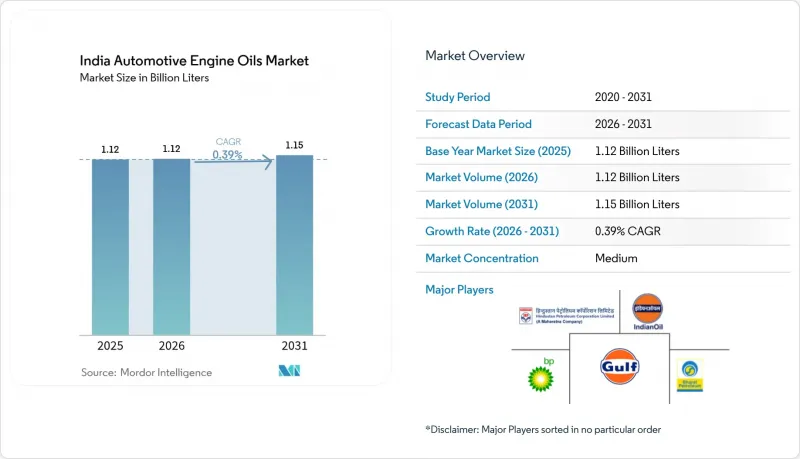
據 Mordor Intelligence 稱,2025 年印度汽車機油市值為 11.2 億公升,預計到 2031 年將達到 11.5 億升,而 2026 年為 11.2 億升,預測期(2026-2031 年)的複合年成長率為 0.39%。
本報告按樹脂類型(乘用車引擎油、重型車輛機油、摩托車機油)和基料(礦物油、合成油、半合成油、生物基油)進行細分。市場預測以銷售量(公升)為單位。
印度汽車機油市場趨勢及洞察。
BS-VI 第二階段排放標準將加速到優質低黏度潤滑油的過渡。
2023年4月引入的實際道路排放氣體測試迫使汽車製造商採用低硫磷灰石(低SAPS)含量的機油,以在實際駕駛條件下保護後處理系統。礦物油配方無法滿足更嚴格的氧化限值和沈積物抑制要求,合成和半合成機油目前在工廠填充競標佔據主導地位。由於延長換油週期可以減少停機時間和維護成本,車隊營運商願意接受30%至50%的溢價。煉油商正在改進添加劑配方,並為最新的汽油和柴油車輛平台推出低黏度等級的5W-30和0W-20機油。中央污染控制委員會的審核正在加強合規性,這項監管舉措是推動整個印度汽車機油市場優質化的不可逆轉的因素。
CNG汽車的快速普及以及高溫環境下對潤滑油的需求
印度CNG車輛(包括公車、計程車和輕型卡車)數量的不斷成長,推高了潤滑油的工作溫度,加速了聚合物剪切和硝化反應。優質CNG潤滑油的價格比柴油潤滑油高出15-20%,但它能提供這些引擎所需的高熱穩定性和氣門座保護。加氣網路的發展,尤其是在北部地區,催生了區域需求叢集,經銷商也優先供應CNG相容產品。政府提出的2030年CNG佔所有運輸燃料15%的目標,正在推動CNG銷售量的穩定成長,並保護供應商免受都市區貨運領域純電動車(BEV)的需求競爭。
電動車和電動摩托車的快速普及正在蠶食引擎油的銷售量。
FAME-II 激勵政策和鋰離子電池組價格的下降正在加速電動二輪車的普及,取代目前推動印度汽車機油市場成長的摩托車。每輛電動踏板車每年可減少 800-900 毫升的機油需求,電動踏板車的普及最初集中在班加羅爾、清奈和普納城市,隨後擴展到小規模城市。雖然大型車輛的電氣化進程滯後,但每輛純電動卡車每次換油可減少高達 40 公升的機油用量,這進一步加劇了其銷售量長期下行的壓力。
細分市場分析
預計到2025年,乘用車引擎油將佔印度汽車引擎油市場佔有率的51.94%,這主要得益於乘用車保有量的擴張以及中型車市場電動車普及速度的放緩。目前,5W-30和5W-40多級合成機油是OEM廠商的標配機油,佔據主導地位,儘管在大都會圈以外的老款小型車中仍然使用15W-40礦物油。摩托車機油預計到2031年將維持最高的複合年成長率(CAGR),達到0.53%,這得益於印度每年2500萬輛摩托車的產量。 OEM廠商主導的向不同黏度規格的10W-30和10W-40合成機油的轉變,透過改善冷啟動保護和離合器性能,推動了優質化。重型卡車機油透過供應長途柴油車和新興的CNG卡車,保持穩定的銷售量。即使合成油越來越普及,對價格敏感的私人車主和駕駛者仍然需要像 20W-40 單黏度油這樣的老式礦物油。
原始設備製造商 (OEM) 和補充裝品牌正在改進其添加劑的化學成分,以獲得 API SP 和 JASO MA2 認證,並積極應對日益嚴格的排放氣體法規和燃油效率標準。因此,產品系列既涵蓋了適用於現代車輛的高階合成油,也涵蓋了適用於老舊車輛的經濟型礦物油,使供應商能夠在各個收入階層中保持市場佔有率。
其他好處:
- Excel格式的市場預測(ME)表
- 3個月的分析師支持
目錄
第1章:引言
- 研究假設和市場定義
- 調查範圍
第2章:調查方法
第3章執行摘要
第4章 市場狀況
- 市場概覽
- 市場促進因素
- 乘用車和摩托車擁有量增加
- CNG汽車的快速普及和對高溫潤滑油日益成長的需求
- BS-VI Stage-2 標準正在推動向優質低黏度潤滑油的轉變。
- 電子商務的最後一公里配送車輛正在縮短維護週期。
- 由於車輛報廢激勵措施,工廠交付需求激增(2026-2028 年)
- 市場限制因素
- 電動車和電動二輪車的日益普及導致機油銷售量下降。
- 長效合成機油可降低每輛車的機油消耗量。
- 利用遠端資訊處理技術進行狀態監測,從而減少換油頻率。
- 價值鍊和通路分析
- 波特五力模型
- 法律規範
- 汽車產業的發展趨勢
第5章 市場規模與成長預測
- 依樹脂類型
- 乘用車引擎機油(PCMO)
- 0W-XX
- 5W-XX
- 10W-XX
- 15W-XX
- 單級
- 其他年級
- 重型機油(HDMO)
- 0W-XX
- 5W-XX
- 10W-XX
- 15W-XX
- 單級
- 其他年級
- 摩托車機油(MCO)
- 0W-XX
- 5W-XX
- 10W-XX
- 15W-XX
- 單級
- 其他年級
- 乘用車引擎機油(PCMO)
- 依基料
- 礦物
- 合成
- 半合成
- 生物基
第6章 競爭情勢
- 市場集中度
- 策略趨勢
- 市佔率和排名分析
- 公司簡介
- APAR Industries Limited
- Bharat Petroleum Corporation Limited
- BP plc
- Chevron Alkhalij
- Exxon Mobil Corporation
- FUCHS
- Gulf Oil International
- Hindustan Petroleum Corporation Limited
- Idemitsu Lubricants India Pvt Ltd
- Indian Oil Corporation Limited
- Liqui Moly
- LUKOIL
- Morris Lubricants India
- Motul
- PETRONAS Lubricants International
- Saudi Arabian Oil Co.
- Savita Oil Technologies Limited
- Shell Plc
- TotalEnergies
- Veedol Corporation Limited
第7章 市場機會與未來展望
第8章:執行長面臨的關鍵策略挑戰
According to Mordor Intelligence, the India automotive engine oils market size was valued at 1.12 Billion Liters in 2025 and estimated to grow from 1.12 Billion Liters in 2026 to reach 1.15 Billion Liters by 2031, at a CAGR of 0.39% during the forecast period (2026-2031).
This report is Segmented by Resin Type (Passenger Car Motor Oil, Heavy Duty Motor Oil, and Motorcycle Engine Oil), Base Stock (Mineral, Synthetic, Semi-Synthetic, and Bio-Based). The Market Forecasts are Provided in Terms of Volume (Litres).
India Automotive Engine Oils Market Trends and Insights
BS-VI Stage-2 Norms Driving Shift to Premium Low-Viscosity Oils
The April 2023 onset of Real Driving Emissions testing forced OEMs to adopt low-SAPS oils that protect after-treatment systems under real-world conditions. Synthetic and semi-synthetic grades now dominate factory-fill bids as mineral formulations struggle with tighter oxidation limits and deposit control. Fleet operators accept the 30-50% price premium because extended drains lower downtime and cut maintenance spend. Refiners have upgraded additive packages, positioning low-viscosity 5W-30 and 0W-20 grades for modern petrol and diesel platforms. Central Pollution Control Board audits reinforce compliance, making this regulatory push an irreversible driver of premiumization across the India automotive engine oil market.
Rapid CNG-Vehicle Growth and Higher-Temperature Lube Demand
India's CNG fleet expansion in buses, taxis, and light-duty trucks raises lubricant operating temperatures, accelerating polymer shear and nitration. Premium CNG-specific oils priced 15-20% above diesel equivalents deliver the higher thermal stability and valve-seat protection these engines require. The north-centric refueling network sparks regional demand clusters where distributors prioritize CNG variants. Government targets that elevate CNG to 15% of all transport fuel by 2030 underpin steady volume growth, cushioning suppliers from BEV cannibalization in urban freight.
Accelerating BEV and e-2W Penetration Eroding Engine-Oil Volume
FAME-II incentives and cheaper lithium-ion packs accelerate electric two-wheeler adoption, displacing motorcycles that currently anchor growth in the India automotive engine oil market. Each e-scooter eliminates 800-900 milliliters of annual oil demand, and adoption is clustering in Bengaluru, Chennai, and Pune before cascading into smaller cities. Heavy-duty electrification is slower, yet every BEV truck removes up to 40 liters per drain, magnifying the long-term drag on volume.
Other drivers and restraints analyzed in the detailed report include:
- E-commerce Last-Mile Fleets Shortening Drain-Interval Cycles
- Scrappage-Policy Led Spike in Factory-Fill Demand (2026-28)
- Extended-Drain Synthetic Oils Cutting Per-Vehicle Consumption
For complete list of drivers and restraints, kindly check the Table Of Contents.
Segment Analysis
Passenger Car Motor Oil posted the largest 2025 share at 51.94% of the India automotive engine oil market share, thanks to an expanding passenger-vehicle parc and slower EV uptake in midsize cars. Multigrade 5W-30 and 5W-40 synthetics now anchor OEM factory fills, while 15W-40 mineral grades linger in older compact cars across non-metro regions. Motorcycle Engine Oil, benefiting from India's 25-million-unit annual two-wheeler production, delivered the fastest 0.53% CAGR through 2031. OEM-driven viscosity shifts toward 10W-30 and 10W-40 synthetics improve cold-start protection and clutch performance, supporting premiumization. Heavy Duty Motor Oil maintains volume stability by servicing long-haul diesel and emerging CNG trucks. Despite synthetic penetration, older mineral 20W-40 monogrades remain relevant among price-sensitive owner-drivers.
OEMs and refill brands are refining additive chemistries to secure API SP and JASO MA2 credentials, positioning for tighter emission and fuel-economy norms. Product portfolios therefore straddle premium synthetics for modern vehicles and affordable mineral lines for legacy fleets, allowing suppliers to protect share across income segments.
Complete Report Scope:
- By Resin Type
- Passenger Car Motor Oil (PCMO)
- 0W-XX
- 5W-XX
- 10W-XX
- 15W-XX
- Monogrades
- Other Grades
- Heavy Duty Motor Oil (HDMO)
- 0W-XX
- 5W-XX
- 10W-XX
- 15W-XX
- Monogrades
- Other Grades
- Motorcycle Engine Oil (MCO)
- 0W-XX
- 5W-XX
- 10W-XX
- 15W-XX
- Monogrades
- Other Grades
- Passenger Car Motor Oil (PCMO)
- By Base Stock
- Mineral
- Synthetic
- Semi-Synthetic
- Bio-Based
List of Companies Covered in this Report:
- APAR Industries Limited
- Bharat Petroleum Corporation Limited
- BP plc
- Chevron Alkhalij
- Exxon Mobil Corporation
- FUCHS
- Gulf Oil International
- Hindustan Petroleum Corporation Limited
- Idemitsu Lubricants India Pvt Ltd
- Indian Oil Corporation Limited
- Liqui Moly
- LUKOIL
- Morris Lubricants India
- Motul
- PETRONAS Lubricants International
- Saudi Arabian Oil Co.
- Savita Oil Technologies Limited
- Shell Plc
- TotalEnergies
- Veedol Corporation Limited
Additional Benefits:
- The market estimate (ME) sheet in Excel format
- 3 months of analyst support
TABLE OF CONTENTS
1 Introduction
- 1.1 Study Assumptions and Market Definition
- 1.2 Scope of the Study
2 Research Methodology
3 Executive Summary
4 Market Landscape
- 4.1 Market Overview
- 4.2 Market Drivers
- 4.2.1 Rising passenger-vehicle and two-wheeler parc expansion
- 4.2.2 Rapid CNG-vehicle growth and higher-temperature lube demand
- 4.2.3 BS-VI Stage-2 norms driving shift to premium low-viscosity oils
- 4.2.4 E-commerce last-mile fleets shortening drain-interval cycles
- 4.2.5 Scrappage-policy led spike in factory-fill demand (2026-28)
- 4.3 Market Restraints
- 4.3.1 Accelerating BEV and e-2W penetration eroding engine-oil volume
- 4.3.2 Extended-drain synthetic oils cutting per-vehicle consumption
- 4.3.3 Telematics-based condition monitoring reducing oil changes
- 4.4 Value Chain and Distribution Channel Analysis
- 4.5 Porter's Five Forces
- 4.5.1 Threat of New Entrants
- 4.5.2 Bargaining Power of Suppliers
- 4.5.3 Bargaining Power of Buyers
- 4.5.4 Threat of Substitutes
- 4.5.5 Industry Rivalry
- 4.6 Regulatory Framework
- 4.7 Automotive Industry Trends
5 Market Size and Growth Forecasts (Volume)
- 5.1 By Resin Type
- 5.1.1 Passenger Car Motor Oil (PCMO)
- 5.1.1.1 0W-XX
- 5.1.1.2 5W-XX
- 5.1.1.3 10W-XX
- 5.1.1.4 15W-XX
- 5.1.1.5 Monogrades
- 5.1.1.6 Other Grades
- 5.1.2 Heavy Duty Motor Oil (HDMO)
- 5.1.2.1 0W-XX
- 5.1.2.2 5W-XX
- 5.1.2.3 10W-XX
- 5.1.2.4 15W-XX
- 5.1.2.5 Monogrades
- 5.1.2.6 Other Grades
- 5.1.3 Motorcycle Engine Oil (MCO)
- 5.1.3.1 0W-XX
- 5.1.3.2 5W-XX
- 5.1.3.3 10W-XX
- 5.1.3.4 15W-XX
- 5.1.3.5 Monogrades
- 5.1.3.6 Other Grades
- 5.1.1 Passenger Car Motor Oil (PCMO)
- 5.2 By Base Stock
- 5.2.1 Mineral
- 5.2.2 Synthetic
- 5.2.3 Semi-Synthetic
- 5.2.4 Bio-Based
6 Competitive Landscape
- 6.1 Market Concentration
- 6.2 Strategic Moves
- 6.3 Market Share (%)/Ranking Analysis
- 6.4 Company Profiles (includes Global level Overview, Market level overview, Core Segments, Financials as available, Production Capacity, Strategic Information, Market Rank/Share for key companies, Products and Services, and Recent Developments)
- 6.4.1 APAR Industries Limited
- 6.4.2 Bharat Petroleum Corporation Limited
- 6.4.3 BP plc
- 6.4.4 Chevron Alkhalij
- 6.4.5 Exxon Mobil Corporation
- 6.4.6 FUCHS
- 6.4.7 Gulf Oil International
- 6.4.8 Hindustan Petroleum Corporation Limited
- 6.4.9 Idemitsu Lubricants India Pvt Ltd
- 6.4.10 Indian Oil Corporation Limited
- 6.4.11 Liqui Moly
- 6.4.12 LUKOIL
- 6.4.13 Morris Lubricants India
- 6.4.14 Motul
- 6.4.15 PETRONAS Lubricants International
- 6.4.16 Saudi Arabian Oil Co.
- 6.4.17 Savita Oil Technologies Limited
- 6.4.18 Shell Plc
- 6.4.19 TotalEnergies
- 6.4.20 Veedol Corporation Limited
7 Market Opportunities and Future Outlook
- 7.1 White-space and Unmet-need Assessment
8 Key Strategic Questions for CEOs

 印尼汽車機油市場:市場佔有率分析、產業趨勢與統計及成長預測(2026-2031)越南汽車引擎油:市場佔有率分析、產業趨勢與統計及成長預測(2026-2031)馬來西亞汽車機油:市場佔有率分析、產業趨勢與統計及成長預測(2026-2031)中國汽車引擎油市場:市場佔有率分析、產業趨勢與統計及成長預測(2026-2031年)北美汽車引擎機油:市場佔有率分析、產業趨勢與統計及成長預測(2026-2031)德國汽車引擎機油:市場佔有率分析、產業趨勢與統計及成長預測(2026-2031)歐洲汽車引擎機油:市場佔有率分析、產業趨勢與統計及成長預測(2026-2031)法國汽車引擎油:市場佔有率分析、產業趨勢與統計及成長預測(2026-2031)
 汽車機油市場:2026-2032年全球市場預測(按產品類型、車輛類型、應用、最終用戶和分銷管道分類)東非汽車機油:市場佔有率分析、產業趨勢與統計及成長預測(2026-2031 年)