


 |
市場調查報告書
商品編碼
2116373
歐洲汽車引擎機油:市場佔有率分析、產業趨勢與統計及成長預測(2026-2031)Europe Automotive Engine Oils - Market Share Analysis, Industry Trends & Statistics, Growth Forecasts (2026 - 2031) |
||||||

※ 本網頁內容可能與最新版本有所差異。詳細情況請與我們聯繫。
根據 Mordor Intelligence 估計,到 2026 年,歐洲汽車引擎機油市場規模將達到 26 億公升,高於 2025 年的 25.9 億公升,預計到 2031 年將達到 26.5 億公升。
預計從 2026 年到 2031 年,年複合成長率將達到 0.35%。
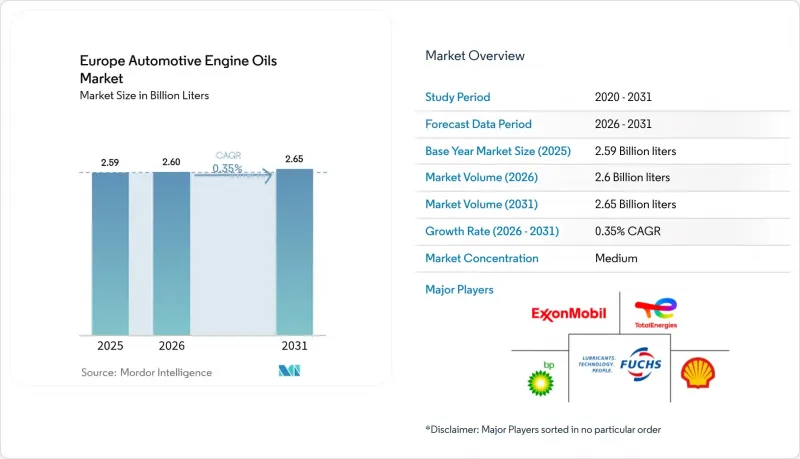
本報告按產品類型(乘用車引擎油、重型車輛機油、摩托車機油)、基料(礦物油、合成油、半合成油、生物基油)和地區(德國、英國、法國、義大利、西班牙、北歐國家、俄羅斯和其他歐洲國家)進行細分。市場預測以公升為單位。
歐洲汽車機油市場的趨勢與洞察
歐盟的二氧化碳排放和燃油效率目標正在推動低黏度配方的發展。
即將實施的適用於所有車型二氧化碳排放上限迫使汽車製造商採用超低黏度0W-20甚至0W-16機油,以實現顯著的燃油效率提升。大眾汽車計畫在2025年前將其所有TSI引擎系列過渡到使用0W-20初始加油機油,這促使售後維修店大量儲備高III類和聚α烯烴含量的先進合成機油。由於黏度較高的5W-30和10W-40機油無法滿足黏度-溫度特性目標,低黏度機油的價格高出20-30%。這項法規正在推動歐洲汽車機油市場對高性能基油和優質添加劑的需求,而傳統機油則日益趨於同質化。
仍在運行的老舊內燃機(ICE)列車數量決定了需要進行的換油次數。
到2024年,德國乘用車的平均車齡將達到10.1年,法國、義大利和西班牙也呈現類似的趨勢。老舊引擎需要更頻繁地更換機油,並且使用傳統或半合成機油即可滿足需求,這抵消了因電氣化而導致的機油需求下降。隨著車輛超過保固期,獨立維修店在更換機油業務中佔據了更大的佔有率,從而維持了歐洲汽車機油市場對潤滑油的基準需求,即便新車電氣化程度越來越高。
電動車的加速普及將導致內燃機汽車數量的長期下降。
到2024年,電池式電動車(BEV)將佔歐洲新車註冊量的14.6%,到2035年,這一比例可能超過在運作中車輛總數的30%。北歐市場的潤滑油銷售量已經開始下滑,預計將給嚴重依賴內燃機需求的供應商帶來壓力。對於尚未涉足電氣化相關流體領域的歐洲汽車機油市場參與企業,這種萎縮風險將最為嚴重。
細分市場分析
預計到2025年,乘用車引擎油(PCMO)將佔據歐洲汽車引擎油市場60.72%的佔有率。儘管預計乘用車保有量將達到2.5億輛,從而帶動PCMO銷售量成長,但由於車輛行駛里程的恢復被電氣化所抵消,其成長已趨於平緩。優質全合成0W-20和0W-16機油的上市,使得換油週期延長至3萬公里,從而幫助汽車製造商在降低用車成本的同時,更好地保護引擎。獨立維修店在通路中扮演主導角色,但授權經銷商通路仍主導利潤豐厚的原廠灌裝業務,而原廠認證是該業務的必要條件。
預計到2031年,摩托車機油將以0.92%的複合年成長率(CAGR)實現最高成長。都市區交通堵塞、最後一公里配送以及休閒騎行正在推動摩托車的需求,尤其是在義大利、西班牙和法國。高性能摩托車需要符合JASO MA2標準的機油,這些機油需具備剪切穩定性、濕式離合器相容性和耐熱性,從而推高了其價格。在歐洲汽車機油市場,參與企業正在贏得願意支付更高價格的愛好者的品牌忠誠度。
其他好處:
- Excel格式的市場預測(ME)表
- 3個月的分析師支持
目錄
第1章:引言
- 研究假設和市場定義
- 調查範圍
第2章:調查方法
第3章執行摘要
第4章 市場狀況
- 市場概覽
- 市場促進因素
- 歐盟的二氧化碳排放和燃油效率目標正在推動低黏度配方的應用。
- 內燃機車輛的老化導致換油次數增加。
- OEM規格的多樣化正在推動對優質合成油的需求。
- 低灰分、低黏度潤滑油是混合動力汽車廣泛應用的必要條件。
- 再生廢油的分配將提振對精煉基油的需求。
- 市場限制因素
- 電動車的加速普及將導致內燃機汽車數量的長期下降。
- 原油和添加劑供應成本的波動給利潤率帶來了壓力。
- 原廠終身免維護的機油添加劑和感知器可延長換油週期。
- 價值鍊和通路分析
- 波特五力模型
- 法律規範
- 汽車產業的發展趨勢
第5章 市場規模與成長預測
- 依產品類型
- 乘用車引擎機油(PCMO)
- 0W-XX
- 5W-XX
- 10W-XX
- 15W-XX
- 單級
- 其他年級
- 重型機油(HDMO)
- 0W-XX
- 5W-XX
- 10W-XX
- 15W-XX
- 單級
- 其他年級
- 摩托車機油(MCO)
- 0W-XX
- 5W-XX
- 10W-XX
- 15W-XX
- 單級
- 其他年級
- 乘用車引擎機油(PCMO)
- 依基料
- 礦物
- 合成
- 半合成
- 生物基
- 按地區
- 德國
- 英國
- 法國
- 義大利
- 西班牙
- 北歐國家
- 俄羅斯
- 其他歐洲國家
第6章 競爭情勢
- 市場集中度
- 策略趨勢
- 市佔率和排名分析
- 公司簡介
- ADDINOL
- BP plc
- Chevron Corporation
- Eni SpA
- Exxon Mobil Corporation
- FUCHS
- Gazprom
- Idemitsu Kosan Co., Ltd.
- LIQUI MOLY
- LUKOIL
- Millers Oils LTD
- MOTOREX
- Motul
- Neste
- PETRONAS Lubricants International
- Phillips 66 Company.
- Ravensberger Schmierstoffvertrieb GmbH
- Repsol
- Shell plc
- TotalEnergies
- Valvoline Global Operations
第7章 市場機會與未來展望
第8章:執行長面臨的關鍵策略挑戰
According to Mordor Intelligence, the european automotive engine oils market size in 2026 is estimated at 2.6 billion liters, growing from 2025 value of 2.59 billion liters with 2031 projections showing 2.65 billion liters, growing at 0.35% CAGR over 2026-2031.
This report is Segmented by Product Type (Passenger Car Motor Oil, Heavy Duty Motor Oil, and Motorcycle Engine Oil), Base Stock (Mineral, Synthetic, Semi-Synthetic, and Bio-Based), and Geography (Germany, United Kingdom, France, Italy, Spain, Nordic Countries, Russia, and Rest of Europe). Market Forecasts are Provided in Terms of Volume (Litres).
Europe Automotive Engine Oils Market Trends and Insights
European Union CO2 and Fuel-Economy Targets Push Low-Viscosity Formulations
Upcoming fleetwide CO2 caps compel automakers to specify ultra-thin 0W-20 and even 0W-16 grades that deliver measurable fuel-efficiency gains. Volkswagen shifted its entire TSI engine family to 0W-20 service fills in 2025, prompting aftermarket workshops to stock advanced synthetics with high Group III and poly-alpha-olefin content. Low-viscosity grades command 20-30% price premiums because heavier 5W-30 and 10W-40 oils cannot meet viscosity-temperature targets. The mandate boosts Europe automotive engine oils market demand for high-performance base stocks and premium additive packages while commoditizing legacy grades.
Aging ICE Vehicle Parc Sustains Oil-Change Volumes
The average German passenger car age climbed to 10.1 years in 2024, and similar trends appear across France, Italy, and Spain. Older engines require more frequent oil changes and tolerate conventional or semi-synthetic formulations, offsetting volume lost to electrification. Independent workshops capture a larger share of this replacement business as vehicles exit warranty coverage, thereby maintaining baseline lubricant demand in the Europe automotive engine oils market even as new-car electrification rises.
Accelerating BEV Penetration Shrinks Long-Term ICE Pool
Battery-electric vehicles captured 14.6% of European new-car registrations in 2024, and the share could exceed 30% of the rolling fleet by 2035. Nordic markets already display lubricant volume contraction, signaling future pressure for suppliers heavily exposed to internal-combustion demand. The contraction risk looms largest for the Europe automotive engine oils market participants lacking diversification into electrification-adjacent fluids.
Other drivers and restraints analyzed in the detailed report include:
- OEM Specification Proliferation Drives Premium Synthetics
- Waste-Oil Regeneration Quotas Spur Re-Refined Base-Oil Demand
- Volatile Crude and Additive Supply Costs Pressure Margins
For complete list of drivers and restraints, kindly check the Table Of Contents.
Segment Analysis
Passenger Car Motor Oil held 60.72% of the European automotive engine oils market in 2025. PCMO volumes benefit from a 250 million-unit passenger car fleet, yet growth remains flat as fleet electrification offsets miles-driven recovery. Premium fully synthetic 0W-20 and 0W-16 formulations extend drain intervals to 30,000 kilometers, allowing OEMs to advertise lower ownership costs while still protecting engines. Independent garages lead distribution, but authorized dealer channels retain high-margin factory-fill business where OEM approvals remain non-negotiable.
Motorcycle Engine Oil is expected to post the fastest 0.92% CAGR through 2031. Urban congestion, last-mile delivery, and recreational riding boost two-wheeler demand, especially in Italy, Spain, and France. High-performance motorcycles require JASO MA2 oils with shear stability, wet-clutch compatibility, and thermal resilience, driving premium pricing. Europe automotive engine oils market participants that cultivate dealer networks and sponsor racing events capture brand loyalty among enthusiasts who accept higher per-liter prices.
Complete Report Scope:
- By Product Type
- Passenger Car Motor Oil (PCMO)
- 0W-XX
- 5W-XX
- 10W-XX
- 15W-XX
- Monogrades
- Other Grades
- Heavy Duty Motor Oil (HDMO)
- 0W-XX
- 5W-XX
- 10W-XX
- 15W-XX
- Monogrades
- Other Grades
- Motorcycle Engine Oil (MCO)
- 0W-XX
- 5W-XX
- 10W-XX
- 15W-XX
- Monogrades
- Other Grades
- Passenger Car Motor Oil (PCMO)
- By Base Stock
- Mineral
- Synthetic
- Semi-Synthetic
- Bio-Based
- By Geography
- Germany
- United Kingdom
- France
- Italy
- Spain
- Nordic Countries
- Russia
- Rest of Europe
List of Companies Covered in this Report:
- ADDINOL
- BP plc
- Chevron Corporation
- Eni S.p.A.
- Exxon Mobil Corporation
- FUCHS
- Gazprom
- Idemitsu Kosan Co., Ltd.
- LIQUI MOLY
- LUKOIL
- Millers Oils LTD
- MOTOREX
- Motul
- Neste
- PETRONAS Lubricants International
- Phillips 66 Company.
- Ravensberger Schmierstoffvertrieb GmbH
- Repsol
- Shell plc
- TotalEnergies
- Valvoline Global Operations
Additional Benefits:
- The market estimate (ME) sheet in Excel format
- 3 months of analyst support
TABLE OF CONTENTS
1 Introduction
- 1.1 Study Assumptions and Market Definition
- 1.2 Scope of the Study
2 Research Methodology
3 Executive Summary
4 Market Landscape
- 4.1 Market Overview
- 4.2 Market Drivers
- 4.2.1 European Union CO2 and fuel-economy targets push low-viscosity formulations
- 4.2.2 Aging ICE vehicle parc sustains oil-change volumes
- 4.2.3 OEM specification proliferation drives premium synthetics
- 4.2.4 Hybrid-vehicle growth needs low-ash, low-viscosity oils
- 4.2.5 Waste-oil regeneration quotas spur re-refined base-oil demand
- 4.3 Market Restraints
- 4.3.1 Accelerating BEV penetration shrinks long-term ICE pool
- 4.3.2 Volatile crude and additive supply costs pressure margins
- 4.3.3 OEM lifetime-fill and sensors extend drain intervals
- 4.4 Value Chain and Distribution Channel Analysis
- 4.5 Porter's Five Forces
- 4.5.1 Threat of New Entrants
- 4.5.2 Bargaining Power of Suppliers
- 4.5.3 Bargaining Power of Buyers
- 4.5.4 Threat of Substitutes
- 4.5.5 Industry Rivalry
- 4.6 Regulatory Framework
- 4.7 Automotive Industry Trends
5 Market Size and Growth Forecasts (Volume)
- 5.1 By Product Type
- 5.1.1 Passenger Car Motor Oil (PCMO)
- 5.1.1.1 0W-XX
- 5.1.1.2 5W-XX
- 5.1.1.3 10W-XX
- 5.1.1.4 15W-XX
- 5.1.1.5 Monogrades
- 5.1.1.6 Other Grades
- 5.1.2 Heavy Duty Motor Oil (HDMO)
- 5.1.2.1 0W-XX
- 5.1.2.2 5W-XX
- 5.1.2.3 10W-XX
- 5.1.2.4 15W-XX
- 5.1.2.5 Monogrades
- 5.1.2.6 Other Grades
- 5.1.3 Motorcycle Engine Oil (MCO)
- 5.1.3.1 0W-XX
- 5.1.3.2 5W-XX
- 5.1.3.3 10W-XX
- 5.1.3.4 15W-XX
- 5.1.3.5 Monogrades
- 5.1.3.6 Other Grades
- 5.1.1 Passenger Car Motor Oil (PCMO)
- 5.2 By Base Stock
- 5.2.1 Mineral
- 5.2.2 Synthetic
- 5.2.3 Semi-Synthetic
- 5.2.4 Bio-Based
- 5.3 By Geography
- 5.3.1 Germany
- 5.3.2 United Kingdom
- 5.3.3 France
- 5.3.4 Italy
- 5.3.5 Spain
- 5.3.6 Nordic Countries
- 5.3.7 Russia
- 5.3.8 Rest of Europe
6 Competitive Landscape
- 6.1 Market Concentration
- 6.2 Strategic Moves
- 6.3 Market Share (%)/Ranking Analysis
- 6.4 Company Profiles (includes Global level Overview, Market level overview, Core Segments, Financials as available, Production Capacity, Strategic Information, Market Rank/Share for key companies, Products and Services, and Recent Developments)
- 6.4.1 ADDINOL
- 6.4.2 BP plc
- 6.4.3 Chevron Corporation
- 6.4.4 Eni S.p.A.
- 6.4.5 Exxon Mobil Corporation
- 6.4.6 FUCHS
- 6.4.7 Gazprom
- 6.4.8 Idemitsu Kosan Co., Ltd.
- 6.4.9 LIQUI MOLY
- 6.4.10 LUKOIL
- 6.4.11 Millers Oils LTD
- 6.4.12 MOTOREX
- 6.4.13 Motul
- 6.4.14 Neste
- 6.4.15 PETRONAS Lubricants International
- 6.4.16 Phillips 66 Company.
- 6.4.17 Ravensberger Schmierstoffvertrieb GmbH
- 6.4.18 Repsol
- 6.4.19 Shell plc
- 6.4.20 TotalEnergies
- 6.4.21 Valvoline Global Operations
7 Market Opportunities and Future Outlook
- 7.1 White-space and Unmet-need Assessment
8 Key Strategic Questions for CEOs

 印尼汽車機油市場:市場佔有率分析、產業趨勢與統計及成長預測(2026-2031)越南汽車引擎油:市場佔有率分析、產業趨勢與統計及成長預測(2026-2031)馬來西亞汽車機油:市場佔有率分析、產業趨勢與統計及成長預測(2026-2031)中國汽車引擎油市場:市場佔有率分析、產業趨勢與統計及成長預測(2026-2031年)北美汽車引擎機油:市場佔有率分析、產業趨勢與統計及成長預測(2026-2031)印度汽車機油:市場佔有率分析、產業趨勢與統計及成長預測(2026-2031)德國汽車引擎機油:市場佔有率分析、產業趨勢與統計及成長預測(2026-2031)法國汽車引擎油:市場佔有率分析、產業趨勢與統計及成長預測(2026-2031)
 汽車機油市場:2026-2032年全球市場預測(按產品類型、車輛類型、應用、最終用戶和分銷管道分類)東非汽車機油:市場佔有率分析、產業趨勢與統計及成長預測(2026-2031 年)