


 |
市場調查報告書
商品編碼
2116368
法國汽車引擎油:市場佔有率分析、產業趨勢與統計及成長預測(2026-2031)France Automotive Engine Oils - Market Share Analysis, Industry Trends & Statistics, Growth Forecasts (2026 - 2031) |
||||||

※ 本網頁內容可能與最新版本有所差異。詳細情況請與我們聯繫。
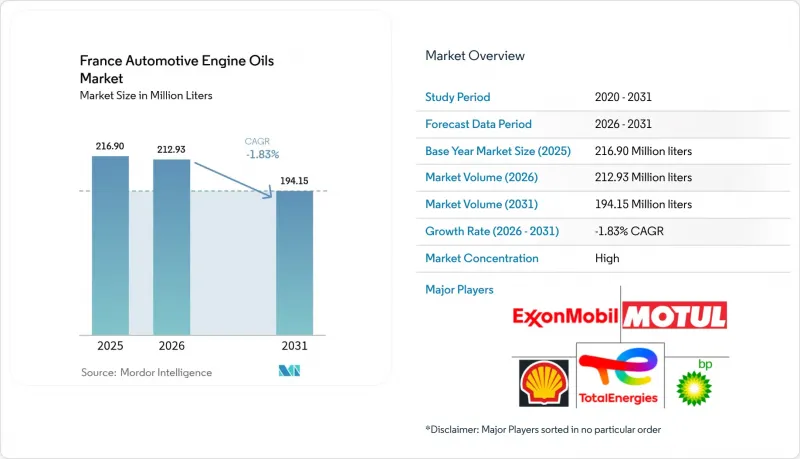
根據 Mordor Intelligence 預測,法國汽車機油市場預計將從 2025 年的 2.169 億升萎縮至 2026 年的 2.1293 億升,然後從 2026 年到 2031 年以 -1.83% 的複合成長,到 2031 年達到 1.15 億年成長率。
本報告依產品類型(乘用車機油(0W-XX、5W-XX、10W-XX、15W-XX、單級油、其他等級)、重型車輛引擎機油(0W-XX、5W-XX、10W-XX、15W-XX、單級油、其他等級)、摩托車引擎油(0W-XX、5WXX、10-10等))和基礎油(礦物油、合成油、半合成油和生物基油)進行分類。市場預測以銷售量(公升)為單位。
法國汽車機油市場趨勢及洞察。
由於車輛老化,維修保養的需求持續時間越來越長。
在法國,乘用車的平均使用壽命為11.5年,大多數汽油和柴油引擎的使用壽命都遠遠超過了原廠保固期。近一半的車輛車齡在8至15年之間,這里程範圍通常意味著每年至少需要更換一次機油。由於公共充電基礎設施有限且可支配收入較低,農村和郊區的車主往往會延長內燃機車輛的使用壽命,這維持了對礦物油和半合成PCMO(汽油、柴油和柴油混合機油)的基本負載需求。車輛擁有時間的延長也推高了對專為老舊引擎設計的黏度等級機油的需求,而ACEA 2024標準提高了氧化穩定性閾值,更有利於優質合成機油的發展。因此,儘管整體銷售量有所下降,但市場仍保持著可預測的保養週期,這在一定程度上緩解了向電動車快速轉型的影響。
原始設備製造商主導向低黏度合成油(歐6/7)的轉變
從2025年開始實施的歐盟7排放標準要求新車型必須符合實際道路排放氣體法規,並將柴油乘用車的出廠加註標準調整為ACEA C5或C6類別的0W-20和5W-30機油。法國Stellantis旗下的汽車製造商已在其眾多新款汽油車型中改用低黏度機油,這一趨勢也體現在售後市場,包括經銷商和快修通路。符合這些新標準的合成機油可將換油週期延長至2萬至3萬公里,使機油經銷商能夠透過高階定位來彌補較低的售價。 ATIEL的「行為準則」將產品認證與嚴格的品質審核掛鉤,設定了較高的進入門檻,有利於現有調配商。中期來看,低黏度機油的廣泛應用預計將擴大合成機油在法國汽車機油市場的佔有率。
電動車的日益普及將抑制內燃機用石油的銷售量。
電池式電動車(BEV)的新車註冊量正在成長,政府政策目標是到2030年實現66%的市場滲透率。在覆蓋巴黎、里昂和馬賽的都市區低排放氣體區(ZFE)內,已對老舊柴油車實施了限制,加速了內燃機汽車(VEHICLES)的淘汰。銷售量下滑在共乘和最後一公里配送領域尤為明顯。儘管這些領域的總行駛里程較長,但為了降低總擁有成本(TCO),它們正經歷著向電動車轉型最快的時期。隨著國家高速公路沿線充電基礎設施的建設,中型商用車的引入速度也正在加快,這對重型機油市場產生了間接影響。
細分市場分析
2025年,乘用車引擎油佔法國汽車引擎油市場的62.05%。然而,隨著電動車在都市區的普及加速,該細分市場的絕對銷量降幅最大。儘管混合動力汽車和輕型商用車的普及率不斷提高,但重負荷引擎油的銷售降幅相對溫和。在長途貨運領域,在氫能和高容量充電基礎設施完善之前,柴油引擎仍將繼續使用。摩托車機油表現最為強勁,年複合成長率僅-1.64%,這得益於休閒騎乘文化以及摩托車電氣化法規推進速度較慢的抑製作用。在乘用車機油(PCMO)市場,隨著歐盟7排放標準的實施臨近,0W-30和5W-30合成機油的市場佔有率正在不斷擴大,對傳統的10W-40礦物油的銷售量構成了壓力。聯網汽車數據平台正日益最佳化個人化的換油通知,透過將消費者的行為從“按日曆定期保養”轉變為“需要時進行保養”,從而重塑短途零售商的客流量模式。
PCMO(汽油/柴油混合油)的持續主導地位部分歸因於二手車電氣化政策進展緩慢。從鄰近的南歐國家進口的二手內燃機(ICE)汽車供應當地經銷商,延長了仍依賴中型SAP(半飽和脂肪)混合油的老舊引擎的使用壽命。然而,分析師預測,一旦純電動車(BEV)價格在2020年代末真正達到與PCMO相同的水平,對PCMO的需求將進一步暴跌,迫使供應商將業務多元化,拓展至變速箱油、電動汽車冷卻液和輔助動力傳動系統潤滑油等領域,以穩定利潤。合成PCMO的優質化正在緩解這種衝擊,並在銷售下滑的情況下提升單位利潤。道達爾能源的「Rubia」和「Quartz EV3R」系列產品就是這種轉型的體現,它們採用了再生基礎油以滿足永續性指標。
其他好處:
- Excel格式的市場預測(ME)表
- 3個月的分析師支持
目錄
第1章:引言
- 研究假設和市場定義
- 調查範圍
第2章:調查方法
第3章執行摘要
第4章 市場狀況
- 市場概覽
- 市場促進因素
- 由於車輛老化,維修保養的需求週期越來越長。
- 原始設備製造商主導向低黏度合成油(歐6/7)的轉變
- 電子商務與完善的售後服務管道
- 乘用車機油與其他潤滑油的耐久性比較
- 互聯油品品質分析與智慧油罐服務
- 市場限制因素
- 電動車的日益普及導致內燃機汽車和石油產品的銷售量下降。
- 長效合成機油導致每公升銷量下降。
- 零售業的仿冒品/自有品牌稀釋
- 價值鍊和通路分析
- 波特五力模型
- 法律規範
- 汽車產業的發展趨勢
第5章 市場規模與成長預測
- 依產品類型
- 乘用車引擎機油(PCMO)
- 0W-XX
- 5W-XX
- 10W-XX
- 15W-XX
- 單級
- 其他年級
- 重型機油(HDMO)
- 0W-XX
- 5W-XX
- 10W-XX
- 15W-XX
- 單級
- 其他年級
- 摩托車機油(MCO)
- 0W-XX
- 5W-XX
- 10W-XX
- 15W-XX
- 單級
- 其他年級
- 乘用車引擎機油(PCMO)
- 依基料
- 礦物
- 合成
- 半合成
- 生物基
第6章 競爭情勢
- 市場集中度
- 策略趨勢
- 市佔率和排名分析
- 公司簡介
- BP plc
- Chevron Corporation
- Eni SpA
- Exxon Mobil Corporation
- FUCHS
- Gulf Oil International Ltd
- IGOL
- Liqui Moly
- Lukoil
- Motul
- PETRONAS Lubricants International
- Shell plc
- SK Enmove co. Ltd
- TotalEnergies
- Wolf Oil Corporation
第7章 市場機會與未來展望
第8章:執行長應考慮的關鍵策略問題
According to Mordor Intelligence, the France automotive engine oils market size is expected to grow from 216.90 million liters in 2025 to 212.93 million liters in 2026 and is forecast to reach 194.15 million liters by 2031 at -1.83% CAGR over 2026-2031.
This report is Segmented by Product Type (Passenger Car Motor Oil (0W-XX, 5W-XX, 10W-XX, 15W-XX, Monogrades, and Other Grades), Heavy Duty Motor Oil (0W-XX, 5W-XX, 10W-XX, 15W-XX, Monogrades, and Other Grades), and Motorcycle Engine Oil (0W-XX, 5W-XX, 10W-XX, and More)), Base Stock (Mineral, Synthetic, Semi-Synthetic, and Bio-Based). Market Forecasts are Provided in Terms of Volume (Litres).
France Automotive Engine Oils Market Trends and Insights
Ageing Vehicle Parc Prolongs Maintenance Demand
France's passenger cars have an average service life of 11.5 years, keeping a large share of petrol and diesel engines on the road well past the typical OEM warranty window. Nearly half the fleet falls within the 8-15-year band, a mileage bracket that typically requires at least one oil change per year. Rural and peri-urban drivers tend to retain ICE vehicles longer due to limited public charging infrastructure and lower disposable income, thereby sustaining base-load demand for mineral and semi-synthetic PCMO. Extended vehicle ownership also fuels demand for viscosity grades engineered for older engines, with the ACEA 2024 sequences introducing higher oxidative stability thresholds that favor premium synthetics. Consequently, while overall liters ebb, the market still records predictable maintenance cycles that partially buffer rapid EV substitution.
OEM-Driven Low-Viscosity Synthetic Shift (Euro 6/7)
Euro 7 brings real-driving-emission compliance from 2025 for new vehicle types, pushing factory-fill standards toward 0W-20 and, in diesel passenger applications, 5W-30 ACEA C5 or C6 categories. French OEMs under the Stellantis umbrella have already transitioned many of their new gasoline models to low-viscosity fill, a trend mirrored in the aftermarket through dealer and quick-service channels. Synthetic oils meeting these newer sequences deliver extended intervals of 20,000-30,000 km, enabling oil marketers to offset lower units with premium positioning. ATIEL's Code of Practice ties product approvals to rigorous quality audits, fostering a high barrier to entry that favors established blenders. Over the medium term, low-viscosity uptake is forecast to increase the synthetic share of the French automotive engine oils market.
EV Parc Expansion Cutting ICE-Oil Volumes
New registrations of battery-electric vehicles are increasing, and government policy aims for 66% market penetration by 2030. Urban low-emission zones (ZFE) covering Paris, Lyon, and Marseille already impose access restrictions on older diesel models, accelerating ICE scrappage. The volume erosion is particularly acute in ride-sharing and last-mile delivery segments, which collectively log high mileage but adopt EVs the fastest to capture total-cost-of-ownership gains. As charging infrastructure expands along national highways, the adoption of medium-duty commercial vehicles accelerates, creating a second-order drag on heavy-duty engine oils.
Other drivers and restraints analyzed in the detailed report include:
- E-Commerce and Organized After-Sales Channels
- Passenger-Car Oil Resilience Versus Other Lubes
- Long-Drain Synthetic Oils Lower Liter Turnover
For complete list of drivers and restraints, kindly check the Table Of Contents.
Segment Analysis
Passenger car motor oil accounted for 62.05% of the France automotive engine oils market share in 2025. The segment nevertheless registers the steepest absolute volume decline as EV uptake accelerates in urban zip codes. Heavy-duty motor oil exhibits a more moderate contraction, despite rising hybrid and light-commercial vehicle adoption. Long-haul trucking retains diesel propulsion pending the development of infrastructure for hydrogen or high-capacity charging. Motorcycle engine oil exhibits the most resilient trajectory, shrinking at only a -1.64% CAGR, cushioned by the recreational riding culture and lower regulatory urgency to electrify two-wheelers. Within PCMO, 0W-30 and 5W-30 synthetics are gaining market share as the Euro 7 implementation nears, squeezing legacy 10W-40 mineral volumes. Connected-vehicle data platforms increasingly tailor oil-change alerts, nudging consumer behavior toward "service when needed," rather than calendar-based routines, thereby reshaping short-chain retail traffic patterns.
Continued PCMO dominance also derives from policy delays on used-car electrification. Second-hand ICE imports from Southern European neighbors supply rural dealerships, extending the lifecycle of older engines that still rely on mid-SAP blends. However, once true pricing parity arrives for BEVs in the late 2020s, analysts expect a sharper PCMO downshift, compelling suppliers to diversify into transmission fluids, EV coolants, and ancillary driveline lubricants to stabilize their revenue. Synthetic PCMO premiumization mitigates the blow, lifting revenue per unit despite contracting volumes, an adaptation visible in TotalEnergies' Rubia and Quartz EV3R ranges, which incorporate regenerated base oil to meet sustainability metrics.
Complete Report Scope:
- By Product Type
- Passenger Car Motor Oil (PCMO)
- 0W-XX
- 5W-XX
- 10W-XX
- 15W-XX
- Monogrades
- Other Grades
- Heavy Duty Motor Oil (HDMO)
- 0W-XX
- 5W-XX
- 10W-XX
- 15W-XX
- Monogrades
- Other Grades
- Motorcycle Engine Oil (MCO)
- 0W-XX
- 5W-XX
- 10W-XX
- 15W-XX
- Monogrades
- Other Grades
- Passenger Car Motor Oil (PCMO)
- By Base Stock
- Mineral
- Synthetic
- Semi-Synthetic
- Bio-Based
List of Companies Covered in this Report:
- BP p.l.c.
- Chevron Corporation
- Eni SpA
- Exxon Mobil Corporation
- FUCHS
- Gulf Oil International Ltd
- IGOL
- Liqui Moly
- Lukoil
- Motul
- PETRONAS Lubricants International
- Shell plc
- SK Enmove co. Ltd
- TotalEnergies
- Wolf Oil Corporation
Additional Benefits:
- The market estimate (ME) sheet in Excel format
- 3 months of analyst support
TABLE OF CONTENTS
1 Introduction
- 1.1 Study Assumptions and Market Definition
- 1.2 Scope of the Study
2 Research Methodology
3 Executive Summary
4 Market Landscape
- 4.1 Market Overview
- 4.2 Market Drivers
- 4.2.1 Ageing vehicle parc prolongs maintenance demand
- 4.2.2 OEM-driven low-viscosity synthetic shift (Euro 6/7)
- 4.2.3 E-commerce and organised after-sales channels
- 4.2.4 Passenger-car oil resilience vs other lubes
- 4.2.5 Connected oil-analysis and smart-tank services
- 4.3 Market Restraints
- 4.3.1 EV parc expansion cutting ICE-oil volumes
- 4.3.2 Long-drain synthetic oils lower litre turnover
- 4.3.3 Counterfeit / private-label dilution in retail
- 4.4 Value Chain and Distribution Channel Analysis
- 4.5 Porter's Five Forces
- 4.5.1 Threat of New Entrants
- 4.5.2 Bargaining Power of Suppliers
- 4.5.3 Bargaining Power of Buyers
- 4.5.4 Threat of Substitutes
- 4.5.5 Industry Rivalry
- 4.6 Regulatory Framework
- 4.7 Automotive Industry Trends
5 Market Size and Growth Forecasts (Volume)
- 5.1 By Product Type
- 5.1.1 Passenger Car Motor Oil (PCMO)
- 5.1.1.1 0W-XX
- 5.1.1.2 5W-XX
- 5.1.1.3 10W-XX
- 5.1.1.4 15W-XX
- 5.1.1.5 Monogrades
- 5.1.1.6 Other Grades
- 5.1.2 Heavy Duty Motor Oil (HDMO)
- 5.1.2.1 0W-XX
- 5.1.2.2 5W-XX
- 5.1.2.3 10W-XX
- 5.1.2.4 15W-XX
- 5.1.2.5 Monogrades
- 5.1.2.6 Other Grades
- 5.1.3 Motorcycle Engine Oil (MCO)
- 5.1.3.1 0W-XX
- 5.1.3.2 5W-XX
- 5.1.3.3 10W-XX
- 5.1.3.4 15W-XX
- 5.1.3.5 Monogrades
- 5.1.3.6 Other Grades
- 5.1.1 Passenger Car Motor Oil (PCMO)
- 5.2 By Base Stock
- 5.2.1 Mineral
- 5.2.2 Synthetic
- 5.2.3 Semi-Synthetic
- 5.2.4 Bio-Based
6 Competitive Landscape
- 6.1 Market Concentration
- 6.2 Strategic Moves
- 6.3 Market Share (%)/Ranking Analysis
- 6.4 Company Profiles (includes Global level Overview, Market level overview, Core Segments, Financials as available, Production Capacity, Strategic Information, Market Rank/Share for key companies, Products and Services, and Recent Developments)
- 6.4.1 BP p.l.c.
- 6.4.2 Chevron Corporation
- 6.4.3 Eni SpA
- 6.4.4 Exxon Mobil Corporation
- 6.4.5 FUCHS
- 6.4.6 Gulf Oil International Ltd
- 6.4.7 IGOL
- 6.4.8 Liqui Moly
- 6.4.9 Lukoil
- 6.4.10 Motul
- 6.4.11 PETRONAS Lubricants International
- 6.4.12 Shell plc
- 6.4.13 SK Enmove co. Ltd
- 6.4.14 TotalEnergies
- 6.4.15 Wolf Oil Corporation
7 Market Opportunities and Future Outlook
- 7.1 White-space and Unmet-need Assessment
8 Key Strategic Questions for CEOs

 印尼汽車機油市場:市場佔有率分析、產業趨勢與統計及成長預測(2026-2031)越南汽車引擎油:市場佔有率分析、產業趨勢與統計及成長預測(2026-2031)馬來西亞汽車機油:市場佔有率分析、產業趨勢與統計及成長預測(2026-2031)中國汽車引擎油市場:市場佔有率分析、產業趨勢與統計及成長預測(2026-2031年)北美汽車引擎機油:市場佔有率分析、產業趨勢與統計及成長預測(2026-2031)印度汽車機油:市場佔有率分析、產業趨勢與統計及成長預測(2026-2031)德國汽車引擎機油:市場佔有率分析、產業趨勢與統計及成長預測(2026-2031)歐洲汽車引擎機油:市場佔有率分析、產業趨勢與統計及成長預測(2026-2031)
 汽車機油市場:2026-2032年全球市場預測(按產品類型、車輛類型、應用、最終用戶和分銷管道分類)東非汽車機油:市場佔有率分析、產業趨勢與統計及成長預測(2026-2031 年)